The Checker Maven
The World's Most Widely Read Checkers and Draughts Publication
Bob Newell, Editor-in-Chief
Published every Saturday morning in Honolulu, Hawai`i
A Denny Dandy

What could be as dandy as breakfast at Denny's, that great American "breakfast at any hour" institution? We're sure nearly all of us who live in the U.S. can confess to indulging in such an extravagant "count no calories" morning feast at least once in recent memory.
But there is something just as dandy as Denny's, and that's today's Denny Dandy in our latest excerpt from Willie Ryan's Tricks Traps & Shots of the Checkerboard. We're sure you'll enjoy it, and it's guaranteed to be calorie free. Here's Willie to tell us all about it.
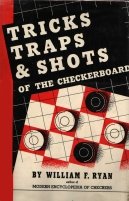
"Very often it is necessary to force a win by the constant threat of a shot without ever actually executing it. In other cases, execution of a shot may be the final product of much preliminary forced play. Here we have a good example of white developing a structural advantage (formational win) in such a manner as ultimately to force black into a staggering stroke. It should be noted that in this case the stroke is the final phase of play, with white's preceding moves forcing black into the inevitable crackup.
| 10-14 | 20-16 | 1-5 |
| 24-20 | 12-19 | 24-20 |
| 7-10 | 23-16 | 5-9 |
| 22-18 | 14-18---A | 32-27 |
| 9-13 | 29-25 | 9-14 |
| 18-9 | 8-12 | 27-24 |
| 5-14 | 16-11 | 3-8---3, |
| 25-22 | 12-16---2 | to the |
| 11-15 | 27-24 | diagram. |
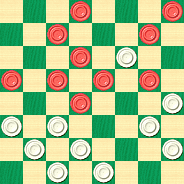
WHITE
White to Play and Win
W:W31,30,28,26,25,24,22,21,20,11:B18,16,15,14,13,10,8,6,4,2.
A---I took this move against Jesse B. Hanson in the Eighth American Championship Tourney and managed to draw with it. Later, in analyzing the formation, I discovered it would lose, white subsequently driving black into the shot, as indicated. The correct play at A for a draw is: 2-7---1, 16-12, 15-19, 22-18, 14-23, 27-18, 8-11, 18-14, 10-17, 21-14, 1-5, 32-27, 6-9, etc. Wm. F. Ryan."
1---8-12 is also good for a draw and is the computer's choice---Ed.
2---A bit surprisingly, the natural-looking 3-7 loses something like this: 3-7 26-23 7-16 23-7 2-11 21-17 6-9 27-23 4-8
31-27 15-19 23-18 19-23 17-14 1-5 14-10 16-19 18-15 11x18 22x15 White Wins---Ed.
3---Loses at once, whereas 16-19 would have held on longer---Ed.
We'd like to egg you on: ham it up a little and bring home the bacon on today's problem. Or will you be toast? We won't try to butter you up; simply clicking on Read More will get you out of a jam and over to the solution.
You can email the Webmaster with your comments on this article.
In Like a Lamb

Pexels CC0
It is traditionally said that March may "come in like a lamb and go out like a lion" or conversely "come in like a lion and go out like a lamb."
Our columns are written quite a few weeks in advance of their publication date, so we won't attempt to predict March weather in North America; that's an iffy proposition in any event.
But one thing we can do is bring March in "like a lamb" with a relatively easy top of the month stroke problem.
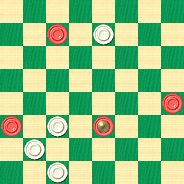
WHITE
White to Play and Win
W:W7,22,25,30:B6,20,21,K23.
So, are you a lion or a lamb? Will you roar past this problem or be meek as a lamb? We can't predict that, either, but we can say for sure that clicking your mouse on Read More will reveal the problem's solution. And here's hoping that March weather won't be too difficult, either.
You can email the Webmaster with your comments on this article.
Checkers: Apps for the iPhone
Public Domain
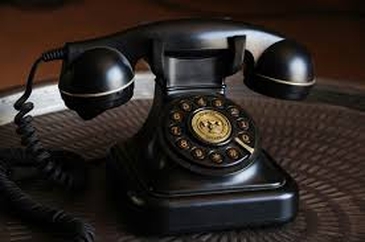
The telephone above is most definitely not an iPhone, but it does seem to pretty well represent the state of the art when it comes to playing checkers on an iPhone.
This article is the first of two on smartphone checker apps. Ed Gilbert, author of the world-class KingsRow checker engine and companion 10-piece endgame database, has graciously given of his time in order to evaluate a group of checker apps for the iPhone. A future article will look into checker apps for Android-based phones.

Ed Gilbert
Photo Credit: Carol Gilbert
Ed's article is extensive and includes large graphics, so it merits its own web page. You can find it here, but we'll give you Ed's bottom line right away: there's not much out there that has merit for the serious player. That's indeed regrettable, because from what Ed shows us, we can't help but conclude that the iPhone app authors could have done much better without a lot of additional effort. Unfortunately, most checker program authors think they are producing toys rather than serious game-playing programs, and that's just what they end up doing.
Let's look at a sample game that Ed ran between the iPhone checker apps "Teeny Checkers" and "Fantastic Checkers".
| Black | Fantastic Checkers |
| White | Teeny Checkers |
| 1. | 11-15 | 22-17 |
| 2. | 9-14 | 17-13 |
25-22 was better.
| 3. | 8-11 | .... |
15-19 would retain the advantage.
| 3. | .... | 25-22 |
| 4. | 4-8 | .... |
Very weak. 11-16 is best.
| 4. | .... | 22-17 |
23-19 would have given a large advantage if not a win.
| 5. | 15-19 | 24x15 |
| 6. | 11x18 | .... |
10-19 was much better and is in fact a book move.
White now has a simple move that very likely leads to a win. Can you spot it?
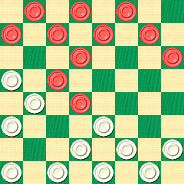
WHITE
White to Play and Win
W:W32,31,30,29,28,27,26,23,21,17,13:B18,14,12,10,8,7,6,5,3,2,1.
We'll give you the answer and find out how the game progressed when you dial your mouse to Read More.
You can email the Webmaster with your comments on this article.
Surprise, Surprise
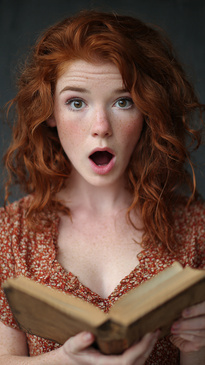
The young lady in the photo above is obviously studying checkers and has just come across the problem that forms the subject of today's Checker School column. The solution to the problem is one that we too found surprising, and we'll bet you'll feel the same way.
Here's the position:

WHITE
White to Play and Win
W:WK30,22,16,K2:B21,14,13,K10.
In a game in which White had and lost the advantage several times, we've arrived at a position where White has one last chance to bring it home. Can you find the surprise move that leads to White victory, or will you be surprised that your solution wasn't the correct one? Try the problem, and then get one last surprise by clicking the mouse on Read More to see the solution, a sample game, and detailed notes.
You can email the Webmaster with your comments on this article.
Wyllie's Waterloo
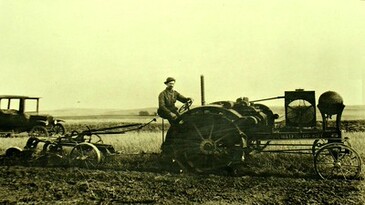
Surely you were expecting us to have chosen a dramatic image of the famed Battle of Waterloo, but we like to keep our readers guessing, and we came up instead with a Waterloo tractor made in Waterloo, Iowa, one hundred and six years after Napoleon's defeat on June 18, 1815. The person on the tractor perhaps played checkers in his leisure time, and we hope he did well and didn't meet his own Waterloo over the board. But we can surely excuse him if he did, for even the checker greats had their own bad days. Willie Ryan, in his book Tricks Traps & Shots of the Checkerboard, tells us about a bad day that one of the greatest of all, James Wyllie, endured.
"It is sheer fallacy to believe that when James Wyllie ruled the boards 80 years ago, he had no worthy contemporaries. On the contrary, Wyllie lived and competed in an era that produced most of the game's outstanding players and personalities, including Andrew Anderson, John Drummond, Robert Martins, John Robertson, Henry Spayth, and Robert D. Yates, to name just a few. Wyllie's predominant fame and popularity stemmed from his prolific activities, his inimitable wit, and his fearlessness as a champion. While others were vainly striving to defend reputations they did not have, jocular James took them all on, in good season and bad, acquitting himself on all occasions with admirable poise. The "Herd Laddie" had his bad innings at the board, as indicated by this reverse at the hands of Robert McCulloch, of Glasgow, best known for his revised publication of McCulloch's Edition of Anderson's Guide. The game proceeded as follows:
| 11-15 | 25-22---B,1 | 9-14 |
| 24-20 | 18-25 | 28-24---3 |
| 8-11 | 29-22 | 5-9 |
| 28-24 | 7-11 | 26-23 |
| 4-8 | 30-25 | 9-13 |
| 23-19 | 2-7 | 31-26---4 |
| 15-18 | 19-15---2 | 7-11---5 |
| 22-15 | 11-18 | 26-22---C, |
| 11-18 | 22-15 | to the posi- |
| 32-28---A | 14-18 | tion in the |
| 10-14 | 24-19 | diagram. |
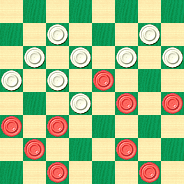
BLACK
Black to Play and Win
B:W27,25,24,23,22,21,20,19,15:B18,14,13,12,11,8,6,3,1.
A---Wyllie's favorite line of the Ayrshire Lassie, and one that lends itself to a wide variety of "soupy" formations.
B---26-23 is equally good. Charles Hefter of Kankakee, Illinois, is the distinguished author of the following coup on that line: 26-23, 9-13, 19-15, 7-11, 31-26, 3-7, 24-19, 5-9, 26-22,1-5, 28-24, 7-10, and now comes the cut-up by 20-16, 11-20, 15-11, 8-15, 21-17, 14-21, 23-7, 2-11, 19-1, 9-14, 22-17, 13-22, 25-9, 5-14, 1-6, 11-16, 6-10, 14-18, 10-14, 18-23, leading to a draw.
C---This is where Wyllie went wild. The game had been adroitly contested by both players to this point. Wyllie could have drawn easily here, by 15-10, 6-15, 19-10, 13-17, 23-19, 11-15, 20-16, 3-7*, 10-3, 1-5, 19-10, 12-28, 3-12, 28-32, 27-24, 32-27, 10-6, 27-20, 6-1, 20-24, 1-6, 24-27, 6-9, 18-23, 26-19, 27-24, 9-18, 24-29. Wm. F. Ryan."
1---Despite the natural look of this move, the computer scores 25-22 as not so good for Black, giving White a definite edge---Ed..
2---27-23 is preferred here---Ed.
3---This move is a probable loss. 20-16 might have kept White in the game, but Black is still strong---Ed.
4---White is now completely lost. Better was 31-26 though the situation remains bad---Ed.
5---This very bad move allows a draw. A winning line for Black might have been 13-17 15-10 6x15 19x10 8-11 24-19 18. 17-22! 26x17 11-15 27-24 18x27 20-16 27-3 17-13 3-8!10x3 31-27 19x10 27x11 25-22 11-7 22-17 7-2 13-9 14-18 17-14 18-23 21-17 23-27 9-5 2-7 17-13 27-31 13-9 7-2 Black Wins. White is completely out of safe moves---Ed.
Will you meet your own Waterloo here? Willie seemed to have a mini-Waterloo of his own in not catching the blunder pointed out at note 5 above. Battle the problem and then march your mouse to Read More to see the solution.
You can email the Webmaster with your comments on this article.
A February Short

Pexels CC0
Even though this is a leap year, February remains as always the shortest month of the year. It's something to be grateful for in wintry North American climes, as this abbreviated month brings us that much closer to spring.
Today's problem is also "short" in that it is a miniature, those minimalist problems that focus our attention and often demand great accuracy and skill. Like their exact opposites, the stroke problem, they are not to everyone's taste, but unlike stroke problems, miniatures are eminently practical in nature.
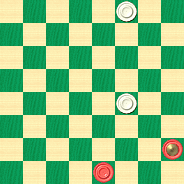
BLACK
Black to Play and Win
B:W30,14:BK5,2.
Don't give this problem short shrift; put it on your short list. After you've solved it, make a short click on Read More to see the solution.
You can email the Webmaster with your comments on this article.
Pretty Tough

As we've noted a number of times, The Checker Maven tries to provide a variety of problems: some easy, some hard, some in-between. Today's problem, a study by celebrated problemist L. T. de Bearn, is, like the cut of meat shown above, definitely on the "tough" side. While obviously appealing to the skilled player looking for a challenge, intermediate players and even ambitious beginning players can benefit by doing some analysis and carefully playing through the solution.
So, without further ado, here's the position.
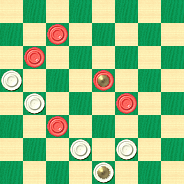
WHITE
White to Play and Draw
W:W13,17,26,27,K31:B6,9,K15,19,22.
Forces are even but White has a pretty serious mobility issue, and in checkers that can spell doom. But there is a way to a draw. Are you tough enough to find it, or will this problem chew you up? Get your teeth into this one, and then bite your mouse down on Read More to see the solution.
You can email the Webmaster with your comments on this article.
What Is Checkers?
Based on the photo above, we suppose our column's title should have been "What are Checkers?" as a plural subject requires a plural verb. But of course, the intended meaning of the phrase references "checkers" as a game, in the singular, and so the singular verb is correct after all.
Although we could go on at length about syntax and other matters grammatical, we're sure you didn't come here for a language lesson. In fact, it's time for an installment of Checker School, and while good grammar and usage are highly recommended, good checker moves are what we're really after.
Today we have an interesting position which is not particularly easy to solve; in fact Ben Boland himself went wrong when he published it in Famous Positions in the Game of Checkers.
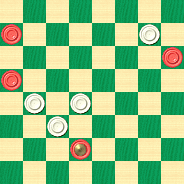
WHITE
White to Play and Draw
W:W8,17,18,22:B5,12,13,K26.
Mr. Boland's premise is correct; the game can be drawn by White, even though the position looks anything but favorable. Can you find the correct "checker usage" that leads to a draw? Or will you be sentenced to fail? Don't worry; you won't get graded on your answer, and you can always click on Read More to see the solution, notes, a sample game, and the reason why today's column is titled What is Checkers?.
You can email the Webmaster with your comments on this article.
Checker Problem Composition Contest

Veteran player and problem composer Bill Salot is sponsoring the second in a series of checker problem composition contests, and perhaps the young lady above is a potential competitor.
The first competition produced a pair of very fine problems. You can get all the details of the new contest and a look at the entries in the previous contest here.
You're sure to enjoy these elegantly-crafted problems, but why not make a try at it in your own right? If you don't know where to begin, take a look at some of your own games; surely in one or more of them, either you or your opponent made some nice play that could well be the basis of a problem. It's an entertaining exercise and a great way to learn more about checkers.
We congratulate Mr. Salot on his efforts in promoting the art of checker problem composition.
You can email the Webmaster with your comments on this article.
"Read More" Once More

Needpix CC0
We have been experiencing ongoing database problems and "Read More" links were out of service this morning. We've fixed this and apologize for the inconvenience.
Our long-term solution is a complete rebuild of our database. That's in progress but it's a big job. In the meanwhile, please bear with us and do let us know if something isn't quite right.
You can email the Webmaster with your comments on this article.
The Checker Maven is produced at editorial offices in Honolulu, Hawai`i, as a completely non-commercial public service from which no income is obtained or sought. Original material is Copyright © 2004-2026 Avi Gobbler Publishing. Other material is public domain, AI generated, as attributed, or licensed under CC1, CC2, CC3 or CC4 and the various CC options. Information presented on this site is offered as-is, at no cost, and bears no express or implied warranty as to accuracy or usability. You agree that you use such information entirely at your own risk. No liabilities of any kind under any legal theory whatsoever are accepted. The Checker Maven is dedicated to the memory of Mr. Bob Newell, Sr.