The Checker Maven
The World's Most Widely Read Checkers and Draughts Publication
Bob Newell, Editor-in-Chief
Published every Saturday morning in Honolulu, Hawai`i
Cowan's Coup Revisited
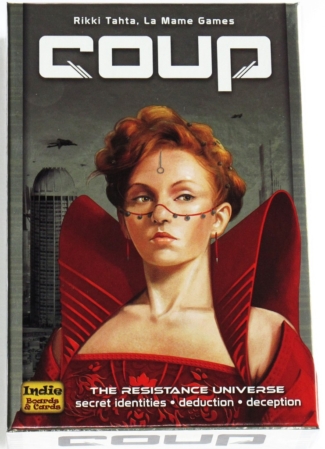
Just over five years ago, we published a column on Cowan's Coup based on analysis by Willie Ryan. This week in our Checker School entry, we'll revisit the position and gain the benefit of Ben Boland's viewpoint, as expressed in his classic Famous Positions in the Game of Checkers.
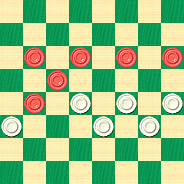
BLACK
White to Play and Draw
W:W24,23,21,20,19,18:B17,14,12,11,10,9.
No matter what move White makes, he's going to lose two men at once. Yet we're asked to find a move that draws.
Is this a coup that you can pull off? Please do try; after all, this is a non-violent coup. But if the solution eludes you, or you'd just like more insight, you can click on Read More to see one way to do it along with numerous sample games and an explanatory note or two.
You can email the Webmaster with your comments on this article.
Labor Day Salute

Public Domain Pictures CC0
Labor Day; it's a welcome day off work, a last hurrah for summer in North America, a time to see a parade, or squeeze in one more barbecue or picnic or camping trip before the leaves fall and the nights become chill.
And, as we point out each year, it's a time to show our respect for the average Jane and Joe that make up America's workforce, those honest, decent, hard-working people who show up every day, do their jobs, and help make America what it is. There was a time when checkers was their game, and although that's less of a truism today, checkers remains democratic, accessible, and suitable for everyone.
On holidays like these, we like to feature great American players and problemists. Today we have one of the few problems authored by one of the greatest American checkerists of all time, Samuel Gonotsky. It is based on actual over the board play.
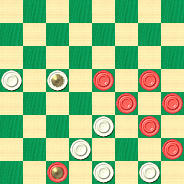
WHITE
White to Play and Draw
W:W32,31,26,23,K14,13:BK30,28,24,20,19,16,15.
White is a man down but has mobility advantages. Can the situation be turned into a draw? Labor away at this one; but seeing the solution is hardly laborious and requires only a mouse click on Read More.
You can email the Webmaster with your comments on this article.
Don't be a Square

"Don't be a square" is probably an expression you haven't heard much lately, as it's long out of date. It actually originated with jazz musicians but by the 1980s, it was starting to sound old-fashioned.
Our use of this phrase to title our column is for two reasons. The first is the shape seen in the problem diagram.
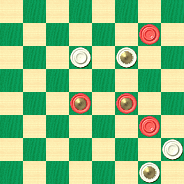
BLACK
Black to Play and Win
B:W23,K22,5,K1:B25,K15,K14,9.
The second meaning derives from the solution itself. You might see what we're getting at when you solve it. It's not overly difficult. Don't be a square--- try to work it out. When you're finished, click your mouse squarely on Read More to see the solution and an explanation.
You can email the Webmaster with your comments on this article.
The Crocodile Position
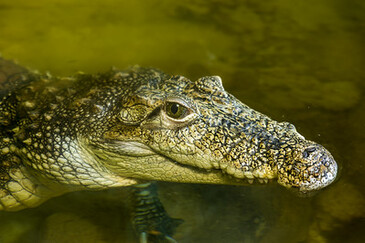
There's been a lot in the news in recent months about alligators attacking humans, sometimes with tragic results. But crocodiles, particularly the South Pacific varieties, can also be very dangerous.
The differences between crocodiles and alligators are many, even if they seem to be similar creatures. For instance, they have different jaw shapes, and crocs are more tolerant of saltwater environments.
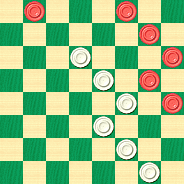
The position below, an entry in our ongoing Checker School series, could be either crocodile or alligator. In fact, as you'll see in our solution notes, it's been called both at various times. But regardless of name, it's quite ferocious.
W. H. RUSSELL
BLACK
WHITE
White to Play and Win
W:W10,15,19,23,27,32:B1,3,8,12,16,20.
Don't get caught up in the jaws of this one; work it out and then snap your mouse on Read More to see the solution, sample games, and detailed notes.
You can email the Webmaster with your comments on this article.
Publication Times
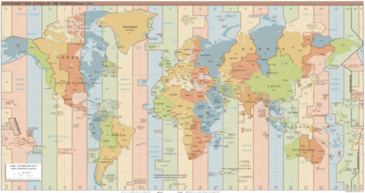
The Checker Maven originally appeared each Saturday at 2:02 AM MST (GMT-7). When our offices relocated from Santa Fe, NM, to Honolulu, HI, our publication time changed to 2:02 AM HST (GMT-10).
Now, many of our readers are on the east coast of the United States and look for the latest column early in the morning. With our present publication time, the week's offering isn't available until 8:02 AM EDT. That's later than we might like, and so effective at once we'll be moving to a publication time of 00:02 AM HST, or two hours earlier than the current publication time.
We hope this time change makes access to The Checker Maven a little more convenient for our readers.
You can email the Webmaster with your comments on this article.
Delicado
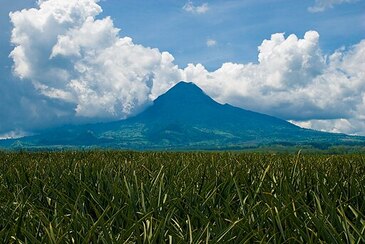
Your editor, many years ago, went hiking and climbing in southern Mindanao in the Philippines. Locals referred to the area where we went as "delicado" --- delicate --- due to the sometime presence of rebel militia. Being young and foolish, we were not deterred from what turned out to be a dangerous undertaking. Fortunately, nothing went wrong.
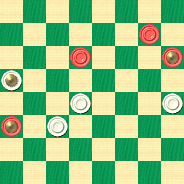
Today's checker problem is "delicado" in a different way, and there's nothing foolish or dangerous about it at all. Your solution may go wrong, but if you work at it, you'll get it, and you may learn some technique in the process.
WHITE
White to Play and Draw
W:W22,20,18,K13:BK21,K12,10,8.
There's no need to carry arms or keep a lookout, and checking your solution is as easy as clicking on Read More.
You can email the Webmaster with your comments on this article.
August Heat

August in the Northern Hemisphere can be pretty darn hot. Sometimes extraordinary measures are required, as shown in the photo above.
Your editor is scheduled to be visiting in far off New York City on the date this column is due to be published, and August in New York is just about always hot and humid.
So we picked out a rather hot stroke problem (please, no heat stroke jokes) for this month. It looks complex but it's actually one of the easier ones, and it's filled with action.

WHITE
White to Play and Win
W:W31,19,14,11,K10,8,6,K3:BK25,24,K23,22,K21,5,1.
Don't overheat your brain; you'll see the solution if you can visualize well (just keep the sweat out of your eyes). When you've solved it, click on Read More to see the solution.
You can email the Webmaster with your comments on this article.
Brooklynite

Public Domain
We came across this personalized postcard evidently made for checker great Tommie Wiswell. Mr. Wiswell is playing a simultaneous exhibition, as he often did. Note that the postcard lists what was apparently his home address, 355 45th Street in Brooklyn, a building that is still standing. Our research tells us it's in the Sunset Park section of Brooklyn, was built in 1910 (interestingly, the year Mr. Wiswell was born); it's listed as a multiple family dwelling; the size is about 2,500 square feet on a 2,000 square foot lot; and it's valued at around $800,000 or so.
We'll use any excuse to feature a Tommie Wiswell problem, of course. This one is based on a Louis Ginsberg game played at an unspecified club in New York City. Mr. Ginsberg was also a Brooklynite, and hence comes the title of the problem.

WHITE
White to Play and Draw
W:W30,22,K11:B14,12,9,6.
The problem isn't all that easy in that there are some nice ways to get it wrong. It would be a lot of fun to work on it at a nearby Brooklyn park, but in this internet age, you can solve it from just about anywhere in the world. Give it a try and then click on Read More to see the solution, notes, and an interesting photo.
You can email the Webmaster with your comments on this article.
Capers on the Kelso: Lucky 13

13 is viewed by some as a bit of a "shady" number but we've always liked it. And there are numerous establishments around the world with the name Lucky 13 Bar and Grill. We hear there is one in Salt Lake City (not shown above) that has really great home style American cooking. How lucky can you get?
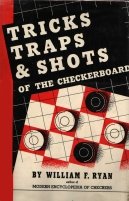
This is the 13th installment of "Capers on the Kelso" from Willie Ryan's Tricks Traps & Shots of the Checkerboard, and we think you're in luck once again. These pages in Willie's classic book contain an unbelievable wealth of great checker material. Today's position is subtle rather than explosive.
We're still working with Willie's "Variation 3" and in "Note B" of the text we find another fascinating and instructive situation.
Here's the run-up, without commentary.
| 1. | 10-15 | 22-18 |
| 2. | 15x22 | 25x18 |
| 3. | 6-10 | 18-14 |
| 4. | 10x17 | 21x14 |
| 5. | 9x18 | 23x14 |
| 6. | 1-6 | 29-25 |
| 7. | 12-16 | 26-23 |
| 8. | 16-19 | 24x15 |
| 9. | 11x18 | 28-24 |
| 10. | 8-11 | 31-26 |
| 11. | 4-8 | 23-19 |
| 12. | 6-10 |
The correct move here was 6-9. Willie now calls this "a dead loss." Indeed, it is; but White will require patience and technique to bring home the win.

WHITE
White to Play and Win
W:W32,30,27,26,25,24,19,14:B18,11,10,8,7,5,3,2.
You don't need to be lucky to solve this one; although the solution is long, it's not nearly as difficult as some of the others in this series. Try your luck; then, for sure you'll luck out when you click your mouse on Read More to see the solution.
You can email the Webmaster with your comments on this article.
Are You Dunne Drummond Yet?

We think you'll agree, when you work through this week's Checker School problem, that it's worthy of an introductory drum roll. There's some very pleasing play involved, and you're sure to get a lot of satisfaction from it. The position is credited to Drummond and Dunne.

WHITE
White to Play, Black to Draw
W:W30,22,20,19,18:B21,13,12,11,10.
Material may be even, but there are significant mobility issues and things are not so simple. How can Black find the way to a draw?
When the drummer is Dunne Drummond, can you drum up the solution? Work it out and then drum your mouse on Read More to see the solution, along with detailed notes and numerous sample games.
You can email the Webmaster with your comments on this article.
The Checker Maven is produced at editorial offices in Honolulu, Hawai`i, as a completely non-commercial public service from which no income is obtained or sought. Original material is Copyright © 2004-2026 Avi Gobbler Publishing. Other material is public domain, AI generated, as attributed, or licensed under CC1, CC2, CC3 or CC4 and the various CC options. Information presented on this site is offered as-is, at no cost, and bears no express or implied warranty as to accuracy or usability. You agree that you use such information entirely at your own risk. No liabilities of any kind under any legal theory whatsoever are accepted. The Checker Maven is dedicated to the memory of Mr. Bob Newell, Sr.