The Checker Maven
The World's Most Widely Read Checkers and Draughts Publication
Bob Newell, Editor-in-Chief
Published every Saturday morning in Honolulu, Hawai`i
Faster Than Greased Lightning
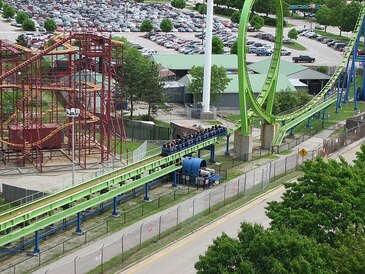
Greezed Lightnin is a roller coaster at Six Flags Kentucky Kingdom, and reputedly lives up to its designation--- faster than greased lightning.
Our first set of speed problems for the year are truly worthy of the same title. They both fall decidedly into the "easy" category, but as we know our readers enjoy a challenge, we're setting the time limits at record lows--- five seconds for the first problem and ten seconds for the second! We think this should satisfy everyone. Advanced players can try to sight-solve the problems in the rather strict time limits allotted. Less experienced players can simply look for the solutions and ignore the clock (well, yes, that is easier said than done).
Are you ready? Click below to start each problem--- faster than greased lightning!
February Speed Problem No. 1 (five seconds)
February Speed Problem No. 2 (ten seconds)
When you're finished, slide your mouse over and zap Read More to see the solutions.
You can email the Webmaster with your comments on this article.
What's Your Call?
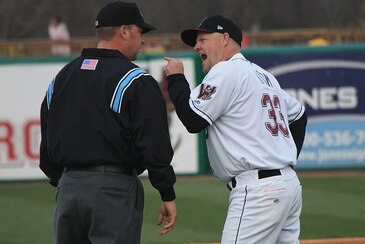
In the world of sports, sometimes a play is a really close call and quite an argument about it takes place. Today's checker problem surely falls into that category. Take a good look at the position below, with White to move. How would you call this one? White win, Black win, or draw? Show it to your checker friends and you're bound to generate a lot of, shall we say, animated discussion (we'd hate to accuse checker players of having heated arguments, after all).
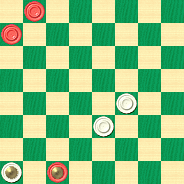
WHITE
White to Play, What Result?
W:WK29,23,19:BK30,5,1.
Make the call, and then do an "instant replay" to demonstrate the correctness of your decision. We'll just give you a bit of fair warning: this one isn't so easy, and just may surprise you. What do you say?
There's one call, though, we can always make without error: it's a certainty that clicking on Read More will bring you to the solution.
You can email the Webmaster with your comments on this article.
The Bizarre World of Strokes
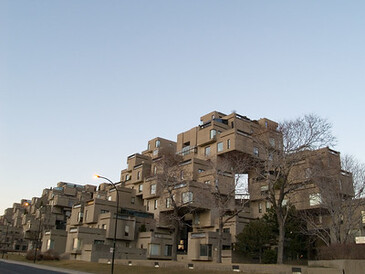
We haven't run a "stroke" problem in a little while, though it's something we like to do for the sake of variety on the first Saturday of some months. Today we return to that theme, and present a problem that was considered "easy" by the author.
Much as the photo above represents the bizarre side of architecture, stroke problems are certainly the bizarre side of the world of checkers. You either love them or hate them, and we think that depends in no small measure on whether you're able to solve them. Stroke problems call upon your ability to visualize long, forced series of moves. They are an excellent test of your skills, but seldom, if ever, an exercise in practical play.
So here's our so-called "easy" problem.
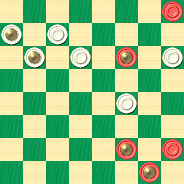
WHITE
White to Play and Win
W:WK5,6,K9,10,12,19:B4,K11,K27,28,K32..
Could you find your way through, or is all simply too bizarre? Whatever your result, click on Read More to see the "easy" solution. Did we say "easy"? You may or may not agree!
You can email the Webmaster with your comments on this article.
One for New Year's Eve

Are you celebrating the upcoming New Year's Eve on an elegant cruise ship somewhere? Well, don't feel bad, we're not either (though maybe some day we might). Checker Maven staff are much more likely to stay home in our Honolulu location and have a quiet night.
We'd like to present you with an alternative, though, to parties and dancing. We have a checker problem that is difficult enough to carry you through the evening and into the early hours of the morning. It's non-alcoholic, doesn't require driving or pushing your way through a crowded dance floor, and is completely free. What else can you find on New Year's Eve that doesn't come with a stiff price tag? (That's why we're skipping the cruise this year, in fact; at nearly $300 per person we'd much rather play checkers instead.)
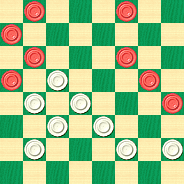
Here is a position that even champion Tom Wiswell called "challenging."
WHITE
White to Play and Draw
W:W28,27,25,23,22,18,17,14:B20,16,13,11,9,5,3,1.
Can you cruise to a solution this New Year's Eve, or even sooner? There's no need to wait, though; clicking on Read More will ensure a smooth voyage straight to the answer.
You can email the Webmaster with your comments on this article.
Neatly Trapped
In today's entry from our Checker School series, we have a most interesting position, as shown below.

BLACK
Black to Play and Win
B:W25,K12,K2:BK11,10,K1.
In this position, Black's mobility is definitely in the plus column. And as our current World Champion has often stated, checkers is all about mobility. In fact, Black has a very neat win here. The position is almost 120 years old and is attributed to R. D. Yates. Well over a century later we find that it still entertains and instructs. It's a fitting tribute to the timeless attraction and value of the game of checkers.
Try to trap White, but don't be trapped yourself: clicking on Read More will move you to the solution, a sample game, and explanatory notes.
You can email the Webmaster with your comments on this article.
A Simple Little Fellow

rawpixel.com CC0
Our title is how famed problemist Tommie Wiswell referred to today's puzzler, which he drew from actual play. It's one of those cases in which the win is "obvious" but actually demonstrating how it's done is the real trick.
WHITE
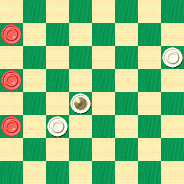
White to Play and Win
W:W12,K18,22:B5,13,21.
The Black pieces are all off on the side of the board, while White has good mobility and a king to boot. So the win should be easy, shouldn't it? But Mr. Wiswell notes that in play over the board, the White player missed the winning continuation. Can you do better?
When you've settled on the winning course of action, click on Read More to see the solution.
You can email the Webmaster with your comments on this article.
Thanksgiving Weekend

Public Domain Pictures CC0
In the United States it's Thanksgiving weekend, bringing one of our favorite times of family, food, and celebration. In the spirit of the weekend, we'd like to bring you an especially elegant checker problem which we're sure will provide you with much pleasure. It's part of our Checker School series and looks like this.

WHITE
White to Play and Win
W:WK10,20,22:B1,9,28.
The problem is due to R. Martins, and while the solution is not overly long, it may surprise you; and, like Thanksgiving dinner, the problem is incredibly rich in content. Take your time, have a slice of pumpkin pie and a cup of coffee, and enjoy. When you're all done, click on Read More to see the solution, a sample game, and detailed explanatory notes.
You can email the Webmaster with your comments on this article.
A Little Deceiver

Austin Neill arstyy CC0
Willie Ryan, possibly the only checkerist ever to achieve anything close to "rock star" status, takes us back to his youth in this month's installment from Tricks Traps & Shots of the Checkerboard. Let's listen as Willie tells us about a trap he learned in those early years. Editior's note: the photo above is definitely not Willie Ryan!
"When I was just a boy of 13, I learned this trap on the Defiance opening by John Drummond, which enabled me to win more than a few games. The basic germ or idea utilized in this example is known as the "Brooklyn"--- a tactical device that has almost as many variations of application as the versatile in-and-outer.
| 11-15 | 29-25 | 15-24 |
| 23-19 | 11-15 | 28-19 |
| 9-14 | 25-22 | 4-8 |
| 27-23 | 7-11 | 22-18 |
| 8-11 | 24-20—A | 6-9 |
| 22-18 | 15-24 | 18-15—B, |
| 15-22 | 28-19 | forming the |
| 25-9 | 11-15 | diagram. |
| 5-14 | 32-28 |

BLACK
Black to Play and Win
B:W31,30,26,23,21,20,19,15:B14,12,10,9,8,3,2,1.
A---The old and somewhat difficult Andrew Anderson defense. A better defense for white is: 22-18, 15-22, 26-17, 11-15, 24-20, etc., as given in my book, Scientific Checkers Made Easy.
B---To the gallows! The correct play here is: 31-27, 8-11, 18-15, 11-18, 21-17, 14-21, 23-5, 2-6, 27-23, 10-15, 19-10, 6-15, 20-16, 12-19, 23-16, 15-19, 16-11, 19-24, 26-23, ending in a draw."
Young or old, one thing is certain: clicking on Read More will show you the snappy and pleasing solution.
You can email the Webmaster with your comments on this article.
Uncle Ben's Porch: An Argument with Mom
Public Domain
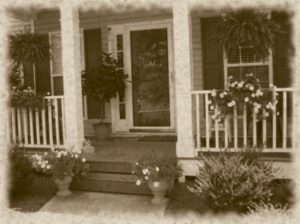
I had a bit of an argument with Mom this morning, and that's never a good way to start off the day. It was Saturday morning, and nearly every Saturday for more than a year I'd gone over to Uncle Ben's for a couple of hours, to sit on his porch, drink his wonderful lemonade, and learn something new about checkers.
But Mom had said that we're two months into a new school year, I'm in fifth grade now, and I need to spend a few extra hours hitting the books, as I hadn't exactly gotten off to a good start in English and math. Besides, she said, you can't be bothering Uncle Ben all the time; the elderly gent can't be expected to entertain children every single week!
I pointed out that Uncle Ben seemed to really look forward to my visits and that he might be disappointed if I didn't show up. Besides, I said (repeating back a few lines I'd heard from Uncle Ben himself), checkers helps a student with logical thinking and the application of reason. (I'm glad Mom didn't ask me to explain what all of that really meant, though.)
After a little while Mom relented and let me go, with a final caution to not stay too long and wear out Uncle Ben's patience or hospitality. Still, I didn't feel very good about the whole incident, and when I arrived at Uncle Ben's and sat down in one of his porch chairs, I couldn't help but blurt out the whole story.
"Well, Tommy," Uncle Ben said after hearing me out, "listening to your Mom and doing as she says is very important, and I shouldn't discourage you from doing so."
At these words, my heart started to sink and I was sure Uncle Ben was going to send me straight home. Certainly, he realized this as he added, "No, no, Tommy, I'm not going to send you off. But we need to make a little deal, one that you need to tell your mother about when we've shaken on it."
"Deal?" I said, unsure of what was coming.
"Yes, a nice gentleman's agreement. The one part of the deal is that you can come here and visit every Saturday that you wish ... but the other part is that your grades have to all be above whatever mark your mother decides. So if she says that you have to have nothing less than a 'B' in every subject, then you have to do that well in school," Uncle Ben concluded.
"But ... but ...." I stammered.
"No 'buts', Tommy! I know, you're worried that your mother will ask you to get all "A"s or something really hard. But I know your mom and I know she'll be fair about it. She'll just expect you to do your part. So, is it a deal, then?"
"Yes, sir," I said, and we shook hands on it. Uncle Ben was right, Mom would be fair, and I did want to keep my grades up, though I knew it would be hard work.
"Well then!" exclaimed Uncle Ben, "all this business talk makes a man thirsty!" And before you could blink twice, Uncle Ben had placed glasses of frosty lemonade on the table in front of us, and turned his attention to the checkerboard.

Public Domain
"You've been coming along fast," he said, "and so today we're going to try something a little harder. It's a bit like school; as you move up in grades, the work gets harder, but you learn more and more all the time. What do you make of this? Here's one in which whoever moves first will win."
This was the position Uncle Ben had set up for me.

WHITE
Either to Play and Win
W:W20,21,23,32:B1,10,12,13.
I took a long, careful drink of lemonade, and all at once, everything seemed clear. "Hey, Uncle Ben, I've got it!" I said proudly, and began to move the men to demonstrate the solution.
What do you make of this problem? Work it through and then click on Read More to see the solution, a sample game, and a large helping of additional illustrated examples.
You can email the Webmaster with your comments on this article.
Maybe Not Quite A Speed Problem

The first Saturday of each month we often offer a speed problem, featuring our relentless Javascript clock, and this month we return to that theme. But today's problem might not be quite a speed problem.
To be sure, the better checkerists out there will likely come up with the solution in short order. But others may perhaps need a little more time. And so, to accommodate everyone, we're being especially generous and allowing a whole two minutes for you to find the solution before the clock runs out. Aren't we the kind ones?
Click on the link below when you're ready to give it a try.
November Speed Problem (moderate difficulty)
Whether you were speedy or not, clicking on Read More will show you the solution in a jiffy.
You can email the Webmaster with your comments on this article.
The Checker Maven is produced at editorial offices in Honolulu, Hawai`i, as a completely non-commercial public service from which no income is obtained or sought. Original material is Copyright © 2004-2026 Avi Gobbler Publishing. Other material is public domain, AI generated, as attributed, or licensed under CC1, CC2, CC3 or CC4 and the various CC options. Information presented on this site is offered as-is, at no cost, and bears no express or implied warranty as to accuracy or usability. You agree that you use such information entirely at your own risk. No liabilities of any kind under any legal theory whatsoever are accepted. The Checker Maven is dedicated to the memory of Mr. Bob Newell, Sr.