The Checker Maven
The World's Most Widely Read Checkers and Draughts Publication
Bob Newell, Editor-in-Chief
Published every Saturday morning in Honolulu, Hawai`i
McKelvie's Jumbo Shot

When you think of a "jumbo shot" the photo above might represent one of your worst nightmares. That one looks like it's going to hurt--- a lot--- and you probably can't expect much in the way of sympathy from the old-fashioned stern-looking nurse who is preparing to administer it. Neither is it likely to be a "shot in the arm," if you know what we're getting at.
On the checkerboard, a jumbo shot could be a nightmare or a delight, depending which end of it you're on. It too could hurt the recipient a great deal while definitely being a shot in the arm to the one who delivers it. Today's excerpt from Willie Ryan's Tricks Traps & Shots of the Checkerboard features our old friend Mr. McKelvie and a shot to end them all. Willie explains, even if somewhat briefly.
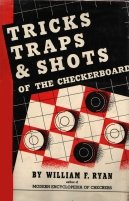
"Here's another good number by Champion D. G. McKelvie on the Souter opening, in which 15 pieces are cleared from the board in one grandiose sweep. McKelvie was evidently a keen student of the stroke art, since many of the best-known coups are credited to his name.
| 11-15 | 26-22---1 | 11-15---3 |
| 23-19 | 8-11 | 30-26 |
| 9-14 | 22-17 | 8-11 |
| 22-17 | 4- 8---2 | 26-22 |
| 6- 9 | 27-23 | 3- 8. This |
| 17-13 | 15-18---A | brings you |
| 2- 6 | 32-27 | to the |
| diagram." |
A---After this, black is trapped and tied. Better play here for a draw is: 14-18, 23-14, 9-18, 17-14, 10-17, 21-14, 7-10, 14-7, 3-10, 24-20, 15-24, 28-19, 5-9*. Wm. F. Ryan.
1---A weak move; 25-22 is much better---Ed.
2---Gives up all advantage. 14-18 would have kept a strong lead---Ed.
3---Turns a probable loss into a clear one. 11-16 would have minimized the damage although there is really no saving this one---Ed.
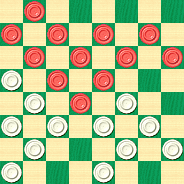
WHITE
White to Play and Win
Will you find this one to be a shot in the arm, or a pain in, you know, the other place? We won't needle you any further; take a stab at it and then press the plunger on Read More to see the solution.
You can email the Webmaster with your comments on this article.
Fall Blows in Fast
Public Domain Pictures CC0
North America is well into the autumn season, and what's left of the leaves on much of the continent is blowing away fast. Winter is just around the corner in most northern locales; there isn't much time left.
We hope that today's speed problem won't blow you away, but you'll have to act quickly as indeed there isn't much time. We think 15 seconds is more than enough for a problem that merits a difficulty rating of "moderate" at most. We'll warn you: there are actually two winning paths; one is much longer than the other.
Don't get frozen out; click below to display the problem and start the clock. Then come back and click on Read More to verify your solution.
November Speed Problem (moderate difficulty; 15 seconds)
You can email the Webmaster with your comments on this article.
A Dishpan Move
We've heard various names given to a losing move in a checker match; these epithets range from the rather mild "unfortunate" to the somewhat stronger "poor" and on up from there to other things that we certainly won't print here.
In the following game, played in the early 1930s between very strong players, such a move was made. When the game was published, the losing choice was called a "dishpan" move, a term which we hadn't heard before. It's an amusing and appropriate choice of words. Let's have a look at the game in question.
9-13 24-20 5-9 22-18 10-15---A 25-22 6-10 27-24---B 10-14 22-17 13x22 26x10 7x14---C 30-26 15x22 26x10 2-7 10-6 1x10 29-25 10-15 23-19 9-13 19x10 7x14 24-19 3-7---D
A---10-14 is often played instead; there is little difference.
B---28-24 is just as good.
C---15-22 same.
D---It was textbook play up to this point. The original editor called this a "hasty dishpan move" noting that the player "must have eaten too much for dinner."
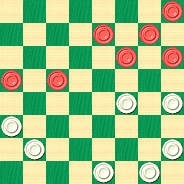
WHITE
White to Play and Win
W:W32,31,28,25,21,20,19:B14,13,12,11,8,7,4.
Will this one wash, or will this position "sink" you? Find the win for White, and while you're at it, correct Black's losing "dishpan" move. When you're done, clicking on Read More will bring you cleanly to the solution.
You can email the Webmaster with your comments on this article.
D. Robertson, Clockmaker and Checkerist?
Public Domain Pictures CC0
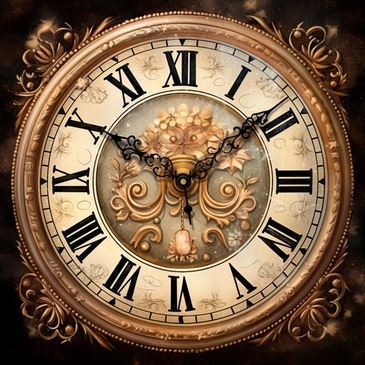
We looked for references to "D. Robertson," to whom today's Checker School studies are credited. We didn't directly find anything about this old-time checkerist, but we did find a beautiful old-time clock replica above, which might be similar to a certain"D. Robertson" clock model which dates to Scotland in the 1800s.. Now, checkerist Robertson also hailed from Scotland in the late 1800s. Could D. Robertson, checkerist, have also been D. Robertson, clockmaker? We made some inquiries, but didn't come up with any clear answers. Still, the possibility is intriguing.
Sadly, the era of analog clocks itself seems to be passing; we're surprised at the number of younger people today who can't read anything but a digital clock. We could continue the theme by further waxing nostalgic about the heyday of checkers, but instead we'll get back on track and present Mr. Roberton's positions.
| D. ROBERTSON | D. ROBERTSON |
| WHITE | WHITE |
 |  |
| BLACK | BLACK |
| Black to Play and Win | Black to Play and Win |
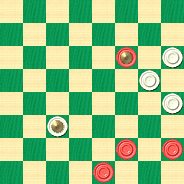
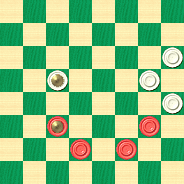
| B:W21,17,13,K11:BK22,6,5,2. | B:W21,K19,17,13:BK11,9,7,6. |
At first glance the positions look balanced, but White's group of three men on the left lacks mobility, and that's often a fatal flaw in checkers. Still, finding the win will require clockwork precision.
Now, this isn't a "beat the clock" speed position, so take all the time you wish before clocking your solution. Then move your hands (remember, it's an analog clock) to Read More to see the solutions, four sample games, and detailed notes.
You can email the Webmaster with your comments on this article.
McKelvie's Masterpiece

Needpix.com CC0
With an article title containing the word "Masterpiece" you probably expected to see the Mona Lisa or some other famous work of art. However, we wanted to showcase something that not only featured the word "masterpiece" but also the name "McKelvie." Well, we didn't come up with an artist named D. McKelvie, but we did find J. McKelvie, a talented illustrator for on-line and print comics. "Li'l Depressed Boy," if you're not familiar with the series (and we certainly weren't) is a comic that started on the internet and now appears in print form. We can't say we're going to rush right out and buy it, but we can say that J. McKelvie is certainly a talented artist who produces masterpieces in their own genre. (The photo above is not related to the "Li'l Depressed Boy" print comics; we couldn't find a free to use image of the actual comic, but you can easily find them on the internet.)
Does J. McKelvie play checkers? We don't know, but D. McKelvie certainly did back in his day, and this month's excerpt from Willie Ryan's Tricks Traps & Shots of the Checkerboard features play attributed to the Mr. D. McKelvie, as Willie explains in somewhat taciturn fashion.
| 9-13 | 21-14 | 3- 7 |
| 21-17 | 12-16 | 20-11 |
| 5- 9 | 24-20 | 7-16 |
| 25-21 | 16-19 | 31-27 |
| 11-15 | 25-21---1 | 1- 5 |
| 29-25 | 4- 8 | 14-10 |
| 9-14 | 32-27 | 6- 9 |
| 23-18 | 8-12 | 10- 6 |
| 14-23 | 27-24 | 9-14 |
| 27-11 | 12-16 | 21-17 |
| 8-15 | 20-11 | 14-21 |
| 17-14 | 7-16 | 6- 1 |
| 10-17 | 24-20 | 5- 9---A |
WHITE
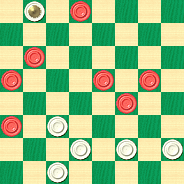
White to Play and Win
A---The loser. 16-20, 27-23, 20-24, 23-16, 24-27, 16-11, 27-31, 11-8, etc., is the correct play to draw."
1---32-27 might have been better but this line seems to equalize---Ed.
Can you create a masterpiece, or will you become a "Li'l Depressed Boy" yourself? Avoid depression by depressing your mouse on Read More to see the spectacular solution.
You can email the Webmaster with your comments on this article.
Ballroom Dancing

Gaby Lopez CC0
Marvin J. Mavin had seemingly mended his errant ways, and had returned to the captaincy of the Detroit Doublejumpers in the National Checker League. (In a previous column we related how Marvin had been sent down to a single-A farm club after showing disrespect to his manager.)

Marvin J. Mavin
Today, the Doublejumpers were in Miami for an exhibition match with one of Florida's top amateur teams, the Dancing Draughtsmen. Sponsored by the National Ballroom Dance Federation (NBDF), the Dancing Draughtsmen were captained by none other than NBDF President Vincent "Vinnie" Boggler. Vinnie, in addition to being a ballroom dancing star, was a strong amateur checker player who could have turned pro had ballroom dancing not been his first love.
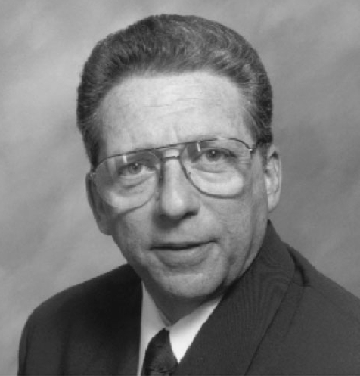
Vincent "Vinnie" Boggler
A large crowd was in attendance to cheer for their local favorites and their anticipation grew as match time approached.
Marvin, in his position at first board, was making what he thought were clever remarks to himself prior to Vinnie's arrival. "Ballroom dancing," he muttered. "That's for old fogeys who watch too many movies with that guy Freddie whatchacallit. Give me a rave any day!"
"Did you say 'rave'?" he heard a voice ask. Marvin looked up and his face immediately turned red. Vinnie had arrived and evidently had heard Marvin's last comment.
"Raves are for people with no dancing talent. Not everyone has what it takes to excel at ballroom dance. And," Vinnie continued, "not everyone has what it takes to excel at checkers." With this, he gave Marvin a pointed look and offered to shake hands. Marvin did so in a half-hearted fashion. Embarrassed on the one hand for being overheard, he was angry on the other over Vinnie's sharp put-down.
Vinnie took his seat just as the whistle blew to signal the start of the match, and didn't hear Marvin mutter, "From the looks of you, you ain't never been to a rave, ballroom boy, and you don't know the first thing about them."
The game started out as follows.
| BLACK | WHITE | |
| Vinnie | Marvin | |
| 1. | 10-14 | 24-19 |
| 2. | 11-16 | 28-24 |
| 3. | 9-13---A |
Marvin was grinning and couldn't keep back a comment. "Nerves, Vinnie? Three moves and you already blew it," he said. "Face it. I'm a checker pro and you're some kind of fancy-pants dancer. You don't have a prayer." And so saying, Marvin quickly made his move---- a little too quickly, in fact.
| 3. | ... | 22-17---B |
Marvin sat back in his chair with a smug expression, then took a second look at the board. His expression quickly changed, being replaced with one of concern, then of dismay. Vinnie looked at him and smiled. "Trip over your own feet, did you? Nerves, Marvin?' he asked.
| 4. | 13x22 | 25x9 |
| 5. | 5x14 | 26-22 |
Vinnie concentrated intently. He and Marvin both knew that Black now had a draw in sight. The margin was slim and careful play would be necessary, but Vinnie was determined to put Marvin in his place. For his own part, Marvin knew that he had blown away the win. He could only hope that Vinnie stumbled in his attempt to find the right steps that lead to the draw.
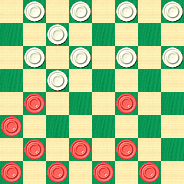
BLACK (Vinnie)
Black to Play and Draw
B:W32,31,30,29,27,24,23,22,21,19:B16,14,12,8,7,6,4,3,2,1.
A---A weak move which very likely loses. 7-10 or 6-10 would have been best.
B---22-18 preserves the probable win.
Can you match steps with Vinnie and find the draw, or will the rhythm elude you? We'll warn you up front that the path to a draw is a long one. Take a whirl with it and then dance your mouse over to Read More to see the solution and the conclusion to our story.
You can email the Webmaster with your comments on this article.
Brush Stroke
Public Domain Pictures CC0
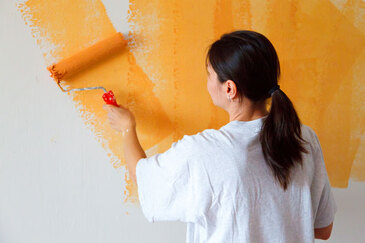
Once before, we thought we had run out of plays on the word "stroke" but the Checker Maven staff managed to come through. This week, they've done it again, although warning that it would probably be the last acceptable instance of "stroke" wordplay (and to be precise, the photo shows someone using a roller rather than a brush).
We're not at all sure that we would cover our office walls with the color selected by the woman in the photo above, but you get the idea, and for all we know, she might be an expert checker player in addition to modeling brush strokes.
Today's stroke problem is indeed no brush-over; it's complex and requires the best in visualization skills.
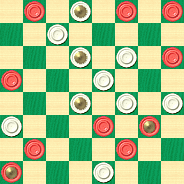
WHITE
White to Play and Win
W:WK2,6,K10,11,15,K18,19,20,21,31:B1,3,4,12,13,23,K24,25,27,K29.
Don't paint yourself into a corner, and after a good brush with this problem, click on Read More to see the solution.
You can email the Webmaster with your comments on this article.
Petterson's Drawbridge
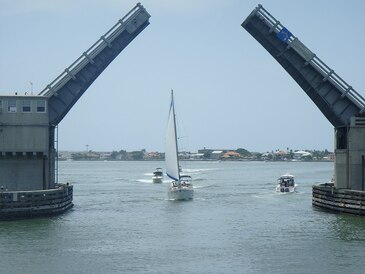
The intriguing drawbridge shown above crosses the Old Pinellas Bayway, and we think it's a fitting illustration for today's Checker School lesson, which is about the classic "Petterson's Drawbridge" position.
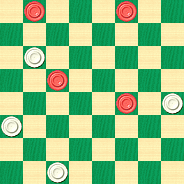
We always ask when we present material on a well-known position: How well do you really know it? We're certain that our more advanced readers know it pretty well, but a thorough review never hurts; and for everyone else, this is a great opportunity to master this very difficult end-game formation. Here are two examples for you to try out. You might wish to attempt the second one first.
| R.D. PETTERSON | J. BRADLEY |
| BLACK | BLACK |
 |  |
| WHITE | WHITE |
| White to Play and Draw | White to Play and Draw |
| W:W9,20,21,30:B1,3,14,19. | W:WK2,10,20,21:B1,3,K18,K19. |
When you've crossed this bridge, or more correctly, these bridges, cross your mouse over to Read More to see the solutions, four sample games, and detailed study notes. If you go over all of this material carefully, you'll be a drawbridge expert (of the checker variety, at least) and your cross-board results will definitely improve.
You can email the Webmaster with your comments on this article.
Reed's Rocket
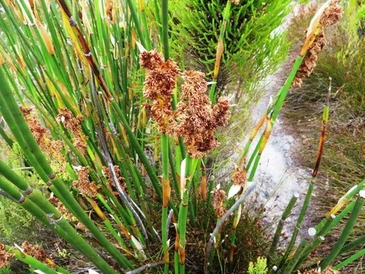
Given the title of today's column, we'll guess that you were expecting to see a picture of a powerful rocket blasting off from its launching pad. Instead, what you see above is a photo of not Reed's Rocket, but a plant called Rocket Reed. It doesn't look especially attractive, unlike today's checker problem, which to us has much more appeal.
Now, old-time checkerist C. F. Barker was certainly a tough customer, but in Willie Ryan's Tricks Traps & Shots of the Checkerboard, Willie describes just how James Reed rocketed to the challenge.
"Here is how James P. Reed, of Pittsburgh, Pennsylvania, put the skids under Boston's renowned Charles Francis Barker, in an American Championship match in 1889:
| 10-14 | 21-14 | 6-10 |
| 22-17 | 9-25 | 27-24 |
| 7-10 | 29-22 | 1- 6 |
| 17-13 | 10-14 | 19-15 |
| 3- 7 | 22-18 | 10-19 |
| 25-22 | 14-17 | 24-15---1 |
| 14-17 | 24-19 | 12-16---A. |
WHITE
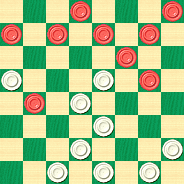
White to Play and Win
W:W32,31,30,28,26,23,18,15,13:B17,16,11,8,7,6,5,4,2.
A---Fatal. 6-9 or 11-16 will draw."
1---Play has been textbook perfect to this point---Ed.
You know what we're going to say now: Can you crack this position, or will you crack up trying? Take a crack at it, and then crack that mouse on Read More to see the powerful solution.
You can email the Webmaster with your comments on this article.
21st Century Checkers: the 9-14 "Double Corner" Ballots
Today we are pleased to present the second volume of Grandmaster Richard Pask’s new work on the 3-move openings: 21st Century Checkers 9-14s, or the Double Corner ballots.
As he did with volume 1, Mr. Pask is making this work available in electronic format, free of charge.
The new book can be downloaded here, and will soon appear on our Richard Pask page as linked in the right-hand column; a large selection of Mr. Pask’s other works can also be found there.
Here’s a position taken from the book. The run-up to the diagram is as follows.
9-14 23-19 5-9 27-23 11-15 22-18 15-22 25-18 7-1; 26-22 11-15 18-11 8-15 24-20 15-24 28-1; 4-8 22-18 8-11 30-26 2-7
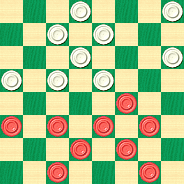
BLACK
Black to Play and Win
B:W31,29,27,26,23,21,20,19,18:B14,12,11,10,9,7,6,3,1.
What would have been the correct move? Can you show the win after 32-27? Can you work all of this out on your own?
See how far you can get, and then click on Read More to see the solutions. And, of course, don’t forget to download the book! Our sincere thanks go to Mr. Pask for allowing us the privilege of presenting his new book.
You can email the Webmaster with your comments on this article.
The Checker Maven is produced at editorial offices in Honolulu, Hawai`i, as a completely non-commercial public service from which no income is obtained or sought. Original material is Copyright © 2004-2026 Avi Gobbler Publishing. Other material is public domain, AI generated, as attributed, or licensed under CC1, CC2, CC3 or CC4 and the various CC options. Information presented on this site is offered as-is, at no cost, and bears no express or implied warranty as to accuracy or usability. You agree that you use such information entirely at your own risk. No liabilities of any kind under any legal theory whatsoever are accepted. The Checker Maven is dedicated to the memory of Mr. Bob Newell, Sr.