The Checker Maven
The World's Most Widely Read Checkers and Draughts Publication
Bob Newell, Editor-in-Chief
Published every Saturday morning in Honolulu, Hawai`i
Mr. Darcy Plays Draughts
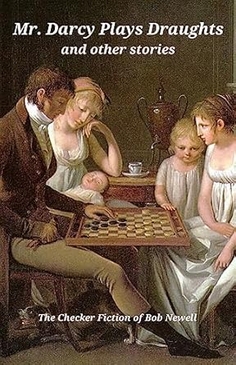
Our new book is out and available on Amazon! The book is published as a non-commercial venture, as net proceeds, if any, will help defray the ever-increasing costs of Checker Maven web hosting so that we may continue to provide a no-cost public service for checkerists.
The book is a collection of some of the best stories appearing in this column over the past years, plus one brand new one, the title story, Mr. Darcy Plays Draughts. Why is Elizabeth suspicious when Mr. Darcy takes up a seemingly innocent interest in the game of draughts?
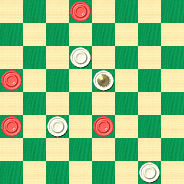
Read the book and find out. But we'll give you a hint right here by presenting a checker problem closely related to those that appear in the story (and no, we're not going to give any more than that away).
WHITE
White to Move and Win
W:W32,22,K15,10:B23,21,13,2.
As always, solve the problem, and then click on Read More to verify the solution. 
You can email the Webmaster with your comments on this article.
The Leaves Fall Quickly

In the autumn, the leaves can fall quickly. In the photo above, Junior is having a great time with the autumn leaves. Dad may have somewhat less fun when it comes time to bundle them up and dispose of them.
Quickly falling leaves inspire one of the easiest speed problems we've published in a while. Of course, you know the catch; you'd better be quick because we're only giving you five seconds.
Click on the link below to display the position and start the clock. Then, quick as can be, come back and rake your mouse on Read More to check your solution.
October Speed Problem (very easy, 5 seconds)
You can email the Webmaster with your comments on this article.
The 4th Catalan Number
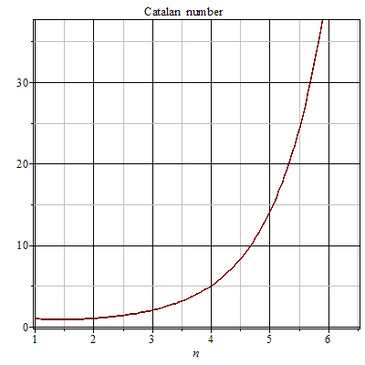
As we continue to explore the Kelso opening with Willie Ryan and his classic book Tricks Traps & Shots of the Checkerboard, we reach our 14th installment on this fascinating opening.
There's almost nothing special about the number 14, except perhaps that it's what's known as a Catalan number, the 4th Catalan number, to be precise. Catalan numbers are named for Belgian mathematician Eugène Charles Catalan, and appear in various applications in the branch of mathematics known as combinatorics. Catalan numbers also appear in graph theory; in particular, Cn is the number of non-isomorphic ordered trees with n vertices. (If you don't quite follow that, watch the movie Good Will Hunting.)
But enough math! By now you're surely ready for some checkers. Here's the run-up to today's position.
| 1. | 10-15 | 22-18 |
| 2. | 15x22 | 25x18 |
| 3. | 6-10 | 18-14 |
| 4. | 10x17 | 21x14 |
| 5. | 9x18 | 23x14 |
| 6. | 1-6 | 29-25 |
| 7. | 12-16 | 26-23 |
| 8. | 16-19 | 24x15 |
| 9. | 11x18 | 28-24 |
| 10. | 8-11 | 31-26 |
Willie offers 31-26 as an alternative to 24-19, the latter of which he calls "A natural though timid move."
| 11. | 4-8 | 23-19 |
| 12. | 6-9 | 19-15 |
| 13. | 11-16 |
Willie correctly says that 9-13 should have been played here and that now "Black will have to do more than whistle to get past the graveyard."
WHITE
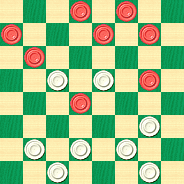
White to Play and Win
W:W32,30,27,26,25,24,15,14:B18,16,9,8,7,5,3,2.
Higher math skills are not required here, just rather high over the board checker skills. This is not an easy problem, but there is still no need to apply combinatorics or graph theory (unless you really want to), as you can always check your solution by simply clicking your mouse on Read More.
You can email the Webmaster with your comments on this article.
More Than One Way To Do It
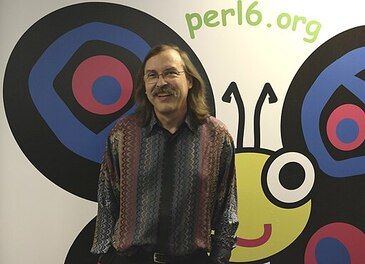
"There's more than one way to do it" is a common enough phrase, and it seems to have gotten attached to the scripting language Perl, due to Perl's extreme (some say excessive) flexibility. At The Checker Maven Perl scripts figure prominently in our computer work, and, even though the modern trend is more towards the Python language, we persist. But that discussion is even further off-topic.
Today's problem, submitted by regular contributors Lloyd and Josh Gordon of Toronto has two main solutions, hence "more than one way to do it." One of the solutions occurred in over the board play, while the other, which is quite different, is due to KingsRow computer analysis.
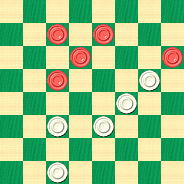
WHITE
White to Play and Win
W:W30,23,22,19,16:B14,12,10,7,6.
Which solution will you find? Can you see them both? To find out, there's only one way to do it: click on Read More.
You can email the Webmaster with your comments on this article.
Cowan's Coup Revisited
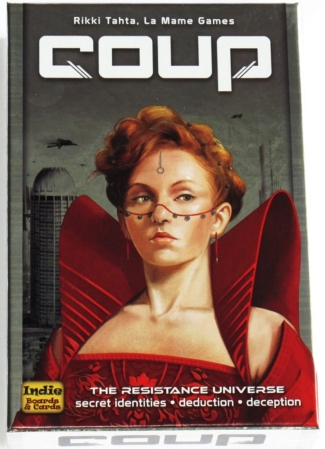
Just over five years ago, we published a column on Cowan's Coup based on analysis by Willie Ryan. This week in our Checker School entry, we'll revisit the position and gain the benefit of Ben Boland's viewpoint, as expressed in his classic Famous Positions in the Game of Checkers.
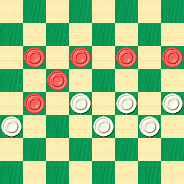
BLACK
White to Play and Draw
W:W24,23,21,20,19,18:B17,14,12,11,10,9.
No matter what move White makes, he's going to lose two men at once. Yet we're asked to find a move that draws.
Is this a coup that you can pull off? Please do try; after all, this is a non-violent coup. But if the solution eludes you, or you'd just like more insight, you can click on Read More to see one way to do it along with numerous sample games and an explanatory note or two.
You can email the Webmaster with your comments on this article.
Labor Day Salute

Public Domain Pictures CC0
Labor Day; it's a welcome day off work, a last hurrah for summer in North America, a time to see a parade, or squeeze in one more barbecue or picnic or camping trip before the leaves fall and the nights become chill.
And, as we point out each year, it's a time to show our respect for the average Jane and Joe that make up America's workforce, those honest, decent, hard-working people who show up every day, do their jobs, and help make America what it is. There was a time when checkers was their game, and although that's less of a truism today, checkers remains democratic, accessible, and suitable for everyone.
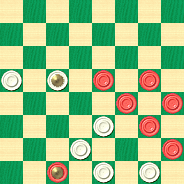
On holidays like these, we like to feature great American players and problemists. Today we have one of the few problems authored by one of the greatest American checkerists of all time, Samuel Gonotsky. It is based on actual over the board play.
WHITE
White to Play and Draw
W:W32,31,26,23,K14,13:BK30,28,24,20,19,16,15.
White is a man down but has mobility advantages. Can the situation be turned into a draw? Labor away at this one; but seeing the solution is hardly laborious and requires only a mouse click on Read More.
You can email the Webmaster with your comments on this article.
Don't be a Square

"Don't be a square" is probably an expression you haven't heard much lately, as it's long out of date. It actually originated with jazz musicians but by the 1980s, it was starting to sound old-fashioned.
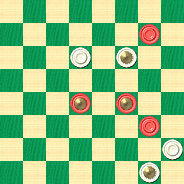
Our use of this phrase to title our column is for two reasons. The first is the shape seen in the problem diagram.
BLACK
Black to Play and Win
B:W23,K22,5,K1:B25,K15,K14,9.
The second meaning derives from the solution itself. You might see what we're getting at when you solve it. It's not overly difficult. Don't be a square--- try to work it out. When you're finished, click your mouse squarely on Read More to see the solution and an explanation.
You can email the Webmaster with your comments on this article.
The Crocodile Position
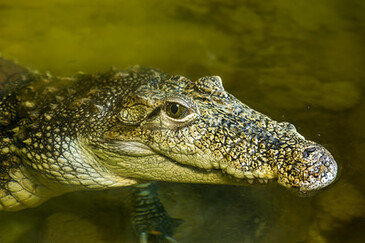
There's been a lot in the news in recent months about alligators attacking humans, sometimes with tragic results. But crocodiles, particularly the South Pacific varieties, can also be very dangerous.
The differences between crocodiles and alligators are many, even if they seem to be similar creatures. For instance, they have different jaw shapes, and crocs are more tolerant of saltwater environments.
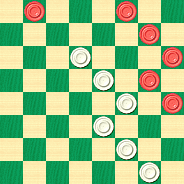
The position below, an entry in our ongoing Checker School series, could be either crocodile or alligator. In fact, as you'll see in our solution notes, it's been called both at various times. But regardless of name, it's quite ferocious.
W. H. RUSSELL
BLACK
WHITE
White to Play and Win
W:W10,15,19,23,27,32:B1,3,8,12,16,20.
Don't get caught up in the jaws of this one; work it out and then snap your mouse on Read More to see the solution, sample games, and detailed notes.
You can email the Webmaster with your comments on this article.
Publication Times
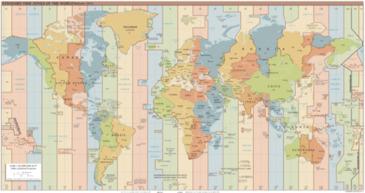
The Checker Maven originally appeared each Saturday at 2:02 AM MST (GMT-7). When our offices relocated from Santa Fe, NM, to Honolulu, HI, our publication time changed to 2:02 AM HST (GMT-10).
Now, many of our readers are on the east coast of the United States and look for the latest column early in the morning. With our present publication time, the week's offering isn't available until 8:02 AM EDT. That's later than we might like, and so effective at once we'll be moving to a publication time of 00:02 AM HST, or two hours earlier than the current publication time.
We hope this time change makes access to The Checker Maven a little more convenient for our readers.
You can email the Webmaster with your comments on this article.
Delicado
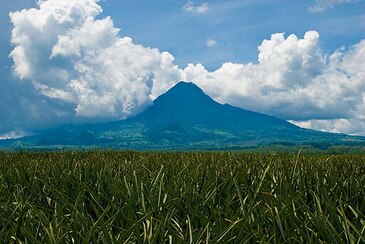
Your editor, many years ago, went hiking and climbing in southern Mindanao in the Philippines. Locals referred to the area where we went as "delicado" --- delicate --- due to the sometime presence of rebel militia. Being young and foolish, we were not deterred from what turned out to be a dangerous undertaking. Fortunately, nothing went wrong.
Today's checker problem is "delicado" in a different way, and there's nothing foolish or dangerous about it at all. Your solution may go wrong, but if you work at it, you'll get it, and you may learn some technique in the process.
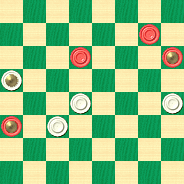
WHITE
White to Play and Draw
W:W22,20,18,K13:BK21,K12,10,8.
There's no need to carry arms or keep a lookout, and checking your solution is as easy as clicking on Read More.
You can email the Webmaster with your comments on this article.
The Checker Maven is produced at editorial offices in Honolulu, Hawai`i, as a completely non-commercial public service from which no income is obtained or sought. Original material is Copyright © 2004-2026 Avi Gobbler Publishing. Other material is public domain, AI generated, as attributed, or licensed under CC1, CC2, CC3 or CC4 and the various CC options. Information presented on this site is offered as-is, at no cost, and bears no express or implied warranty as to accuracy or usability. You agree that you use such information entirely at your own risk. No liabilities of any kind under any legal theory whatsoever are accepted. The Checker Maven is dedicated to the memory of Mr. Bob Newell, Sr.