The Checker Maven
The World's Most Widely Read Checkers and Draughts Publication
Bob Newell, Editor-in-Chief
Published every Saturday morning in Honolulu, Hawai`i
Thanksgiving Weekend 2020
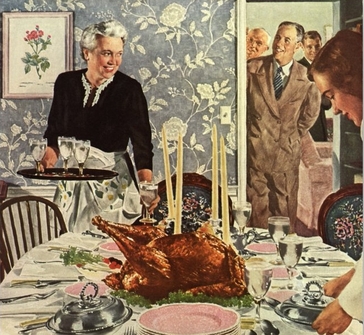
It's Thanksgiving weekend, our favorite holiday time of the year, and we recognize that we have much to give thanks for. While it's been an extraordinarily difficult year for all of us, and many have suffered loss, there is always hope for the future. Our society hasn't collapsed. Our nation is intact and will eventually heal. At The Checker Maven we believe that if we all do our part, work together, and take care of each other, we will come out stronger in the end.
So we give thanks and we are grateful for what we have. We mourn our losses but we carry on undeterred.
Thanksgiving is often a time for us to turn to American checkerist Tom Wiswell for one of his wonderful checker problems. We think Mr. Wiswell's life and work embodied the spirit of this holiday and of our times, for as we've noted before, he too did his part to help America through dark days.
Mr. Wiswell titled the problem below "Companion Piece" because it relates to another similarly-themed problem in his book Checker Magic. It's a bit of a complex setting, making it a good candidate for a holiday weekend.
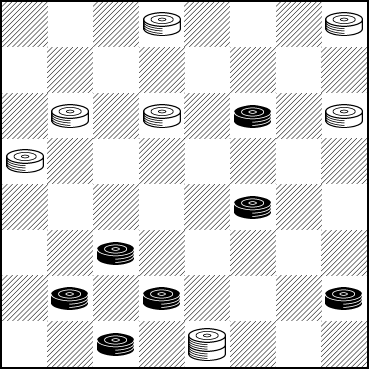
BLACK
Black to Play and Draw
B:WK2,20,21,23,24,29,31:B3,5,7,8,11,14,22
See how you do, then click on Read More for the solution, notes, and run-up to the position.
You can email the Webmaster with your comments on this article.
Hopeless: A Speed Problem

Sometimes in real life everything seems hopeless, yet we still need to carry on and make the best of things. There's no other way.
But over the checkerboard, sometimes it's truly game over. In this respect we're glad checkers doesn't mirror real life. It's a game. A great game, but fortunately, a game.
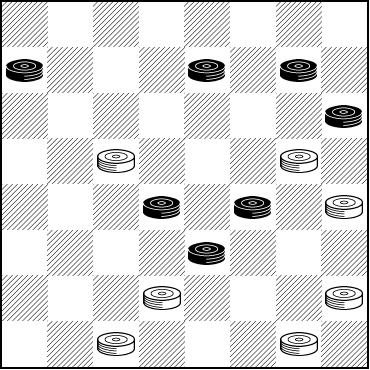
Here's just such a situation. It looks pretty tough for White, but there is indeed a ray of hope--- a pretty large one, as it turns out.
WHITE
White to Play and Win
W:W14,16,20,26,28,30,32:B5,7,8,12,18,19,23
This one is actually pretty easy. Sometimes when things look down there is a simple answer right in front of us, if only we can see it.
We hope you can find the solution, but in any case you can always click on Read More to see how it's done.
You can email the Webmaster with your comments on this article.
Editor's Choice
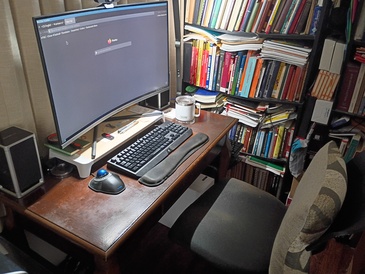
Checker Maven Editor's Office
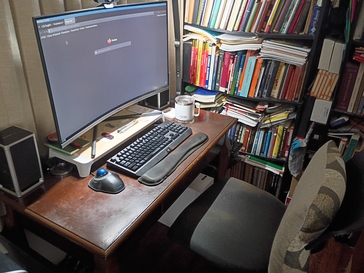
The Checker Maven runs on a modest budget and occupies a modest space in a modest building. Your editor's quarters, above, reflects our every-inch-counts working environment.
Every so often we run an "Editor's Choice" column. These don't follow any particular schedule or theme and are not part of one of our ongoing story series. They are simply a presentation of a checker problem or situation that we've found interesting, instructive, or both. Generally it's something from our library but at times it's a contributed problem.
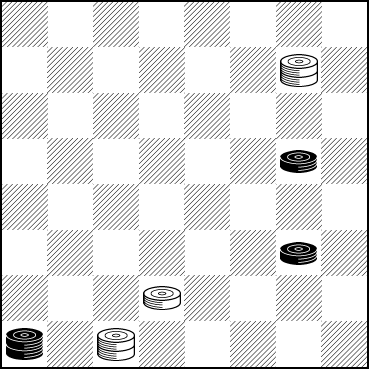
We've always admired the work of past problem great Fausto Dalumi and today we reprint one of his problems from something like 90 years ago. We think it's as fresh and interesting today as it was way back when.
WHITE
White to Play and Win
W:WK8,26,K30:B16,24,K29
Whether you attempt this problem in a small and crowded space or a large and spacious palace makes no difference. It's a nice problem either way. Mr. Dalumi noted that every White move is a "star" move.
Space out your efforts (or crowd them in at your choice) and see if you can find the solution. When ready, do allow room to click your mouse on Read More to see how it's done.
You can email the Webmaster with your comments on this article.
Mr. Hatley in the Library of Congress
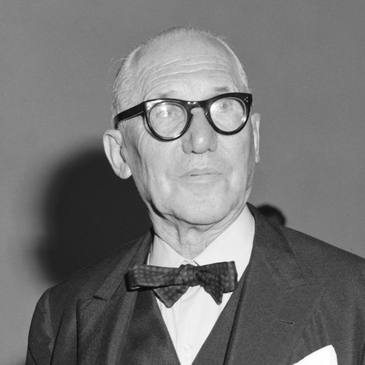
Mr. Hatley
Joop van Bilsen for Anefo CC0
In one of our recent Checker School columns, we met Mr. Hatley, his son Ned, and Farmer Sneed, all characters in Andrew J. Banks' charming 1945 book Checker Board Strategy. Today, Mr. Hatley and Ned return. Mr. Hatley is telling his son about the first checker book ever published in English. Mr. Hatley then goes on to show Ned a long series of instructive problems that we suppose are in the spirit of that early book rather than necessarily contained therein.
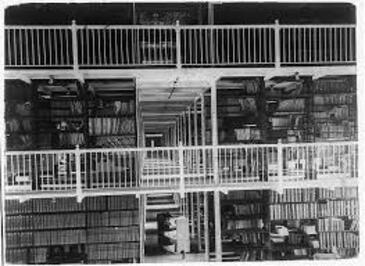
LOC CC0
In the reading room of the Rare Book Section of the Library of Congress sat a short elderly man. He put on his horn rimmed glasses and squinted his dark eyes as he spoke to his son.
"Ned, I want you to see the first checkerbook printed in English," said Mr. Hatley, pointing to a small rare volume, "Guide to the Game of Draughts," by William Payne, Londdon, England.
"Why father, it was published in 1756." Ned counted some 50 games and 38 problems.
"Look at the quaint old English!" he exclaimed.
You will find some of Payne's problems in practically every checkerbook.
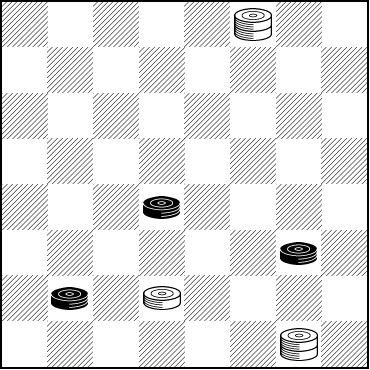
One of the problems that Mr. Hatley showed Ned on that day, some 75 years ago, was the one below, credited to A. E. Clow of Ontario.
BLACK
WHITE
White to Play and Win
W:WK3,26,K32:B18,24,25
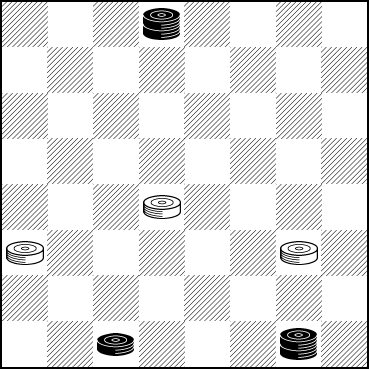
Mr. Hatley also gave Ned a second example in the same vein, credited to David Kirkwood way back in 1875.
WHITE
BLACK
Black to Play and Win
B:W9,12,15:BK1,3,K31
How would you do as Mr. Hatley's student? You don't need to journey to the hallowed halls of the Library of Congress; you can solve these in the comfort of your own home. See how you do and then click on Read More to see the solutions.
You can email the Webmaster with your comments on this article.
Falling Into Fall

It seems as though this young lady has taken a deliberate tumble into a pile of autumn leaves, a fall into fall, if you will. We wonder if she has tumbled to something here, as she looks relaxed and content.
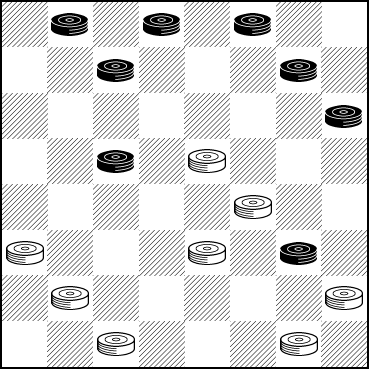
We think you'll be quite content, too, after solving this month's speed problem, provided by regular contributors Lloyd and Josh Gordon of Toronto.
WHITE
White to Play and Win
W:W15,19,21,23,25,28,30,32:B1,2,3,6,8,12,14,24
We'd rate this one as "very easy" for most experienced players, and good practice for the rest of us. Don't take a fall; see how quickly you can solve it, then click on Read More to verify your solution.
You can email the Webmaster with your comments on this article.
Sal Returns To The Beacon Cafe
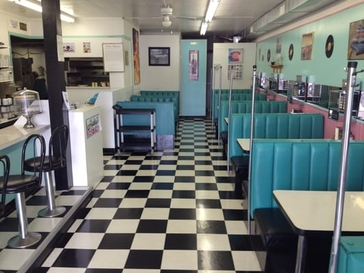
Saturday, September 10, 1955: It was the first Saturday after the Labor Day weekend. For Sal Westerman, a retired actuary in Bismarck, North Dakota, the day held special meaning, for at 1 PM, the Coffee and Cake Checker Club would resume its weekly meetings after the summer break.
Sal missed those get-togethers at the Beacon Cafe in the Provident Life Building. It was the highlight of the week for the elderly gentleman. Oh, he understood that during the all-too brief North Dakota summers, pretty much every organized indoor activity came to a stop so that people could enjoy the long hours of daylight and spend time outdoors. But he missed his club nonetheless.
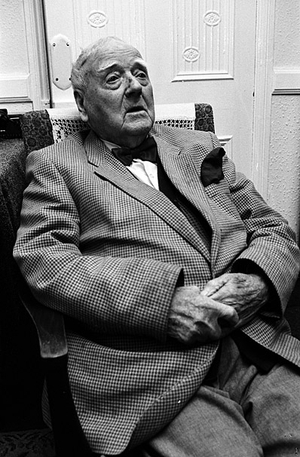
Sal Westerman
His wife Sylvia sensed his eagerness and served an early lunch so that Sal could be on his way and not be a minute late. Sal walked much faster than usual from his home to the Beacon that afternoon, and arrived a full five minutes early.
When Deana, the proprietor and the best baker in a dozen counties, greeted him, he felt a warm flow of contentment. Looking to the back of the Cafe, he was even more pleased to see that a few of the boys (all of them at least 50 years old) were already in the big booth that the Club always used. Delmer, Dan, Wayne, and Larry were on hand, and look! even Tom was present.
There were greetings and handshakes all around, and by one o'clock two more members had arrived: Louie and Ron. It was a great gathering and Sal couldn't have been more pleased.

Ron Klunker
"Welcome back, boys!" he said. "I hope you all had a great summer and are ready for some checkers!" There were words of assent all around and Larry and Louie even gave out a little cheer. But it was Wayne who asked the inevitable question.
"What've you got for us today?"
"Oh," Sal chuckled, "a real nice one from Ed." Ed was Sal's checker penpal way out east in Pennsylvania. "Ed says you have to find 18 star moves to solve it."
"18 star moves!" Dan exclaimed. "That's darn tough!"
Behind her counter, Deana, sensed her moment. She was as good at marketing as she was at baking. "Zucchini nut bars today," she said. "Fresh and hot."
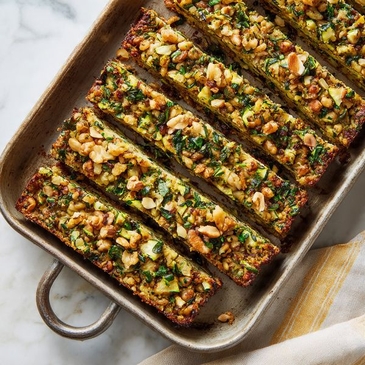
"Sounds great!" Sal said. "I'll be happy to have the boys buy me a couple when they can't win this one!"
"Says who!" exclaimed Tom. "Lay 'em out, Sal!"
Sal set up two checkerboards, one in the big booth and one in the adjoining booth. With such a great turnout, one board would hardly be enough. He arranged the pieces in the following position.
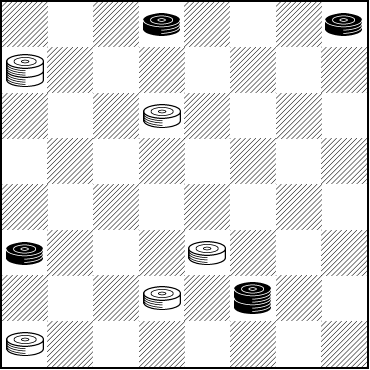
WHITE
White to Play and Win
W:WK5,10,23,26,29:B2,4,21,K27
"Golly," Dan said, and then added, "gee."
"Since you have to find 18 star moves, I'll give you some extra time," Sal said. "How about half an hour?"
There was a great clamoring of disagreement. "An hour!" Louie demanded. "Play fair!"
"Okay, an hour. But not a minute more!" Sal looked over at Deana. "We're going to need a lot of coffee," he said.
"Gotcha covered," came the reply but the boys paid no attention. They were already deeply engrossed in Ed's problem.
We're certain you're glad the Club is finally meeting again, and no doubt you'd like one of those zucchini chocolate chip bars. Can you solve the problem and win one (virtually, of course)? Take as much time as you like. Put a pot of coffee on the stove and try to work it out; then click on Read More to see the solution and the conclusion of our story.
You can email the Webmaster with your comments on this article.
Labor Day 2020

Public Domain Pictures CC0
Labor Day is another of those holidays that we, as Americans, enjoy celebrating. It's a great opportunity to honor the contributions of the vast numbers of hard-working members of our society who form the backbone of our nation. From CEO to technology professional to trucker to gardener, and all the many and varied other occupations, each and every one of you is important and deserves respect and recognition.
But in these Covid-19 days, many have fallen on difficult times as jobs have disappeared, businesses have closed, and there is more than enough hardship and grief to go around. We can only wish for a recovery that is as speedy as possible given the seriousness of the situation. We look forward to a future Labor Day when we all have reason to celebrate in happiness and prosperity.
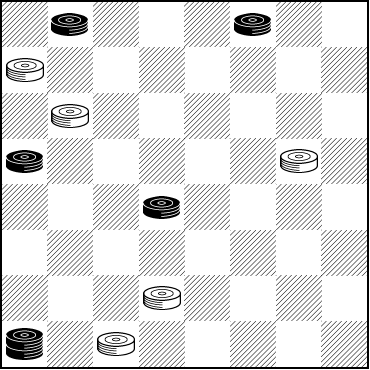
We once again turn to Tom Wiswell, an American who lived through difficult days, too: the dark days of World War II. Mr. Wiswell used checkers as a means of helping to keep up our spirits, and we can use a little of the same today. He called the following problem "Imagination" saying that he could not imagine a good player without imagination.
WHITE
White to Play and Draw
W:W5,9,16,26,30:B1,3,13,18,K29
Mr. Wiswell says that "ordinary methods" won't do here, so indeed use your imagination to labor away, and when you're ready, click your mouse on the (non-imaginary) Read More button to see the solution.
You can email the Webmaster with your comments on this article.
Didactic Value

In our last Checker School column, our friend Farmer Sneed got a checkerboard thrashing from Ned's father, Mr. Hatley, who said he owes his skills to knowledge of checker problems. Better that than the kind of thrashing you might get from the person above, who we'll merely call a "traditional" educator.
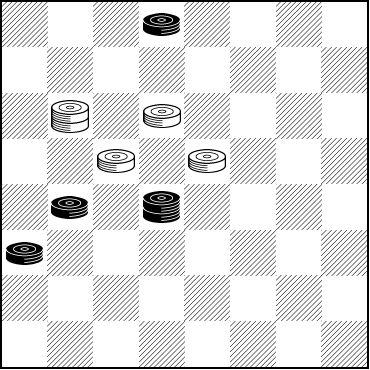
Today's column features a theme which the good farmer would do well to learn. It's really pretty simple and will be familiar to any skilled player. (Checker School features problems and themes with didactic value, often resulting in relatively less difficult solutions. "Didactic" may be a new word for Farmer Sneed, adding to the value of this lesson.)
WHITE
White to Play and Win
W:B2,17,21,K18:W10,14,15,K9
We won't smash your knuckles with a ruler if you don't get this one, and in fact we're sure you'll find the win. When you're ready, smash your mouse (not your ruler) on Read More to see the solution.
You can email the Webmaster with your comments on this article.
In The Heat Of The Summer

In North America, August is typically the hottest or at least one of the hottest months, but it's pretty much the last month of the summer vacation season. In some European countries, August means "les vacances" and cities such as Paris are depleted of residents (at least in non-Covid years).
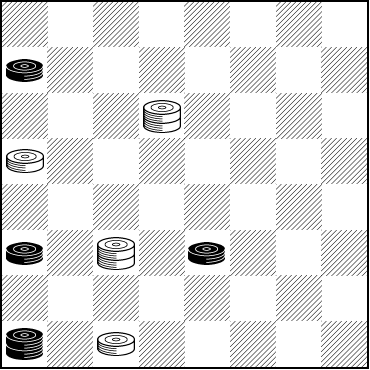
Is it just too hot to play checkers in August? Maybe, maybe not. When it's really hot out, spending some time indoors in air conditioned surroundings may be a nice option. But at any rate, today we have a speed problem that will only occupy you briefly, allowing you to get back to your summer activities without delay. We rate it as "very easy" and present it in accord with our goal of having something for everyone. For the novice, this is a nice exercise. For the expert, see if you can spot the fastest solution in under three seconds.
WHITE
White to Play and Win
W:WK10,13,K22,30:B5,21,23,K29
Solve it at top speed, without overheating, and then click your mouse on Read More to see the cool solution.
You can email the Webmaster with your comments on this article.
Alex Moiseyev, Problem Composer (Part 2 of 2)

Alex Moiseyev
Last month we presented the first of two English checker problems by champion Alex Moiseyev, who holds the title of Grandmaster not just in checkers, but in checker problem composition for the 10x10 International game.
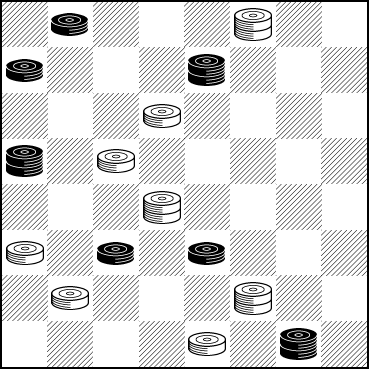
Let's have a look at the second and last problem in our series, one that is indeed worthy of a titled player.
WHITE
White to Play and Win
W:WK3,10,14,K18,21,25,K27,31:B1,5,K7,K13,22,23,K32
This problem is definitely at the master level. But don't let that discourage you; there is a lot to learn from trying to work through it. When you're ready, click on Read More to see the solution and notes.
You can email the Webmaster with your comments on this article.
The Checker Maven is produced at editorial offices in Honolulu, Hawai`i, as a completely non-commercial public service from which no income is obtained or sought. Original material is Copyright © 2004-2026 Avi Gobbler Publishing. Other material is public domain, AI generated, as attributed, or licensed under CC1, CC2, CC3 or CC4 and the various CC options. Information presented on this site is offered as-is, at no cost, and bears no express or implied warranty as to accuracy or usability. You agree that you use such information entirely at your own risk. No liabilities of any kind under any legal theory whatsoever are accepted. The Checker Maven is dedicated to the memory of Mr. Bob Newell, Sr.