The Checker Maven
The World's Most Widely Read Checkers and Draughts Publication
Bob Newell, Editor-in-Chief
Published every Saturday morning in Honolulu, Hawai`i
Three Easy Strokes: Part One

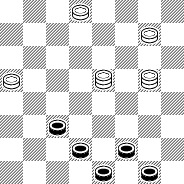
Our title, predictably, doesn't refer to an easy par-three golf hole, but to our desire to present a short series of stroke problems that, frankly, aren't quite as difficult as some of our earlier offerings.
Try your hand at this first one and decide for yourself if it's a spring breeze; then click on Read More for the solution.
BLACK
Black to Move and Win

You can email the Webmaster with your comments on this article.
Minority Rules
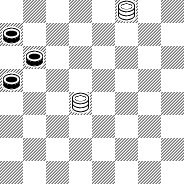
We're really pleased to present this stunning Tom Wiswell problem. As usual, it is not easy, but it is elegant, entertaining, and instructive, and illustrates the depth and scope of our game of checkers. The setting is below; we think this is among the finest problems we've put forth to date.
WHITE
White to Play and Win
Solve it if you can, and then click on Read More for the surprising solution.
[Read More]You can email the Webmaster with your comments on this article.
Two Easy Pieces, Fourth Installment
As we continue our electronic republication of Willie Ryan's classic Tricks Traps & Shots of the Checkerboard we wish to thank those readers who pointed out typos in the original book. We also recognize there are some readers (your editor at times among them) who don't think these pieces are all that easy! But we'll let Willie carry on.
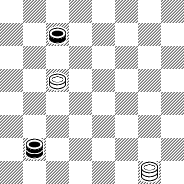
White to Play and Draw
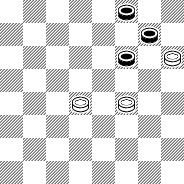
Black to Play and Draw
You can email the Webmaster with your comments on this article.
The Grandmaster Gem --- Solved!
Way back in December, we presented Brian Hinkle's Grandmaster Gem --- a problem which up to that point had been solved by only two people, and had baffled many master class players. Since we published it, only one correct solution has been received; but there have been numerous pleas for help!
We are at long last pleased to provide the solution, written and annotated by problem author and Checker Maven contributor Brian Hinkle.
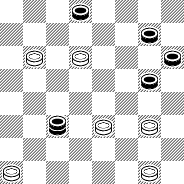
WHITE
White to Play and Win
1. 10-7 A 2x11 2. 24-20 B 22-26 C 3. 9-6 26x19
4. 6-2 D 19-15 E 5. 2-7 F 15-18 6. 29-25 G 18-15
7. 25-21 15-18 8. 21-17 18-15 9. 17-13 15-18
10. 13-9 18-15 H 11. 9-5 15-18 12. 5-1 18-15
13. 1-6 I 15-18 14. 32-27 J 18-22 15. 27-23 22-26
16. 23-18 26-22 K 17. 18-14 22-26 18. 14-9 26-23
19. 9-5 23-19 20. 5-1 19-23 21. 1-5 23-19
22. 5-9 19-23 23. 9-14 23-19 24. 14-17 19-23
25. 6-9 23-19 26. 9-14 19-24 27. 14-18 L 24-19
28. 17-22 19-15 29. 18-23 15-19 30. 22-26 19-24
31. 26-30 24-28 32. 7-10 28-24 33. 10-14 24-28
34. 14-18 28-24 35. 18-22 24-28 36. 22-26 28-24
37. 26-31 24-28 38. 31-27 28-24 39. 27-32 24-27
40. 23-18 27-24 41. 32-28 M 24-27 42. 28-24 27-31 N
43. 30-25 31-26 44. 25-21 26-31 45. 21-17 31-26
46. 17-14 26-31 47. 14-10 31-26 48. 10-7 26-31
49. 18-22 White Wins.
A - This 1. 10-7 pitch is the only move that wins with full plans to sacrifice another piece! It would be natural to try to keep the extra piece with 1. 10-6 or 1. 9-5 but Black will move 16-20 against either move and get a man-down draw. Another wrong try is
1. 24-20 16-19 2. 23x16 12x19 3. 20-16 8-12 4. 9-5 22-18 5. 16-11 18-15 6. 11-7 2x11 7. 5-1 15x6 8. 1x10 19-23 Drawn.
So Grasshopper, choose wisely: would you rather have a man-up draw or would you have the courage to sacrifice 2 men and get a man-down win?
B - Temporarily locking down Black's 4 pieces on 8, 11, 12, and 16.
Note: after 2. 24-20, this setting makes a beautiful twin with the terms: Either to play, White wins. Can you see how White would win if it were White's move?
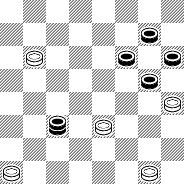
WHITE
White to Play and Win
C - Black may as well chase the piece on 23 now and hope white moves 23-18? which would allow Black to draw.. Delaying with 22-17 will result in the same 2x4 cramp shown in the trunk line.
D - White is now a man-down after sacrificing a second piece. Does this position look like a white win to you? It is, believe it or not!
E - White gets the 2x4 bind regardless of where the Black king moves next.
F - The 2x4 cramp + "the move" = man down win. In this position "the move" means the total number of pieces in the columns up from squares 29, 30, 31 and 32 will total 5 when it is White's turn. If White doesn't have "the move", then it is only a draw!
G - White must crown the piece on 29 first. Starting the piece on 32-27 will allow Black to slip away with a draw with 18-22 7. 27-23 22-26 8. 23-18 26-23 9. 18-14 16-19 10. 7x16 23-18 11. 16x23 18x27... Drawn.
H - Going into the double corner makes for a quick win...18-14 11. 9-6 14-9 12. 6-1 9-5 13. 1-6 5-1 14. 6-10 1-5 15. 32-27 5-9 16. 27-23 9-5 17. 10-14 5-1 18. 7-10 1-5 19. 10-6 5-1 20. 6-9 1-5 21. 14-18 5x14 22. 18x9 White Wins.
I - White must park the second king here on square 6 so a winning swap can be threatened later as the piece on 32 moves up the board to crown.
J - With the White king placed on square 6 it is now time to get a third king.
K - If 26-23, 6-10 is the important swap that White needs to threaten.
L - Same as Ben Boland's Famous Positions p.135 after the 3rd move, colors reversed. Although not mentioned by Boland, it is important to note that if it were Black's turn, then it is only a draw. Having the 4x2 bind is not enough to win. Again, note that there are 5 pieces in the winning side's system ... a high five to the winner!
M - The only move to win.
N - 42. 27-32 18-15 43.11x18 20-4 44. 12-16 4-8 45. 18-22 8-12 46. 16-20 24-19 47. 32-27 12-16 48. 27-32 19-15 49. 32-27 15-18 White Wins, Famous Positions, colors reversed.
This checker problem was created after I noticed that the early 23-18 Switcher game between Alex Moiseyev and Louis Cowie played at the 2002 Ohio State tournament could have resulted in a strange man-down position. Later, I noticed this was the Fugitive King win in Famous Positions and I mentioned this to Rich Beckwith; it was an observation I made when I was going through a period without using any computer software.
Fascinated with this discovery, I decided to find the earliest possible setting of the Fugitive King win and then disguise it in a natural setting where 2 men must be sacrificed in order to get the pretty man-down win. It took about 10 hours of work to set it up just right after I understood everything, including "the move", using KingsRow. Back in June 2004 none of the checker programs with the 8 piece database could solve it so many players assumed it was a draw! Ed Gilbert confirmed it was a win with KingsRow's 9 piece database.
I congratulate the only 3 players in the world who solved it: Alex Moiseyev, Jim Morrison and Albert Tucker.
Almost everyone else thought this position was set up wrong, especially players who used checker software with the 8 piece database. This underscores a growing dependency on computers. It turns out that computers were not needed to solve this puzzle at all and in this case they just got in the way. The main thing you needed to solve this puzzle was knowledge of the Fugitive King win published in Ben Boland's Famous Positions.
Runups:
1. 11-15 21-17 2. 9-13 23-18 3. 8-11 25-21 4. 6-9 27-23 5. 1-6 32-27 6. 3-8 30-25 7. 9-14 18x9 8. 5x14 24-19 9. 15x24 27x20 10. 6-9 22-18 11. 13x22 26x17 12. 11-15 18x11 13. 8x15 17-13 14. 4-8 13x6 15. 2x9 31-26 (Louis Cowie played 25-22? against Alex Moiseyev in the 2002 Ohio State tournament and lost.) 16. 8-11 26-22 17. 15-19 23x16 18. 12x19 22-17 19. 9-13 25-22 20. 11-15 20-16 21. 19-24 28x19 22. 15x24 (Left as a Black win in Master Play p. 351-P. Black will use knowledge of the Fugitive King ending to complete the win. From this point on, there is no draw escape for White.) 16-12 23. 24-27 12-8 24. 27-32 8-3 25. 32-27 3-8 26. 27-24 8-3 27. 24-19 3-8 28. 19-15 8-3 29. 15-11 29-25 30. 11-15 3-8 31. 15-19 8-3 32. 19-23 3-8 33. 23-26 8-3 34. 7-11 3-7 35. 11-16 7-2 36. 16-20 2-6 37. 14-18 6x15 38. 18-23 ... Black Wins.
1. 11-15 22-18 2. 15x22 25x18 3. 8-11 29-25 4. 4-8 24-20 5. 12-16 28-24 6. 10-15 26-22 7. 9-14 18x9 8. 5x14 31-26 9. 8-12 23-18 10. 14x23 26x10 11. 6x15 21-17 12. 1-5 17-14 13. 2-6 32-28 14. 3-8 14-10 15. 7x14 27-23 16. 5-9 24-19 17. 15x24 28x19 18. 9-13 22-18 19. 6-9 25-21 20. 13-17 30-26 21. 9-13 18x9 22. 17-22 26x17 23. 13x22 9-6 White Wins.
If you enjoyed this problem, then let me know.
If you have any additional run ups or associated positions to share, then please email me at sbhinkle@charter.net.

You can email the Webmaster with your comments on this article.
Mayday! Mayday!
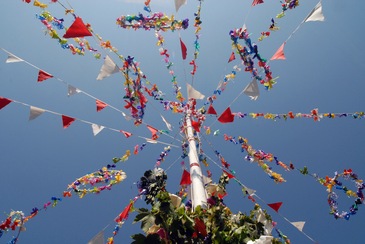
The month of May has begun, marked by the usual "May Day" celebrations around the world. But "Mayday!" has another meaning - send help fast!
We don't think you'll need help with this month's speed problems, but solving them fast is the goal. How well can you do? Try them out and click on Read More for the solutions.
(We are always in need of speed problems. If you have any that you'd like us to publish, please contact us using the contact link in the left column.)
Problem 1: Very Easy
Problem 2: Easy
Thanks to Brian Hinkle, an oversight in the setting and solution of Problem 2 has been corrected.
You can email the Webmaster with your comments on this article.
But Is It Worth Your Job?
Creazilla CC0
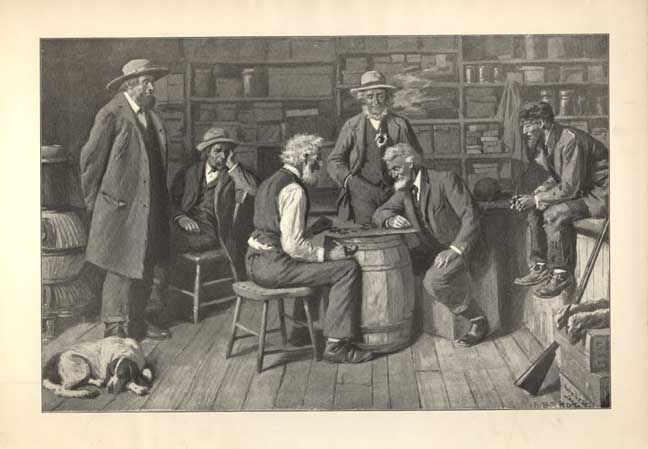
In 1892, John T. Denvir was working at a lucrative $2,000 per year job. During the lunch hour, he would go to his checker club to play a few games in the space of the one hour lunch period. One day, he played a rather brilliant game against Lucius S. Head, which however caused him to return to work an hour late. He fully expected to be fired, and considered himself very lucky indeed to have gotten off instead with a stern scolding.
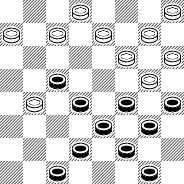
Here's the runup to the critical position:
11-16 23-18 10-14 18-15 16-19 22-17 7-10 24-20 9-13 26-22 5-9 30-26 8-11 15x8 4x11 27-23 2-7 23x16 12x19 32-27 11-15 20-16
BLACK
Black to Play and Win
If you can solve it, you certainly have excellent visualization skills. Check your solution against our animation, which includes the whole game.
A brilliancy indeed, but is it worth your job?
You can email the Webmaster with your comments on this article.
The Masked Man is Back in Town

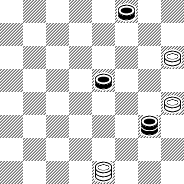
Continuing our monthly "Masked Man" series, this month's offering is perhaps the most difficult to date. Can you identify the problemist pictured above (posing with his daughter), and then solve the problem below?
WHITE
White to Play and Draw
Forces are even, but White's freedom of movement seems limited... can you pull off the draw? No less than four "star" moves will be necessary.
Check your solution, and learn the identity of the composer, by clicking on Read More.
You can email the Webmaster with your comments on this article.
Crime Does Not Pay
A little while back we lamented the presence of computer-using cheaters on the major online play sites. We recently came across an article published over 80 years back in the Morris-Systems Checkerist magazine that highlights a similar problem, and how one cheater got what he had coming. We've reprinted the article below.

Falls Into Graceless Trap After Double Move
The desire to win in any form of competitive sport is a very human one. Facing a man who is a degree stronger or more skillful, and submitting to defeat after defeat is a test of character, temper, fortitude--or, reduced to one word, a test of sportsmanship. Occasionally we encounter an individual for whom the hunger of victory is so intense that while he would probably shrink from attempting an unfair or unethical move in other walks of life, he has but meager scruples as to the management of his game, and in order to gain the upper hand resorts to illegitimate tactics. The number of such is of course infinitely small compared with those who would rather be riddled to pieces than surrender their principles of good sportsmanship; but even the insignificant number of sly-hand movers is to be regretted.
Not always, however, is it profitable for the sly-hander to make his moves unseen, and the man who thinks he is "getting away with it" will find now and then that he has dug a pit for himself too deep for escape.
We happened into a rather amusing demonstration of this not long ago while watching a player of good repute in a park exhibition where he was handling a number of boards simultaneously. As the exhibition player went from board to board we noticed that one of his opponents near us advanced a piece as if to test the position, then glanced up to see if he had been observed. When the exhibition player appeared at this board again the opponent made his regular move, but the piece he had advanced a minute before remained where he had placed it. The exhibitionist was plainly surprised. Evidently he had remembered the earlier position. We saw him eye his man with a keen glance, but said nothing, made his move and then went on to the next board.
Later, in the end game, the position on the board was as shown (below).
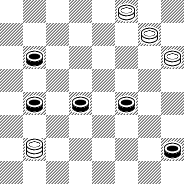
"Double Mover"--Black
The exhibition player had the white side. As he passed down the aisle to other boards, the "double mover," seeing himself pursued by the white king, made another illegitimate move, going from 5 to 9, with the thought of preventing white from playing 8-11 (which would then lose to 20-16 --Ed.). He scratched his head as if wondering whether his conscience would stand for it. When the checker performer returned to the board he caught the situation at a glance. He raised himself to a straight posture and looked squarely at his man, puzzled for words, but unwilling to embarrass the other while the crowd stood by. Nevertheless, his steady, searching look told the "double mover" he was discovered. Here is a picture of the board after the illegitimate move:
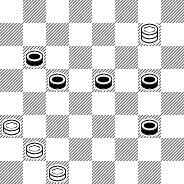
White--Exhibition Player
White to Move and Win
Studying the situation carefully the exhibition player smiled inwardly as he became aware that his opponent had unwittingly entangled himself in the coils of a binding trap.
Had the "double mover" been content with his first illegal move he might have gained a draw, but when he repeated his offense, he apparently aroused the wrath of the checker g-ds and brought himself to swift and sorry doom.
How did the Exhibition Player give the "Double Mover" his comeuppance? Solve the problem and click on Read More for the solution.
You can email the Webmaster with your comments on this article.
The Lancashire Checker Newsletter
You've read in our companion article about competitive over the board play and excellent beer at the Manchester Draughts Club. The "rest of the story" is the Lancashire Checker Newsletter, published on alternate months, also by Dr. John Reade. This is a professional quality twelve page printed newsletter, with feature articles, news items, commented games, and challenging problems.
The best of this is that the newsletter is available by subscription to anyone who wants it; the annual cost is just 10 pounds in the UK, 15 euros in the rest of Europe, and $20 in the USA. Dr. Reade offers the first two years for the price of one at initial signup. He may be reached by email at sue.reade@virgin.net. Trust us; you won't want to miss out on this fine publication.
Dr. Reade has given us permission to feature a problem from the February 2005 newsletter. It is by American problemist Will H. Tyson, who lived from 1865 to 1928.
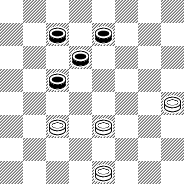
WHITE
White to Move and Win
You will find this of approximately intermediate difficulty, with a nice theme, an instructive solution, and a great opportunity for less experienced players such as the editor of The Checker Maven to go badly wrong. As usual, click on Read More to check your answers.
You can email the Webmaster with your comments on this article.
Hidden Beauty on a Draughtsboard
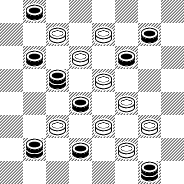
Our article title is the subtitle of Melvyn Green's Stroke Problems, a large and grand collection of original compositions by the Salford, England master of the art. Mr. Green has very kindly given us permission to publish one of what he terms the "easier" situations from his book.
BLACK
WHITE
White to Move and Win
Well, easy is relative; try your luck on this entertaining and very pleasing offering. We're sure you'll be delighted, and will want to have your own copy of Melvyn's book; you can contact the webmaster for information on how to obtain it.
Oh, the solution? Click on Read More.... but only if you must!
You can email the Webmaster with your comments on this article.
The Checker Maven is produced at editorial offices in Honolulu, Hawai`i, as a completely non-commercial public service from which no income is obtained or sought. Original material is Copyright © 2004-2026 Avi Gobbler Publishing. Other material is public domain, AI generated, as attributed, or licensed under CC1, CC2, CC3 or CC4 and the various CC options. Information presented on this site is offered as-is, at no cost, and bears no express or implied warranty as to accuracy or usability. You agree that you use such information entirely at your own risk. No liabilities of any kind under any legal theory whatsoever are accepted. The Checker Maven is dedicated to the memory of Mr. Bob Newell, Sr.
.jpg)