The Checker Maven
The World's Most Widely Read Checkers and Draughts Publication
Bob Newell, Editor-in-Chief
Published every Saturday morning in Honolulu, Hawai`i
Noticing missing images? An explanation is here.
The Bizarre World of Strokes
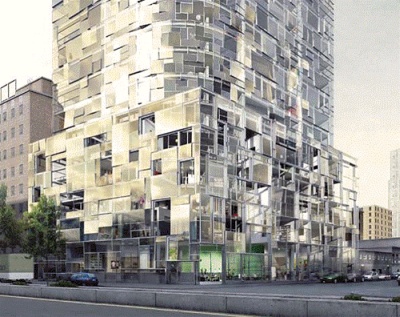
We haven't run a "stroke" problem in a little while, though it's something we like to do for the sake of variety on the first Saturday of some months. Today we return to that theme, and present a problem that was considered "easy" by the author.
Much as the photo above represents the bizarre side of architecture, stroke problems are certainly the bizarre side of the world of checkers. You either love them or hate them, and we think that depends in no small measure on whether you're able to solve them. Stroke problems call upon your ability to visualize long, forced series of moves. They are an excellent test of your skills, but seldom, if ever, an exercise in practical play.
So here's our so-called "easy" problem.
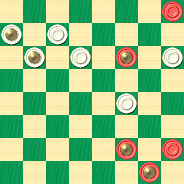
WHITE
White to Play and Win
W:WK5,6,K9,10,12,19:B4,K11,K27,28,K32..
Could you find your way through, or is all simply too bizarre? Whatever your result, click on Read More to see the "easy" solution. Did we say "easy"? You may or may not agree!
One for New Year's Eve

Are you celebrating the upcoming New Year's Eve on an elegant cruise ship off the coast of O`ahu? Well, don't feel bad, we're not either (though maybe some day we might). We'll likely stay home in our Honolulu location and watch the goings on from our lanai.
We'd like to present you with an alternative, though, to parties and dancing. We have a checker problem that is difficult enough to carry you through the evening and into the early hours of the morning. It's non-alcoholic, doesn't require driving or pushing your way through a crowded dance floor, and is completely free. What else can you find on New Year's Eve that doesn't come with a stiff price tag? (That's why we're skipping the cruise this year, in fact; at nearly $300 per person we'd much rather play checkers instead.)
Here is a position that even champion Tom Wiswell called "challenging."
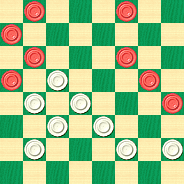
WHITE
White to Play and Draw
W:W28,27,25,23,22,18,17,14:B20,16,13,11,9,5,3,1.
Can you cruise to a solution this New Year's Eve, or even sooner? There's no need to wait, though; clicking on Read More will ensure a smooth voyage straight to the answer.
A Souter Six-Shooter

As we continue to republish the unequalled classic Tricks Traps & Shots of the Checkerboard we today find author Willie Ryan ready for a real shoot-em-up. It's one we're sure you'll enjoy. Willie tells us all about it below.
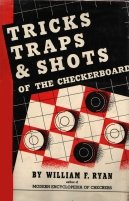
"The ancient Souter opening, formed by 6-9 at the fifth move of the game tabulated below, was a great favorite with all the champions in Wyllie's day. According to historians, the opening was named after a Scottish shoemaker who knew his way around with it. Here's a Souter snare that will shake the crown from any king:
| 11-15 | 24-20 | 10-14---B |
| 23-19 | 15-24 | 19-10 |
| 9-14 | 28-19 | 6-15 |
| 22-17 | 11-15 | 13-9 |
| 6-9---A | 27-24 | 14-18 |
| 17-13 | 14-17 | 23-14 |
| 2-6 | 21-14 | 7-11 |
| 25-22 | 9-18 | 31-26 |
| 8-11 | 26-23 | 12-16---C, |
| 29-25 | 18-27 | forming |
| 4-8 | 32-23 | the |
| diagram. |
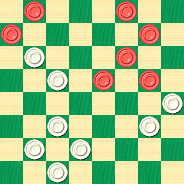
WHITE
White to Play and Win
W:W9,14,20,22,24,25,26,30:B1,3,5,8,11,15,16.
A---The Souter opening, a standard debut leading to an equal game.
B---A good "catch" line for black is 5-9. After this move, 23-18, 8-11, 20-16, 11-27, 18-2, 27-32, etc., leads to a draw; but if white plays 25-21 after 5-9, then black scores with this impressive combination: 5-9, 25-21, 9-14, 21-17 (all that's left), 14-21, 23-18, 8-11, 31-27 (31-26, 3-8 wins), 11-16*, 20-2, 1-5, 18-11, 3-7, 2-9, 7-32, 9-6, 32-28, 6-15, 28-10. W. S. Lambert. A real beauty.
C---Well-known play to here. The text loses by the pending shot. The correct moves are: 3-7*, 25-21, 15-19, 24-15, 11-25, 9-6, 1-17, 21-14, 8-11 *, leading to a draw."
Were you quick on the draw in finding the solution? Don't be blown away; click on Read More to shoot directly to the solution.
Neatly Trapped
In today's entry from our Checker School series, we have a most interesting position, as shown below.

BLACK
Black to Play and Win
B:W25,K12,K2:BK11,10,K1.
In this position, Black's mobility is definitely in the plus column. And as our current World Champion has often stated, checkers is all about mobility. In fact, Black has a very neat win here. The position is almost 120 years old and is attributed to R. D. Yates. Well over a century later we find that it still entertains and instructs. It's a fitting tribute to the timeless attraction and value of the game of checkers.
Try to trap White, but don't be trapped yourself: clicking on Read More will move you to the solution, a sample game, and explanatory notes.
A Simple Little Fellow
Our title is how famed problemist Tommie Wiswell referred to today's puzzler, which he drew from actual play. It's one of those cases in which the win is "obvious" but actually demonstrating how it's done is the real trick.
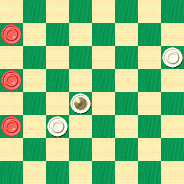
WHITE
White to Play and Win
W:W12,K18,22:B5,13,21.
The Black pieces are all off on the side of the board, while White has good mobility and a king to boot. So the win should be easy, shouldn't it? But Mr. Wiswell notes that in play over the board, the White player missed the winning continuation. Can you do better?
When you've settled on the winning course of action, click on Read More to see the solution.
What Happened to "Let's Play Checkers"?

We've been promising an ebook version of the classic Let's Play Checkers, by Kenneth Grover and Tommie Wiswell, for some little while now. Here's what's been going on.
First, the ebook edition turned out to be a lot more effort than we expected. We'd rather be late than produce less than a top-quality edition, and typesetting this book is simply taking a lot of time to do right.
But there is another issue, one that we ran into at a fairly late stage in the project. While our initial research indicated that the book was in the public domain, and therefore eligible for reissue by us, we have recently learned that copyright claims had in fact been asserted, and therefore we must now seek permission to republish the book.
We're in the process of trying to locate the copyright claimant, which is difficult enough in and of itself; then we'll need to ask for the necessary releases, something which the claimant may or may not be willing to grant. Under current copyright law, the book won't go into the public domain until the year 2035! (We believe this is excessive and out of tune with the original intent of copyright legislation, but that's another whole topic.)
Of course we're hoping for the best and for a speedy result. We'll keep you informed as we go along.
Draughts on a Winter's Eve
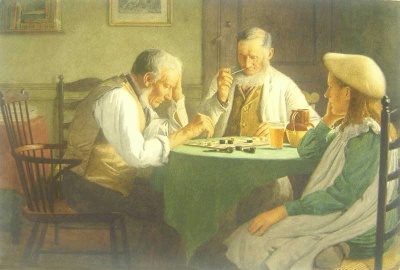
Sometimes, on a cold winter's eve when the snow lay in heaps upon the ground, my neighbor would visit and we would sit at the table and play not a few games of draughts. My daughter would bring us something warm to drink, or even, at times, a pitcher of ale; my neighbor always would remark about how fine was my ale, thinking, I wager, to be urged on to a second glass. We would play until the fire burned low on some of those nights, and daughter would sit and watch all the while. How hard it was the next morning to rise early for work, and how equally difficult it must have been for her to rise for school! Still, we enjoyed our games, and she seemed to enjoy sitting by every bit as much.
So it was one evening that, with the hour getting late and the room starting to chill, we decided to contest one final game. And what a game it turned out to be, one to remember all through the years! My neighbor and I, being very closely matched as to skill and temperment, had pretty evenly divided the score thus far, and of course we were both rather hoping to win this last match and carry the honors of the evening. I had the Black men, he the White, and the game proceeded in this manner.
1. 9-14 22-18
2. 5-9 24-19
3. 11-15 18x11
4. 8x24 28x19
5. 4-8 25-22
6. 9-13 29-25
7. 8-11 22-18
8. 14-17 21x14
9. 10x17 18-15
10. 11x18 23x14
11. 7-11 25-22
12. 11-16 14-10
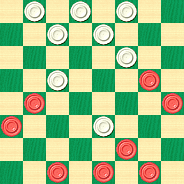
BLACK
Black to Play and Draw
B:W32,31,30,27,26,22,19,10:B17,16,13,12,6,3,2,1.
"Alas," I cried, "I fear all is lost. Good neighbor, I believe the evening is yours." Although I did always essay to win in a gracious manner and equally so to lose in a sportsmanlike fashion, still, I am sure, there was disappointment in my voice.
But suddenly, to my great surprise--- and, I am certain, my neighbor's as well--- my daughter spoke out and said, "Oh, father, I think not; surely the game is drawn!"
"Daughter," said I, "there is no shame in my loss. Pray do not detract from the skill shown by our good neighbor in his command of the White pieces in this excellently played game."
"Oh, no, father, that I would not do," she replied, "but still, though well played by you and our neighbor alike, even so, the game is most surely drawn."
At this moment our neighbor smiled, put down his pipe, and said, "Aye, then, good father, let your spirited young lass contest the finish in your stead!"
"Oh, father, may I?" asked she, and I knew she was not to be denied; whereupon, I moved my chair to the side, she moved her own round to the Black side of the board, and the play went on.
For the solution, and the rest of our story, just click on Read More.
Three Years of Publication
Today The Checker Maven completes three years of uninterrupted, on-time publication. During that time, we have been fortunate to hold the interest and attention of thousands of readers from all around the world, who have made us what is surely the most widely-read periodical publication in the centuries-old history of the game of checkers. We're very proud of that distinction, and in return we can only wish to continue to publish and to provide Saturday-morning pleasure to all of you who are kind enough to drop by our electronic home.
During this past year, we've done less electronic book publication than we might have wished, and a new on-line feature or two didn't get completed, as we weren't able to function at full force for some months due to medical issues that required our concentrated attention. But that is all in the past, and the prospects for the year ahead look bright. Our plans include, in addition to our regular weekly columns, two e-books and a very exciting new interactive checker experience.
Thank you, one and all, for your continued support and patronage!
Thanksgiving Weekend

In the United States it's Thanksgiving weekend, bringing one of our favorite times of family, food, and celebration. In the spirit of the weekend, we'd like to bring you an especially elegant checker problem which we're sure will provide you with much pleasure. It's part of our Checker School series and looks like this.

WHITE
White to Play and Win
W:WK10,20,22:B1,9,28.
The problem is due to R. Martins, and while the solution is not overly long, it may surprise you; and, like Thanksgiving dinner, the problem is incredibly rich in content. Take your time, have a slice of pumpkin pie and a cup of coffee, and enjoy. When you're all done, click on Read More to see the solution, a sample game, and detailed explanatory notes.
A Little Deceiver

Willie Ryan, possibly the only checkerist ever to achieve anything close to "rock star" status, takes us back to his youth in this month's installment from Tricks Traps & Shots of the Checkerboard. Let's listen as Willie tells us about a trap he learned in those early years. Editior's note: the photo above is definitely not Willie Ryan!
"When I was just a boy of 13, I learned this trap on the Defiance opening by John Drummond, which enabled me to win more than a few games. The basic germ or idea utilized in this example is known as the "Brooklyn"--- a tactical device that has almost as many variations of application as the versatile in-and-outer.
| 11-15 | 29-25 | 15-24 |
| 23-19 | 11-15 | 28-19 |
| 9-14 | 25-22 | 4-8 |
| 27-23 | 7-11 | 22-18 |
| 8-11 | 24-20—A | 6-9 |
| 22-18 | 15-24 | 18-15—B, |
| 15-22 | 28-19 | forming the |
| 25-9 | 11-15 | diagram. |
| 5-14 | 32-28 |

BLACK
Black to Play and Win
B:W31,30,26,23,21,20,19,15:B14,12,10,9,8,3,2,1.
A---The old and somewhat difficult Andrew Anderson defense. A better defense for white is: 22-18, 15-22, 26-17, 11-15, 24-20, etc., as given in my book, Scientific Checkers Made Easy.
B---To the gallows! The correct play here is: 31-27, 8-11, 18-15, 11-18, 21-17, 14-21, 23-5, 2-6, 27-23, 10-15, 19-10, 6-15, 20-16, 12-19, 23-16, 15-19, 16-11, 19-24, 26-23, ending in a draw."
Young or old, one thing is certain: clicking on Read More will show you the snappy and pleasing solution.
The Checker Maven is produced at editorial offices in Honolulu, Hawai`i, as a completely non-commercial public service from which no income is obtained or sought. Original material is Copyright © 2004-2026 Avi Gobbler Publishing. Other material is public domain, AI generated, as attributed, or licensed under CC1, CC2, CC3 or CC4. Information presented on this site is offered as-is, at no cost, and bears no express or implied warranty as to accuracy or usability. You agree that you use such information entirely at your own risk. No liabilities of any kind under any legal theory whatsoever are accepted. The Checker Maven is dedicated to the memory of Mr. Bob Newell, Sr.