The Checker Maven
The World's Most Widely Read Checkers and Draughts Publication
Bob Newell, Editor-in-Chief
Published every Saturday morning in Honolulu, Hawai`i
More Pictures: Problem Composing Contest 68
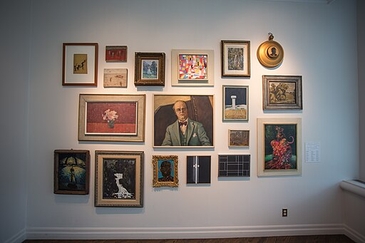
Is there such a thing as too many pictures? Evidently so. The photo above shows an art display that hardly accords with accepted practices. It's overcrowded and the pictures aren't well positioned.
The previous entry in Bill Salot's outstanding series of checker problem composing contests featured problems that had a visual aspect--- they were works of art in both the visual and ludological senses. For our current contest, Mr. Salot has continued with that theme. Too many pictures? Hardly! We're sure everyone will welcome this new trio of dual-artform problem settings.
The contest problems themselves can be found, as always, on the contest page. We hope you'll drop by, give the problems a try, and of course cast your vote for the one you like best.
As a lead-in, we present a problem by the late Roy Little, which he called Mr. X. It was the winner of Contest 11 back in June, 2013.
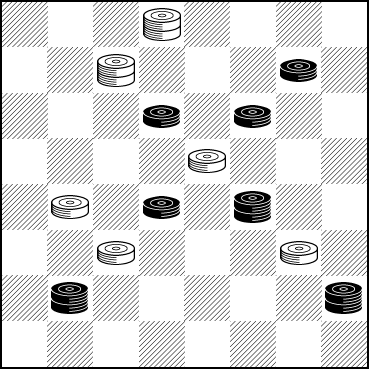
WHITE
White to Play and Win
W:WK2,K6,15,17,22,24:B8,10,11,18,K19,K25,K28
Solve this one, click on Read More to check your solution, and then visit the contest page!
You can email the Webmaster with your comments on this article.
Pictures At An Exhibition: Problem Composing Contest 67
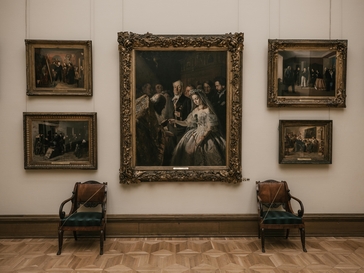
Pexels CC0
Pictures at an Exhibition, composed in 1874 by Modest Mussorgsky, was originally a suite of ten piano pieces linked together by a "Promenade" theme, intended to represent the experience of walking through an exhibition of the paintings of artist Viktor Hartmann at the Imperial Academy of Arts in St. Petersburg, Russia. The compositions were orchestrated in 1922 by Maurice Ravel, and this is the version that is most well known today.
We have something similar in checkers, and in this, the 67th Problem Composing Contest sponsored by Bill Salot, we'll see an exhibition of checker art that is visual as well as artistic in play quality. To illustrate this, here is one that Bill calls WreckTangle and credits to former World Champion Alex Moiseyev, who created it independently. However, it happens that Ed Atkinson was the original composer; he called it Pandora's Box.
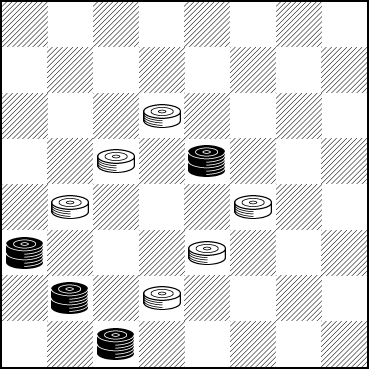
WHITE
White to Play and Win
W:W10,14,17,19,23,26:BK15,K21,K25,K30
Bill notes that there are other famous images on a checkerboard, such as the Picture Frame arising from games in Boland's Famous Positions, Page 187. Bill goes on to remark that there are numerous other patterns published in various checker problem books.
In this month's contest, Bill features three "art works" so to speak (alas, not ten as in the original "Pictures at an Exhibition"). They can be found on the contest page. Be sure to try them out and then vote for your favorite.
The solution to WreckTangle (or Pandora's Box, if you will) can be seen (after you've tried to solve it, of course!) by clicking on Read More. We hope you enjoy it and all of the contest problems.
You can email the Webmaster with your comments on this article.
Hopper: A Speed Problem
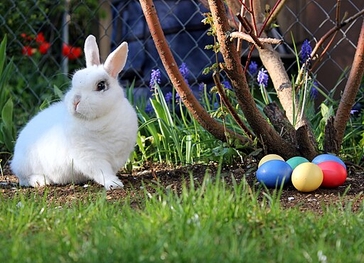
It's quite early for the Easter Bunny (Easter 2023 is on April 9) and somewhat late for Chinese New Year and the Year of the Rabbit (January 22). So let's look at a little math problem instead:
"Chris is training Hoppity, her pet rabbit, to climb stairs. It will hop up one or two stairs at a time. If a flight of stairs has ten steps, in how many ways can Hoppity hop up the this flight of stairs?"
Oh, wait, this is a checker column. Well, in fact regular contributors Lloyd and Josh Gordon have sent along a "speed" problem they call "Hopper" so it seemed like something about a rabbit would be an appropriate lead-in. And no, the problem has nothing to do with the late GAYP master Millard Hopper.
The problem itself is a lot of fun, and of course the layout of the pieces, not to mention the problem's title, give a huge hint. It's certainly not a hard problem and can be quickly solved with just a bit of visualization. As we're fond of saying, top players will see it at once while the rest of us may require a few more seconds, or maybe even a minute or so.
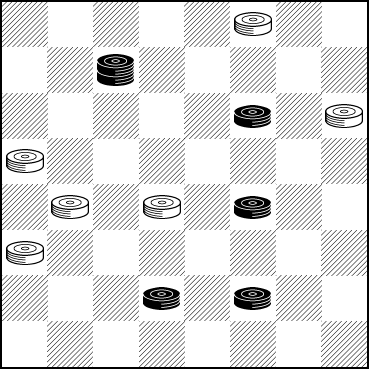
BLACK
Black to Play and Win
B:W12,15,16,20,21,30:B6,7,14,22,K27
It doesn't matter what category you may fall in, whether top flight professional or enthusiastic novice. See how fast you solve it and then hop your mouse to Read More to jump to the solution.
You can email the Webmaster with your comments on this article.
Quick As a Bee
Public Domain Pictures CC0
You're likely familiar with the phrase, "quick like a bunny" or "quick as a bunny" meaning, in its imperative form, to tell someone to do something very rapidly. However, that phrase is relatively recent, dating back to only the 1940s according to most sources.
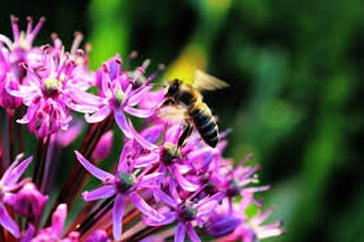
"Quick as a bee" has the same meaning, but is much older; 400 years older, to be exact. It appeared in John Heyward's Proverbs back in 1546. So for today, we'll weigh in on the side of history, and ask you to solve this month's speed problem "quick as a bee." In fact, it's quite easy, and an experienced player will see the solution in about two seconds. Novices should eventually get it as well.
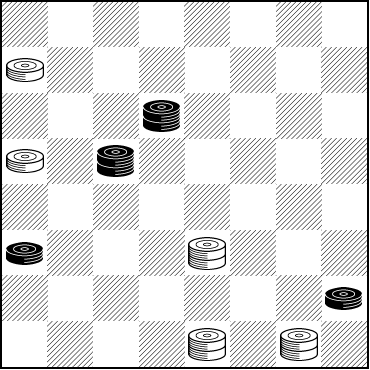
BLACK
Black to Play and Draw
B:WK1,K2,K10,20,28:B5,12,K19,K23
Do you have the solution already? You can always buzz (1546) or hop (1940s) over to Read More to see the solution.
You can email the Webmaster with your comments on this article.
Chases: Problem Contest 66
Rawpixel CC0
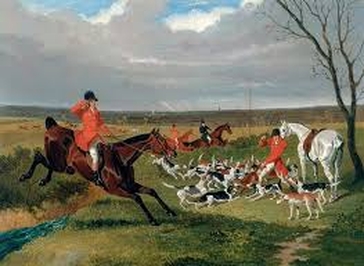
The chase is on! The traditional fox hunt, now very much out of favor and considered cruel, has for the most part become illegal, and although especially in England it's a centuries-old amusement for the wealthy, perhaps indeed its time has passed.
But in our game of checkers, the chase is alive and well, and forms the theme of the 66th in Bill Salot's long and outstanding series of checker problem composing contests.
Mr. Salot states that, as in the preceding contest, these original, unpublished, strategic dandies are non-strokes, although a shot may ring out occasionally during a wild "chase." Four new problems await you on the contest page. Be sure to try them all and then don't forget to vote for your favorite.
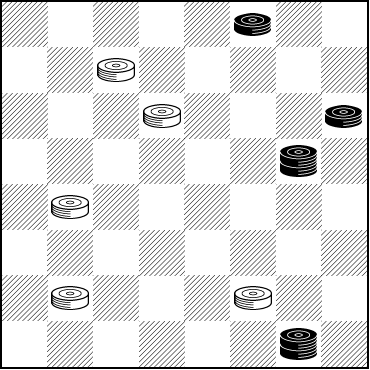
Here's a teaser problem showing off the contest theme. It's by the late grandmaster composer Ed Atkinson, and it's typical of his genius.
Ed Atkinson
BLACK
WHITE
White to Play and Win
W:W6,10,17,25,27:B3,12,K16,K32
Chase after the solution, but there's no need to hunt down the results, as you can just click on Read More to see how it's done. Then, on to the contest page!
You can email the Webmaster with your comments on this article.
Starting Off The Year
Public Domain Pictures CC0
We're already almost a full week into the new year 2023 at the time of publication of this column. By now surely you're back to work, school, or whatever your regular activities may be. You've had time to recover from any potential excesses of holiday celebration, and we're in that post-holiday letdown period.
So perhaps an easy checker problem will cheer you a bit and get you on your way to another year of checker enjoyment. Here's one from regular contributors Lloyd and "Gosh Josh" Gordon.
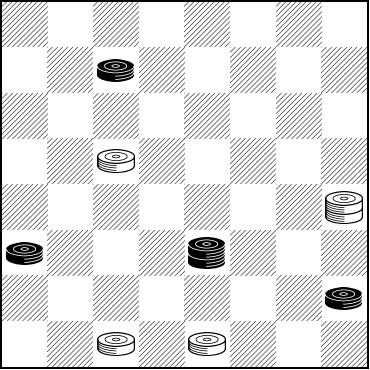
WHITE
White to Play and Draw
W:W31,30,14,K20:B28,21,6,K23
The draw is straightforward but ... well, you'll find out. See how you do with this one and then click on Read More to see the solution.
You can email the Webmaster with your comments on this article.
It's A Trap
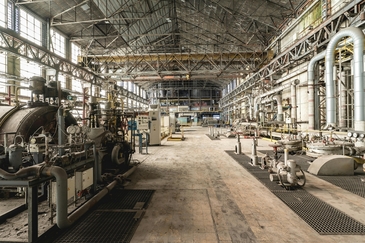
There are all sorts of traps in life. You can get trapped in a dead-end job with no way out; you need the money and you don't have the skills for something better. You can get trapped in a bad relationship. You can get trapped in credit card debt.
As we well know, there are traps in checkers, too. Can you get trapped into becoming a checkers addict, if there is such a thing? Maybe. That's beyond our realm of knowledge. But over the board traps? They're legion.
In today's Checker School column, we'll have a look at what John T. Denvir, an older-day checker writer who is either famous or infamous depending on the account you read, calls Trap No. 36 in his book, John T. Denvir's Traps and Shots, published in 1894.
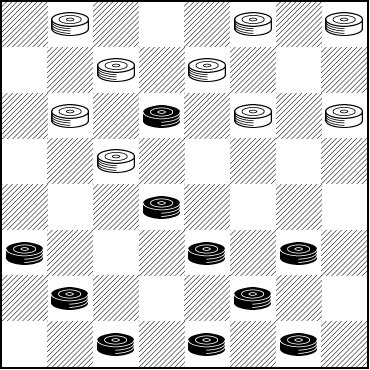
BLACK
Black to Play and Win
B:B1,2,3,6,8,9,10,12,15,23:W19,21,22,24,26,27,29,30,32
This is quite an interesting one and we hope you'll give it a good try. Will you be trapped into spending a lot of time looking for the solution? We can't really say; all we know for sure is that clicking on Read More will take you to the solution, and not lead you into a trap.
You can email the Webmaster with your comments on this article.
999: An 18th Anniversary Special
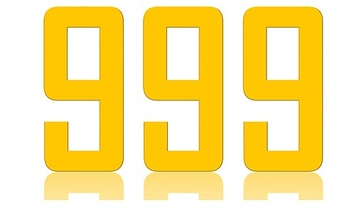
There are various meanings and significances for the number 999. For one thing, it's the emergency phone number in Great Britain and some other places. Another UK related but much less important usage was as the name of a London punk-rock band quite some while ago.
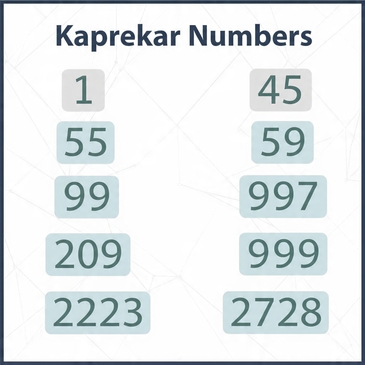
Perhaps of greater interest is that 999 is a so-called Kaprekar number. An adapted version of the Wikipedia definition of a Kaprekar number is as follows: "A natural number in a given number base is a Kaprekar number if the representation of its square in that base can be split into two parts that add up to the original number." So, quite trivially 999 squared in base 10 is 998001, which can be split into 998 and 001, which add up to 999. Simple!
PICRYL CC0
We'll omit the more fanciful descriptions of 999 as an "angel number" and instead tell you why we've chosen this title for today's column, which features a very special problem by grandmaster composer Brian Hinkle. It has nine pieces per side, or 9x9, and of those pieces, 9 are kings, hence, 9x9x9 or 999.
Here's the position.
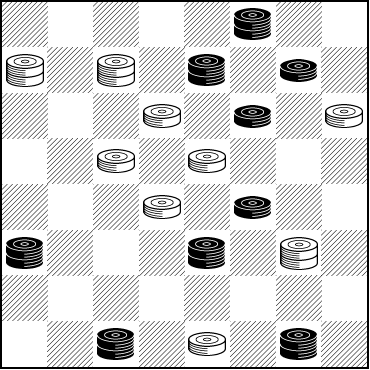
WHITE
White to Play and Draw
W:WK5,K6,10,12,14,15,18,K24,31:BK3,K7,8,11,19,K21,K23,K30,K32
Brian would prefer no spoilers, so we won't say anything further, not even whether it's easy, medium, or hard (although, since it's from Brian, "easy" would surprise us). See how you do with it. Take 999 seconds, 999 minutes, or however long you wish. Try 999 different approaches. But certainly you only need to click your mouse once--- not 999 times--- on Read More to see the solution.
You can email the Webmaster with your comments on this article.
Strategic Non-Strokes: Problem Contest 65
Public Domain
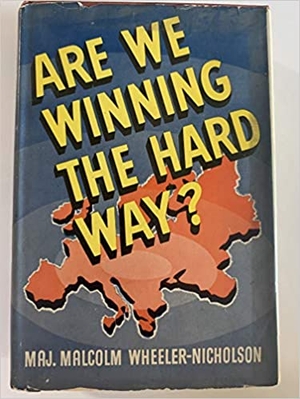
Major Malcolm Wheeler-Nicholson was an interesting character to say the least. After an abruptly terminated military career, he went on to become a prolific writer of both fiction and non-fiction, such as the book shown above, published in 1943, which analyzes the strategies of the Axis powers. Notably, some accounts point to him as the founder of DC Comics.
But sometimes the hard way is the only way. The 65th in Bill Salot's stunning "Unofficial World Championship" checker problem contests is here, and it bears the title Strategic Non-Strokes. Bill says these positions are "won the hard way" without resorting to a big stroke. We won't say the wins are "ground out"--- that reminds us too much of doing long division by hand in grade school--- but technique and insight is definitely required.
You can view all the problems on the usual contest page. Try them all and then be sure to vote for the one you think should be the winner.
As an introduction to the contest, have a look at the problem below.
BLACK
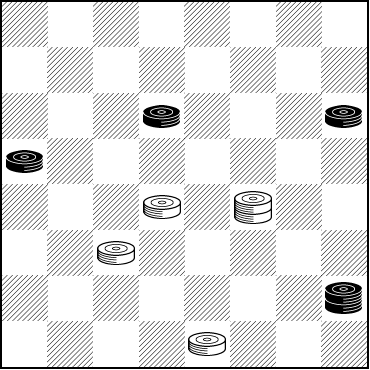
WHITE
White to Play and Win
W:W18,K19,22,31:B10,12,13,K28
Can you win this ... the hard way? Or any way? See how you do and then let your mouse click hard on Read More to see the solution and notes. After that, head on to the contest page for four more great problems.
You can email the Webmaster with your comments on this article.
Drawbridge
Pexels CC0
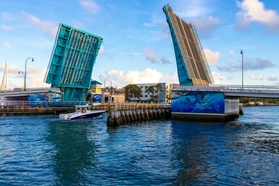
The drawbridge goes back a long way. In medieval times, castles might be protected by a moat spanned by a drawbridge, which, if the castle were to be attacked, would be pulled up to deny access to the invaders. In the photo above, a more modern use of a drawbridge is shown; when a large vessel needs to cross the roadway, the bridge is pulled up to allow passage.
A bridge in checkers, of course, is something different. Bridge positions have been heavily analyzed. Whole books have been written about them. They certainly can be tricky.
Today's speed problem is about a bridge, and White is seeking a draw--- hence, it's a "drawbridge" position. It's not very difficult and is within range of the thoughtful novice. Old pros will see it right away.
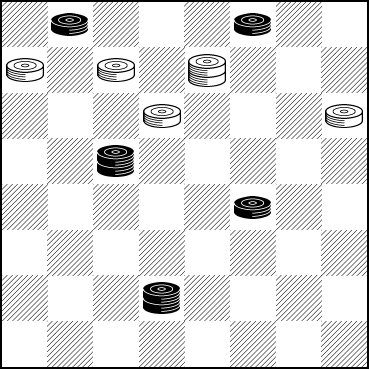
WHITE
White to Play and Draw
W:W5,6,K7,10,12:B1,3,K14,19,K26
Got it? Did you cross the bridge or was it a bridge too far? No matter. Cross your mouse over to Read More and click to verify your solution.
You can email the Webmaster with your comments on this article.
The Checker Maven is produced at editorial offices in Honolulu, Hawai`i, as a completely non-commercial public service from which no income is obtained or sought. Original material is Copyright © 2004-2026 Avi Gobbler Publishing. Other material is public domain, AI generated, as attributed, or licensed under CC1, CC2, CC3 or CC4 and the various CC options. Information presented on this site is offered as-is, at no cost, and bears no express or implied warranty as to accuracy or usability. You agree that you use such information entirely at your own risk. No liabilities of any kind under any legal theory whatsoever are accepted. The Checker Maven is dedicated to the memory of Mr. Bob Newell, Sr.
.jpg)