The Checker Maven
The World's Most Widely Read Checkers and Draughts Publication
Bob Newell, Editor-in-Chief
Published every Saturday morning in Honolulu, Hawai`i
Easy Peasy Lemon Squeezy
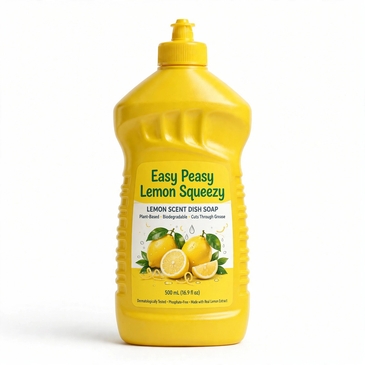
Today's column title has interesting origins. Easy Peasy Lemon Squeezy has a popular meaning which refers to something very easy to do or accomplish. The "easy peasy" part, from what our research tells us, dates back at least as far as a 1940 movie. The "lemon squeezy" part is often said to refer to a 1950s British soap product, Sqezy, which unsurprisingly came in a squeeze bottle and had a lemon scent (we were unable to find a public domain image for this product). However this account is rather speculative.
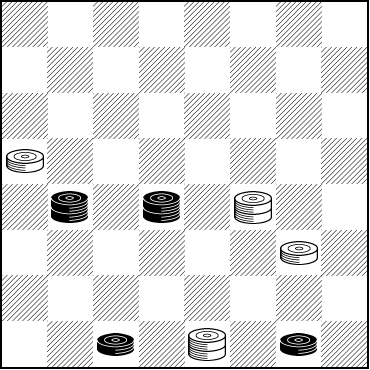
The problem below could be the easiest speed problem we've ever published; the trick is to solve it in just a few seconds without making a slip-up as there are a couple of opportunities to do so. Is the problem "easy peasy lemon squeezy"? You'll have to decide for yourself.
BLACK
Black to Play and Win in 3 Seconds
B:WK2,9,K14,20:B1,3,K15,K16
Pretend you're playing a bullet game (one minute of time for the entire game). Can you solve this instantly? It's easy peasy with minimal thought, but will you find the right moves through rapid reflex? It's an interesting challenge. Give yourself about three seconds. If you haven't gotten it by then, keep going and you'll surely see it in a few more seconds. When done, click on Read More to verify the solution.
You can email the Webmaster with your comments on this article.
Labor Day 2026

Public Domain Pictures
Labor Day is a day we always look forward to; celebrated on the first Monday of September in the United States and Canada, it is an opportunity to recognize the working man and woman, who are the soul of the economy and upon whom we all depend.
We've often said that all honest work is honorable and deserving of respect. Perhaps you're part of an elevator crew.

NARA DVIDS CC0
Or maybe you're a shuttle driver.

PICRYL CC0
A fireman?

NARA DVIDS CC0
Or even a television news anchor!

Rawpixel CC0
No matter what your profession or job, The Checker Maven salutes you, and as always for Labor Day, we present a special checker problem. Often we turn to one of the greats, Tommie Wiswell. But instead today we turn to Jessie Hanson, a member of the 1927 All-American team. Mr. Wiswell says of him, "he has published numerous problems of a very high order." Here's one of his gems.

BLACK
Black to Play and Win
B:W14,17,18,19,20,23:B1,5,6,7,11,12
We'll give you fair warning; this one is much trickier than it looks, but your labor for today is to solve the problem and then, like any good working person, check your work--- by clicking on Read More.
You can email the Webmaster with your comments on this article.
Checker School: Memory Association
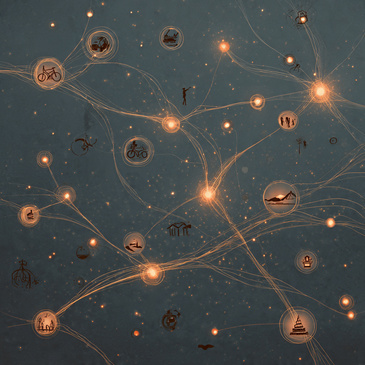
Association of concepts and ideas in our memory is vital to our everyday existence on just about every level. We maintain mental "maps" in varying levels of detail and the better we can develop and utilitize these maps, the better we can do when the inevitable problems and challenges come our way, as we will have stored away knowledge about similar problems and their solutions.
Now, we've been going through parts of Andrew J. Banks' eclectic book, Checker Board Strategy, as part of our long standing Checker School series, and Mr. Banks has the following interesting observation about memory and association:
"Association of ideas is the third way of developing a logical memory. If I merely say 'Think of something!' you will be at a loss for ideas. But if I say, 'Think of an article of clothing,' ideas will flash. This test illustrates the power of association. After you have learned a problem, meditate and reflect; thus you often can associate that problem with a similar one."
We definitely think Mr. Banks is in accord with us. After all, as described above, we mostly solve problems in general by implicitly or explicitly comparing them to problems we have solved in the past, and extending or adapting those previous solutions.
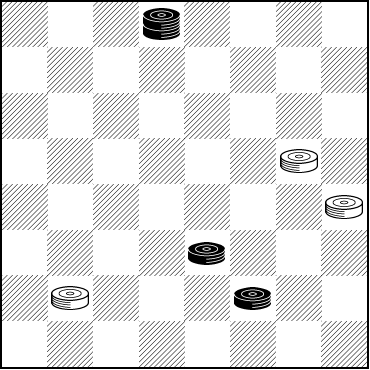
So, then, look at the position below. Is it comparable to or associated with anything you've seen before? Does that give you some ideas?
BLACK
Black to Play and Win
B:B6,10,K31:W8,13,17
Access your memory bank; correlate, adapt, and extend, and find the solution--- this one isn't all that difficult. After you're done, associate your mouse with Read More to check your answer.
You can email the Webmaster with your comments on this article.
The Exception That Proves The Rule
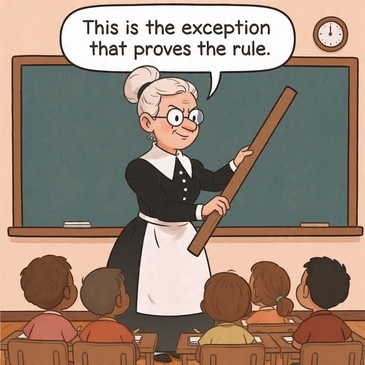
There's an old schoolhouse saying about "the exception that proves the rule" meaning that there may be a general rule (typically in grammar) but there are exceptions to the rule, and somehow that "proves" the rule. We always thought that this was, in fact, exceptionally nonsensical, with no basis in logic.
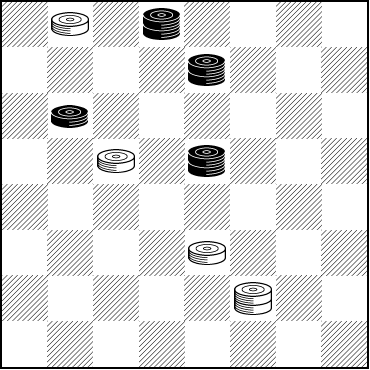
Getting to the point: While today's problem is not quite a "first Saturday of the month" speed problem, it's not overly difficult and it is quite clever, and demonstrates that every rule indeed has its exceptions, even if they don't exactly "prove the rule."
BLACK
Black to Play and Win
B:W32,19,10,K6:B24,K31,K26,K18
No, you won't need exceptional skill to solve this one, and we hope you won't take exception to our evaluation. But either way, see how you do and then click on Read More to see the exceptional solution.
You can email the Webmaster with your comments on this article.
America's 250th Birthday
This column will appear on America's 250th birthday! It's a great day and a great and historic milestone. Your editor is old enough to remember America's 200th back in 1976, and is thrilled to be here for this next major marker in the history of a nation that is like no other in the human experience. To recognize this day in our own way, here is a fanciful story featuring many of your favorite Checker Maven characters.

Marvin J. Mavin was enjoying a fine summer day. The National Checker League was in the off season and training camp didn't start for another month. At home in his wife Priscilla's enormous upscale condo, all he had to do was choose an activity. Swim in Priscilla's private pool? Go for a stroll around their exclusive upscale neighborhood? Stay home with a tall cool one and watch Checker Television Network? Or just take a nice little nap?
Marvin was pondering these options when suddenly there was something like a mist in the center of the room. Marvin thought perhaps he had fallen asleep and was dreaming, but then he heard a voice.
"This way, Marvin." The voice was polite but definitely commanding. "Step into the mist. The others await."
"But ... but ... " Marvin began. He was quickly interrupted.
"There is no time to lose. This day only comes once. Enter."
Marvin, not knowing why, stepped into the mist.
# # #

Marvin's wife, Priscilla, had gone to the office. Being a holiday, she thought to have at least half a day of uninterrupted work time, for as the CEO of a large international conglomerate, the work never ended.
She was busily reading through income statements when all of a sudden her desk vanished and was replaced by an opening in the floor. There was a stairway leading downward in the opening.
"Enter," a voice said in a quiet but firm voice. "Come down the stairs. The others are waiting."
"What others?" Priscilla asked, wondering if she should press the button under her desk that silently called Security. Oh ... right ... her desk had disappeared.
"Come," the voice said, not answering her question. "This day only comes once."
Priscilla, wondering if she had perhaps lost her mind under the pressure of business, started down the stairs.
# # #
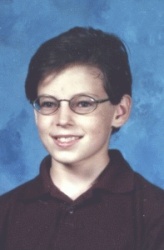
Tommy Wagner was on his way to Uncle Ben's for his Saturday checker lesson on Uncle Ben's porch. It was another hot day in central Florida and Tommy was looking forward to having some of the delicious cold lemonade that Uncle Ben always made for them both to enjoy.
But a strange sight greeted him when he arrived at Uncle Ben's address. The house wasn't there! And Uncle Ben was standing in front of some sort of a shimmering rectangle that was filled with blue light that seemed to crackle with white lightning bolts.
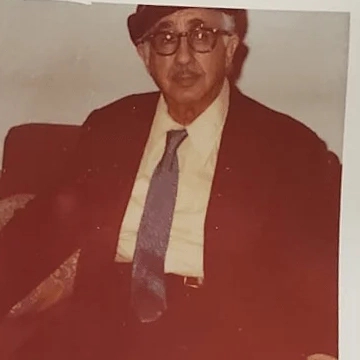
"This way, Tommy," Uncle Ben said, "we've been called. Come with me through the portal."
"Uh ... Uncle Ben ... I don't get it ... where's the house?"
"Never mind, Tommy; all will become clear. Now hurry, this day only comes once."
Tommy really wasn't sure what to do. But he trusted Uncle Ben, and so the two of them stepped into the blue light.
# # #
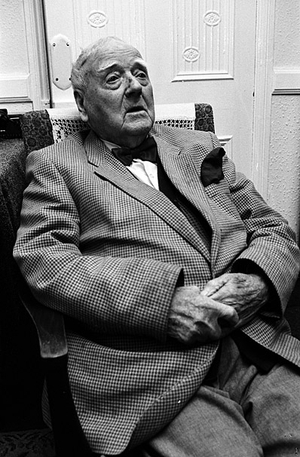
Sal Westerman was in his basement study with all the fans turned on, trying to stay cool. His study was his refuge, especially during the hot days of summer. Bismarck, North Dakota may be known as a cold northern city but summers could be blistering hot and this summer, 1955, was no exception.
He had a new issue of All Checkers Digest to enjoy, and he had made a pitcher of iced tea and put it in the old refrigerator he had in his study to keep it cold during the rest of the day. He had just closed the door of the fridge when the fridge disappeared before his eyes. Instead, there was just an empty space, and behind the empty space, a portion of the wall had also vanished to be replaced by the entryway to a long corridor that stretched off into the distance.
"This way, please, Mr. Westerman," a voice said. The voice was polite and respectful but it had a certain--- presence.
"This way ... what?" Sal stammered. "What's happening here?"
"All in due course, sir," the voice said, "but please come now. There is not a lot of time."
Sal, not knowing what else to do, entered the corridor.
# # #

Many others had similar experiences. Sal's wife Sylvia was interrupted and summoned in the midst of sewing a quilt. The "boys" from Sal's Coffee and Cake Checker Club also were called. Like Sal, some were asked to walk down corridors; some were taken through shimmering portals; others descended stairways or entered clouds of mist.
Young Ed and Young Bill were called upon, each of them from different years and in different places. Even old Benny from Benny's Tavern in 1940s Newark, New Jersey, received a visit and a command from an unseen voice.
# # #
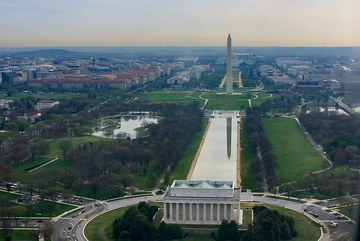
All of them suddenly found themselves standing in the National Mall in Washington D.C. Someone was standing in front of them, preparing to speak. The gathered group thought they recognized--- could it really be him?
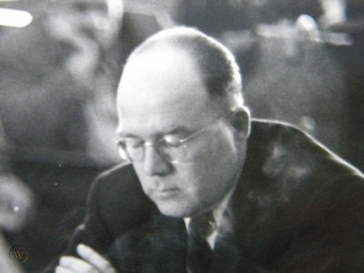
The speaker immediately confirmed their thoughts. "Yes, I am the spirit of Tommie Wiswell," he said, "and I've gathered you together here from across the years and across the miles. All of you have been characters in the Checker Maven webzine's series of checker fiction stories, and its editor has asked me to assemble you today in the heart of the nation's capital to honor America on her 250th birthday. I know all of you to be true patriots and, no matter the year, place or circumstances, you all have a love for your country.
"America has withstood much over the years, but in good times and bad, the American spirit has prevailed, and I believe that it always will. So today we'll celebrate America's birthday together. For some of you, it's many years in the future; for others, it's the actual day, but I'm sure you will all understand."
Tommie raised his arm in a salute and the gathered group returned the salute. "On with the celebration!" he said.
# # #
The next day, Sal and Marvin and Benny and everyone else wondered what had really happened. Perhaps it was only a dream. But what a dream it was. It was a dream come true; a dream of 250 years of democracy and bringing the light of freedom into the world.
# # #
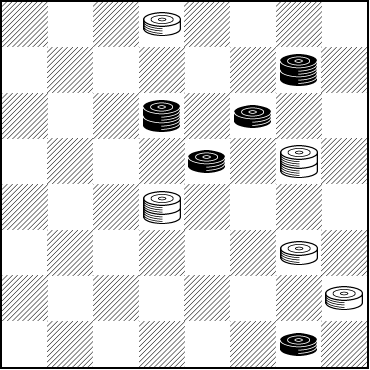
Our story, unusually, didn't feature a checker problem, but we won't disappoint you. Of course given our story you know we're going to turn to that great American checkerist--- and patriot--- Tom Wiswell. The problem isn't by Tom; it's by Charles Hefter, but Tom thought it worthy of inclusion in one of his books.
BLACK
Black to Play and Draw
B:W5,9,K15,K17,31:B1,18,22,K23,K25
Many "star" moves are involved on Black's part; can you meet the challenge? When you're ready, click on Read More to see the solution.
You can email the Webmaster with your comments on this article.
Highly Practical Practice
Editor's Note: Ed Gilbert pointed out a flaw in the original setting. Here's a corrected version.
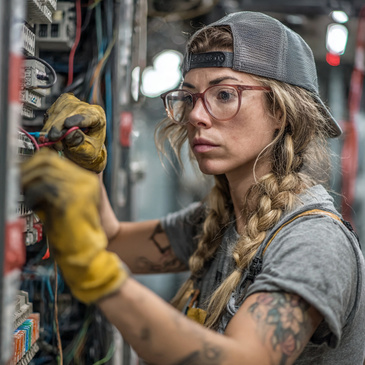
There's theory and there's practice. The electrician shown working above is applying practical knowledge no doubt mostly obtained through study and experience. A similar concept applies to our game of checkers. We need to learn the theory but in the end, practical application is what wins or saves games for us, and the more experience we have, the better.
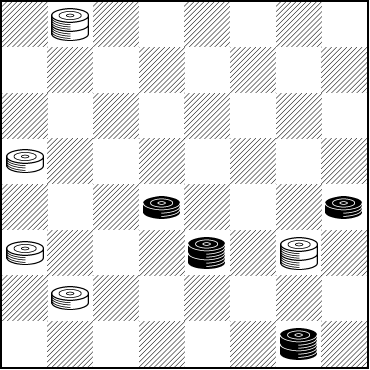
In the diagram below, credited to regular contributors Lloyd and "Gosh Josh" Gordon, White is a piece up but Black can achieve a draw--- with careful play.
Now, being something in the nature of a speed problem, the draw is neither difficult nor sophisticated.
WHITE
White to Play, Black to Draw
W:W25,21,13,K24,K1:B20,18,K32,K23
Experienced players will have little trouble; improving players may take a bit longer, but either way, it's a nice little workout. Give it a practical try and then take the practical step of clicking on Read More to see the solution.
You can email the Webmaster with your comments on this article.
Memorial Day 2026
PICRYL CC0
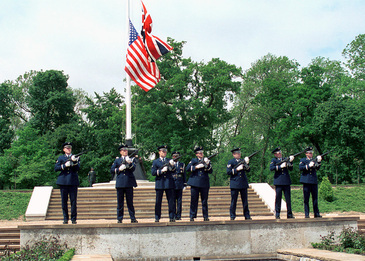
On Memorial Day we give honor to those who made the ultimate sacrifice and recognize all who served. The world is not a peaceful place, unfortunately, and there are others who would happily take away our freedoms and impose their will. This weekend The Checker Maven extends its appreciation to those who day in and day out have protected and continue to protect our way of life even at great personal cost.
Our own observations have been that many checker players tend to the patriotic side and here at The Checker Maven it's no different. We've often said that we are unapologetic patriots. Times have been difficult lately; we won't say more than that but we do not waver from the idea of patriotism as wanting what's best for one's country, and if things are not as they should be, we work to make them better.
We've also frequently said that a checkerist who was a true patriot was Tom Wiswell, who served in the Army during World War II. So let's look at something of his. It's from a game he played once upon a time against James Ricca. Mr. Wiswell had White and was to play and draw.
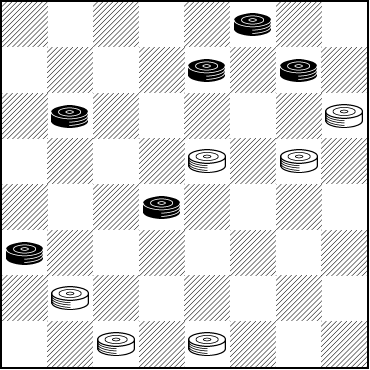
WHITE
White to Play and Draw
W:W12,15,16,25,30,31:B3,7,8,9,18,21
The solution to this one is fairly long and will require thought, but the situation is a practical one. Give it your best and then click on Read More to see the solution.
You can email the Webmaster with your comments on this article.
Make Haste Slowly
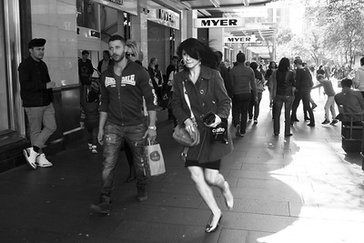
Looks like the folks in the photo above are in quite a rush. Maybe they should "make haste slowly" lest they trip and fall.
"Make haste slowly" is the watchphrase for this month's speed problem. In the diagram below, White is two pieces up and the win, as they say "should be easy" and it actually is --- if you make haste slowly.
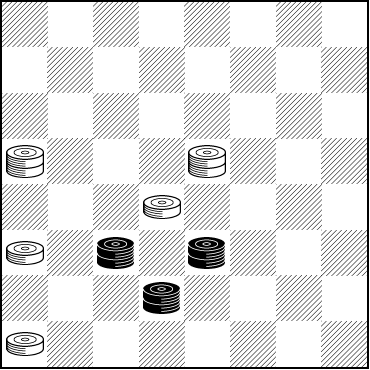
WHITE
White to Play and Win
W:W29,21,18,K15,K13:BK26,K23,K22
How fast can you solve this one? Perhaps fast enough --- but not too fast? Proceed a bit slowly, and when you're ready hasten to click on Read More to see the solution.
You can email the Webmaster with your comments on this article.
Checker School: The Opposition
PICRYL CC0
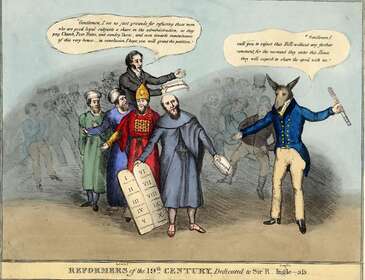
Since time immemorial, in the world of politics, business, religion, what have you--- someone will come up with an idea or a concept and invariably there will be opposition from someone else, typically another political party. In genteel Parliamentary circles, these opposers are often called "The Loyal Opposition" but behind the polite facade often lies something entirely different. In less genteel circles, less genteel terms may be used but the concept is still the same.
In our game of checkers "the opposition" refers (happily) to quite another thing. In years past, and even now, this has been called "the move" and to paraphrase various famous checkerists, "Much nonsense has been written about it."
Do you win with the move? Sometimes. Does having the move make a difference? Sometimes. But recasting the notion as "having the opposition" (loyal or not) can clarify matters a bit, and this leads to today's position, accredited to J. Wyllie and published, among other places, in Andrew Banks' electic book Checker Board Strategy.
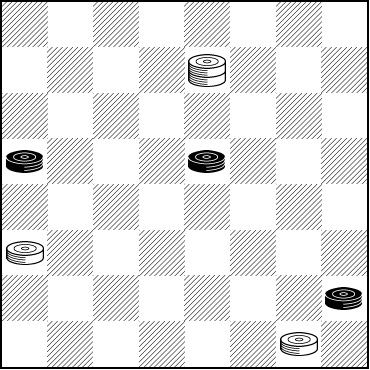
WHITE
White to Play and Win
W:B13,15,28:W21,32,K7
This one is pretty easy; figure out "the move" that wins, and after that, we have no "opposition" to your clicking on Read More to check your solution.
You can email the Webmaster with your comments on this article.
Easy When You Know How
Easy? Hard? If you know how to do something, it's easy. If you don't know how, it's hard. While a bit of a simplification, this rings largely true. If you know what you're doing, you'll be able to succeed, even if perhaps with some effort. And that's very much the case in our game of checkers.
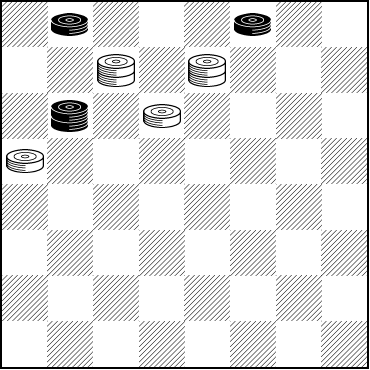
WHITE
White to Play and Win
W:WK6,K7,10,13:B1,3,K9
In the problem above, White is a piece up and should easily win, correct? And indeed the win isn't that hard--- if you are able to visualize it. In other words, if you know how.
There are actually two winning moves; one wraps things up pretty nicely, while the other wins but takes more effort. Save yourself some time; find the faster win. After all, this is a speed problem! With the time you save, get yourself some coffee and cake and relax a little.
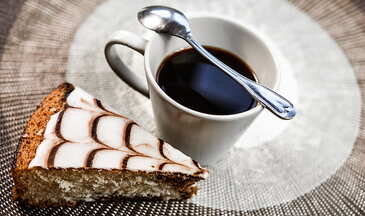
PickPik CC0
See how you do and then, quick-quick, click-click your mouse on Read More to see the solution.
You can email the Webmaster with your comments on this article.
The Checker Maven is produced at editorial offices in Honolulu, Hawai`i, as a completely non-commercial public service from which no income is obtained or sought. Original material is Copyright © 2004-2026 Avi Gobbler Publishing. Other material is public domain, AI generated, as attributed, or licensed under CC1, CC2, CC3 or CC4 and the various CC options. Information presented on this site is offered as-is, at no cost, and bears no express or implied warranty as to accuracy or usability. You agree that you use such information entirely at your own risk. No liabilities of any kind under any legal theory whatsoever are accepted. The Checker Maven is dedicated to the memory of Mr. Bob Newell, Sr.

.jpg)