The Checker Maven
The World's Most Widely Read Checkers and Draughts Publication
Bob Newell, Editor-in-Chief
Published every Saturday morning in Honolulu, Hawai`i
Beginner's Corner: Seeing is Believing

Pexels CC0
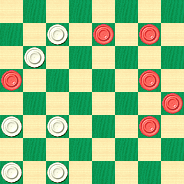
We're continuing our new Beginner's Corner series with a problem that has to be "seen" to be believed.
WHITE
White to Play and Win
W:W30,29,22,21,9,6:B24,20,16,13,8,7.
Don't worry; this problem is not especially hard, but requires a real effort at visualization. Try to solve the problem from the diagram if at all possible; only set up the position on a board if you must, and only move the pieces if absolutely necessary.
When you've "seen" the solution, click on Read More to check your answer.
You can email the Webmaster with your comments on this article.
A Checker Engagement

PxHere CC0
Byron had just proposed to Yvette. On bended knee, he had offered her a beautiful ring and asked her to be his wife.
But somewhat to his surprise, she did not take the ring at once.
"Pray thee stand, Byron," she said, "and hear what I have to say, for I have long anticipated this moment."
Byron stood, still holding the ring in his outstretched hand, clearly looking uncomfortable and uncertain. "Yes?" he said. It was more like a croak than a word.
"I take the counsel of Uncle Harvey," Yvette began.
Public Domain
Byron groaned inwardly, though he didn't dare let it show. Uncle Harvey was Yvette's stuffed shirt uncle in Chicago, a checkerist of a certain reknown, and well known for his opinions on how young people ought to be raised. So what came next was no surprise.
"Uncle Harvey has taught that a young lady should test the character of her intended young man by means of the game of checkers," she said. "By such trials, she will learn if the young man is indeed suitable."
Byron didn't say what he was thinking: that Uncle Harvey was a big blowhard with ideas as outdated as his starched collars. Instead, he said, "I thought Uncle Harvey also believed that checkers is for the boys at home, and the girls should stay with knitting or cooking."
Yvette stiffened. "That is of little consequence," she said. "If you wish me to marry you, then you shall submit to trial by checkerboard. If you succeed in the trial, I shall give you my hand. If you fail, or if you refuse the trial, then even though I love you dearly, we must part company for ever more."
LOC Public Domain
What Byron really wanted to do was to take the next train to Chicago and strangle Uncle Harvey with his bare hands. But that wouldn't be likely to win him a bride.
"Very well, then," Byron said. "I shall undertake the challenge, but you must promise me that, if I am victorious, you will accept my offer of marriage and set an early date."
Yvette smiled. "But of course," she replied. "Come in to the dining room. I have laid out a position on the checkerboard. You must solve it ere you leave here this afternoon. Pray thee do not ascribe a failure to solve to an error in the setting."
Straight out of Uncle Harvey's booklet, Byron thought. He had read the booklet once, at Yvette's urging, and had gotten quite a laugh out of it until he realized that the old geezer was actually serious about what he said.
Now, Byron was a hard working and ambitious young man, helping his father sell modern luxury buggies, a fine business that would one day be his. He had little time for checkers, and frankly wasn't at all good at it.
"The position is not one that is easily solved," Yvette was saying, "but it is one that will prove--- or disprove--- the worth of a suitor."
Great, just great, Byron thought. I probably couldn't even solve an easy problem, let alone one that would prove "the worth of a suitor."
Public Domain Pictures CC0
The two of them stepped out of the parlor and into the dining room. Byron looked and saw a checkerboard on the dining table, set up to the following position.
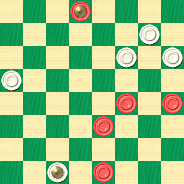
BLACK
Black to Play and Win
B:W25,22,21,20,K3:BK31,14,13,10,2.
Would you have passed Uncle Harvey's test and won Yvette's hand? Click on Read More for the conclusion of our story and the solution to the problem.
You can email the Webmaster with your comments on this article.
May Speedster
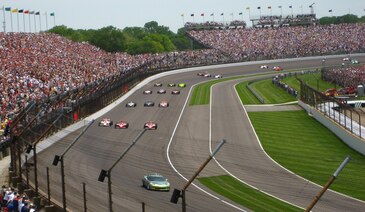
Although it doesn't come until later in the month, May is the time of year for the famed Indianapolis 500 car race, surely one of the best-known automotive sports events anywhere.
Our checker speed problems do garner a little less media attention than the Indy 500, but we think in their own way they're just as interesting, and don't require travel and tickets to experience in person. This month, our problem is relatively easy and we're only giving you ten seconds to solve it. Click on the link below when you're ready. Ladies and gentlemen, start your engines!
May Speed Problem (easy, 10 seconds)
When you've raced to a solution, click on Read More to check your answer.
You can email the Webmaster with your comments on this article.
Beginner's Corner
Now, we're not saying beginners at the great game of checkers should stay in the corner, be put in the corner, or for that matter, be cornered. But after a spate of some pretty difficult problems and positions, we decided we should run a few easier ones, of the kind that our newer players can both solve and benefit from. More experienced players can solve these as speed problems, so it's our hope that there's something here for everyone.
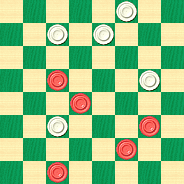
BLACK
Black to Play and Win
B:W30,27,26,17,11:B19,15,9,6,3.
This problem embodies two tactical motifs, which we'll explain in the solution. Try to solve the position from the diagram, without setting up or moving the pieces. Then click on Read More to corner the market on the answer.
You can email the Webmaster with your comments on this article.
April Speedster

Pexels CC0
Did winter speed by, and are we speeding into spring? Does time race by as fast as those cars race around the track?
Time certainly seems to subjectively pass faster as we get older; many studies have proven that assertion. On the checkerboard, too, time can speed by, especially when the clock is running.
You'll see what we mean when you try this month's speed problem. We're allowing 60 seconds--- a full minute--- because the problem is quite a bit harder than most of our speed problems.
April Speed Problem 60 seconds; relatively difficult
When you've sped through to a solution, click on Read More to verify your answer.
You can email the Webmaster with your comments on this article.
North Dakota

Pexels CC0
North Dakota! The very name conjures images of snow and cold, and winters that seem to go on forever. Indoor activities definitely dominate the scene during the winter months.
It's no surprise, then, that North Dakota for many years had a very active checker scene, producing a well-regarded checkers magazine, and contesting numerous tournaments including a regular state championship.
The current state champion is Larry Atwood, a mathematics teacher at Minot State University in Minot, North Dakota (we were unable to find out by press time how long Mr. Atwood has held this title, though we think it's quite a little while).
In today's column, we go back in North Dakota history to the time of a player with a most checker-like name, Howard King. We don't have any information on Mr. King other than our supposition that he was a North Dakota checkerist in the first half of the 20th century. However, Mr. King is credited with the problem shown below.
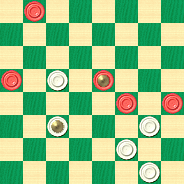
WHITE
White to Play and Draw
W:W32,27,24,K22,14:B20,19,K15,13,1.
Black has just played 16-19, striving for the win with a clever trap. But White has an instructive draw here if he doesn't fall into Black's snare. This is definitely one of our more difficult problems, but the solution is there, and illustrates a very important point in checker play.
Don't be left out in the cold or stay in the dark; find the moves that save the draw. But if you find yourself snowed in, you can always click on Read More to dig out the solution.
You can email the Webmaster with your comments on this article.
A Quiet Scene

Pexels CC0
The scene shown above is certainly quiet and idyllic. It's hardly the place you'd expect to find drama and excitement.
But then again, one never knows.
A checkerboard analogy, shown below, will demonstrate our point.
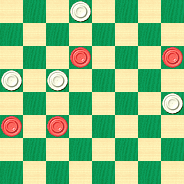
BLACK
Black to Play and Draw
B:W31,20,19,13:B23,21,12,11.
What do we have here? The White men on 19 and 20 and the Black men on 11 and 12 are holding each other off. So is the White man on 31 and the Black man on 23. Black's man on 21 can go in for a King, as can the White man on 13. Looks like a pretty quiet setup. What are we missing? Oh ... yes ... take a closer look at the Black man on 11. After White gets a king that Black man might be in real danger.
It's said that quiet little villages have their secrets. The same is true for checkerboard positions. Black does indeed have a draw, but like closely held secrets, you'll have to dig it out.
When you've unearthed the solution, or did all the digging you wish to do, click on Read More to see the surprising answer.
You can email the Webmaster with your comments on this article.
A Gentle Stroke

Freerange Stock CC0
We've often said that stroke problems are not for everyone, but a gentle stroke of the type shown above (yes, we've done this theme before) is pleasing to almost everyone.
The stroke problem below has fewer pieces than is typical for problems of this type, and is in fact quite a lot more gentle than many others. See how fast you can solve it from the diagram, without setting up a board or moving the pieces.
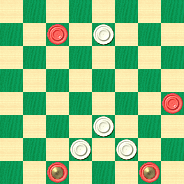
WHITE
White to Play and Win
W:W7,23,26,27:B6,20,K30,K32.
When you've found the solution, click your mouse (gently, of course) on Read More to verify your answer.
You can email the Webmaster with your comments on this article.
Diagramless
AI
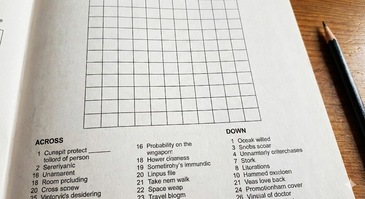
Today's column brings our loyal readers something completely different. Not only do you have to solve a checker problem, you need to figure out what the problem is! It's somewhat analogous to a diagramless crossword, though we see it as considerably easier to solve.
The following verse was published under the title "Puzzle Problem" in The Checkerist in 1887 by our old friend O.H. Richmond, whose work we've featured before. Though we've never found out what the "O.H." in "O.H. Richmond" stands for, "R.A.G." in the poem obviously refers to Robert A. Gurley.
A game of checkers once was played in 1883
Between a man named Robinson and his friend R.A.G.
It was a very pretty game; with neither one ahead.
Until it came quite near the end, when R. A. Gurley said;
"I think I have the best of it, as one can see,
With my two Kings on four and five, and single man on three."
"You may be right," said Robinson, "but I have got the move.
And though my men are single ones, yet tartars they may prove.
But I must move to eleven now, for if to twelve I go,
You catch me in a problem, by Spayth, of Buffalo."
"Ah," said Gurley, "Rob, my boy, that move was very fine.
I fear t'will let that other man from thirteen down to nine.
For if I move my single man, it lets you get a King.
And yours on twenty we'll change off as sure as anything."
The end soon came, Rob drew the game,
But Gurley found next day,
oh, what a sin! he had a win
by a pretty piece of play.
Where's the diagram? Not so fast! There's enough information in the poem to figure out the position and the terms of the problem. You'll need to do that first; if you do, you'll have a nice checker problem to solve.
When you've got it all worked out, just click on Read More to see the problem diagram and the solution.
You can email the Webmaster with your comments on this article.
Fundamentals
NARA & DVIDS Public Domain
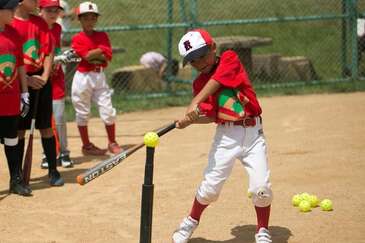
One thing experts agree on: if you're going to master something, whether it's playing baseball, writing novels, or becoming a checker champion, you've got to know the fundamentals. In the photo above, an aspiring baseball player is learning the fundamental skill of making contact with the ball.
Our game of checkers has its own fundamental skills, and solving a position like the one below is a definite and required step on the road to excellence.
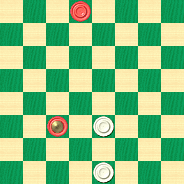
WHITE
White to Play and Draw
W:W23,31:B2,K22.
[Read More]
You can email the Webmaster with your comments on this article.
The Checker Maven is produced at editorial offices in Honolulu, Hawai`i, as a completely non-commercial public service from which no income is obtained or sought. Original material is Copyright © 2004-2026 Avi Gobbler Publishing. Other material is public domain, AI generated, as attributed, or licensed under CC1, CC2, CC3 or CC4 and the various CC options. Information presented on this site is offered as-is, at no cost, and bears no express or implied warranty as to accuracy or usability. You agree that you use such information entirely at your own risk. No liabilities of any kind under any legal theory whatsoever are accepted. The Checker Maven is dedicated to the memory of Mr. Bob Newell, Sr.