The Checker Maven
The World's Most Widely Read Checkers and Draughts Publication
Bob Newell, Editor-in-Chief
Published every Saturday morning in Honolulu, Hawai`i
Horse-Radish
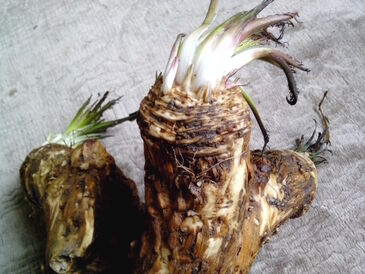
Pixnio CC0
Horseradish, of course, is a well known condiment, with a sharp taste and sinus-clearing effect. It's often enjoyed with prime rib of beef, on hot dogs, and in numerous other ways. It's not to everyone's taste; you either love it or you don't.
Horse-radish, in checkers (note the hyphenation) is an older term not much heard today that refers to moves that are sharp, like horseradish, but not to everyone's taste, because they are usually unsound or at least questionable in theory. They're all about over the board play; a horse-radish move, even if inferior, may be hard to refute on the spot if you're not familiar with the line.
You won't be surprised to hear that Willie Ryan was a fan of horse-radish, and the following problem comes from a horse-radish line in one of his earliest books.
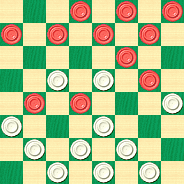
WHITE
White to Play and Win
W:W14,15,20,21,23,25,26,27,30,31,32:B2,3,4,5,6,7,8,11,16,17,18.
Is this sort of thing to your taste, or is it a little too sharp? Does it clear your thinking? Give it a taste, and then click on Read More to see the solution.
You can email the Webmaster with your comments on this article.
Is It Spring Yet?

Public Domain Pictures CC0
Technically, it's already spring in the Northern Hemisphere, as the vernal equinox always arrives in March. Whether or not it's warmed up in your location is something else, and since these columns are written some weeks in advance, we really can't say. Hopefully, the long winter is coming to an end for most North Americans. (If you're in the Southern Hemisphere, we realize you're moving into winter, and we can only hope on your behalf that it will be a mild one.)
To herald the arrival of spring, we have an easy speed problem that will entertain without baffling.
April Speed Problem (Easy; 10 seconds)
When you've warmed to the answer, warm up your mouse by clicking on Read More to check your solution.
You can email the Webmaster with your comments on this article.
A Little Mischief
Rawpixels CC0
We owe today's problem to a certain L. L. Granger, who published it as Prize Problem No. 4 in The Canadian Checker Player nearly a century ago. He called the problem "A Little Mischief" but it turned out to be rather a lot of mischief.
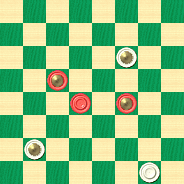
WHITE
White to Play, What Result?
W:B18,K14,K19:W32,K11,K25.
Black has a mobile, centralized position. Is it enough to win, or can White draw? That's the real question here. These "What result?" problems are a breed of mischief all their own.
How much mischief are you up to? The problem isn't easy; prize problems seldom are. Give it a try, and then click on Read More to see the original solution and modern computer analysis.
You can email the Webmaster with your comments on this article.
Famous Shots V
Our monthly Checker School column continues today with its series of famous shots in the game of checkers. These are situations that all experts should know and all students should learn, as they do come up over the board, more often than you might think.
Let's look at this month's entry.
11-15 23-19 8-11 22-17 9-13 17-14 10x17 21x14 15-18 19-15 4-8 24-19 13-17----A 28-24 11-16---B 26-23 16-20 31-26---C
A---6-10 is much better here.
B---Turns a relatively small disadvantage into a probable loss. 6-9 would have minimized the damage.
C---A real lesson in the need to keep your head while you're ahead. Instead of playing 15-10 to go on to a probable win, White will now lose!
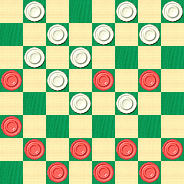
BLACK
Black to Play and Win
B:W32,30,29,27,26,25,24,23,19,15,14:B20,18,17,12,8,7,6,5,3,2,1.
Can you solve it? Can you put a name to the shot? For extra credit, can you name the "shot" shown in the picture at the top?
Try to answer all the questions, and then click on Read More to get all the answers.
You can email the Webmaster with your comments on this article.
Getting Jumpy

Getting jumpy waiting for spring to come? Ready for winter to be over even there might be more cold weather and another snowstorm in the offing??
Be patient; it won't be much longer until winter is left behind.
Our speed problem, though, won't require that much patience. It's fairly easy and can surely be solved in thirty seconds. When you're ready, click below to start the clock and show the position. When you're done, jump your mouse to Read More to check your solution.
March Speed Problem (not too hard; 30 seconds)
You can email the Webmaster with your comments on this article.
A Short Speedster
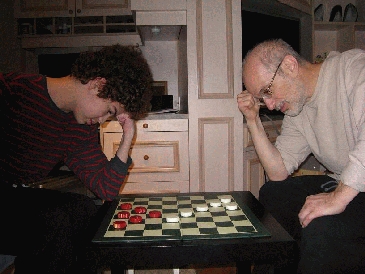
For February, the shortest month, we're pleased to present another short speed problem from father and son team Lloyd and Josh Gordon of Toronto, Ontario, Canada. It features a practical over-the-board situation and is relatively easy (hence a 10 second time limit).
We invite other readers to submit similar problems, suited for solving in anything from five seconds to one minute. Meanwhile, a big "mahalo" (thanks) to Lloyd and Josh.
When you're ready, click on the link below; then come back and click on Read More to verify your solution.
February Speed Problem (Easy, 10 seconds)
You can email the Webmaster with your comments on this article.
Man Up
"Man up!" is an expression that is probably out of favor these days as it refers specifically to masculinity. We won't get into debates about this and we'll say no more than that we believe in all forms of equality. However "man up" in checkers is a different concept. When you are a "man up" you're quite likely to win--- if you know how.
Today's Beginner's Corner episode deals once again with that "you've got to win it" idea. A man up is usually a win, but short of the expert level, the other player isn't just going to concede; you'll have to show that you know how to win it.
Here's one such situation.
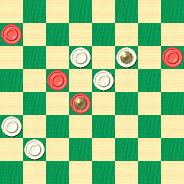
WHITE
White to Play and Win
W:W25,21,15,K11,10:BK18,14,12,5.
Can you "man up"* and win with a man up? We think you can. Prove us right by solving the problem and then clicking on Read More to see the solution.
*Editor's Note: Obviously both men and women play and excel at checkers.
You can email the Webmaster with your comments on this article.
The Holidays Sped By

The holidays have sped by as they always do; there's the long run-up, a week or so of family fun and frolics, and then--- it's over, and we face that winter letdown and months of solid, virtually uninterrupted work, school, or what-have-you.
Fortunately, there's a bright spot for readers of The Checker Maven. For some little while, the father and son team of Lloyd and Josh Gordon, of Toronto, Ontario, Canada, have been replenishing our stock of speed problems, with positions from their own games and of their own design. We're presenting the first of these today.
Photo by Mrs. Lloyd Gordon
Josh and Lloyd generally assemble problem positions that vary from easy to medium in difficulty, making them perfect for speed problems. This month we'll start with an easy one. You won't have a lot of trouble solving it, and it's quite clever and pleasing. Ten seconds will be plenty of time, we think, although perhaps you may disagree!
When you're ready, click on the link below to show the problem and start the clock. Then come back here and click on Read More to verify your solution.
January 2014 Speed Problem Easy; 10 seconds
Thank you, Josh and Lloyd, for sending these problems, and we hope that the rest of your Eastern Ontario winter won't be too tough.
You can email the Webmaster with your comments on this article.
New Year's Edition 2014

There are just a couple of days left in 2013 and then 2014 will be upon us. The years pass by; it seems like we've hardly turned the clock on 2000 and now Y2K is almost ancient history! In any event, The Checker Maven hopes that 2013 was a good year for you and yours, and that 2014 will bring every good thing you might wish for.
To celebrate the coming New Year, how about an A. J. Heffner problem from way, way before Y2K? This one is close to 100 years old but it's never lost its practical appeal. Willie Ryan says he's seen it come up in play more than once ... and doubtless it's occurred many times since.
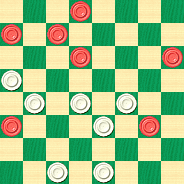
WHITE
White to Play and Win
W:W31,30,23,19,18,17,13:B24,21,12,10,6,5,2.
What's up here? Black is going to get a king and there's nothing White can do about it, although White can get one of his own if he wishes. Where's the White win, though? Can you find it?
The problem isn't particularly easy, and the solution is fairly long, but hey, you've got the rest of the year to solve it! When you've figured it out, click on Read More to see the solution.
You can email the Webmaster with your comments on this article.
Happy Holidays 2013

It's the holidays once again, and The Checker Maven offers best wishes for a wonderful season to you and yours.
At this festive time, the checkerboard often gets set aside as we all become busy indeed, perhaps more so than we ought. So we invite you to take a step back and relax with an entertaining checker problem. It's one that you can easily share with relatives and friends as a sort of mini holiday present, a nowadays all-too rare gift of time and attention.

The problem comes from our old friend Willie Ryan, who calls it a simple problem and yet in the class of gems, because it comes up often in practical play and many times is missed over the board.
Here's the situation.
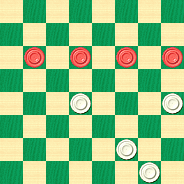
WHITE
White to Play and Draw
W:W32,27,20,18:B12,11,10,9.
Forces are even at four men each, but White is obviously cramped, and in checkers, mobility is key. How can White save the game?
Follow the path we proposed at Thanksgiving this year. Reward yourself and friends and family for tackling the problem with an extra slice of holiday pie.
You can email the Webmaster with your comments on this article.
The Checker Maven is produced at editorial offices in Honolulu, Hawai`i, as a completely non-commercial public service from which no income is obtained or sought. Original material is Copyright © 2004-2026 Avi Gobbler Publishing. Other material is public domain, AI generated, as attributed, or licensed under CC1, CC2, CC3 or CC4 and the various CC options. Information presented on this site is offered as-is, at no cost, and bears no express or implied warranty as to accuracy or usability. You agree that you use such information entirely at your own risk. No liabilities of any kind under any legal theory whatsoever are accepted. The Checker Maven is dedicated to the memory of Mr. Bob Newell, Sr.