The Checker Maven
The World's Most Widely Read Checkers and Draughts Publication
Bob Newell, Editor-in-Chief
Published every Saturday morning in Honolulu, Hawai`i
Easy Peasy Lemon Squeezy

Today's column title has interesting origins. Easy Peasy Lemon Squeezy has a popular meaning which refers to something very easy to do or accomplish. The "easy peasy" part, from what our research tells us, dates back at least as far as a 1940 movie. The "lemon squeezy" part is often said to refer to a 1950s British soap product, Sqezy, which unsurprisingly came in a squeeze bottle and had a lemon scent (we were unable to find a public domain image for this product). However this account is rather speculative.
The problem below could be the easiest speed problem we've ever published; the trick is to solve it in just a few seconds without making a slip-up as there are a couple of opportunities to do so. Is the problem "easy peasy lemon squeezy"? You'll have to decide for yourself.
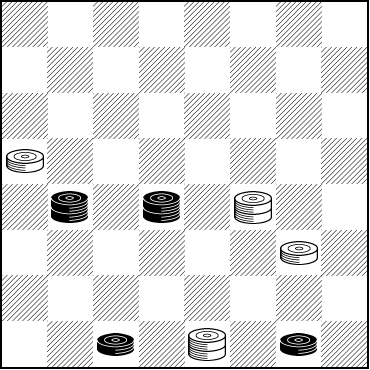
BLACK
Black to Play and Win in 3 Seconds
B:WK2,9,K14,20:B1,3,K15,K16
Pretend you're playing a bullet game (one minute of time for the entire game). Can you solve this instantly? It's easy peasy with minimal thought, but will you find the right moves through rapid reflex? It's an interesting challenge. Give yourself about three seconds. If you haven't gotten it by then, keep going and you'll surely see it in a few more seconds. When done, click on Read More to verify the solution.
You can email the Webmaster with your comments on this article.
Laws of Learning
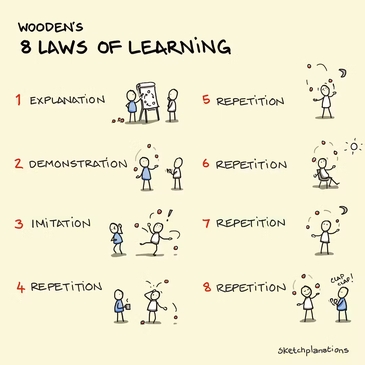
In this installment of our long-running Checker School series, we turn again to the eclectic volume entitled Checker Board Strategy, by Andrew J. Banks, published back in 1945. Part V of this book, "Fundamentals," starts out with a section called Laws of Learning. We offer the following brief quote.
In his college laboratory, Ned guided some white rats that were running in a maze box. Their problem was to find the path to some food. The scientific boy tutored some of the rats a few times by blocking the blind alleys, which directed them into the correct paths. Then he removed the block; this restored the original problem. Other rats were not guided at all. Which rats, do you think, learned the maze with fewer trials? In general those that Ned helped learned faster; however, those that he guided too much learned more slowly than those without any help--- perhaps a certain number of errors must be made in order to learn what to avoid.
The application to our game of checkers is obvious, but do you agree? We do. A certain amount of tutoring and explanation certainly is helpful but ultimately, over the board when your tutor is not present, you'll have to apply what you know, and you'll make some errors. You really cement your learning when you review your game later on and correct your errors. Note in the illustration above, "repetition" figures prominently.
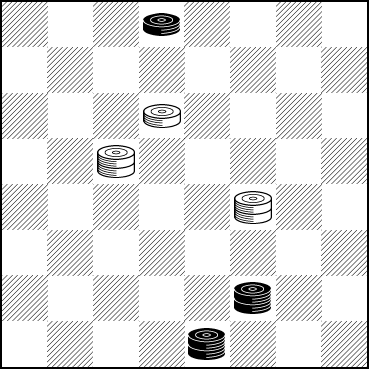
Here are two classic problems which Mr. Andrews presented to illustrate his point. The first one is quite easy.
WHITE
White to Play and Win
W:B2,K27,K31:W10,K14,K19
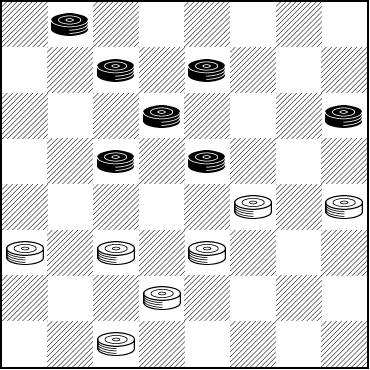
The second one is also relatively easy with a little thought.
WHITE
White to Play and Win
W:B1,6,7,10,12,14,15:W19,20,21,22,23,26,30
These might be quite familiar to experienced players, who are challenged to solve them rapidly. For those of us not in the upper realms of checker knowledge, you might wish to solve the first one, check the solution, and then come back and try the second one. In any event, clicking on Read More will allow you to verify your work.
You can email the Webmaster with your comments on this article.
Marvin J Mavin: Opening Day

It was opening day for the new National Checker League season. Training camps were completed, season tickets sold, myriad print and media articles produced, and there was a general air of excitement. With the scandals of the previous season over and the NCL under new and vibrant leadership, everyone, from coach to player to fan to referee, greeted opening day with eager anticipation.

The same was true for Marvin J. Mavin, team captain of the highly rated Detroit Doublejumpers. There was just one problem. Marvin was feeling ill and feared he had the flu, or worse.
The Doublejumpers opened at home against the Phoenix Paraffin, captained by top ranked player Stella Striker. Marvin expected a competitive game played at the grandmaster level, and he would normally be all for it, except that he wondered if he would be at his best. His head ached, his sinuses were acting up, and he felt feverish with a feeling of intermittment chills punctuated by periods of sweat.
The match was scheduled for 7 PM and practice turnout was at 4:30. Marvin's wife, Priscilla, before her driver picked her up at 7 AM to take her to her CEO's office at Rust Belt Holdings, took one look at Marvin and told him he was staying home tonight.

"For one thing," Priscilla said in the stern voice often used with Marvin, "you might make others sick. What if you have Covid or something? You want to spread contagion? I shouldn't have to tell you that you don't need any more controversy in your career."
Priscilla continued, "But that's not all. What about your health? Don't you think you ought to take care of yourself? You may not like to hear it but you're quite sick right now and the last place you should be is in front of a checkerboard being watched by 50,000 checker fans."
"Aw, gee, Prissy," Marvin said, although it was more like a groan, "you gotta ..."
"Keep quiet and listen!" Priscilla cut in. "I'm not done yet. Lastly, your team counts on you, and you can't tell me you'll be able to play your best in your current condition. You are staying home. Period. I don't want to hear a word from you about it. Now goodbye. My driver is waiting and probably wondering what happened to me."
At that Priscilla headed over to the private elevator in her swanky 5,000 square foot condo and set off for work.
Marvin knew he was sick, but he thought that a morning and an afternoon of rest would be enough to shake off whatever it was he had and still play that evening.

Rawpixel CC0
He slept during most of the day. Priscilla, the previous evening, had her private chef prepare a large pot of chicken soup, and Marvin had some of that during his brief waking periods. By about three thirty in the afternoon, Marvin felt that he would be able to play. So, despite Priscilla's admonitions, and definitely risking her ire, Marvin took a hot shower. That made him feel a lot better and so he dressed and went down to the garage, where Priscilla kept her little fleet. Marvin wasn't allowed to drive the Mercedes or the Bentley, and certainly not the Rolls-Royce, but he did have permission to drive the "everyday" Lexus.
During pre-game practice and warm-ups, he felt a little tired but thought he was doing well enough, until the Coach approached him.

Coach Sawizawiz
Recall from our previous story that the Doublejumpers had once again inadvertently hired a bizarre coach who went by the name California Hummingbird, and ending up firing her on the first day of training camp. While Problem Coach Riddleme filled in for a while, the Doublejumpers managed to recall Sammy Sawizawiz, and he was now Head Coach.
"Marv," Coach Sawizawiz said, "you seem a little off today. Everything okay? You want me to change the lineup and bring in Milo Gru? I know it's opening day and all, but still, if you're not at 100%, maybe I shouldn't play you today."
"Nah, Coach," Marvin replied, "I just kinda took a coupla naps today and it sorta like made me a little sluggish and stuff. I'll be fine."
Coach looked dubious but said, "Okay, fine, but I want 100% from you."
"You got it, Coach," Marvin said.
It was soon time. The players came out on the field, the National Anthem was played, everyone took their places, and the referee blew his whistle and called, "Play checkers!"

Stella Striker of the Paraffin was a top player and Marvin knew he needed to be at his best. Still, he decided to play a safe line and see how the game developed; he hoped to stay within published play for as long as possible and give himself a little extra time to shake off the fogginess he was feeling.
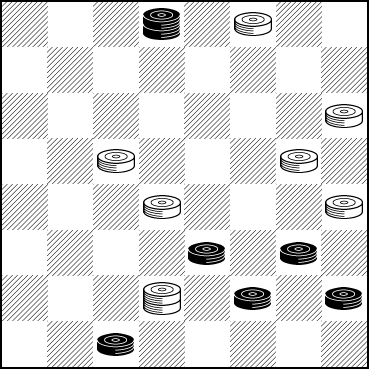
Stella, however, liked sharp play and sharp lines and wasn't afraid to go into new territory. Marvin made a couple of small slips and the game ended up in the following tough position.
BLACK
Black to Play, What Result?
B:WK7,13,15,17,19,21,30:B3,5,6,9,10,K31
Suddenly Coach Sawizawiz was on the field, signalling to the referee for a time out. The referee blew his whistle and a three minute break began.

Courteous Curt Curtiss
Coach approached Marvin and said, "That's it." He pointed to the dugout and signaled for number six --- a player popularly known as "Courteous Curt Curtiss" --- to come in as a pinch mover. "You're out, Marvin," Coach said. "You didn't play at anything like your full ability, and in fact you look even more ill than you did before. I'm disappointed that you didn't put your team first and sit this one out as you should have. Go home, and when you get well we'll have a serious discussion about what you did."
Marvin, dejected, left the field and made his way to the showers.
Can Courteous Curt, as a pinch mover, pull off a draw in this position? Will Marvin face consequences? How would you have done if called in as a pinch mover? Solve the problem, then click on Read More to see the solution and the rest of this installment.
You can email the Webmaster with your comments on this article.
New Season, New Member
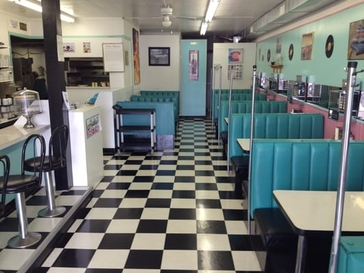
The Beacon Cafe
In Bismarck, North Dakota, it was the Saturday after Labor Day in September 1955, and for long-time resident Sal Westerman that meant one and only one thing. The Coffee and Cake Checker Club would resume meeting at the Beacon Cafe after the club's summer hiatus. A long string of checker filled Saturday afternoons lay ahead.
Sal was in high spirits as he made the ten minute walk from his home on 13th Street over to the Provident Life Building, in which the Beacon Cafe was situated. Sal and the "boys" (all but one of whom were over 50) met at the Beacon and enjoyed wonderful baked treats made by the proprietess, Deana Nagel, accompanied by lots and lots of coffee.
As expected, there was a great turnout for the first meeting of the new season, and by the 1 PM start time the group filled both of the large booths at the back of the cafe. On hand were Larry, Delmer, Wayne, Tom, Louie the Flash, Kevin the Spooler, Dan, Mike, Ron, Young Blaine, and even Old Frank, making an even dozen.
But then, just after Sal joined the group, there was a new arrival. Now, Sal had known in advance about this, due to a telephone inquiry, but he deliberately hadn't made a prior announcement. "Boys," Sal said, "meet our newest member, Nancy German."
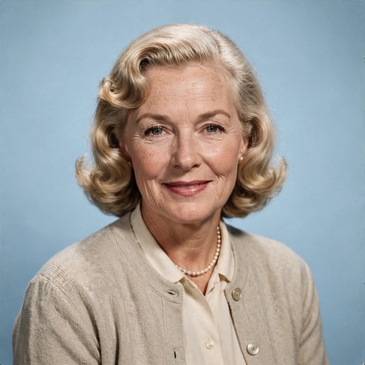
Nancy German
Nancy, reaching the back of the Cafe, gave a big smile. "Pleased to meet you, boys," she said, "and I hope you'll welcome a lady to your group."
There were enthusiatic nods all around. "Delighted to have you," Sal said, "and why don't you tell us about yourself?"
"Well," Nancy said, "I grew up in South Dakota and just moved to Bismarck over the summer to take a new job. I played a lot of checkers down in Pierre and was even on the Pierre municipal team. So when I heard about Sal and the club, naturally I wanted to join. Now, I have to work on Saturday a lot of the time, so I won't be here every week, but I'll do my best, both to show up, participate in problem solving, and try to give you some good games of skittles."
Again all the boys expressed enthusiasm. "Have a seat," Dan said, moving over to make room at the side of one of the booths. We usually start out with Sal giving us a problem to solve."
Nancy took the proferred seat. "Yes, Sal explained that to me over the phone, and how you boys buy treats if you can't solve it and Sal buys if you can. But look, as a newcomer, regardless how it turns out, I'd like to treat today."

Deana
Just then, with her usual great timing, the Beacon's proprietess, Deana Nagel, spoke up from behind her service counter. "Fresh apple pie," she said. "I got hold of a batch of really nice apples from a farm just outside of Mandan, across the river."
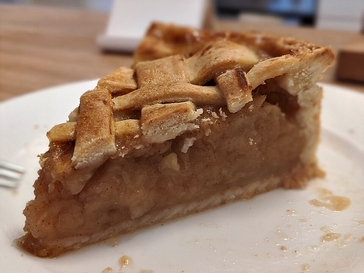
"Mighty kind of you to offer to buy," Wayne said to Nancy, "and apple pie sounds fantastic, but you really don't have to do that."
"I want to," Nancy replied. "I'd like to show appreciation for you welcoming me to your club and letting me be one of the 'boys'."
There were chuckles from everyone. "Sure," said Louie the Flash, "you can be one of us 'boys' if you wish."
Then Sal said, "Well now, shall we get into it? First problem of the season!"
Sal laid out the following position on a checkerboard on the table in each booth.
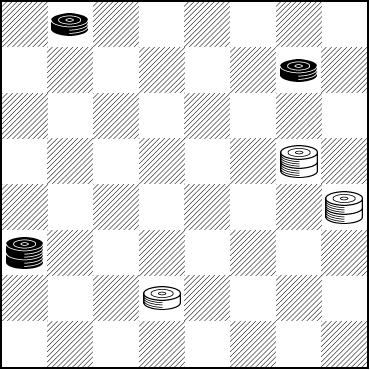
WHITE
White to Play and Win
W:WK16,K20,26:B1,8,K21
"Take a little time," he said, "maybe you're all a bit rusty after the summer layoff."
But the boys--- and Nancy--- were deep into contemplation of the problem.
We welcome our readers back to the Beacon Cafe, at least virtually, even though 1955 was quite a while back. Get yourself some of that good virtual cafe coffee, and sit down with the 'boys' to solve the problem. When you're done, click on Read More to see the solution, the brief conclusion of our story, and to get yourself some virtual apple pie made with apples fresh off the tree from Mandan, North Dakota. Sorry ... if you want real coffee and apple pie, you're on your own--- but it sure does sound good.
You can email the Webmaster with your comments on this article.
Labor Day 2026

Public Domain Pictures
Labor Day is a day we always look forward to; celebrated on the first Monday of September in the United States and Canada, it is an opportunity to recognize the working man and woman, who are the soul of the economy and upon whom we all depend.
We've often said that all honest work is honorable and deserving of respect. Perhaps you're part of an elevator crew.

NARA DVIDS CC0
Or maybe you're a shuttle driver.

PICRYL CC0
A fireman?

NARA DVIDS CC0
Or even a television news anchor!

Rawpixel CC0
No matter what your profession or job, The Checker Maven salutes you, and as always for Labor Day, we present a special checker problem. Often we turn to one of the greats, Tommie Wiswell. But instead today we turn to Jessie Hanson, a member of the 1927 All-American team. Mr. Wiswell says of him, "he has published numerous problems of a very high order." Here's one of his gems.

BLACK
Black to Play and Win
B:W14,17,18,19,20,23:B1,5,6,7,11,12
We'll give you fair warning; this one is much trickier than it looks, but your labor for today is to solve the problem and then, like any good working person, check your work--- by clicking on Read More.
You can email the Webmaster with your comments on this article.
Checker School: Memory Association

Association of concepts and ideas in our memory is vital to our everyday existence on just about every level. We maintain mental "maps" in varying levels of detail and the better we can develop and utilitize these maps, the better we can do when the inevitable problems and challenges come our way, as we will have stored away knowledge about similar problems and their solutions.
Now, we've been going through parts of Andrew J. Banks' eclectic book, Checker Board Strategy, as part of our long standing Checker School series, and Mr. Banks has the following interesting observation about memory and association:
"Association of ideas is the third way of developing a logical memory. If I merely say 'Think of something!' you will be at a loss for ideas. But if I say, 'Think of an article of clothing,' ideas will flash. This test illustrates the power of association. After you have learned a problem, meditate and reflect; thus you often can associate that problem with a similar one."
We definitely think Mr. Banks is in accord with us. After all, as described above, we mostly solve problems in general by implicitly or explicitly comparing them to problems we have solved in the past, and extending or adapting those previous solutions.
So, then, look at the position below. Is it comparable to or associated with anything you've seen before? Does that give you some ideas?
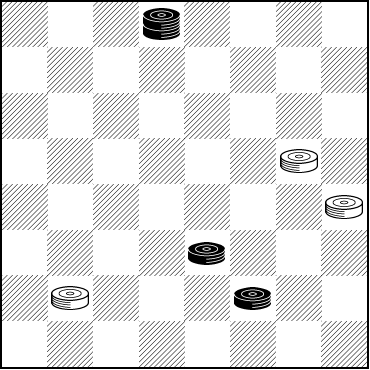
BLACK
Black to Play and Win
B:B6,10,K31:W8,13,17
Access your memory bank; correlate, adapt, and extend, and find the solution--- this one isn't all that difficult. After you're done, associate your mouse with Read More to check your answer.
You can email the Webmaster with your comments on this article.
New Age Training Camp
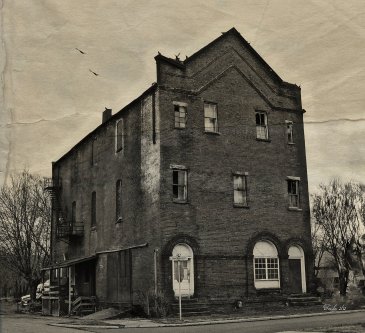
There had been a lot of changes in the National Checker League since the big scandal in the previous season. The NCL was under new management with a new Commissioner and a new Deputy Commissioner. Several coaches and assistant coaches on various teams, and a number of players as well, had either been dismissed, forced to resign, or outright arrested by law enforcement.
The Detroit Doublejumpers, who had as its Captain our protagonist, Marvin J. Mavin, also had several new coaches and a few new players.

Morticia Mumples
Most notably there was a new Head Coach, as former Head Coach Baba Dudut had been arrested on corruption, racketeering, and other charges. The new coach was Morticia Mumples, who was hired away from the AAA Memphis Mills. She replaced Interim Coach Sammy Sawizawiz who had filled in for a couple of months.
Morticia had a good track record. She had been a professional player, mostly in AAA checkers but with a few years as a substitute in the big leagues. She had coached the Mills to a league championship. Known as a stern taskmaster but also someone who always treated players fairly, she was widely regarded as a good hire.
But something had happened between the close of the season in May and the opening of training camp in August. After signing the contract with the Doublejumpers Morticia disappeared for two months. No one knew where she had gone or what may have happened to her.

Then just before training camp started, she showed up again and was, shall we say, a different person. She called in the sports press and said, "My new name is California Hummingbird. This summer I went on a retreat in a remote mountain monastery in a secret location, which I cannot reveal, but I have seen the light. I will teach the Doublejumpers a whole new approach to the game of checkers, and they too shall see the light and experience bliss and nirvana."
She took no questions from the press. Doublejumper management, when asked, said they would just wait and see. In public, they stated, "Ms. Mumples ... er, Hummingbird ... has a demonstrated record of success and we are counting on her." In private, though, they were rather concerned.
The Doublejumpers always trained at a luxury camp in the appropriately named town of Au Train on Michigan's Upper Peninsula, and traditionally the team boarded a charter bus in Detroit, with the ride to Au Train taking the good part of the day. This year was no different, except that prior to departure, Coach Hummingbird engaged the services of a spiritual practitioner, Swami Sammy Salami, to bless the bus and ask for a safe journey and a successful training month.

PICRYL CC0
Swami Salami chanted in a language he claimed to be Vedic Sanskrit but nearly every phrase sounded something like "oma blah glah nah oma namma ramma gamma"; but since no one on the team had ever studied Sanskrit, they couldn't really say anything.
In any event the bus did arrive safely at the campsite and the players quickly occupied their cabins and then assembled for their inaugural camp dinner. This was normally a festive affair with great food featuring fresh fish and locally sourced produce; there were always a couple of toasts and then the Coach would close the dinner with a talk that set the mood for the month of training.
Under former coach Baba Dudut and his own predecessors, this was usually a lot of tough talk about hard mental and physical work. But Coach Hummingbird took a much different approach.

Coach Hummingbird, formerly Morticia
"My camp will be gentle," she said, "now that I have achieved enlightenment. We do work hard, but we enjoy the work and we envelop it in a spiritual cloak that shields all the pain and leaves only the bliss of achievement and success. I will teach you mantras to chant. We will recite shlokas from spiritual texts. When we do physical training, we will be one with nature and with the Higher Orders. We will revel in the companionship of teamwork and shared achievement. Each morning we will rise early for chanting and yoga ... "
"Not tactics training?" one team member interrupted. "We always used to ... "
"We will meet our spiritual needs first," replied Coach Hummingbird, "for if our spirits are not balanced, how can we do worldly work?"
There were a number of shaking heads and a few muttered under the breath comments as the dinner adjourned.
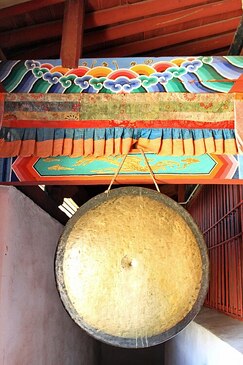
The next morning, the Doublejumper team was awakened at 5 AM to the sound of a gong. They were all ushered into one of the practice rooms. Our hero Marvin was heard to remark that "the sun ain't even hardly up yet" but then Coach Hummingbird was speaking.
"I will give each of you a spiritual name," Coach said, "and during our time at training camp you will be known by that name and that name alone. It is your key to the ethereal energies that will help you play better checkers."
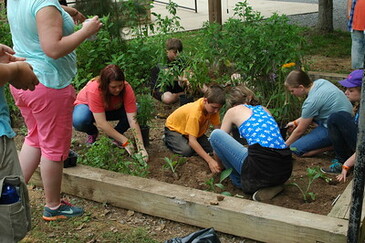
Coach went around whispering in the ears of the players, and when she got to Marvin, she gave him a friendly smile and said quietly, "You, Captain Marvin, must be both a leader and a player. Therefore you shall be known as Holistic Harmonic Happy Hope, or 4H for short."
Land Between the Lakes CC0
Marvin replied, "4H? Ain't that some kinda farm club?" But Coach just smiled and moved on to the next player.
The players then adjourned for breakfast. Instead of the usual sausages, eggs, pancakes and coffee, breakfast consisted of yogurt, fruit juice, herbal tea, and blackberries. The players grumbled but Coach said, "We consume only spiritual food to nourish the spirit. We must not put harmful substances into our sacred bodies."
Next up was an hour of yoga. This was followed by an hour of meditation. Finally before lunch the players gathered again and were asked to each give a statement about how checkers affected the higher orders of their connection to the Great Wheel of Life. Most of the players mumbled a few phrases, not really knowing what to say. Marvin, for his part, said, "I ain't got no idea about nothing like that."
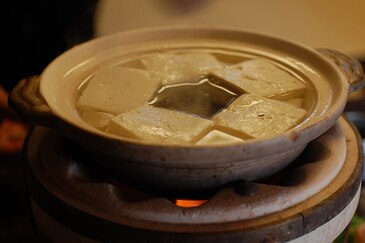
Lunch consisted of a green salad with no dressing, cubes of boiled tofu, and something Coach called "tea of heaven" which apparently was a brew made from various leaves and twigs.
The afternoon was similar to the morning. Finally, at about 4 PM, Marvin spoke up on behalf of the team.
"Coach, ain't we gonna like, practice checkers and stuff? You know, like checker problems and scrimmage games and openings and endings and ... you know, checker camp sorta things?"

Freerange Stock CC0
"Oh, 4H," Coach replied, "your inner harmonies are clearly misaligned. In my newly conceived checker camp we don't study checkers in the way you describe. Instead we let our spirits soar, we see them fly over the checkerboard; then the pieces on the board, far below, become energetic nodes through which our inner energies pass. We envision a victory and ... voila! The victory is ours!"
Marvin thought for a minute, "Uh ... yeah ... well ... at least can we have some, like, decent food for dinner?"
Another team member then spoke up. It was the second board starter, Timmy Timbuck. "Coach, when you were coaching in AAA did you do all this sort of stuff?"
"Oh, no," Coach replied. "That was back when I was still known as Morticia Mumples. I had not yet achieved enlightenment. But I have now seen a new and better path to success. I couldn't wait to share it with you players. It will be the New Age of checkers!"
At this point the other coaches--- the Problem Coach, the Opening Coach, the Endgame Coach, and the Strategy Coach--- went off to the side and conferred..

Coach Riddleme
Problem Coach Riddleme, who was normally among the hardest taskmasters in the league, was the one who spoke up.
"Team," he said, "we're taking the bus into town for dinner at a steakhouse. Load up. Wheels roll in five minutes."
The players actually cheered. But Coach Hummingbird, clearly shocked and surprised, attempted to protest. "I'm the Head Coach!" she wailed. "You can't do this without my permission!"
"Wrong," replied Coach Riddleme. "Doublejumper executives, unknown to you, have asked all the other coaches to keep an eye on things and take action if necessary. We have full authority. Sorry, Ms. whatever you call yourself, you're no longer Head Coach."

The team went into town and happily consumed steak and lobster dinners. When they returned to camp, Coach Hummingbird was nowhere to be seen. Later, a note was found in her cabin saying she couldn't work with insensitive non-spiritual clods who had no chance at enlightenment. She would return to the monastery in the secret mountain location to wait the coming of the Great Om-My.
Coach Riddleme announced that he was taking over until another Head Coach could be appointed. But even though it was rather late, he called for an hour of problem solving. "We've got to make up for lost time," he said, "but no worries, you'll have your pancake breakfast in the morning with plenty of coffee. Now here, look at this, it's in two parts."
| 1. | 9-13 | 22-18 |
| 2. | 12-16 | 24-20 |
| 3. | 8-12 | 25-22 |
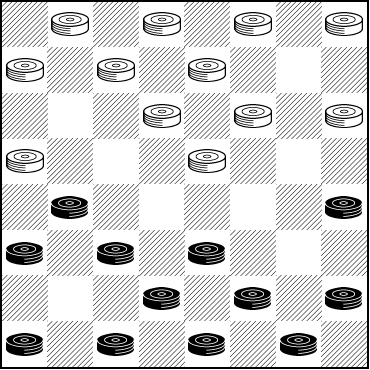
BLACK
Black to Play and Draw
B:W18,20,21,22,23,26,27,28,29,30,31,32:B1,2,3,4,5,6,7,10,11,12,13,16
Black played a potentially losing move at this point and the game continued:
| 4. | 16-19 | 23x16 |
| 5. | 12x19 | 27-23 |
| 6. | 11-16 | 20x11 |
| 7. | 7x16 | 18-15 |
| 8. | 4-8 | ... |
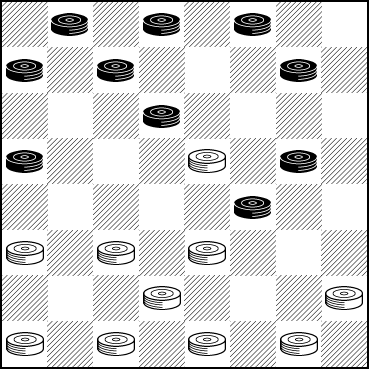
WHITE
White to Play and Win
W:W15,21,22,23,26,28,29,30,31,32:B1,2,3,5,6,8,10,13,16,19
Of course there were quite a few more problems and positions to be solved before lights out was finally called, but the players were glad to actually, you know, play checkers.
We don't know what you prefer; is it steak and lobster or boiled tofu? The choice is yours and literally a matter of taste. But we'll bet you'll enjoy taking on Coach Riddleme's first checker problem. Reach checker enlightenment by finding the solution and then clicking on Read More to see the solution. Recitation of shlokas is optional.
You can email the Webmaster with your comments on this article.
Sad Sal
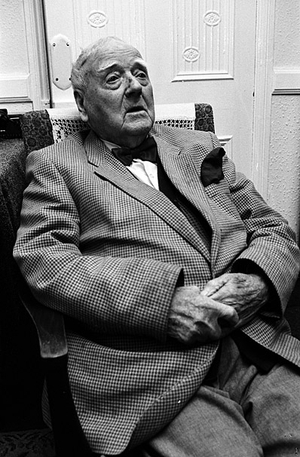
Sal Westerman
It was August, 1955 (it's always 1955 in these stories) and Labor Day weekend was not far off. For Sal Westerman, that was a good thing.
Sal, being definitely on the elderly side, certainly didn't want to wish his life away. Not at all; he tried to make the most of every day. It's just that by the time late summer came around, he was really missing his Saturday afternoon meetings of his Coffee and Cake Checker Club.

Rawpixels CC0
The Club indeed did meet every Saturday afternoon, but only from just after Labor Day until just before Memorial Day. Summers in Bismarck, North Dakota, were noticeably short and North Dakotans made the most of warmer weather to be outdoors, whether camping or fishing, tending to their yards, playing softball, or any other summer activity. The club's venue, the Beacon Cafe, even shut down for most of the month of August so its proprietress, Deana Nagel, could travel back to Gackle, N.D., to help out with the harvest on the family farm.
Sal of course had his own ways of keeping busy during summertime, including a lakeside vacation with his wife Sylvia and numerous other things, many of which of course had to do with checkers. But he missed getting together with the "boys" as he called them (all but one of whom were at minimum 50 years old) for afternoons of checker fun.
This year, for some reason, Sal especially missed his club, and even though it would just be a couple more weeks until the "season" began, he felt somewhat depressed. Perhaps more than somewhat.

To begin with, it was a Saturday afternoon, and he was home alone in his study. His wife was visiting her sister Phoebe in Dickinson, N.D., and Sal avoided going along as he and Phoebe did not have, shall we say, a warm relationship. The Beacon Cafe was closed. Sal had tried calling a couple of the boys to meet up for lunch or coffee, but he wasn't able to reach anyone. They were all off on vacation, fishing or camping, or just too busy with yard work or other summertime chores.
Sal thought about going over to the bar at the Patterson Hotel for a beer, but it seemed like too much effort. It was really hot outside and any amount of walking, even to a nearby park, just seemed like too much. Nothing seemed to appeal to him. Summer had been great, but did it have to be so long? Of course, it wasn't long at all but at the moment it seemed that way.

Taking an afternoon nap was always an option, but he realized that if he did he would wake up even more depressed, having done nothing all afternoon. He'd read the last few issues of All Checkers Digest from cover to cover several times. He'd finished that problem book project that he had started with Young Ed from Pennsylvania and was still impatiently waiting for a proof copy. Things just weren't going his way today.
Maybe he could go to a movie. But that would involve walking and besides there was nothing playing that he wanted to see. Watching daytime weekend television was an even worse option. Going to the library? Going out for a hamburger? Too hot. Too hard.
Sal was sitting in his easy chair, unable to get out of his low mood, when the phone rang and startled him. Who could it be? Sylvia didn't call from Dickinson in the afternoon, and he had just heard from her last night.

Public Domain
Sal hurried as quickly as he could up the stairs to the kitchen, where the phone sat on a small table by the wall. He answered on what was probably the fifth ring, hoping he wasn't too late, and hoping even more it wasn't someone trying to sell him insurance.
"Hello?" Sal said after he picked up the receiver.
"Sal?" came the voice on the other end. "It's Ed, in Pennsylvania. Look, this long distance call is kind of expensive, but I had an idea for one more problem to add to our book. Quick, write this down."
Sylvia thoughtfully kept a small notepad and a pencil next to the telephone. Sal picked up the pencil and said, "Go ahead, Young Ed, I'm ready."
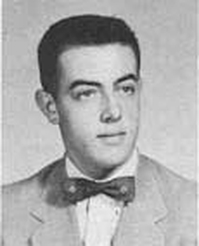
Young Ed
Ed quickly stated the position of the pieces and the problem premise. "Try it out and drop me a line," he said, "and tell me if you think it ought to go in the book. I'll run along now before I spend a month's rent on this call. Take care and say hello to Sylvia for me."
The line disconnected. Sal hung up the phone and looked at the notes he had hastily scribbled. The position was really interesting ...
Sal couldn't wait to get back down to his study and set up the problem. His dark mood had vanished in an instant. This was going to be a great day after all!
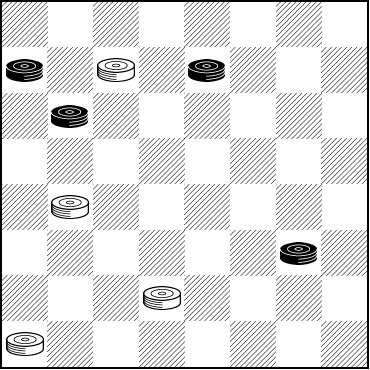
WHITE
White to Play and Win
W:B5,7,9,24:W6,17,26,29
There's nothing like the excitement of a good new checker problem to lift a checker fan's mood. Of course, we hope your mood today isn't a dark one, but dark, light, or in-between, an Ed Atkinson problem is always a treat. This is one of the last of them in our supply. Enjoy it and click on Read More when you're ready to check your solution.
You can email the Webmaster with your comments on this article.
2025 World Championship Match

From June 14 to June 22 in 2025 at a site in Italy, 3-Move World Champion Sergio Scarpetta defended his title against challenger Melikaya Nonyukela. The match was tense and exciting and went to the very last game. The final score was 16-16, comprised of 3 wins per player and 26 draws. With a tie score, the title remained with Mr. Scarpetta but Mr. Nonyukela showed himself to be a player of championship rank and a force to be reckoned with.
Grandmaster Richard Pask has annotated all 32 games of the match and presented them in a new booklet which he has generously allowed us to make available for free download from our website. Get your copy here; these games are definitely worthy of many hours of study and enjoyment.
As a sample, let's look at a position later in Game 32, the last in the match. At that point Mr. Scarpetta led by 16-15 but Mr. Nonyukela had the opportunity to play for a win and bring the match to an overall draw.
Here's the critical position.
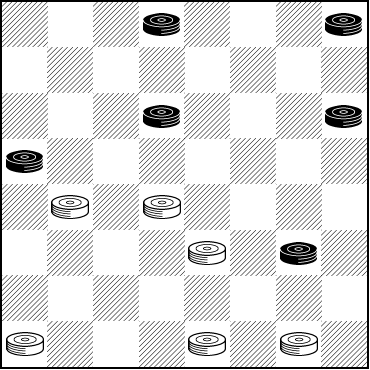
WHITE
White to Play and Draw
W:W17,18,23,29,31,32:B2,4,10,12,13,24
What would you have done here? What would be the outcome? This faced Mr. Scarpetta at the very end of the very last game. See what you might do, and then download the book and turn to Game 32 to see the run-up, full notes, and the surprising outcome.
Once again we thank Mr. Pask for the privilege of presenting his work.
You can email the Webmaster with your comments on this article.
The Exception That Proves The Rule
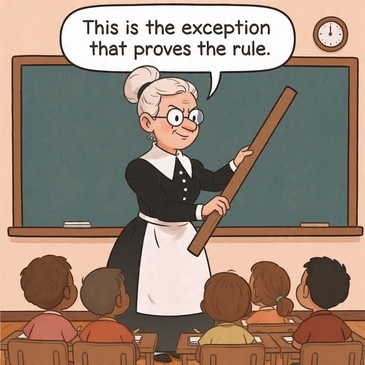
There's an old schoolhouse saying about "the exception that proves the rule" meaning that there may be a general rule (typically in grammar) but there are exceptions to the rule, and somehow that "proves" the rule. We always thought that this was, in fact, exceptionally nonsensical, with no basis in logic.
Getting to the point: While today's problem is not quite a "first Saturday of the month" speed problem, it's not overly difficult and it is quite clever, and demonstrates that every rule indeed has its exceptions, even if they don't exactly "prove the rule."
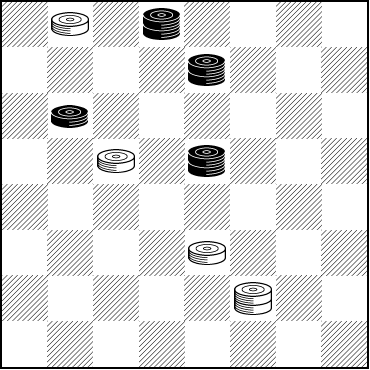
BLACK
Black to Play and Win
B:W32,19,10,K6:B24,K31,K26,K18
No, you won't need exceptional skill to solve this one, and we hope you won't take exception to our evaluation. But either way, see how you do and then click on Read More to see the exceptional solution.
You can email the Webmaster with your comments on this article.
The Checker Maven is produced at editorial offices in Honolulu, Hawai`i, as a completely non-commercial public service from which no income is obtained or sought. Original material is Copyright © 2004-2026 Avi Gobbler Publishing. Other material is public domain, AI generated, as attributed, or licensed under CC1, CC2, CC3 or CC4 and the various CC options. Information presented on this site is offered as-is, at no cost, and bears no express or implied warranty as to accuracy or usability. You agree that you use such information entirely at your own risk. No liabilities of any kind under any legal theory whatsoever are accepted. The Checker Maven is dedicated to the memory of Mr. Bob Newell, Sr.