The Checker Maven
The World's Most Widely Read Checkers and Draughts Publication
Bob Newell, Editor-in-Chief
Published every Saturday morning in Honolulu, Hawai`i
Secret Hideaway
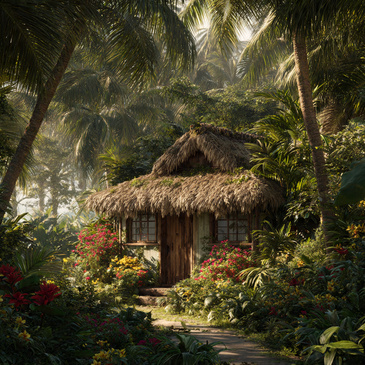
Don't tell anyone, but The Checker Maven has a secret hideaway.
Unfortunately, it isn't a bungalow tucked away on a remote tropical island, much as we might wish; but for a checker fan, it might be something even better: we have a hidden stash of checker problems.
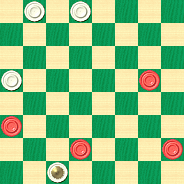
No, we're definitely not telling. But in our weekly columns, little by little we'll share some (maybe even all) of the contents of our secret checker problem hideaway with you. Today, we'll start with a deceptive little situation of the "what result?" variety. Take a look at the diagram below.
BLACK
Black to Play, What Result?
B:W32,31,20,K3:B17,12,7,5.
We can't offer a week's vacation in Paradise as a prize for solving this one; we can only promise you self-satisfaction and a feeling of accomplishment. Tease out the secret and then click on Read More, which will reveal the solution's hideaway.
You can email the Webmaster with your comments on this article.
Labor Day Race, 2009
Rawpixel CC0
There is an event called the Saguaro Race, held on Labor Day weekend in Arizona, near Tucson. There's a choice between a more serious eight-mile event, or a two-mile "fun" event. Given the heat of the Arizona desert, and our less than stellar endurance, we know which one we would opt for--- but to each his own, and we're certain that a good time would be had by all.
As our own celebration of Labor Day, the holiday set aside for recognizing the ordinary worker who makes America great, we offer our own race, and we promise that it's much less taxing than the Saguaro event. It's a race against the Javascript clock to solve a checker problem before time runs out. The problem will tax your brain, but not all that much, so we'll give you 30 seconds to figure it out. (The Saguaro participants, no matter which event they choose, can't possibly finish that fast!)
Click on the link below to display the problem, then come back and click on Read More to see the solution.
September Speed Problem (moderately easy, 30 seconds)
You can email the Webmaster with your comments on this article.
Back to School, 2009
Public Domain Pictures CC0
Yes, it's that time of year again, when to the general dismay of young folks everywhere, school opens again for another seemingly endless academic year. We counsel students to take courage and persevere--- it isn't really all that bad, and you will be repaid many times over in the years to come.
Our continuing Checker School lessons also offer much reward, and the effort involved is most enjoyable. This month, as we continue with studies drawn from Ben Boland's Famous Positions in the Game of Checkers, we look at three positions that seem unlike each other, but have a definite relationship that you'll understand as you study the solutions and notes.
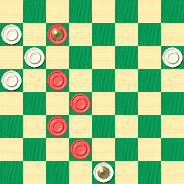
In Mr. Wardell's study, Black has even material but a position that looks hard to defend, yet somehow must manage to draw
WHITE
BLACK
Black to Play and Draw
B:W28,24,21,20,K2:BK27,19,15,11,7.
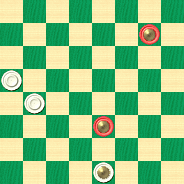
In the second study, by Mr. Grey, Black is a piece down and seems to need a miracle.
WHITE
BLACK
Black to Play and Draw
B:W20,16,K2:BK25,K10
In the final study, by Mr. Hennigan, Black has even material but a rather tough-looking position, yet the draw is there.
WHITE

BLACK
Black to Play and Draw
B:W30,29,K24:B27,23,22.
Spend some time on these; after all, good lessons require effort! When you're ready, click on Read More for the solutions, sample games, and detailed study notes.
You can email the Webmaster with your comments on this article.
Monty's King-Pinch
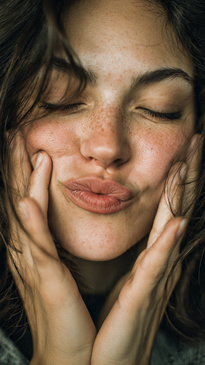
In the English language, the word "pinch" has a couple of different meanings. The young lady above is demonstrating the most common meaning, pinching her cheeks in a manner that we're sure she finds amusing. But today, we're going to consider another meaning of the word, namely, "to steal."
In our continuing series of excerpts from Willie Ryan's famous book, Tricks Traps & Shots of the Checkerboard, Willie talks about Monte Schleifer's clever way of stealing, or pinching, a king, via a most interesting stratagem. Willie tells us more below.
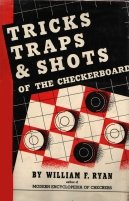
"When I was a schoolboy of 13, I learned that the City College of New York had organized a checker club for students, and were holding weekly meetings every Friday afternoon. On my initial visit to this club, I had the pleasure of meeting for the first time Monte Schleifer of Brooklyn and Jack Cox of the Bronx. Today, they rank high among the nation's leading player-analysts. As a special contribution to this book, Monty offers this attractive morsel of brilliant play, showing a clever drawing idea. For the diagram, move:
| 11-15 | 10-14---A | 4-11 |
| 24-19 | 27-24 | 24-19 |
| 15-24 | 16-20 | 6-10 |
| 28-19 | 31-27 | 29-25 |
| 8-11 | 7-11 | 12-16 |
| 22-18 | 19-15 | 19-12 |
| 11-16 | 2-1---B | 10-15. |
| 25-22 | 15-8 |
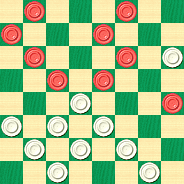
WHITE
White to Play and Draw
W:W32,30,27,26,25,23,22,21,18,12:B20,15,14,11,9,7,5,3,1.
A---The following unusual shot came up in a mail game between Joseph Viera of Nantucket, Massachusetts, and Fred Butterworth of Passaic, New Jersey: 4-8, 22-17, 8-11, 17-13, 16-20, 26-22, 11-16, 29-25, 9-14, 18-9, 5-14, 22-18, 14-17, 21-14, 10-17, 31-26, 7-10, 18-15, 3-8, 23-18, 16-23, 26-19, 17-22, 25-21, 10-14, 18-9, 1-5, 15-11 (what's going on here?), 8-31, 30-26, 5-14, 26-1; a draw. A well-played crossboard game.
B---Strongest, but 4-8, 29-25, 2-7, 24-19, 7-10, 32-28, 12-16, etc., also seal the draw."
Can you figure out how Monty pinches a king? When you've worked out your solution, click on Read More to let Willie show you how it's done.
You can email the Webmaster with your comments on this article.
Smaller Than Life
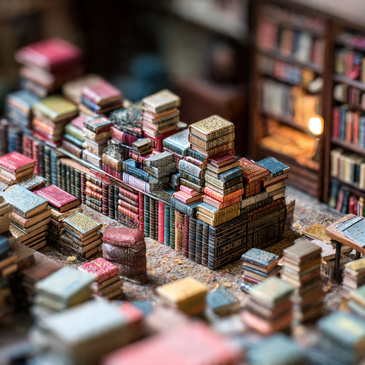
On the opposite end of the "larger than life" spectrum is the "smaller than life" world of miniatures. We're fascinated by the tiny books shown in the photo above, although we do know that unfortunately they aren't checker books. However, checkers has its own world of miniatures, and today we're pleased to bring you another miniature problem. We like to publish these from time to time; while they are not everyone's cup of tea, they are elegant, entertaining, and nearly always applicable to practical play. Shown below is one that we think merits all of the previous adjectives.
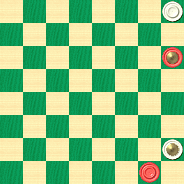
BLACK
Black to Play and Win
B:W29,K5:BK21,1.
Give the problem a "good little try" and then click on Read More to see the "little old solution."
You can email the Webmaster with your comments on this article.
Atomic Marvin

Marvin J. Mavin
Marvin J. Mavin, checker star and captain of the major league checker team, the Detroit Doublejumpers, had been in Santa Fe, New Mexico, doing training work with the local semi-pro team, the Santa Fe Salsa. As an exciting conclusion to his visit to the Land of Enchantment, Marvin was invited to come up to Atomic City to take on its supercomputer, nicknamed "Road Rager," which ran a top-level checker program with the erudite name of "Plutonium Bomber Instantiation," or simply "PBI." It was rumored, however, that Marvin was at least as interested in trying out the local microbrews, especially "Atomic Ale," as he was in playing checkers.
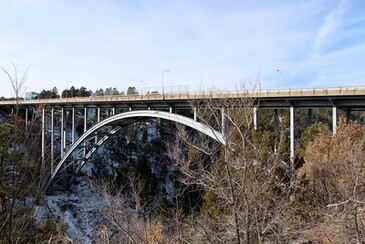
There was little time for diversions, however; Marvin finished up his training work in Santa Fe around noon on his last day there, and was due to begin his match with PBI just two hours later, at the "Nick the Geek" supercomputer center at the Atomic City Laboratory in Atomic City. Without further ado, Marvin drove up the mountain roads to his destination and was soon badged in at the supercomputer center. The auditorium was completely full as Marvin made his entrance to enthusiastic applause.
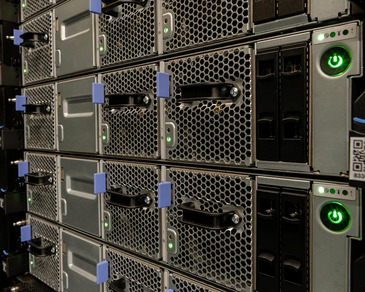
Rawpixel CC0
Everyone knew that this was something of an historical event. PBI was known to be one of the world's top computer programs (although there was some debate as to which one was really best). It would be playing against one of the top major league checker players. How would it all turn out? PBI's programmers were hoping for the best for their creation, but it seemed that the audience had much sympathy for Marvin.
Marvin sat in front of the Black pieces, ready to take on the silicon giant. "I hear that Atomic Ale is a real blast," Marvin said to one of the PBI programmers, chuckling at his cleverness. The programmer, seated on the White side with a computer console to his left, seemed to wince at Marvin's trite pun and muttered something under his breath to the effect that he thought Marvin was here to play checkers, not drink beer.
But just a moment later, the contest began.
Black: Marvin J. Mavin
White: Plutonium Bomber Instantiation
| 1. | 9-13 | 21-17 |
| 2. | 5-9 | 25-21 |
| 3. | 11-15 | 23-18 |
| 4. | 1-5 | 18x11 |
| 5. | 8x15 | 30-25 |
| 6. | 3-8 | 24-19 |
| 7. | 15x24 | 28x19 |
| 8. | 7-11 | 26-23 |
| 9. | 9-14 |
Perhaps the best move here, but 11-16 or even 11-15 should also retain equality.
| 9. | ... | 22-18 |
| 10. | 13x22 | 18x9 |
| 11. | 6x13 | 25x18 |
| 12. | 11-15 | 18x11 |
| 13. | 8x24 | 27x20 |
| 14. | 10-15 | 31-26 |
| 15. | 4-8 | 20-16 |
| 16. | 12x19 | 23x16 |
| 17. | 8-11 | 16x7 |
| 18. | 2x11 | 26-22 |
| 19. | 11-16 | 21-17 |
| 20. | 5-9 | 32-27 |
Marvin was looking pretty happy with himself. Up to this point the game had been very well played by both sides with no mistakes being made. He concentrated on the position for a while and then said, "Bomb Boy .... I think you've bombed out this time!" He made the following move.
| 21. | 16-19 |
Marvin rocked back in his chair, folded his arms over his chest, and grinned. "What'll you do about that, Bomb Boy?" he asked. "You might be a real smart computer, but you ain't a match for Marvin J. Mavin! I think it's just about time to try out the local brew, because this game is sure over soon!"
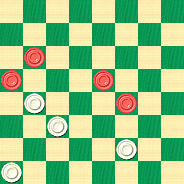
WHITE
White to Play, What Result?
W:W29,27,22,17:B19,15,13,9.
Has Marvin indeed defeated one of the world's mightiest computers? Has he truly earned his beer today? Analyze the position and decide whether White should play on, or simply resign. When you have your answer, click on Read More for the high-yield solution.
You can email the Webmaster with your comments on this article.
Beat the Heat
PickPik CC0
August in most of the Northern Hemisphere brings some of the hottest weather of the year. We know that here in our Santa Fe offices, located in New Mexico's high desert country, it's hard to think about moving very fast in the blistering heat of summer. But nevertheless, we invite you to "beat the heat" with our August speed problem, an offering that isn't so easy and is perhaps a little over the top for speed solving.
Taking all this into account and allowing for the summer heat, we'll give you extra solving time. In fact, we'll go so far as to allow you three minutes to find the solution. Generous, aren't we?
When you're ready, click on the link below to display the problem and kick off the red-hot Javascript timer. Come back and click on Read More when you're ready to see the solution.
August Speed Problem (moderately difficult; 3 minutes)
You can email the Webmaster with your comments on this article.
La Reina de Damas en Mexico
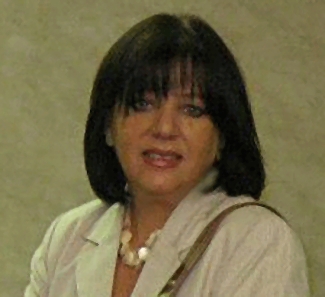
Una senora llamada Irma Sierra vive en la ciudad de Guadalajara, y ella es la reina de damas en Mexico.
Or, to paraphrase, a lady named Irma Sierra (full name Irma Alicia Sierra Noriega) lives in the city of Guadalajara, and she is the veritable queen of checkers in the warm and charming country of Mexico.
Irma granted The Checker Maven an exclusive interview, and we're most pleased to share with you a little about one of the most colorful women in checkers. This column is the first in a projected series that we're calling Contemporary Women in Checkers. We hope you enjoy it, and we hope that in some small way we can help to encourage more women to take up the great game of checkers.
Irma's native language, of course, is Spanish, but she is completely fluent in English and we present her comments here virtually unedited. Brava, Irma, you are a linguist as well as a checkerist! Irma is also a wife, mother, and grandmother, and she balances these traditional roles with a busy travel schedule which includes checker tournaments whenever possible.
Checker Maven: How did you get interested in playing checkers?
Irma: When I was 48, I started to use the computer for the first time, and a friend and I were playing checkers in Messenger, and we saw an advertisment: MSN Games by Zone. I went there and started to play checkers for the first time in my life. I kept playing because I fell in love with checkers...
Checker Maven: When did you learn the game?
Irma: There was a guy with the nickname Chumpchange in the social room of Zone, a very nice person, and he became my friend and taught me some moves.
Checker Maven: What lead you to becoming a serious checker player?
Irma: Well, when I started to beat some "guests" (those were the serious players in the social room in Zone) i decided to go to Kings Room where the serious players were. I had to beg to get a game, and there it was where I met my friends that invited me to participate in a tournament in Lebanon Tennessee, and I dared to go! Vonda Jones ("Bugs") and Ken Christan ("Redeyechecker") went to pick me up at the airport, and I had to remember how they looked just from the pictures I had seen on the NCCheckers site, they never saw me passing through until I saw them. It was very nice and fun!
Checker Maven: How is Mexico as a checker playing country --- are there many players and are there many good players?
Irma: Here in Mexico I didn't know anybody who played checkers, only my friend and I, but on the internet there are a few others and some are very good checker players, like Gilberto Cisneros. He went to the Nationals in Las Vegas in 2008, and there are I am sure others that I do not know. But you have to understand that in Mexico it is usual to play Spanish checkers, and not American checkers.
Checker Maven: Do many women play checkers in Mexico? What do Mexicans generally think about women checker players?
Irma: I don't know if many women play checkers in Mexico, but the culture here is different, not many get on the computer to play games, but I know one who is very good from Mexico City; she plays in Kurnik. And about what they think ... ha ha ha ... only my friends know there is a Mexican woman that plays checkers: ME! And they are impressed when they hear that I go to play checkers in US tournaments, but they think I am nuts! (The macho thing ... )
Checker Maven: Do you have any goals in checkers? How will you reach them?
Irma: My goal is to keep learning to play better. And I will get that playing in GoldToken, my super favorite place, and in Kurnik, with my friends that are always willing to teach me. Thank you all! And also going to tournaments to have lots and lots of fun!
Checker Maven: How would you encourage more women to play checkers? What should change in the world of checkers for more women to become serious players?
Irma: Well, there are very few women checkers players in the world, I think because traditionally it was a men's game and they never tried to play it, but they should!! Checkers is a beautiful game, and maybe it has something to do with patience to learn; it is not easy to be losing and losing, you know? And I would add the fact that some men don't take us as serious players ... the macho thing again?
Checker Maven: Do you enjoy tournament play?
Irma: I love to play live tournaments not just for the game, but also to meet all my checkers friends from GoldToken and Kurnik... I love them all!
Checker Maven: What are one or two of your most memorable moments in checkers?
Irma: Oh yes, when I beat Jan Bulstra in Ohio, he kept saying: oh Irma, oh Irma ... ha ha ha .... I loved it! Besides that, I have drawn at least one time to many Majors players, like John Acker, Teal Stanley, Ken Christian, Howard Gain, Leonard Hickman, Hollis McClard, Bill Shoffner and Howard Hoover...:and maybe I forgot some others? Another nice moment that I enjoyed a lot is drawing against Lindus Edwards in GoldToken.
To conclude, we'd like to present two games played by Irma. The first is a live tournament game, and the second, which we've turned into a problem for you, the reader, to solve, was played on the GoldToken internet game site. Annotations are derived from analysis with the KingsRow computer engine. Both games illustrate Irma's well-honed ability to instantly capitalize on an opponent's error.
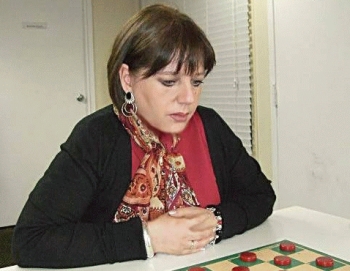
Black: Jan Bulstra
White: Irma Sierra
| 1. | 9-13 | 24-19 |
| 2. | 11-16 | 22-18 |
| 3. | 10-15 |
In this unbalanced 3-move ballot favoring White, 8-11 is the only move to draw at this point. The move played is a probable loss, and Irma takes full advantage.
| 3. | ... | 19x10 |
| 4. | 6x22 | 25x18 |
| 5. | 1-6 | 28-24 |
| 6. | 16-20 | 29-25 |
| 7. | 8-11 | 24-19 |
| 8. | 11-16 |
6-9 or 7-10 could have been played here, but the position is pretty much lost for Black.
| 8. | ... | 18-14 |
| 9. | 4-8 |
Going further astray. 6-9 was a better option in a bad situation.
| 9. | ... | 25-22 |
Irma continues to play very accurately.
| 10. | 7-10 | 14x7 |
| 11. | 3x10 | 22-18 |
| 12. | 6-9 | 18-14 |
| 13. | 10x17 | 21x14 |
| 14. | 9x18 | 23x14 |
| 15. | 16x23 | 27x18 |
White has a commanding position in the center. It's only a matter of time.
| 16. | 13-17 |
Off the mark. 2-6 would be a better choice.
| 16. | ... | 26-23 |
26-22 would have forced a quicker finish after 17-26 30-23 and Black soon runs out of moves.
| 17 | . 2-6 | 18-15 |
| 18. | 17-22 | 23-19 |
| 19. | 6-9 | 14-10 |
| 20. | 9-13 |
This is the end of the recorded game; Black resigned a few moves later. The game might have continued as shown.
| 20. | ... | 32-27 |
| 21. | 5-9 | 27-24 |
| 22. | 20x27 | 31x24 |
| 23. | 9-14 | 24-20 |
| 24. | 14-18 | 20-16 |
| 25. | 18-23 | 16-11 |
White Wins.
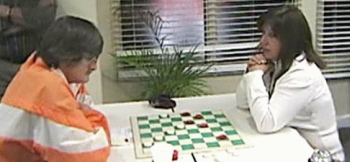
Black: Irma Sierra
White: "Kokomo" a.k.a. Bill Shoffner
| 1. | 11-15 | 22-18 |
| 2. | 15x22 | 25x18 |
White opts for the Single Corner.
| 3. | 10-15 |
8-11 or 12-16 are more common lines but this move can also be played.
| 3. | ... | 18x11 |
| 4. | 8x15 | 29-25 |
| 5. | 4-8 | 25-22 |
| 6. | 8-11 | 24-19 |
23-18 is common here, though the text move is quite good.
| 7. | 15x24 | 28x19 |
| 8. | 9-14 | 22-18 |
The computer suggests 27-24 or even 30-25, but White's move is fine.
| 9. | 6-10 | 18x9 |
| 10. | 5x14 |
The game is being played very accurately by both sides.
| 10. | ... | 26-22 |
| 11. | 11-16 |
One could argue that 11-15 is slightly more accurate, playing into the center.
| 11. | ... | 22-18 |
| 12. | 1-5 |
This returns to a computer book position!
| 12. | ... | 18x9 |
| 13. | 5x14 | 31-26? |
BLACK
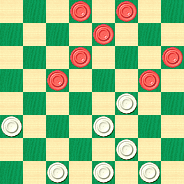
WHITE
White to Play and Draw
W:W32,31,30,27,23,21,19:B16,14,12,10,7,3,2.
We're asking to solve two problems here. First, correct White's 31-26. What should Kokomo have played instead? Second, find the winning line of play for Black after White's 31-26. How can Irma win the game?
WHITE
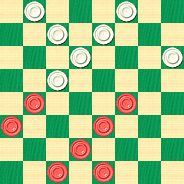
BLACK
Black to Play and Win
B:W32,30,27,26,23,21,19:B16,14,12,10,7,3,2.
When you have your answers, click on Read More to see the solutions as well as the actual conclusion of the game.
You can email the Webmaster with your comments on this article.
Christie's Shot
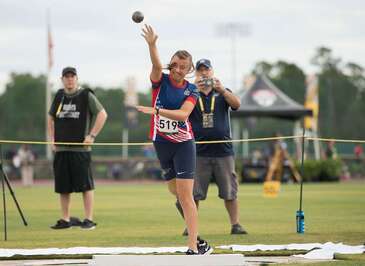
NARA & DVIDS Public Domain
In our photo, it looks like U.S. Air Force Captain Christy Wise is about to throw the shot put. We don't know, however, if Captain Wise also plays checkers; and our subject for today is of course a checker shot known most appropriately as "Christie's Shot." However, that's Henry Christie of Great Britain ... and we're getting ahead of ourselves. Willie Ryan, in his classic Tricks Traps & Shots of the Checkerboard presents both the history and practice of this deft maneuver. Let's let Willie take over the narrative.
"In the 1891 English Tourney, Champion Henry Christie hooked J. L. Richmond on the following blitzer, and ever since it has been known as the Christie Shot. However, some authorities claim Charles Hefter dropped J. P. Reed on the same scoop prior to 1891. Actually, the Christie Shot was first shown by E. Jacques of Malvern, Ont., Canada, in 1865, bringing up the stroke from a Cross game. Hence, Jacques was first. But it remained for Christie to give the coup historical significance. In this book, I have followed the policy of several authors, by labelling the stroke on the next page 'Christie's Shot,' so as to distinguish it from the Jacques Shot on page 95.
| 11-15 | 23-18 | 4- 8 |
| 22-18 | 6-10 | 19-15 |
| 15-22 | 25-21 | 6- 9 |
| 25-18 | 10-17 | 23-19 |
| 12-16 | 21-14 | 17-22 |
| 29-25 | 2-6---A | 26-17 |
| 9-13 | 26-23 | 9-13 |
| 18-14 | 13-17 | 15-10---C |
| 10-17 | 31-26 | 13-22 |
| 21-14 | 8-11 | 19-15. |
| 16-20 | 24-19 |
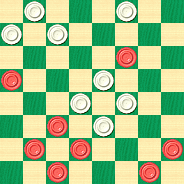
BLACK
Black to Play and Win
B:W32,30,28,27,18,15,14,10:B22,20,11,8,7,5,3,1.
A---Black can shoot for an alternative fast win by: 1-6, 26-23, 13-17, 31-26, 6-9, 24-19, 9-13, 14-9---B, 5-14, 18-9, 2-6, 9-2, 17-22, etc.
B---Into the cauldron! The correct sequence for a draw is: 19-15---1, 17-22, 26-17, 13-22, 14-9, 5-14, 18-9, 22-26, 9-5, 26-31, 5-1, 31-24, 28-19, 20-24,1-5, 8-11,15-8, 4-11, 5-9, 7-10, 9-13,11-15, 23-18, 15-22, 13-17, 22-26, 30-23, 24-27. J. Tonar.
C---Another good game gone wrong. White should play: 19-16, 13-22, 16-12, 1-6, 27-23, 22-25*, 30-21, 7-10, 14-7, 3-26, 12-3, 6-9, 3-7, 11-16, 32-27, 9-14, 18-9, 5-14, 7-10, 16-19, 10-17, 26-31; a draw. F. C. Oakley."
1---28-24 also draws---KingsRow.
Can you "drive" to a win, or have you "sliced" off a little too much? You can always "hook" the solution by clicking on Read More to see the proper follow-through.
You can email the Webmaster with your comments on this article.
The Triplets
PICRYL CC0
The triplets shown above are surely too young to study today's extensive Checker School lesson... although you never know for sure. However if you're reading this column and are not yet at the expert level, perhaps you might wish to pay close attention to today's class.
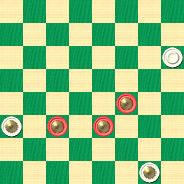
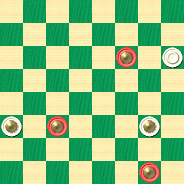
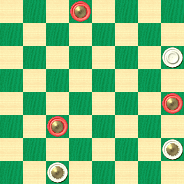
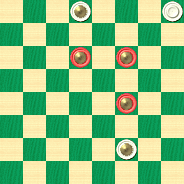
The checker "triplets" we'll set out are known as the Bowen Triplets, presumably because there are three related positions with three pieces on each side. In addition, we have nine other, similar positions, all of which also involve three pieces per side.
Let's see, that's three pieces per side, six pieces total, twelve positions in all ... we had better stop there and just present our material, which comes from Ben Boland's classic text Famous Positions in the Game of Checkers.
Note: for the sake of consistency, in all positions White is at the top and Black at the bottom, regardless of who is to move.
| R. E. BOWEN 1 | R. E. BOWEN 2 | R. E. BOWEN 3 |
| WHITE | WHITE | WHITE |
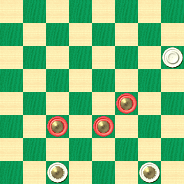 | 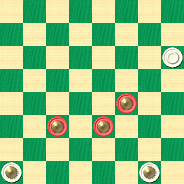 |  |
| BLACK | BLACK | BLACK |
| Either Plays, Black Wins | Either Plays, Black Wins | White to Play and Draw |
| Black to Play and Win | ||
| B:W21,K3,K1:BK14,K11,K10. | B:W21,K4,K1:BK14,K11,K10. | B:W21,K12,K1:BK14,K11,K10. |
| Dr. T. J. BROWN 4 | J. GORDON 5 | E. CLARK 6 |
| WHITE | WHITE | WHITE |
 |  |  |
| BLACK | BLACK | BLACK |
| White Plays, Black Wins | Black to Play and Win | White to Play and Draw |
| W:W21,K12,K9:BK22,K11,K1. | B:W21,K20,K5:BK19,K18,K14. | W:W21,K5,K3:BK31,K13,K11. |
| D. MILLIGAN 7 | B. TAYLOR 8 | J. K. LYONS 9 |
| WHITE | WHITE | WHITE |
 |  |  |
| BLACK | BLACK | BLACK |
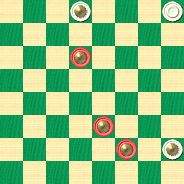
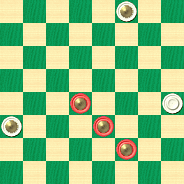
| White to Play and Draw | Black to Play and Win | White to Play and Draw |
| W:WK31,29,K6:BK23,K22,K14. | B:WK31,29,K5:BK23,K10,K6. | W:WK30,13,K12:BK15,K10,K6. |
| C. NELSON 10 | A. W. VALENTINE 11 | W. J. ZAHL 12 |
| WHITE | WHITE | WHITE |
 |  | 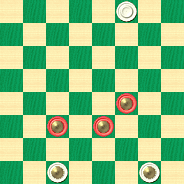 |
| BLACK | BLACK | BLACK |
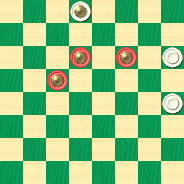
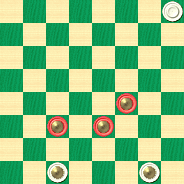
| Black to Play and Win | White to Play and Draw | Either Plays, Black Wins |
| Black to Play and Win | ||
| B:WK31,21,13:BK23,K22,K19. | B:W29,K3,K1:BK14,K11,K10. | B:W30,K3,K1:BK14,K11,K10. |
It will take you some little while if you wish to work through all of these, but if you take the time and put in the effort, you cannot help but improve your play. So, we suggest that you double--- or better yet, triple--- your efforts and search out the answers. And, for extra credit, if twins are two, triplets are three, and so on ... can you tell us what twelve are called?
When you're done, you can click on Read More to see Mr. Boland's usual detailed solutions and copious explanatory notes, as well as the answer to our trivia question.
You can email the Webmaster with your comments on this article.
The Checker Maven is produced at editorial offices in Honolulu, Hawai`i, as a completely non-commercial public service from which no income is obtained or sought. Original material is Copyright © 2004-2026 Avi Gobbler Publishing. Other material is public domain, AI generated, as attributed, or licensed under CC1, CC2, CC3 or CC4 and the various CC options. Information presented on this site is offered as-is, at no cost, and bears no express or implied warranty as to accuracy or usability. You agree that you use such information entirely at your own risk. No liabilities of any kind under any legal theory whatsoever are accepted. The Checker Maven is dedicated to the memory of Mr. Bob Newell, Sr.