The Checker Maven
The World's Most Widely Read Checkers and Draughts Publication
Bob Newell, Editor-in-Chief
Published every Saturday morning in Honolulu, Hawai`i
Noticing missing images? An explanation is here.
Marvin at Summer Training Camp
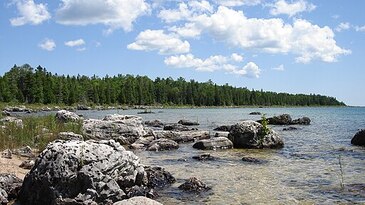
August was in its latter half, and it was time for all the teams in the National Checker League to go to training camp prior to the start of the new season in September.
The Detroit Doublejumpers, the reigning American champions, held their camp in Michigan's Upper Peninsula, at a rustic but elegant resort near the town of (most appropriately) Au Train. There was plenty of room for the team's 15 person compliment of players and coaches, and there were many recreational options available after a hard day of training.

Marvin J. Mavin
Beer, however, was strictly forbidden, as was any sort of alcoholic beverage. And that annoyed the Doublejumper's team captain, Marvin J. Mavin.
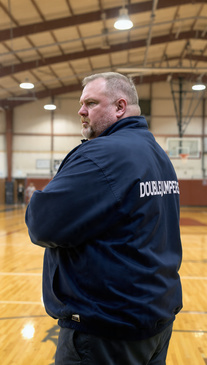
Coach Ronaldson
After a summer vacation that featured beer-at-will, Marvin was out of shape, and Head Coach Clyde Ronaldson made a point of insisting that his players be in top mental and physical condition. He well understood that professional checkers requires endurance and stamina.
Marvin didn't like the physical training at all. But there was no doubt that Coach Ronaldson ran the team. When Marvin checked in to camp, Coach took one look at him and immediately assigned him extra jogging and weight-lifting sessions. Marvin, who was always just on the edge of getting into trouble, kept quiet in front of the Coach, but grumbled to himself.
"How am I supposed to work on my game when I'm running laps up and down the lake?" he said. "And how can I relax and cool down without a tall cool one?"

It got worse. One day when Marvin lagged behind the rest of the team in the daily group run--- held at 5:30 in the morning--- he was assigned to play a simul against the rest of the team. That meant facing off against 9 other high-level professional players. He would have to run one half-mile lap for each draw and two for each loss; and to top it all off he would be playing White on each board.
Marvin was already exhausted from the morning run. He was further allowed only a salad and a glass of water for lunch as Coach said he was overweight and restricted his diet.
He was just beside himself. He was pretty sure he could beat the lower six players, but the next three were going to be trouble, and he didn't look forward to running still more laps in the afternoon heat.

At one o'clock on the dot, the players assembled on the canopy covered outdoor patio. Coach blew his whistle, looked Marvin straight in the eye, and said, "Play Checkers!"
It must be said that Marvin put in a great effort, and things went very well for him. He quickly won his games on the lower four boards, won the next three soon thereafter, and after another twenty minutes won on Board Two.
But Board One didn't look so good. He was playing against his Associate Captain, Pete Butterworth, a highly skilled player. In one-on-one competition, Marvin generally held a slight edge, but in a simul, Pete often had something of the upper hand.

Pete Butterworth
Public Domain
If Marvin could win, he wouldn't have to run any laps, and at the moment, the thought of even a single lap was more than he could bear. Unless it was a lap into town to pick up a six-pack, but that would get him suspended from the team for sure.
However Marvin, with White, found himself in a man-down position. He was pretty sure he could draw, but he needed to find a win. That was asking for a lot.
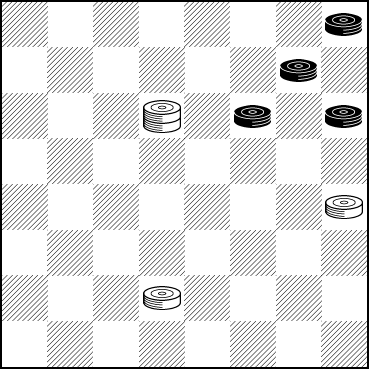
WHITE
White to Play and Win
W:WK10,20,26:B4,8,11,12
"Sorry, Marv," Pete said. "Hate to have you run those laps, but ..."
Marvin, fidgeting in his chair as he so often did, replied, "Yeah ... me too. Maybe there's something here ..."
He thought for a while longer, and then gave Pete a little smile. "Watch this!" he said, and made his move.
Can you come up with a White win in this situation? If not, you'll be running laps! (On a volunteer basis, of course.) See if you can win it with White and then click on Read More to see the solution and the conclusion to our story.
You can email the Webmaster with your comments on this article.
ReVEALed
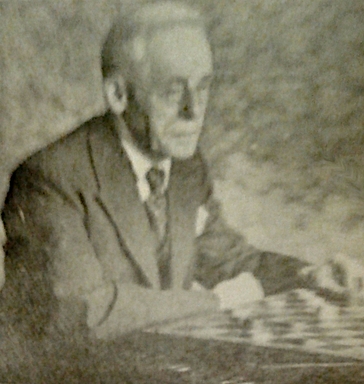
Public Domain
Our Checker School series has recently featured 'gem' problems from noted problemist William Veal. Today we conclude the series and "reVEAL' a photo of Mr. Veal in his later days. The photo appeared in a 1952 edition of Elam's Checker Board while noting Mr. Veal's passing. The Checker Maven thanks correspondent (and himself a champion problemist) Ed Atkinson for the photo.
Now let's look at today's problem.
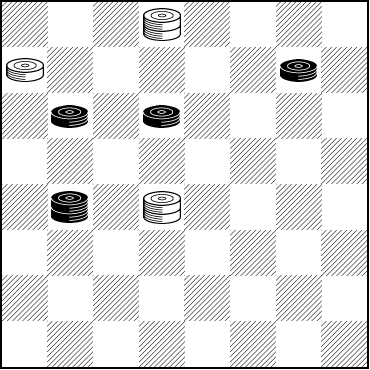
BLACK
Black to Play and Win
B:WK15,28,K31:BK16,23,24,25
White is a man down but is about to even the count. Yet Black, through clever play, can still win it. The problem is about 'medium' in difficulty and reVEALs a nice little tactical trick. Can you find it? You know what we're going to say--- clicking on Read More will reVEAL the solution.
You can email the Webmaster with your comments on this article.
Person Overboard

Man (person!) overboard! It's an emergency situation and we'd best hope someone trained and experienced in water rescue is on hand.
Something similar occurs in our game of checkers. One of our men goes overboard, we're down a piece, and we're looking to find a way to get a draw.
That's the situation for White in the diagram below. But there is a way to pull off a draw, if you can see it. We'd call this a "not quite" speed problem. It isn't too difficult but you can easily go wrong.
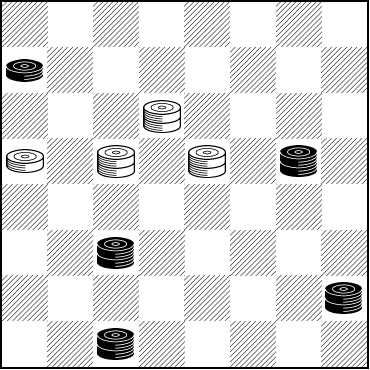
WHITE
White to Play and Draw
W:WK10,13,K14,K15:B5,K16,K22,K28,K30
Are you trained and experienced in man down (man overboard) situations? You won't have to go too far overboard to solve this one; but a life preserver is always at hand. Just click on Read More to see the solution.
You can email the Webmaster with your comments on this article.
Coffee and Cake at the Beacon
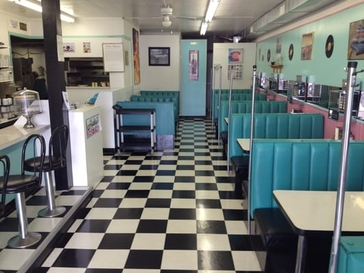
It was another Saturday afternoon at The Beacon Cafe in the Provident Life Building in Bismarck, North Dakota, and the Coffee and Cake Checker Club was in session in one of the large booths.
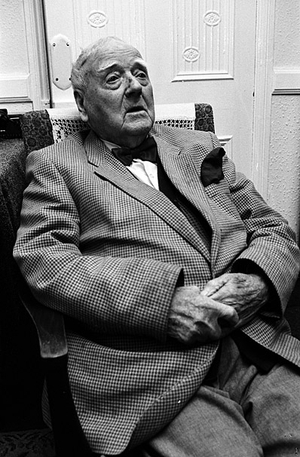
Sal
Sal was the leader and there were five others present today. It was cloudy, windy, and chilly outside and the coffee was flowing.

Mike
After the boys (all of whom were at least 50 years old) had played an hour or so of informal games, one of them, Mike, said, "Hey Sal, don't you have a coffee and cake problem today? You didn't have one last week and I've been kind of wanting to win another piece of cake off you."
Sal frowned. The last time he tried, Mike had indeed solved Sal's problem and Sal had to buy coffee and cake. But then Sal's frown turned into a smile. "Matter of fact, Ed sent me a real nice one."
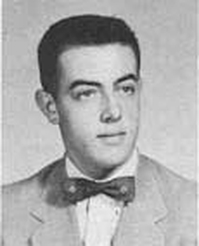
Ed
"Uh-oh," Mike said. Whenever Sal had a problem from either Brian in St. Louis or Ed in Harrisburg, it was bound to be tough. Top quality for sure, but never easy.
Sal leaned back against the seat. "Are you up for it?"

Deana
Mike and the rest of the group hesitated a little, but Deana, the owner, knowing just when to jump in, said from behind her counter, "I've got fresh apple kuchen this afternoon, boys!"
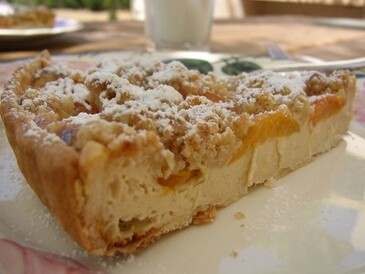
Well, that did it. Deana's apple kuchen, like most of her desserts, was irresistible.
"Lay it out," Mike said to Sal, pointing to one of the checkerboards, "and pretty soon I'll be enjoying that kuchen you're going to buy me."
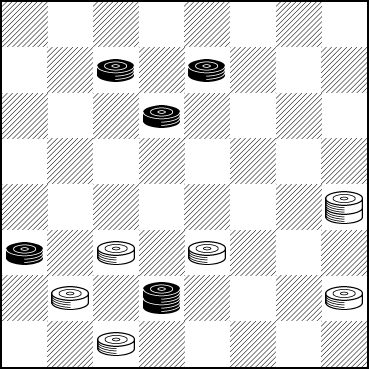
WHITE
White to Play and Win
W:WK20,22,23,25,28,30:B6,7,10,21,K26.
"There it is," Sal said after setting up the position. "Take your time. Just not too long. I don't want to have to rush the kuchen that you'll be buying me, Mike!"
Mike laughed. "We'll see about that," he said. But five minutes later, all of the boys were still scratching their heads.
"I'll give you five more minutes but that's it," Sal said. He was greeted by the usual groans.
Once again we're asking if you can win coffee and cake from Sal, but unlike at The Beacon, you can take all the time you wish. When you're finished, click on Read More to see the solution.
You can email the Webmaster with your comments on this article.
A Small Slice of Veal
pxhere CC0
Some of us need to be on diets. 1,000 calories a day, maybe? That doesn't allow for much. Salads with no-fat dressing, if any dressing at all; steamed vegetables (hold the butter, thank you), and a little protein. Just a little.
Fortunately our game of checkers doesn't involve diets, but it can involve small servings in the form of miniature problems. Today in Checker School we continue with another composition by William Veal--- a small slice, if you will. (We seem to be seeing a lot of Mr. Veal recently!)
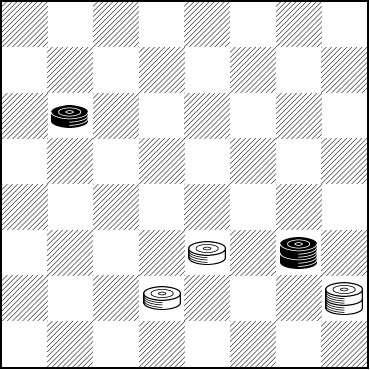
WHITE
Black to Play, White Wins
B:W23,26,K28:B9,K24.
Well, yes, White is a man up and should win, but maybe it's not as easy as all that. The White men look pretty exposed and Black might be able to chase one of them down ... but we'll let you figure out the best line of play. In the end, it's a fairly small effort. So slice (and dice) this one, and then click on Read More to see the solution.
You can email the Webmaster with your comments on this article.
Summer Speed

Pexels CC0
Summer speed. It can mean a number of things, but today we encourage you to enjoy the way things slow down to 'summer speed' during those long, warm days. Take some time to relax and get out of the daily rat race that persists during the larger part of the year. Surely take time to enjoy a little checkers.
So for us, today, 'summer speed' refers to a nice little speed problem provided by regular contributors Lloyd and Josh Gordon of Toronto. This one falls into the 'very easy' category so we won't even bother with the Javascript clock. Just solve it at whatever speed you like.
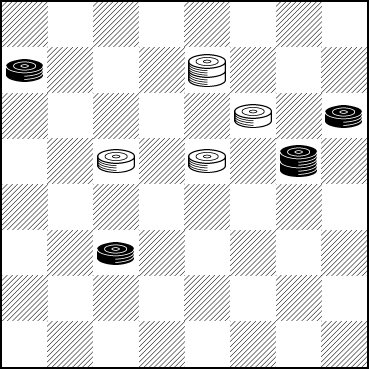
WHITE
White to Play and Win
W:WK7,11,14,15:B5,12,K16,22.
Surely you've solved it already, but if you'd like to double-check, click on Read More to see the snappy solution.
You can email the Webmaster with your comments on this article.
4th of July Week
When this column first appears, we'll be just a few days away from the Fourth of July, America's birthday and one of our favorite holidays. We never tire of saying that we are unapologetic American patriots with a deep appreciation for our freedom and democracy. We're not one of those who believes that America is responsible for the ills of the world and we're proud of what's good about our nation.
We always turn to Tom Wiswell on this holiday. Mr. Wiswell, as we've so often noted, was a patriot who served our nation as did so many members of the Greatest Generation.
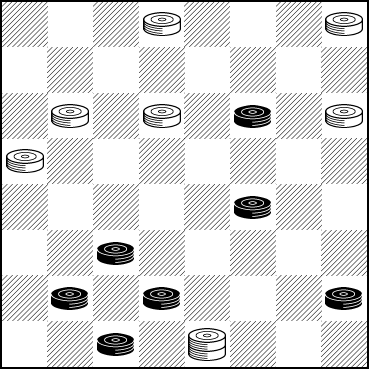
BLACK
Black to Play and Draw
B:WK2,20,21,23,24,29,31:B3,5,7,8,11,14,22.
It's indeed a nice problem, as we have come to expect from Mr. Wiswell. Give it a good try and then click on Read More to see the solution and notes.
You can email the Webmaster with your comments on this article.
William Veal
Public Domain
William Veal was a British problemist of some renown, perhaps best known (to us, at least) for composing a monster stroke problem featured some years ago in our columns.
Did Mr. Veal's ancestors at one point deal in veal? That would fit with popular theory, which insists that names like "Smith" eventually trace back to someone who was a smith, and so on. Of course, those links are likely very tenuous if they exist at all.
But one other possibility was turned up by our Research Department. "Vieil" is the Old French term for "old" and this became "viel" in Anglo-Norman French. It refers to an old man or the elder of two people with the same name. It's not a long leap from there to "Veal."
A long leap? That brings us back to checkers and this month's Checker School column, the first of a series of "gems" from, of course, William Veal.
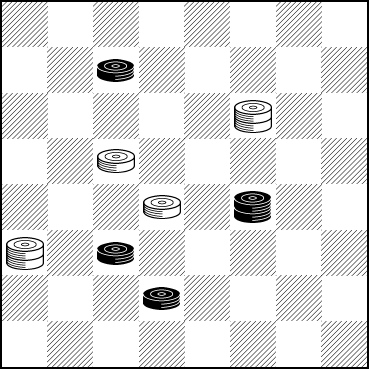
WHITE
White to Play and Win
W:WK11,14,18,K21:B6,K19,22,26.
Certainly at first glance a White win is anything but obvious, and Black is poised to crown one or perhaps two of his men. Can you match Mr. Veal and find the solution? There's a bit of a clue (just a bit) in the writeup above. See how you do and then click on Read More to see the solution.
You can email the Webmaster with your comments on this article.
Short and Neat
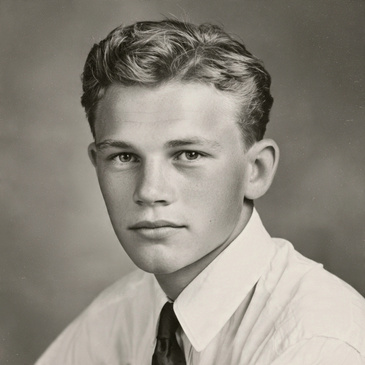
In the latter 1940s, back in the heydays of checkers, men's hairstyles were short and neat, and in general, appearances were more dressy than today. Men wore fedoras, and a suit with a white shirt and tie was almost a sort of uniform.
The following problem was published anonymously in an old newspaper, which declared it to be "short and neat." We're surprised it didn't appear next to an advertisement for grooming products!
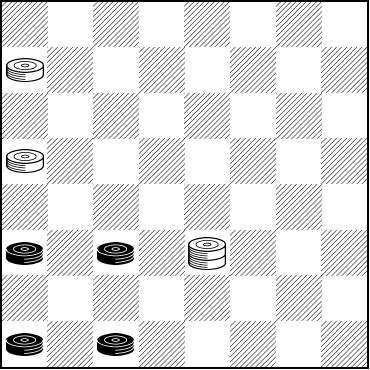
BLACK
Black to Play and Win
B:WK10,20,28:B3,4,11,12.
Short and neat? We'll let you decide, but in any case Black, being a piece up, ought to win. Yet as we've often said, showing the win is the hard part. Can you find a short and neat solution? Or even a long and messy one? Give it a try--- more than a short try--- and then neatly click your mouse on Read More to see the solution.
You can email the Webmaster with your comments on this article.
The Deep End
PxHere CC0
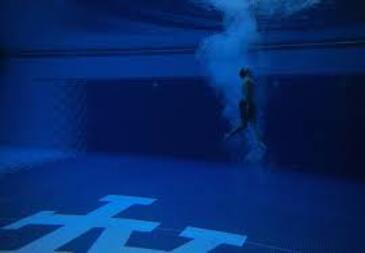
We're definitely diving into the deep end with this month's mind-boggling stroke problem. You'll really need to keep your wits about you to solve this one.
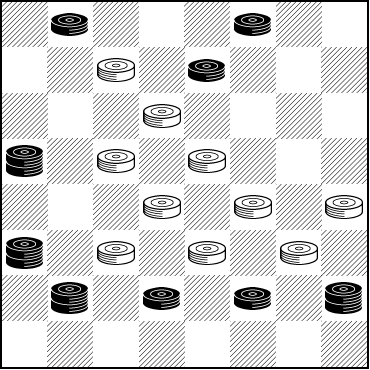
WHITE
White to Play and Win
W:W6,10,14,15,18,19,20,22,23,24:B1,3,7,K13,K21,K25,26,27,K28.
Can you solve it without moving the pieces? It's an enormous test of visualization skills. And though it's hardly a practical over the board situation, we think this sort of problem builds your ability to see ahead and calculate (and do go ahead and move the pieces if it's all just a bit too deep).
Don't go off the deep end yourself; try it out and then click on Read More to dive into the solution.
You can email the Webmaster with your comments on this article.
The Checker Maven is produced at editorial offices in Honolulu, Hawai`i, as a completely non-commercial public service from which no income is obtained or sought. Original material is Copyright © 2004-2026 Avi Gobbler Publishing. Other material is public domain, AI generated, as attributed, or licensed under CC1, CC2, CC3 or CC4 and the various CC options. Information presented on this site is offered as-is, at no cost, and bears no express or implied warranty as to accuracy or usability. You agree that you use such information entirely at your own risk. No liabilities of any kind under any legal theory whatsoever are accepted. The Checker Maven is dedicated to the memory of Mr. Bob Newell, Sr.