The Checker Maven
The World's Most Widely Read Checkers and Draughts Publication
Bob Newell, Editor-in-Chief
Published every Saturday morning in Honolulu, Hawai`i
2025 World Championship Match
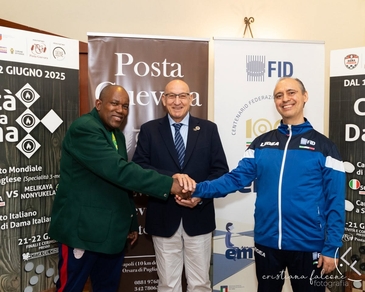
From June 14 to June 22 in 2025 at a site in Italy, 3-Move World Champion Sergio Scarpetta defended his title against challenger Melikaya Nonyukela. The match was tense and exciting and went to the very last game. The final score was 16-16, comprised of 3 wins per player and 26 draws. With a tie score, the title remained with Mr. Scarpetta but Mr. Nonyukela showed himself to be a player of championship rank and a force to be reckoned with.
Grandmaster Richard Pask has annotated all 32 games of the match and presented them in a new booklet which he has generously allowed us to make available for free download from our website. Get your copy here; these games are definitely worthy of many hours of study and enjoyment.
As a sample, let's look at a position later in Game 32, the last in the match. At that point Mr. Scarpetta led by 16-15 but Mr. Nonyukela had the opportunity to play for a win and bring the match to an overall draw.
Here's the critical position.
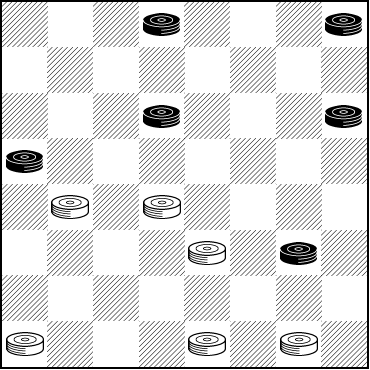
WHITE
White to Play and Draw
W:W17,18,23,29,31,32:B2,4,10,12,13,24
What would you have done here? What would be the outcome? This faced Mr. Scarpetta at the very end of the very last game. See what you might do, and then download the book and turn to Game 32 to see the run-up, full notes, and the surprising outcome.
Once again we thank Mr. Pask for the privilege of presenting his work.
You can email the Webmaster with your comments on this article.
Postal Play
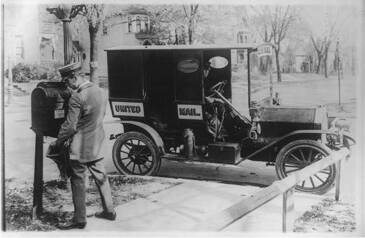
PICRYL CC0
Postal play in checkers used to be a big thing. The late legendary Richard Fortman was one of the postal greats. Mac Banks, in our own day, is another big name in postal play. But by and large postal play has disappeared. Certainly there are no more postal championships.
The reason, of course, is the rise of the computer as a virtually unbeatable resource; unless matches are strictly played by what we shall call "gentleperson" rules, on the honor system, promising to not use computers, every match is likely to be 100% draws. And even on the honor system, there are now excellent references, vetted by computers, that ensure one side or the other won't get an advantage.
So it's refreshing to come across an actual, current day postal game, played strictly without references. Grandmaster Richard Pask sent us the annotated transcript of a recently completed game with Ron Green, which Mr. Pask says gives us "(a)n important addition to the literature of the 9-13 23-19; 10-15 ballot."
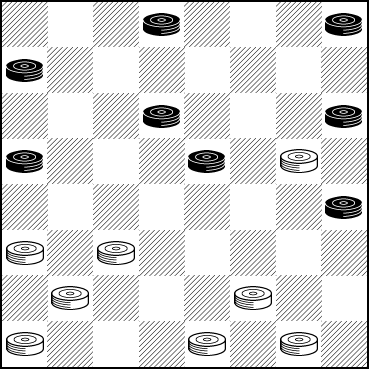
WHITE
White to Play and Draw
W:W16,21,22,25,27,29,31,32:B2,4,5,10,12,13,15,20
We'll present this in the manner Mr. Pask did in his notes, as a two-part problem. If you wish to take on the full challenge, look at the first diagram (above). Work out what you might play from there; then see what you might do at the second diagram (below). We have omitted the run-up and the continuation; those will be found along with the solutions.
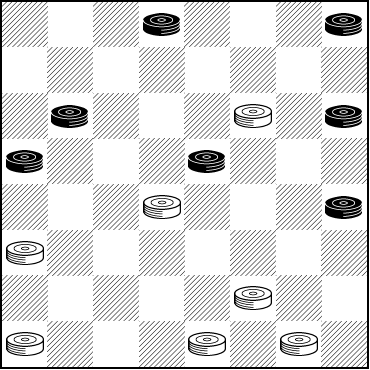
WHITE
White to Play and Draw
W:W11,18,21,27,29,31,32:B2,4,9,12,13,15,20
After all of this, click on Read More to see Mr. Pask's complete write-up.
You can email the Webmaster with your comments on this article.
The Various Meanings of "Run Down"
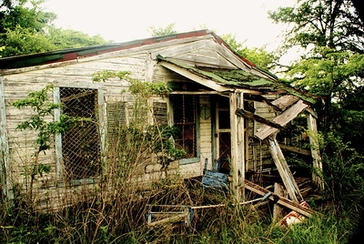
The short term "run down" can mean several things in the rather flexible English language. That building above certainly is run down, meaning dilapidated, neglected, in bad condition. If you're ill, you might be feeling "run down." And there are other meanings; a crime suspect might be "run down" by the police. A pedestrian, heaven forbid, might get run down in traffic. Or in baseball, a baserunner might be caught in a rundown (no hyphen) and tagged out.
In the game of checkers, a piece might get "run down" and captured. That's something of a hint for today's problem. Let's look at the run up to the run down.
| 1. | 10-14 | 22-18 |
| 2. | 11-16 | 26-22 |
| 3. | 7-10 | 24-19 |
| 4. | 8-11 | 28-24 |
| 5. | 16-20 | 30-26 |
| 6. | 9-13 | ... |
If you search for this move in online databases, such as Checker Cruncher, you'll see one game in which this move occurs, and Black wins that one (there may be others that we didn't find). But actually 9-13 loses! Can you correct this? There are several moves that would draw here.
| 6. | ... | 18x9 |
| 7. | 5x14 | ... |
Alas, after the exchange, Black is in a loss. But White will need to demonstrate good cross-board skills and make a number of star moves to pull off the win.
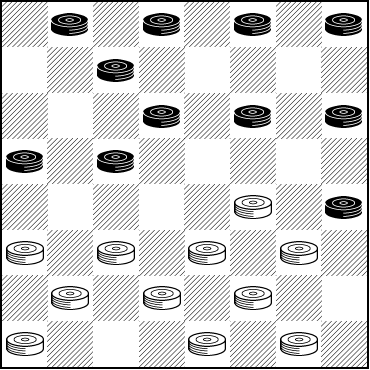
WHITE
White to Play and Win
W:W19,21,22,23,24,25,26,27,29,31,32:B1,2,3,4,6,10,11,12,13,14,20
The solution is a bit long, but don't let this problem run you down; instead, run down the solution and then run your mouse down to Read More to check your work.
You can email the Webmaster with your comments on this article.
4th of July 2023
Presidio of Monterey CC0
We never get tired of saying that we love the 4th of July, America's birthday. We are proud and unapologetic American patriots.[1]
For our 4th of July column, we always turn to an American checkerist. Often it's Tom Wiswell but today we'd like to feature another of America's all-time greats, Willie Ryan, with a game and problem from his aptly titled American Checkerist publication. Let's start with the run-up.
| 1. | 10-15 | 21-17 |
| 2. | 9-13 | 17-14 |
| 3. | 15-18 | ... |
Ryan calls this a probable loss but today we know that although perhaps not the best choice, it doesn't lose.
| 3 | ... | 22x15 |
| 4. | 11x18 | 24-19 |
Once thought to win, but only draws with correct play by Black.
| 5. | 8-11 | 28-24 |
| 6. | 6-9 | ... |
The losing move. Correct would have been 4-8 or 6-10. it's easy for Black to go wrong in this line.
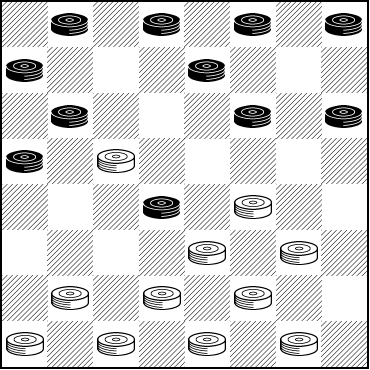
WHITE
White to Play and Win
W:W14,19,23,24,25,26,27,29,30,31,32:B1,2,3,4,5,7,9,11,12,13,18
The winning line is quite long, and not all that easy to discover. However, it's very instructive and this problem is well worth your time. See how far you can go, and then click on Read More to see the solution.
[1] Tragically, today to some the concept of patriotism is viewed as politically incorrect at best and racist at worst. We strongly disagree, and prefer the statement put forth by Gaines Foster of Louisiana State University: " ... you're an American because you believe in democracy, you believe in equality, you believe in opportunity."
You can email the Webmaster with your comments on this article.
A Well-Rounded Gentleman
Public Domain
You may never have heard of him, but Theodore "Ted" Bullockus was one of those well-rounded fellows who was good at both checkers and chess. Mr. Bullockus was born on May 29, 1917; we don't have any further information about his life and career, although he apparently was born in the Bronx, where his Lithuanian parents lived. Mr. Bullockus passed away on October 11, 2008, in Sun City, California (now part of the Menofee retirement community).
We could only find one grainy photo of this gentleman, taken during a chess tournament some years back. But he must have been quite capable. We located this checker study of his, based on a Wood Mail Tourney game (players unknown). Here's the run-up.
| 1. | 9-14 | 22-17 |
| 2. | 5-9 | 17-13 |
| 3. | 1-5 | 24-19 |
| 4. | 11-16 | 28-24 |
| 5. | 16-20 | 32-28 |
| 6. | 8-11 | 19-16 |
| 7. | 12x19 | 24x8 |
| 8. | 4x11 | 23-19 |
| 9. | 11-15 | 19-16 |
| 10. | 15-18 | 16-12 |
| 11. | 10-15 | 26-23 |
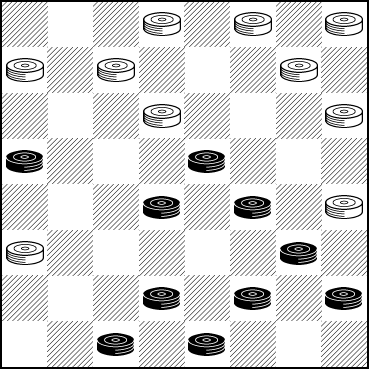
26-22 would have drawn, but now Black has a win. Can you find it?
BLACK
Black to Play and Win
B:W12,13,21,23,25,27,28,29,30,31:B2,3,5,6,7,9,14,15,18,20
Match wits with Mr. Bullockus and see how you do. When you're ready, click on Read More to see the solution.
You can email the Webmaster with your comments on this article.
Fix Me
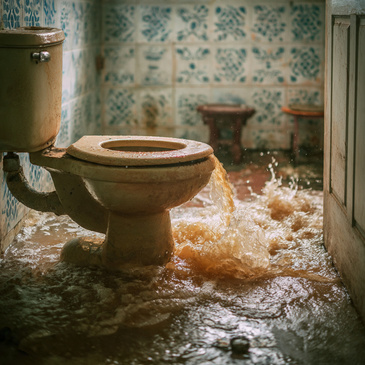
It looks like some fixing is in order here. This could be among the worst home repair jobs possible. What a mess!
Some checker games need to be fixed, too, and "fixing" will be the point of today's Checker School column.
We came across a game played in the 1920 Pennsylvania State Championship Tournament which could, well, use some work. It's not that the players were unskilled. In fact, most of the game is well played. But there were three significant errors, all of which could have been fixed. Let's have a look.
Black: O. Zanger
White: H. B. Reynolds
| 1. | 10-14 | 23-19 |
| 2. | 6-10 | 22-17 |
| 3. | 9-13 | 27-23 |
| 4. | 13x22 | 25x9 |
| 5. | 5x14 | 29-25 |
| 6. | 11-15 | 25-22 |
| 7. | 8-11 | 32-27 |
| 8. | 4-8 | 22-17 |
| 9. | 2-6 | 17-13 |
WHITE
BLACK
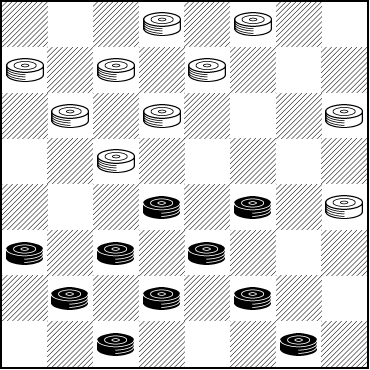
Black to Play and Draw
B:W13,19,21,23,24,26,27,28,30,31:B1,3,6,7,8,10,11,12,14,15
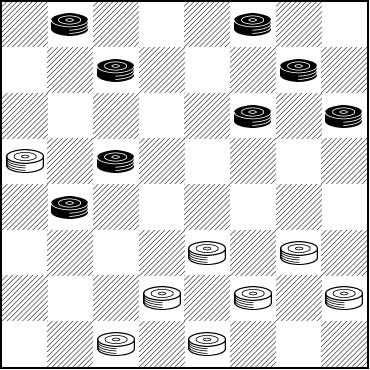
| 10. | 14-17 | ... |
This moves loses. In Diagram 1 above, fix me!
| 10. | ... | 21x14 |
| 11. | 10x17 | 19x10 |
| 12. | 7x14 | ... |
BLACK
WHITE
White to Play and Win
W:W13,23,24,26,27,28,30,31:B1,3,6,8,11,12,14,17
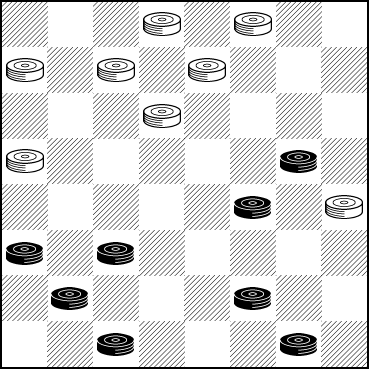
| 12. | ... | 24-20 |
This move gives up the win and only draws. In Diagram 2 above, fix me!
WHITE
BLACK
Black to Play and Draw
B:W13,20,23,26,27,28,30,31:B1,3,6,8,11,12,14,17
| 13. | 3-7 | ... |
This move loses. In Diagram 3 above, fix me!
| 13. | ... | 23-19 |
| 14. | 17-21 | 27-23 |
| 15. | 14-17 | 23-18 |
| 16. | 6-10 | 26-22 |
| 17. | 17x26 | 31x22 |
| 18. | 1-5 | ... |
The players left the game here as a White win.
| 18. | ... | 22-17 |
The White win is clear. Black is going to have to give up a lot of men.
Can you "fix" the three unfortunate moves above? Resolving actual over-the-board situations such as these is a great way to improve your own play. Don't fixate on this; just do the best you can, and then fix your mouse on Read More to see the correct moves.
And stay safe and well, checker fans, wherever you are.
You can email the Webmaster with your comments on this article.
Happy Holidays 2019

Pexels CC0
The holiday season is in full swing and we extend greetings and best wishes to all of our readers. No matter which holiday you celebrate, may you find happiness and blessing.
We thought we'd present a little longer study this week. Perhaps you'll have some extra spare time over the holidays (or perhaps not!), but in any case it's a good one. The problem situation is based on a game contested in Markham, Ontario, on April 15, 1889. The players were checkerists Fleming and Wright, and the game and variations appeared in a relatively short-lived periodical called The Chicago Evening Lamp.
| 1. | 11-15 | 23-19 |
| 2. | 8-11 | 22-17 |
| 3. | 9-14 | 25-22 |
| 4. | 11-16 | 24-20 |
| 5. | 16x23 | 27x11 |
| 6. | 7x16 | 20x11 |
| 7. | 3-7 | 28-24 |
| 8. | 7x16 | 24-20 |
| 9. | 16-19 | 29-25 |
| 10. | 4-8 | 22-18 |
| 11. | 14x23 | 17-14 |
| 12. | 10x17 | 21x14 |
Perfectly played thus far, and we've reached the end of the KingsRow opening book for the game as actually played.
| 13. | 8-11 | 31-27 |
| 14. | 19-24 | 27x18 |
| 15. | 12-16 | 32-28 |
This seemingly natural move actually loses. 25-22 would have been correct to draw.
| 16. | 24-27 | 28-24 |
| 17. | 27-31 | 25-22 |
| 18. | 31-27 | 24-19 |
| 19. | 16x23 | 26x19 |
Here the Lamp called the game a draw and showed a drawing line. But it's actually a Black win.
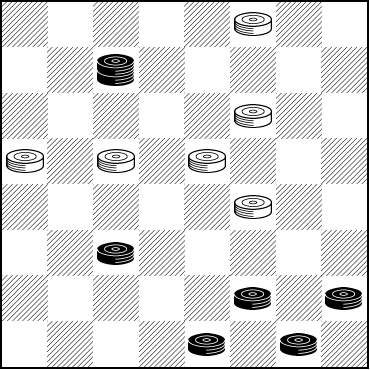
BLACK
Black to Play and Win
B:W14,18,19,20,22,30:B1,2,5,6,11,K27
Can you do better than the Lamp did, over 130 years ago? Shed some light on this interesting position, and then click on Read More to illuminate the solution and notes.
You can email the Webmaster with your comments on this article.
Season Opener

It was Opening Day for the National Checker League as the 2019-2020 season was about to begin, and Marvin J. Mavin, Captain of the defending champion Detroit Doublejumpers, was ready.

Marvin J. Mavin
August training camp had been rough, with lots of physical and mental training. But Marvin had to admit it felt good to be in top shape, even though he thought the coaches had been pretty tough on him. No beer for a whole month, and running laps constantly.
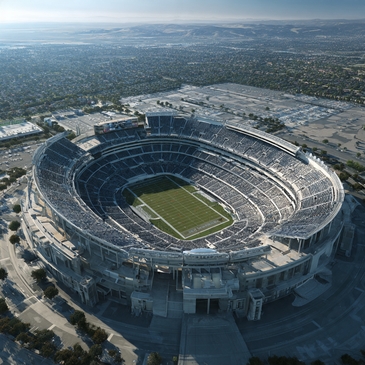
This afternoon, the Doublejumpers were facing the Seattle Single Corners at Starbugs Stadium in Seattle. A sellout crowd of over 50,000 was on hand to see what promised to be an exciting contest.
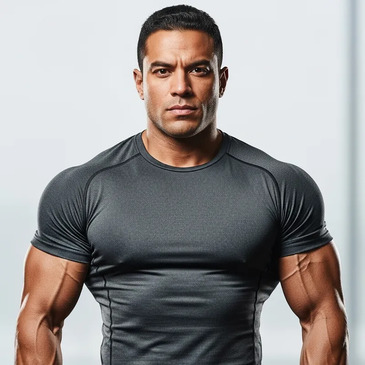
Marvin, on first board, was paired up against the Seattle captain, a short, squat fellow that just went by the name Sluggo. In high school and college, Sluggo was a champion weight lifter and wrestler, but he was so good at checkers that he decided to take a pro contract. Still, one look at him told you that he had definitely kept up the physical training.
Word had gotten around the League about Marvin's experiences in training camp this year, and Sluggo started to ride Marvin as soon as they took their places across the checkerboard.
"Heard you had to run some laps," Sluggo said. "Must a been tough for a wimp like you." Sluggo laughed, a deep, nasty sound that had intimidated many an opponent both over the board and in the ring.
"Yeah, well, unlike you I got a brain," Marvin said.
"Not very original," Sluggo replied, "and anyhow you won't have one yourself after I bust up your head."
"Hey! Are you threatening me? You can't do that!"
Sluggo looked Marvin right in the eye. "Really? Whatcha gonna do about it?" Sluggo raised his clenched fists to chest level.
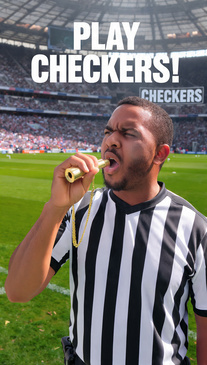
Marvin involuntarily took a step back, but just then the referee's whistle blew and the call "Play checkers!" resounded across the field.
Sluggo stuck out his hand for a handshake, but Marvin didn't take it. He was afraid Sluggo would break his fingers. That got another low laugh from Sluggo. "Have it your way, little boy," he said. "I'll beat you on the board, over the board, and into the board."
The game proceeded as follows. Marvin had Black and Sluggo had White.
| 1. | 11-16 | 23-18 |
| 2. | 10-15 | 18x11 |
| 3. | 8x15 | 24-19 |
| 4. | 15x24 | 27x11 |
| 5. | 7x16 | 28-24 |
| 6. | 4-8 | 22-18 |
| 7. | 8-11 | 26-23 |
| 8. | 16-20 | 31-27 |
| 9. | 6-10 | 18-14 |
| 10. | 10x17 | 21x14 |
| 11. | 9x18 | 23x14 |
| 12. | 11-15 | 30-26 |
| 13. | 3-7 | 26-23 |
| 14. | 1-6 | 25-21 |
Loses. 25-22 was correct.
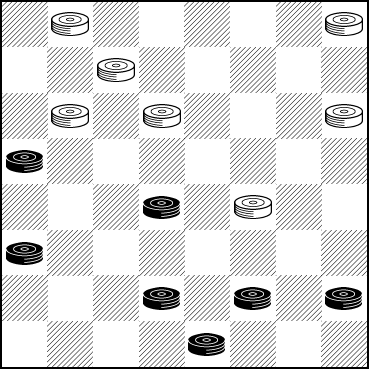
BLACK
Black to Play and Win
B:W14,21,23,24,27,29,32:B2,5,6,7,12,15,20
Marvin chuckled. "Hey, you did pretty well up to now--- for a lamebrain. But that last move is gonna cost you the game."
"Oh yeah?" replied Sluggo. "Sez who?"
"Sez me, Marvin J. Mavin."
"You're dead meat. Nobody beats Sluggo."
Marvin chuckled again. "We'll see about that," he said, and made his move.
Can you beat Sluggo? No, not on a wrestling mat, but over the board? See if you can find the win and then slam your mouse on Read More to see the solution and the conclusion of our story.
You can email the Webmaster with your comments on this article.
Marvin's Summer Vacation

Public Domain Pictures CC0
Marvin J. Mavin, Captain of the Detroit Doublejumpers, a highly ranked team in the National Checker League, was on summer vacation. The League wrapped up the World Series of Checkers in May, and players were off until training camp started up at the beginning of August.
Over eight weeks of vacation. He'd spend some of it with his girlfriend Priscilla, although she could only get away from her corporate executive job for a week at a time, and only now and then. He'd spend four weeks doing outreach work in the inner cities. And he'd spend three blessed weeks at a lake cabin, kicking back and thinking of little else but when to pop open his next beer. No cell phone. And definitely no checker board.
Except it didn't work out exactly like that.
Forest Service CC0
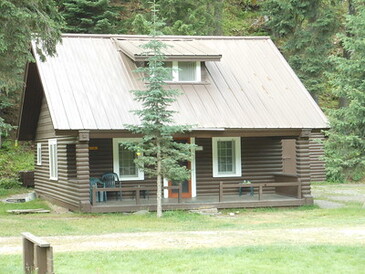
Marvin booked a cabin in Idaho under the name of John Smith. He thought that was pretty clever. Of course, he was a national sports figure and pretty easy to recognize, but he always looked for a cabin that was out of the way and isolated, and then he stuck pretty much to himself, arranging to have the refrigerator well stocked before his arrival, so that he could just hang around the cabin, walk down to the lake, and not be bothered by anything or anyone.
It must have been on the third or fourth day when he saw a familiar looking figure walking further down the lakeshore. Now, Marvin's cabin was indeed well separated from the others, so it was pretty far, but the figure was quite unmistakable. Marvin just hoped he hadn't been noticed, and he was pretty careful to check each time he went to the lake thereafter.
Two evenings later, Marvin had just finished with dinner --- he had plenty of microwave meals in the cabin's freezer --- he was about to open another beer when there was a knock at the cabin door.
Marvin was pretty surprised. Could it be the camp manager? No one else was supposed to bother him. He got up, opened the door, and saw ---
Dmitri.

Dmitri
Yes indeed, Dmitri Tovarischky. The guy he had seen further down the lakeshore. The guy who was his archenemy, a former Soviet champion who was asked to leave the National Checker League over a gambling violation, and who now stalked the star players.
"Ah, Checkers Boy. I see you other day by lake. How conwenient we are staying in same campsite," Dmitri said. "Maybe coincidence, maybe not, eh? I come in now, da?"
Dmitri entered before Marvin could reply.
Marvin made a mental note to later find out who leaked his vacation plans.
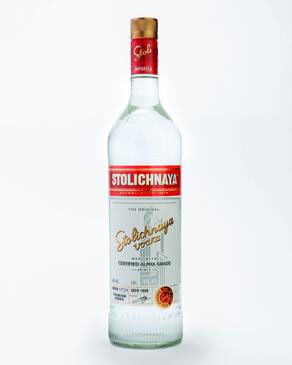
"We play one game, da?" he said. "Play maybe for wodka. I win, you give me couple bottles Stolichnaya. You win, I give you same thing, only you don't win, this I know already."
Pexels CC0
"I ain't got no 'wodka,' Pinko. Never touch the stuff. Now leave and don't come back."
"Ah, Checkers Boy should not be rude. I have little set here, I put on table." Boris quickly got out a portable checker set and made it ready. Marvin could tell it was going to be hard getting rid of him. "Maybe play for hundred bucks?"
So that was what it was all about. Dmitri was an inveterate hustler. Marvin replied, "Okay. One game. A hundred bucks to the winner. Nothing on a draw. But no matter what you get lost permanently."
"Easy money for me," Dmitri said. "Deal."
The two of them sat down and the game began. Outside, the sun was setting over the lake and the air was cooling. It was a beautiful Idaho evening but neither of them noticed.
NARA & DVIDS Public Domain
Dmitri played Black and Marvin had White.
| 1. | 11-15 | 23-19 |
| 2. | 8-11 | 22-17 |
| 3. | 4-8 | 26-22 |
| 4. | 9-13 | ... |
26-22 was weaker than 25-22. Perhaps Marvin was throwing Dmitri a bit of a curve ball? But Dmitri missed the opportunity to reply with 15-18.
| 4. | ... | 27-23 |
| 5. | 5-9 | 23-18 |
| 6. | 10-14 | 17x10 |
| 7. | 7x23 | 19x10 |
| 8. | 6x15 | 31-26 |
| 9. | 23-27 | 32x23 |
| 10. | 2-7 | 23-18 |
"Hoo, Checkers Boy, you are making stupid move. Why you not play 23-19? Now Dmitri have big winning game!"
| 11. | 7-10 | ... |
"Dmitri can even win by playing of 12-16. So many ways to win, so nice, da?"
Marvin, for his part, was starting to sweat. How could he have made such a blunder?
| 11. | ... | 21-17 |
| 12. | 1-5 | ... |
"Uh, hey there Commie, I think you blew it. You even mentioned 12-16 your own self, why didn't ya play it?" Marvin said.
"I am still going to win, Checkers Boy, do not worry yourself." But Dmitri sounded a bit less confident.
| 12. | ... | 25-21 |
| 13. | 9-14 | 18x9 |
| 14. | 5x14 | 26-23 |
| 15. | 11-16 | 30-25 |
| 16. | 16-19 | ... |
At this, Marvin started to laugh. "Nice try, get an early king, that's what you think? You shoulda played 8-11, pal. Now you lose."
| 16. | ... | 23x16 |
| 17. | 12x19 | ... |
WHITE
White to Play and Win
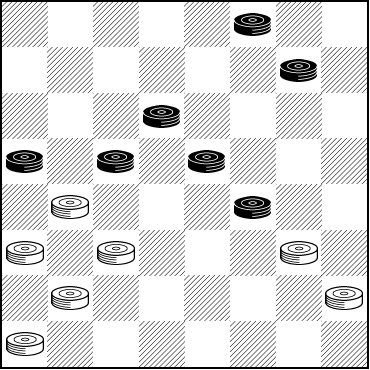
W:W17,21,22,24,25,28,29:B3,8,10,13,14,15,19.
Does Marvin now have a win on the board? Did Dmitri make a huge blunder in his own right? Study the position and see if you can find the winning moves. This one actually falls on the easy side. When you're ready, click on Read More to see the solution and the conclusion of our story.
You can email the Webmaster with your comments on this article.
Three Wrongs, One Right
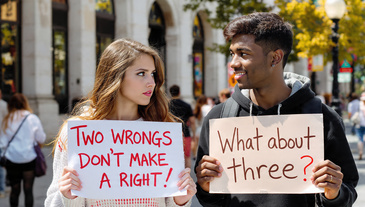
Two wrongs don't make a right, we're told, and if so, surely three wrongs don't, either. A third wrong will only lead to even more trouble--- or in the case of our game of checkers, a loss--- and that leads us to this week's four-fold problem.
We'll look at a published game from years back, in which three wrongs weren't counterbalanced by a right (until today, at least).
| 1. | 11-15 | 22-18 |
| 2. | 15x22 | 25x18 |
| 3. | 12-16 | 29-25 |
| 4. | 10-14 | 24-19 |
| 5. | 8-12 | 26-22 |
| 6. | 4-8 | 18-15 |
| 7. | 16-20 |
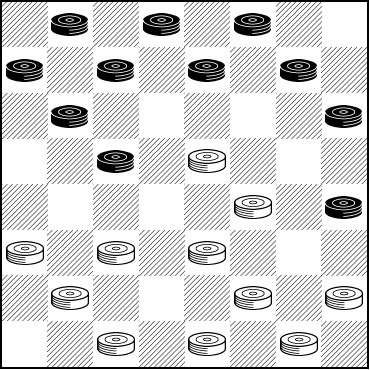
WHITE
White to Play and Draw
W:W15,19,21,22,23,25,27,28,30,31,32:B1,2,3,5,6,7,8,9,12,14,20.
At this juncture, White played 23-18, and annotator Gary Garwood called it a weak move. He suggested instead 31-26 or 22-18. But these moves are just as bad. All three of them lose. Three wrongs, no right. But in fact there is a right move and White can obtain a draw here.
Can you find the correct move to draw for White, and then (for extra credit, if you will) show the Black wins for all three incorrect moves? It's a tall assignment, but one that will give you quite a bit of checker insight.
When you're right (and you know it, as the saying goes) do the right thing by clicking your mouse on Read More to see the solutions.
You can email the Webmaster with your comments on this article.
The Checker Maven is produced at editorial offices in Honolulu, Hawai`i, as a completely non-commercial public service from which no income is obtained or sought. Original material is Copyright © 2004-2026 Avi Gobbler Publishing. Other material is public domain, AI generated, as attributed, or licensed under CC1, CC2, CC3 or CC4 and the various CC options. Information presented on this site is offered as-is, at no cost, and bears no express or implied warranty as to accuracy or usability. You agree that you use such information entirely at your own risk. No liabilities of any kind under any legal theory whatsoever are accepted. The Checker Maven is dedicated to the memory of Mr. Bob Newell, Sr.