The Checker Maven
The World's Most Widely Read Checkers and Draughts Publication
Bob Newell, Editor-in-Chief
Published every Saturday morning in Honolulu, Hawai`i
The Big Squeeze
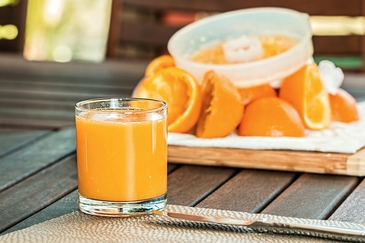
Pexels CC0
There's nothing so good as fresh-squeezed juice as a morning pick-me-up; it just can't compare with cardboard cartons, concentrates, or powders. However, we do recommend a somewhat different squeezing process than that shown in the photo above; it seems like rather a lot of oranges were squeezed to get one glass of juice.
There are squeezes in checkers, too, and although they don't directly produce juice, they just might produce a nice victory. Willie Ryan, in his classic work Tricks Traps & Shots of the Checkerboard, has a page or two on squeeze plays, and he's here in print to explain to us just how it works.
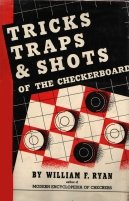
"One of the most unusual games I ever won was the strange coup I sprung on the renowned John T. Bradford of Philadelphia, a member of the American International Checker Team of 1927, in the American Championship Tourney of 1937; and I believe it is the only win of its kind on the published record. The game leading up to this peculiar situation is reproduced on the next page, exactly as we played it.
| 10-14 | 9-14---A | 15-24 |
| 23-18 | 18-11 | 28-19 |
| 14-23 | 7-16 | 2-7 |
| 27-18 | 26-23 | 31-26 |
| 12-16 | 4-8 | 1-6 |
| 32-27 | 22-17 | 22-18 |
| 16-20 | 8-12 | 14-17 |
| 26-23 | 25-22 | 21-14 |
| 6-10 | 3-7 | 10-17 |
| 30-26 | 24-19 | 25-21 |
| 11-15 | 7-11 | 6-10 |
| 18-11 | 17-13 | 21-14 |
| 8-15 | 11-15 | 10-17 |
| 23-18 | 29-25 | 19-15---B |
BLACK
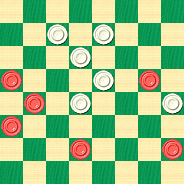
Black to Play and Win
B:W27,26,23,18,15,13:B20,17,16,12,7,5.
A---First introduced by me at the 1937 American Championship Tourney, departing from the usual line by 7-11.
B---The wrong one. A draw is gained easily with: 18-14*, 7-11, 13-9, 17-21, 9-6, 21-25, 6-2, 25-30, 2-7, 11-15, 19-10, 16-19. After 19-15, black starts the biggest squeeze play on record, going all the way from square 7 to square 22 before regaining the sacrificed piece."
Willie certainly gives a giant hint in his second note, but we still believe you'll have to give this one a little thought to squeeze out the solution. Find the Black win and then squeeze the mouse button over Read More to see the answer.
You can email the Webmaster with your comments on this article.
Two-Fisted Checkers

Pexels CC0
No fooling around, no sir-ee. What we have here today is an honest-to-goodness two-fisted, hard-core, serious checker problem. This week, wimpy checkerists need not apply. Do you think you're good? Do you have what it takes? Prove it. Have a look at this one. Read 'em and weep.
BLACK
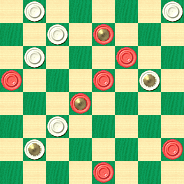
Black to Play and Win
B:W32,29,27,24,K17,11,K8:BK26,22,20,18,K15,5,2.
This problem was first published, as far as we know, something over 85 years ago, and it was variously listed as "advanced," "extra diffcult," and other such things. They weren't a-kiddin', folks. If you can solve it, you're good.
If you can't, there's always the Read More link, which will solve it for you. But you don't want that, do you? Stay in the fight and solve it on your own!
You can email the Webmaster with your comments on this article.
Relocation Complete!

Bernard Spragg Wikimedia Commons CC0
Our containers have been offloaded and unpacked, and the relocation of our main Checker Maven office from Santa Fe to Honolulu is at least relatively complete; there's always more to do and we wonder if anything like this is ever really quite finished. It took a little longer than expected, which again is not a big surprise, but we're happy to be here and to have a long and complex move behind us.
As we've said before, our parent company, Mr. Fred Investments, couldn't continue to maintain two locations for a subsidiary that was never intended to make a profit (and surely doesn't!). This has been our second downsizing, but it's been, we hope, without sacrificing content or quality. And now, with the economy beginning to come back at least somewhat, we look forward to a bright future. Thanks for staying with us.
You can email the Webmaster with your comments on this article.
April Showers

Michael Podger PICRYL CC0
It's said that April showers "bring May flowers." Certainly, that's true at least in certain parts of North America, where, after a long winter season, the arrival of spring as a harbinger of warmer days is much awaited and indeed can't seem to come quickly enough.
And speaking of "quickly" it's our first column of the month, which brings neither showers nor flowers, but a speed problem. This one requires a little more thought than some others, and so we'll set the clock to 60 seconds. Can you solve our one-minute mystery? Click on the link below to set the second hand in motion and reveal the problem. Then, come back and click on Read More to have the solution rain down upon you.
April Speed Problem (medium difficulty)
You can email the Webmaster with your comments on this article.
Great Men Like Checkers
PICRYL CC0
There's no doubt that many a great man was a checkerist, and you'll see why we've chosen the title Great Men Like Checkers for today's Checker School column when you read through the solution section.
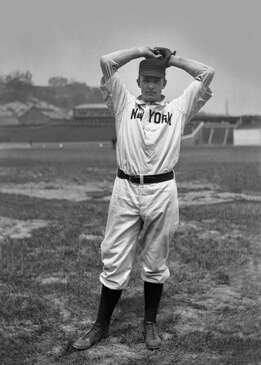
The definition of a great man can vary. Some think of great national leaders, others think of religious figures, and still others might vote for sports heroes. There is room for all of these, and more. Our photo above shows a great baseball player from the olden days, Christy Mathewson, who besides being a baseball Hall of Famer, was also a master checker player.
On the other hand, few people remember checkerist Fred Allen; and thought he might not be a member of the Hall of Fame, he is credited with a very fine and instructive checker position, which forms the subject of our column today. In our opinion, it's more than enough to secure Mr. Allen's place in checker history.
WHITE
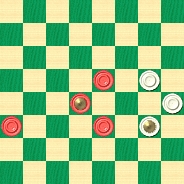
BLACK
Black to Play and Win
B:W17,13,K9:B18,K15,12,10.
It's an intriguing layout: the near-symmetry of the three per side on the right offset by the lone extra Black man on square 12. Is it enough for a Black win? According to Mr. Allen, it is indeed, but it's all in knowing how. Can you demonstrate your own checker greatness by showing how it's done? Solving the problem likely won't make you into a Hall of Famer, but work it through and then click on Read More to see the solution, no less than five sample games (this is indeed a practical exercise), and explanatory notes.
You can email the Webmaster with your comments on this article.
Martins' Masterpiece
PICRYL CC0
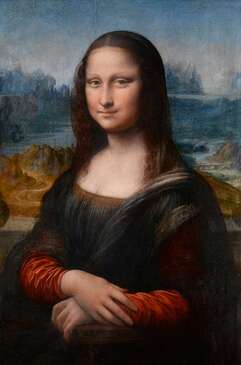
We'd likely be correct if we were to claim that when we say the word "masterpiece" an image such as the painting above, Da Vinci's incomparable Mona Lisa, would come to mind. Certainly it's something that will be recognized for all time as a great work of art.
Of course, great artistry exists in many fields of human endeavor. Much as there are renowned painters, there are sculptors, poets, composers, and more. There is an artistry to our game of checkers too, as most experienced practitioners are surely aware. Now, we won't say checker artistry quite reaches the level of Mona Lisa, but it can still be quite amazing.
One of checker's greatest artists had to have been Willie Ryan, and in his book Trips Traps & Shots of the Checkerboard, he collected more than a few checker masterpieces. Today, he'll tell us about one that he calls Martins' Masterpiece.
"Here is how the redoubtable Robert Martins vanquished an unwary adversary with a blaze of sudden fireworks on the ending of a Whilter game. This stroke is considered by many authorities to be the best concealed sweep recorded in checker literature.
| 11-15 | 8-11 | 10-17 |
| 23-19 | 31-26 | 21-14 |
| 9-14 | 16-20 | 11-15 |
| 22-17 | 19-16 | 18-11 |
| 7-11 | 12-19 | 9-18 |
| 25-22 | 23-16 | 30-21 |
| 11-16 | 14-18 | 18-22 |
| 26-23 | 26-23 | 24-19 |
| 5- 9 | 18-22 | 22-26 |
| 17-13 | 25-18 | 28-24 |
| 3- 7 | 15-22 | 26-30 |
| 29-25 | 23-18 | 21-17 |
| 1- 5 | 22-25 | 30-26---A, 2 |
| 22-17 | 17-14 | This takes you |
| to the diagram. |
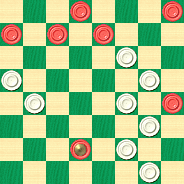
WHITE
White to Play and Win
W:W11,13,16,17,19,24,27,32:B2,4,5,6,7,K26,20.
A---This is where Martins lowered the boom. Bringing out the king 30-25 lands a draw easily with the following play: 30-25, 17-14, 6-10, 14-9, 5-14, 13-9, 14-18, 9-6, 2-9, 11-2, etc."
2---The game was played perfectly by both sides up to this point, but a single mistake is more than enough to end the game---Ed.
Demonstrate your own checker artistry by finding the win. We have to agree that it's a masterpiece in its own right. To see the solution, brush your mouse on Read More.
You can email the Webmaster with your comments on this article.
A Real Fooler
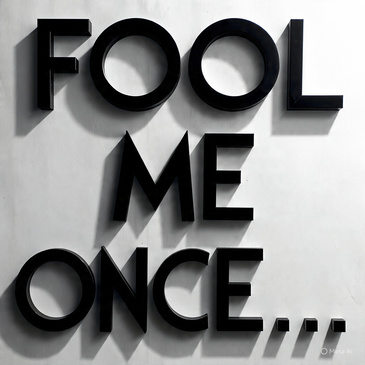
Everyone knows the old saying "Fool me once, shame on you; fool me twice, shame on me."
But in our game of checkers, and especially in the realm of checker problems, we're willing to be fooled over and over again, and we react not with resentment but with enjoyment--- and thanks.
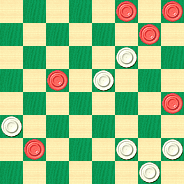
Who isn't pleased to be fooled by a problem composed by someone as great as Tom Wiswell? See what you think of the one below.
WHITE
White to Play and Draw
W:W11,15,21,27,28,32:B3,4,8,14,20,25.
We warn you that this is a difficult problem, though it has at its heart a simple theme. Will you be fooled but delighted? Or will you fool around enough to find the solution? Give it a try, and then give a no-fooling click on Read More to see the solution.
You can email the Webmaster with your comments on this article.
In Like a Lion
Public Domain Pictures CC0
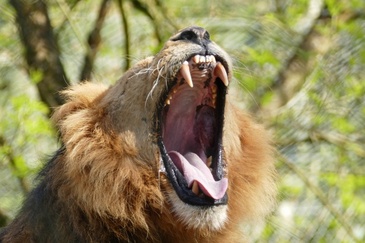
It is sometimes said that in the Northern Hemisphere, the month of March roars in like a lion with winter storms featuring high winds, snow, and cold temperatures. What a prospect to contemplate! We have a better idea, and so for our top-of-the-month column, we're bringing you a stroke problem that roars like a lion, but has the courtesy to at least do so indoors, where a warm fire and a hot drink are just the right accompaniments.

WHITE
White to Play and Win
W:W27,23,18,17,14,13,11,7:BK32,K22,K21,9,6,5,2.
When you have yourself roared through the problem, click on Read More to see the solution.
You can email the Webmaster with your comments on this article.
Blither's Advice
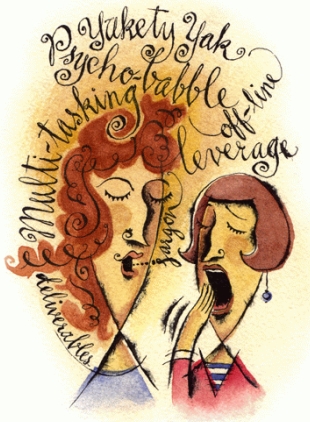
There are people who talk a lot, and despite our illustration above, we don't at all mean to stereotype this behavior. Copious yakking knows no boundaries of gender, group, or anything else.
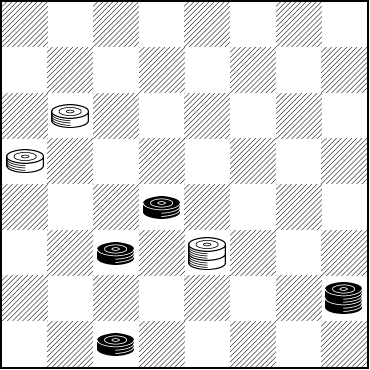
At times, wordiness can be most beneficial. For instance, our monthly Checker School columns usually contain rather verbose advice and explanation, and we think that's a good thing, as it makes the lessons easier to learn and apply. But this month, Ben Boland, the original source of our current pedagogical series, is untypically laconic. Is it because the material is easier than usual? Or was Mr. Boland having an especially quiet day? We can't know the answer, but we can have a look at the subject study, which traces back to a certain L. J. Vair.
WHITE
BLACK
Black to Play and Win
B:W24,20,K10:B15,11,K5,3.
You might say that the position speaks for itself; Black is a man up and ought to be able to win. Yet, it's trickier than you might think at first glance. Can you get the last word on this problem or will it leave you speechless? We're only going to say that clicking on Read More will bring you to the solution, a sample game, and explanatory notes.
You can email the Webmaster with your comments on this article.
Moving Day

Pexels CC0
During the coming week, The Checker Maven is relocating full-time to Honolulu, Hawai`i.

Our Santa Fe offices closed permanently on February 26, 2010. Business will resume in our Honolulu office on March 8 at partial capacity; we expect to be back to full operation before the end of March.
We will of course publish a new column each Saturday morning during the transition, without interruption or delay.

We've had a great run in Santa Fe, but it's time to move on and consolidate in the interests of reduced costs and efficiency.
Catch you soon at our Honolulu office.

You can email the Webmaster with your comments on this article.
The Checker Maven is produced at editorial offices in Honolulu, Hawai`i, as a completely non-commercial public service from which no income is obtained or sought. Original material is Copyright © 2004-2026 Avi Gobbler Publishing. Other material is public domain, AI generated, as attributed, or licensed under CC1, CC2, CC3 or CC4 and the various CC options. Information presented on this site is offered as-is, at no cost, and bears no express or implied warranty as to accuracy or usability. You agree that you use such information entirely at your own risk. No liabilities of any kind under any legal theory whatsoever are accepted. The Checker Maven is dedicated to the memory of Mr. Bob Newell, Sr.