The Checker Maven
The World's Most Widely Read Checkers and Draughts Publication
Bob Newell, Editor-in-Chief
Published every Saturday morning in Honolulu, Hawai`i
Searight's Escape
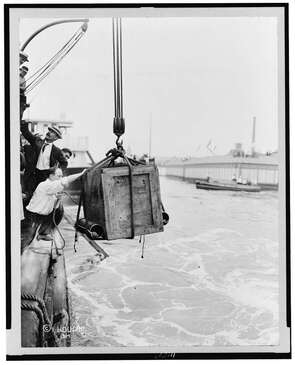
LOC Public Domain
Houdini was arguably the greatest (or at least the most famous) escape artist of all time. Some of his daring feats, like the water-tank escape shown above, are definitely not recommended for trial at home; not, at least, if you value your life.
Checkerist Searight most probably never did a water-tank exhibition, but his checkerboard feats are as classy in the checker world as Houdini's were his own realm. Today, we quote Willie Ryan in Trips Traps & Shots of the Checkerboard, as he describes one of Mr. Searight's more amazing checkerboard escapes.
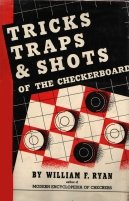
"You'll never be a champion at checkers unless you thoroughly familiarize yourself with all the better-known losses that have been the undoing of great players in the past. By studying the mistakes of the masters, you can avoid the costly errors they made, and gain knowledge that would take years to acquire by practical experience. Among the 'must' positions is Searight's draw. The game mapped out below was contested by Champion Newell W. Banks and me. When Banks reached the diagrammed stage, he 'muffed' a draw, losing the game and the match."
| 11-16 | 9-18 | 7-10 |
| 22-17 | 23-14 | 22-18 |
| 16-20 | 1-6 | 3-7 |
| 17-14 | 24-19 | 13-9 |
| 10-17 | 15-24 | 5-14 |
| 21-14 | 28-19 | 18- 9 |
| 9-18 | 6-10 | 11-15 |
| 23-14 | 30-26 | 32-28 |
| 8-11 | 10-17 | 15-24 |
| 25-22 | 22-13 | 28-19 |
| 11-15 | 4-8 | 7-11 |
| 29-25 | 25-22 | 27-24 |
| 6- 9 | 8-11 | 20-27 |
| 26-23 | 26-23 | 31-24---1 |
1---Impeccable play up to this point---Ed.
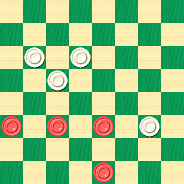
BLACK
Black to Play and Draw
B:W9,19,23,24:B2,10,11,12.
Can you escape with your life in this position, or will you pay the price of failure? We won't say there's an easy out; some struggling is necessary, but it's worth it. Get on with the show, and then slip out to Read More to see the solution and notes.
You can email the Webmaster with your comments on this article.
No Winter Slowdown Here
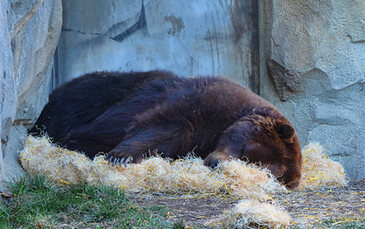
Winter is often thought of as a time of slowing down, and for some large animals, the deep sleep of hibernation. Well, winter is arriving in much of the North American continent, but there's certainly no slowdown, let alone hibernation, of checker activity. And with today's speed problem, snoozing will not be an option, because you've only got 15 seconds to pull off a solution.
Put on your indoor running shoes and get ready for a real wake-up call, When you're ready, click on the link below; then come back and awaken the Read More button to check your solution. Solve now, sleep later!
November 2010 Speed Problem (easy)
You can email the Webmaster with your comments on this article.
Win One For Uncle Ben
Public Domain
It was Saturday morning, the time of the week that Tommy would head over to Uncle Ben's porch for a checker lesson and some of Uncle Ben's famous lemonade.
But Tommy wouldn't be doing that today. Yesterday, Uncle Ben had been taken to Community Memorial Medical Center.

When Tommy heard the news, he was absolutely determined to pay his beloved checker mentor a visit at the hospital. There were just two problems with that. The biggest problem was that Tommy was still thirteen, and the minimum visiting age was fourteen. Second, Tommy's mother didn't exactly approve of him "bothering poor Uncle Ben while he's ill." Well, she didn't quite tell him he couldn't go ... and so, before she could actually utter those irrevocable words of prohibition, Tommy was on his bicycle, pedalling furiously downtown, making the trip in near-record time.
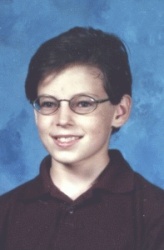
Tommy Wagner
The ward nurse, of course, asked Tommy about his age. Tommy was not one to tell lies, so he told the nurse that he was "almost fourteen" and kind of didn't say the word "almost" in quite as loud a voice as he said the word "fourteen." The nurse told him that she'd let him visit, but he'd have to keep it to ten minutes.
Uncle Ben was sitting up in his bed when Tommy went into his room. "Ah, what a nice surprise!" he exclaimed with a smile when he saw his young student. "I didn't expect to see you this morning! How ever did you get past the head nurse?" he asked, but then added, "Oh ... no matter. You're a resourceful checker player, after all."
"How are you doing, sir?" Tommy inquired.
"I'll be just fine, Tommy," Uncle Ben said, "I had a bit of a fall and they are just keeping me a little longer for observation. No real harm done. But I'm afraid we won't have any lemonade this morning."
"Oh, no, sir, I didn't come for a checker lesson. I just wanted to see how you were, and let you know that our school team has a big match this week against our rivals, Sunshine Middle, and I'll be playing second board!"
"Oh, you'd better practice up, then," replied Uncle Ben. "Second board --- I see Coach Hovmiller has moved you up rather quickly. You'll not have an easy game, but I'm sure you'll be ready." Uncle Ben turned to reach for something on his bedstand. "Here," he said, "I've got just the thing for you to try out."
Uncle Ben handed the object to Tommy; it was a sheet of paper with a hand-drawn diagram of a checker problem!
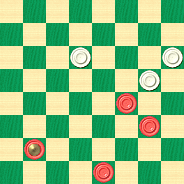
BLACK
Black to Play and Win
B:B2,9,14,K8:W21,23,17.
"Now, I know you didn't expect a lesson, nor will they let you stay here much longer, so how about you just take this problem home and practice with it?"
Tommy was all smiles. How could Uncle Ben have guessed that he would visit? But just at that moment, the ward nurse stuck her head through the door and said, "Time's up, young man!"
"Thank you, Uncle Ben," said Tommy as he turned to leave. "I'll surely study this problem carefully. And," he went on, "I'm going to win my game this week ... just for you!"
Now it was Uncle Ben who was all smiles. But the ward nurse had an insistent look. "Get well soon!" called Tommy as he left. "See you next week!"
Can you win one for Uncle Ben? He's counting on you! Solve the problem and then click on Read More to see the solution, a sample game, and no less than seventeen additional examples.
You can email the Webmaster with your comments on this article.
The Twins, Bowen's, Of Course

Pixabay CC0
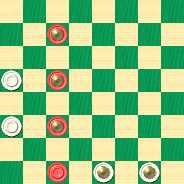
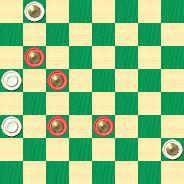
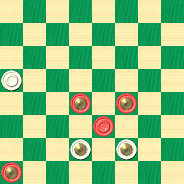
We don't know a whole lot, we confess, about old-time checkerist R. E. Bowen. To be specific, we're not sure if he ever had twins in his family, such as the twins shown above. We do know, though, that Mr. Bowen created twins, or more accurately, wrote about them; but they are decidedly twins of the checker variety, in the form of a "twin" position as shown in the first diagram below. In this situation, it all depends who plays first; but in the related positions shown in our second and third diagrams, Black will definitely win.
It's a classic lesson from the pages of our current Checker School textbook, Ben Boland's Famous Positions in the Game of Checkers. The lesson may be known to you, in name if not in detail, and this is your opportunity to learn just about everything about it.
WHITE
BLACK
Black Plays, White Draws
White Plays, Black Wins
B:W20,12,K2,K1:BK27,K19,K11,3.
W:W20,12,K2,K1:BK27,K19,K11,3.
E. CLARK
WHITE
BLACK
Black to Play and Win
B:WK32,20,12,K5:BK24,K19,K11,K10.
D. KIRKWOOD
WHITE
BLACK
Black to Play and Win
B:W20,K7,K6:BK15,K14,10,K4.
There are really four distinct problems here, so you might think of it as a pair of twins. Twins squared? We won't speculate further, but we do know that clicking on Read More will show you the solutions, sample games, detailed notes, and a surprise bonus feature.
You can email the Webmaster with your comments on this article.
Fuller's Brushdown!
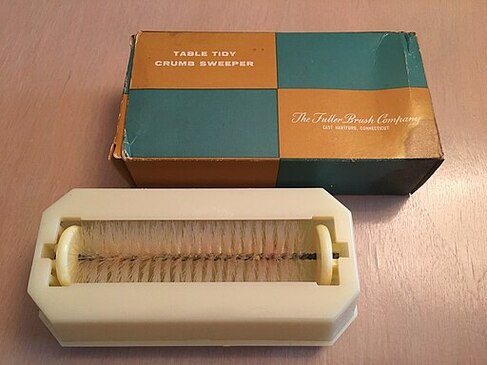
Who among us who is, shall we say, above a certain age, can fail to remember the Fuller Brush Man? Selling door-to-door, with his signature case of Fuller Brush Company wares--- they were sold with a unique lifetime guarantee--- he was a part of American culture, and was even immortalized in a Red Skelton movie in 1948. The Fuller Brush Man is perhaps no longer the icon he once was, but the company itself lives on, having relocated to Kansas in 1973. The photo above is of one of the company's unique products from back in the day.
During Willie Ryan's days, the Fuller Brush Man was still a well-known figure, and hence it's no surprise that Willie makes a punning reference in his book Tricks Traps & Shots of the Checkerboard while describing a position attributed to checkerist Everett Fuller. But Willie can tell us about it much better than we can.
"Now and then, Everett Fuller of Milwaukee, Champion of Wisconsin, introduces a sparkling problem or an unusual game. Everett is the father of the following stroke, which, as strokes go, deserves a blue ribbon for its subtlety and bizarre character:
| 11-16 | 22-17 | 15-24 |
| 24-20 | 6-10 | 27-23 |
| 16-19 | 17-13 | 3- 8---4 |
| 23-16 | 8-11 | 23-18---5 |
| 12-19 | 26-22 | 8-12 |
| 22-18 | 14-18---1 | 30-26---6 |
| 9-14 | 21-17---2 | 12-16---7 |
| 18- 9 | 18-25 | 13- 9 |
| 5-14 | 29-22 | 4- 8 |
| 25-22 | 19-24---3 | 17-13. |
| 10-15 | 28-19 | See the |
| diagram." |
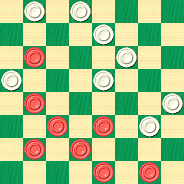
BLACK
Black to Play and Draw
B:W32,31,26,22,20,18,13,9:B24,16,11,10,8,7,2,1.
Notes by the Editor using KingsRow.
1---The computer gives Black a small edge here.
2---30-26 was better and now Black gets a significant lead.
3---Black should have played 4-8 to keep his advantage.
4---KingsRow prefers 24-28. After the text move the game is actually just a bit in White's favor.
5---13-9 was necessary to keep the White edge.
6---Just about loses. 13-9 was still best here.
7---The game continues to see-saw; 10-15 would have kept Black's superiority.
Can you solve this one, or will it give you the brush-off? In any case we offer a lifetime guarantee: clicking on Read More will always show you the solution.
You can email the Webmaster with your comments on this article.
Principles of Strategy

Public Domain
Checkers is sometimes compared to a war game, with the players taking on the role of opposing Generals, commanding their respective forces of Red and White warriors. Fortunately, this analogy only goes so far; although checker combat can be sharp and demanding, it is happily of a peaceful, intellectual nature.
But much as war has its well-evolved principles of strategy, checkers too is a game of a highly strategic nature (though tactics often come to the fore). Checker strategy, however, is a topic that has generally not been well elaborated in checker literature. Literally only a handful of books have dealt in-depth with this facet of the game.
One of these books is Principles of Strategy in the Game of Checkers, the only published book by the late Brooklyn champion Louis Ginsberg. Dealing with the critically important Dyke positions, and published over 65 years ago, the book remains relevant and vital today with its insightful notes and clear elucidation of strategic principles.
This little book has long been out of print, but today we are releasing a newly-typeset electronic edition, which you can download at once here. We owe thanks to a mysterious "Mr. T." who provided us with carefully corrected interpreted scans of the original and helped greatly in moving the project forward. The book is available in PDF format and can easily be printed on plain letter paper if you prefer hard copy.
Let's take a quick peek at one of the positions in the book. It arises from the following play. Notes are taken from the book; notice the remarkable clarity and insight the author provides.
11-16---A 24-20 16-19---B 23x16 12x19 22-17---C 10-15---D 25-22---E 8-12---F 27-24---G 7-10---H 20-16---I 2-7---J 32-27---K 4-8 27-23 9-14---L 30-25---M 5-9---N; forms diagram
A---The Bristol opening which often assumes a "Dyke" formation.
B---Black takes command of 19 and expects to develop the "Dyke" if the opportunity offers.
C---A weak move, but generally made by the uninformed. Again the importance of 22-18 is noted, for if Black has visions of the center, the man on 18 must be removed by the 9-14 exchange (10-14, although sound, leads to a complicated formation of a different nature).
D---Black begins to mass his pieces as shown in previous examples.
E---White must try to establish his position and break up the coming "Dyke."
F---This move must eventually be made to support the piece on 19. If 7-10, trying to establish the formation too quickly, White goes 20-16 and spoils the "Dyke" as pointed out in Example 1.
G---The ever present defense in these formations, to be followed by 32-27, when the time comes, as explained before.
H---The text move is given to illustrate how a strong formation can be wrecked. It is proper to go 4-8 for if 32-27 comes next, 7-10 and the "Dyke" is very strong. If White tries 20-16 after 7-10 then 3-7 is the key move for the attack, eliminating the trunk game.
I---Threatening square 11, explained in Example 1.
J---Black gets ready to attack the piece on 16, having in mind 4-8 followed by 8-11. If White plays 16-11, 7-16, 24-20, then 3-8, 20-11, 19-23, etc.
K---White's destination is 18.
L---It is quite evident something must be done to stop the impending attack against the man on 15.
M---Threatening the three for two. This type of move in similar positions should always be considered as a threat against 18, a strategic point.
N---Nothing else to be done.
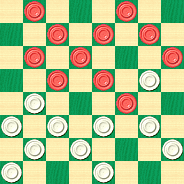
WHITE
White to Play and Win
W:W31,29,28,26,25,24,23,22,21,17,16:B19,15,14,12,10,9,8,7,6,3,1.
It's not as hard as it looks; can you break the Dyke or will the position hold water? It's up to you; solve the position and click on Read More to "leak" the solution.
You can email the Webmaster with your comments on this article.
An Easy Stroke
PxHere CC0
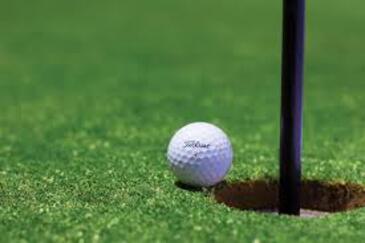
We're not golfers ourselves, but we'll wager that even for less experienced players, the stroke above would be a pretty easy one and rather hard to miss.
In the same spirit, this week's column brings you a stroke problem that is rated as quite easy by its author, and indeed, it doesn't have the decidedly scary look of many another stroke problem.
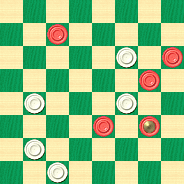
WHITE
White to Play and Win
W:W11,17,19,25,30:B6,12,16,23,K24.
Now, we can't put this one off with the claim that we don't play checkers, and it would be unseemly to say "better you than us" in this case. In truth, the problem isn't half as hard as you might think, and we did try it out and solved it quickly enough. We've not set this one up as a speed problem, but time yourself and see if you can solve it in 15 seconds or less; then click on Read More to verify your solution.
Remember, a gentle tap will do it ...
You can email the Webmaster with your comments on this article.
Basic Checkers Part Eight
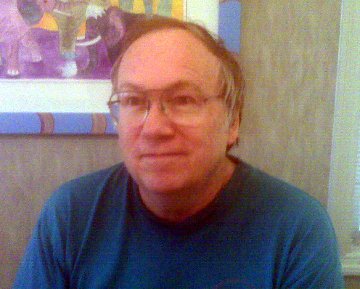
Many of us believe that Jim Loy never sleeps, for this Bozeman, Montana-based Renaissance man is so prolific and turns out so much high-quality work that we can't believe there are enough hours in the day for him to get it all done. But he does, and though he's never revealed his secret, we're most happy and appreciative to benefit from his efforts.
What does Jim do? A visit to his website, jimloy.com, will tell you--- Jim does everything. From bowling to chess to tennis to billiards, there seems to be little that doesn't interest him, and he does nothing halfway. Fortunately for us, Jim takes a serious interest in checkers, too, and has lately been working on a series of projects aimed at restoring and correcting the classic works of the game.
Jim's checker books sell for a relatively nominal price on the American Checker Federation website. You'll find problem books, game books, and more; but today we want to focus on Jim's newest work, Basic Checkers Part 8: Corrections.
If you've read The Checker Maven for the past few months, you'll know that we recently participated in a reissue of Richard Fortman's seminal work, Basic Checkers. In our reissue, we reproduced the book with its original content; while we corrected obvious typos and other errors, we did not update or correct the actual game play. Mr. Loy's new book does exactly that; he provides us with just under a hundred pages of corrected or alternative lines of play. The book is the culmination of an effort Jim began in 2006, and gathers together work originally published in the ACF Bulletin as well as new work.
As an illustration, and also as this week's problem position, let's look at play in the 11-15, 22-17, 9-13 opening (taken from Part 8, page 57, note I).
11-15 22-17 9-13 17-14 10x17 21x14 8-11 23-19 15-18 19-15 4-8 24-19 6-10 15x6 1x17 25-21---A 17-22 26x17 13x22 27-23 18x27 32x23; forms diagram.
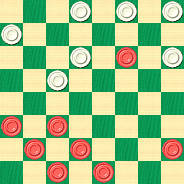
BLACK
Black to Play and win
B:W31,30,29,28,23,21,19:B22,12,11,8,7,5,3,2.
A---26-22 or 25-22 draw instead.
Black wins here in an unexpected and quite sophisticated manner. Finding the win may prove a difficult problem, but this one is good enough to merit considerable effort. So do try to work it out and then click on Read More for the solution and notes.
You can email the Webmaster with your comments on this article.
Checkercycle:Video Instruction on the Web
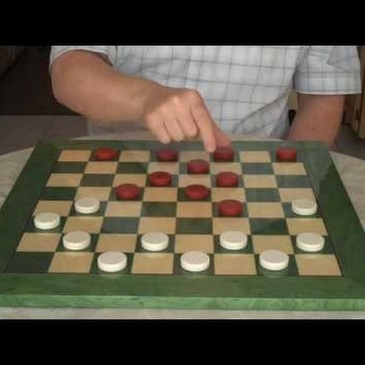
With permission
What would you think about watching some videos to help improve your checker play? Wouldn't it be great to have someone talk you through a game played by the masters, or describe how to win a difficult ending? It'd be the next best thing to having a personal tutor.
We're happy to report that checker video instruction is alive and well on the internet! The YouTube media site contains a substantial and growing collection of instructional material, but one name stands out: Checkercycle, the creator of dozens of video tutorials of unquestionably high quality.
Now, we know who this gentleman is, and with the serious checkers crowd in America being a relatively small fraternity, you might know too. But we note that in his videos, Mr. Checkercycle's face is seldom shown, so we're not telling, even though the info he gave us in an email interview will surely give away this not so well-kept secret. Here's the discussion we had with this extraordinary man of checkers.
CM: You are clearly a knowledgeable player. Do you play tournaments? Have you won any titles or the like?
CC: I played in the NYC 2005 3-move and won 1st place in the minors. I was also in the 2007 Yonkers Open GAYP, taking 2nd place, and in the Jim Morrison Nationals in 2009, taking 3rd place in the majors.
CM: You must have a good checker library. Tell us about it, and how you obtained it--- a difficult thing these days.
CC: My first book was The Wonderful World of Checkers and Draughts by Tom Wiswell, which I got the from the library. I then got Straight Checkers Gold from Al Lyman, which had about eight books in the teaching program. I then started going to Checker Maven and Jim Loy's site, and as I found out more information thanks to these great sites, I started buying books from Amazon and ABE.com. My friends bought me books at the tournaments and I bought them also; we helped build each other's collections. I liked all the Tom Wiswell and William Ryan books. I like the Richard Pask and Robert Pike's books too. It is hard to get books and that is something I would like to change. I am happy that I will be able to buy the Basic Checkers at the National Tournament. The fact that it also supports the youth is such a beautiful thing and I would like to thank you for your hard work.
CM: What got you interested in making tutorial videos?
CC: One day I was showing my friend a game I played on the internet on a small magnetic board and he made a video of it. I thought how nice it would be on a big board, and because books are so hard to get, I could encourage others people to play this fine game. I kept on trying to come up with new ideas as I went along.
CM: How many videos have you made?
CC: So far I've made about 50 videos.
CM: How's the response been--- lots of viewers, feedback, etc.?
CC: At first I got very few comments but the ones I did get were positive. Then I got some more feedback, and I listened to what the players were telling me and asking me to do. I have to give them a lot of credit for their ideas.
CM: What's in store for the future for Checkercycle?
CC: I am looking forward to playing in the National Checker tournament on August 1st in Springfield, Illinois. The people I have met have been great. I had the pleasure of playing a 96 year old gentleman last year and meeting many great people. It was a lot of fun and I'm looking forward to more tournaments. I'd like to continue doing video and I'd like to improve my game along the way. I always want to help people play checkers and see the beauty of the game. I feel that exercise, checkers or chess and socializing is a good way to stay young and I have that 96 old gentleman who is still playing in tournaments as a fine example. (He did beat me in our contest that day.) He must have some great stories to tell and I hope I get to hear them.
CM: What do you think is in store for the future of the game itself?
CC: The game should continue to grow because of the internet, and the many devoted people from the ACF, and the people who help tell the stories and make the game so enjoyable like the Checker Maven. I know that it not easy with so many different games and with the popularity of chess. However I think checkers and chess are very good games and a lot of fun.
CM: Any advice to the up-and-coming generation of checker players?
CC: The next generation of checker players could really be outstanding, and with the help of computers, videos, checker sites and the support of the checker clubs, we could see the next masters be younger and be equal to the great players of the past. Only time will tell. The tools of learning the art of checkers are being happily shared with the young and not so young players . The beauty of the game, the fun of the game has always been there to enjoy for everyone.
CM: Anything you'd like to add, say, recommend, etc.?
CC: I started playing checkers when I was about 7 years old with my Dad, and we played for hours at a time. When I came out of the Army I continued to play checker games with him. I will always have that memory and will cherish it. The internet came along and gave me the chance again to play the game that I grew up to love.
Checkercyle's home page on YouTube can be found here, and we highly recommend that you go there and take the time to view the material he presents so effectively in his video presentations.
And now let's try a problem, taken from Checkercycle's video on the classic Payne's Draw. The position is shown below.
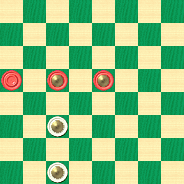
WHITE
Black to Play, White to Draw
B:B13,K14,K15:WK22,K30.
Try it out and click on Read More to see the solution. Then be sure to check out Checkercycle's other great checker lessons. You'll be glad you did and we'll guarantee that you'll learn something.
You can email the Webmaster with your comments on this article.
21st Century Checkers
Today is a very special one as, thanks to the generosity of Grandmaster Richard Pask, we release an electronic version of 21st Century Checkers 9-13s, which is the first volume of an envisioned series of seven, covering all the accepted opening ballots. More than an extension or rework of Mr. Pask's earlier Solid Checkers (which will also be reissued by us in mid-2011), Mr. Pask has used the computer to take a fresh and comprehensive look at three-move play. The new book contains nearly 15,000 checker moves; consider that Richard Fortman's monumental Basic Checkers contains about 50,000 moves total in all seven parts, and you'll realize the enormous scope of Mr. Pask's new initiative.
The book can be downloaded here, and will eventually appear on our Richard Pask page, as linked in the right-hand column. If you wish to make a printed copy, be aware that the book makes extensive use of color and printing in black-and-white or grayscale may not be satisfactory.
Without a doubt this is a book you will want to have.
So, let's have a quick look! As an example of the book's content, and for this week's problem offering, here is a position that arises out of the 9-13 22-18 6-9 ballot.
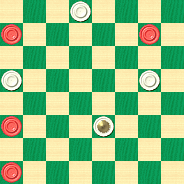
BLACK
Black to Play and Draw
B:W31,20,17,K10:B28,25,12,4.
Black's pieces are on the edge of the board and White has a king. How can Black save this one? "Book" your solution and then click on Read More to learn where to find the answer.
You can email the Webmaster with your comments on this article.
The Checker Maven is produced at editorial offices in Honolulu, Hawai`i, as a completely non-commercial public service from which no income is obtained or sought. Original material is Copyright © 2004-2026 Avi Gobbler Publishing. Other material is public domain, AI generated, as attributed, or licensed under CC1, CC2, CC3 or CC4 and the various CC options. Information presented on this site is offered as-is, at no cost, and bears no express or implied warranty as to accuracy or usability. You agree that you use such information entirely at your own risk. No liabilities of any kind under any legal theory whatsoever are accepted. The Checker Maven is dedicated to the memory of Mr. Bob Newell, Sr.
.jpg)