The Checker Maven
The World's Most Widely Read Checkers and Draughts Publication
Bob Newell, Editor-in-Chief
Published every Saturday morning in Honolulu, Hawai`i
Speedy, Short Month
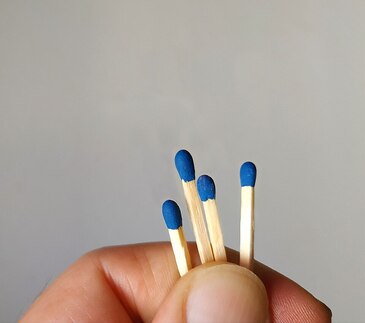
February, the shortest month of the year, speeds by and gives no quarter. 28 days instead of 30 or 31? Don't tell the bank, who wants the same, full mortgage payment. Likewise, don't complain to the landlord, who will only say: Pay the rent--- all of it---- or else. In this short month, it seems we draw the short straw.
In the same spirit of speed and brevity--- though we'd rather skip the unfriendly, uncaring part--- we offer a speed problem that's certainly not very hard, but may be difficult to analyze quickly enough. We're imposing a 28 second time limit, in honor of the month of February. Probably you'll solve it much more quickly, of course--- or will you?
Click below to reveal the problem and start the clock; then come back and click on Read More to see the solution.
February Speed Problem (easy, 28 seconds)

You can email the Webmaster with your comments on this article.
Double Cross in the Double Cross

A few years ago, Ed Gilbert, the author of the KingsRow computer checkers engine, and the creator of the companion 10-piece endgame database, sent some new play to one of checker's sharpest-eyed analysts, Brian Hinkle. Ed told Brian the following:
"The 5-9 24-20 Double Cross is indeed a draw. This is exciting news to me, since this is a new, unknown draw in a ballot that is generally considered by a lot of players to be the most difficult of the 3-move tournament ballots. This morning I loaded the new opening book into Kingsrow and played along the PV. It dropped out of book at the 40th ply into a very interesting position where White had sacrificed a man to gain a first king with a positional advantage."
Ed showed the following line of play:
| 1. | 9-14 | 23-18 |
| 2. | 14x23 | 27x18 |
| 3. | 5-9 | 24-20 |
| 4. | 10-15 | 28-24 |
| 5. | 7-10 | 21-17 |
| 6. | 3-7 | 17-13 |
| 7. | 9-14 | 18x9 |
| 8. | 15-18 | 22x15 |
| 9. | 10x28 | 9-5 |
| 10. | 11-16 | 20x11 |
| 11. | 8x15 | 31-27---A |
| 12. | 4-8 | 25-22 |
| 13. | 8-11 | 29-25 |
| 14. | 11-16 | 25-21 |
| 15. | 16-20 | 21-17 |
| 16. | 7-11 | 27-23 |
| 17. | 12-16 | 13-9 |
| 18. | 6x13 | 17-14 |
| 19. | 2-6 | 14-9 |
| 20. | 6-10 | 9-6---B |
A---25-22 4-8 31-27 same.
B---This is the end of the computer's opening book moves. Note that Ed constructed a special opening book that examined the Double Cross in great depth and detail.
Ed comments further, "Every black move from 24-20 up to move 13 is forced."
Here is the position at the end of the KingsRow specialized Double Cross opening book.

BLACK
Black to Play and Draw
B:W32,30,26,23,22,6,5:B28,20,16,15,13,11,10,1.
Finding the rest of the solution is not an easy task, but you owe it to yourself to give it a try. The solution is not long, but it is very surprising, perhaps ranking among the most surprising things we've ever seen on the checkerboard. After you've done your analysis, click on Read More to see the truly stunning conclusion.
You can email the Webmaster with your comments on this article.
Blind Man's Bluff
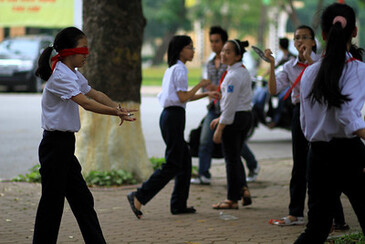
Most of us take our sight for granted, and we often forget that there are those among us who don't have this gift. Now, note that we don't call them "unfortunates"; we'd rather call them "inspirations" because the blind among us are capable of incredible things, often with a drive and willpower that puts the rest of us to shame.
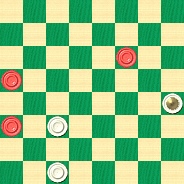
An old time checker-player, one Mr. W. Bennett, was blind, but that didn't slow him down in the least, as the instructive problem below illustrates well.
BLACK
WHITE
White to Play and Win
W:WK20,22,30:B11,13,21.
Can you solve it? For an extra challenge, try to work it out the way Mr. Bennett did; solve the problem not only without moving the pieces, but without looking at the diagram or a checkerboard. Along the way, you'll discover a subtle and practical winning technique which you'll be able to put to use in your own play.
When you've completed this truly illuminating exercise, click on Read More for the solution, a sample game, and notes.
[Read More]
You can email the Webmaster with your comments on this article.
Lee's Loophole
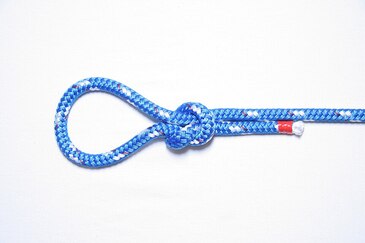
Does our photo show a 'loophole,' as advertised in our column's title, or something much more nefarious? That's the subject of today's excerpt from Willie Ryan's book, Tricks Traps & Shots of the Checkerboard. Willie sees a loophole. What do you see?
First, though, let's have Willie give us a brief introduction.
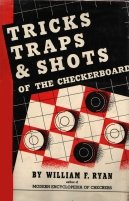
"Of the many subtle stratagems to be found in the mellowed pages of checker lore, none has impressed me so much as the deeply rooted Paul J. Lee 'rebound,' which I consider the best concealed drawing device I have ever seen. It may be brought up in play from various openings. Here is one method:"
| 10-15 | 24-19 | 6-9 |
| 22-18 | 15-24 | 22-18 |
| 15-22 | 28-19 | 1-6 |
| 25-18 | 8-11 | 21-17---1 |
| 9-13 | 29-25 | 13-22 |
| 18-14 | 11-16 | 26-17 |
| 11-15 | 25-22 | 6-10 |

WHITE
White to Play and Draw
W:W32,31,30,27,23,19,18,17,14:B16,12,10,9,7,5,4,3,2.
What will it be? Loophole or constriction? Can you solve this one without choking up? When you've made your attempt, slip your mouse through to Read More to see the outcome.
1---26-22 would have made for an easier journey for White---Ed.
[Read More]You can email the Webmaster with your comments on this article.
The Cold War Revisited

Marvin J. Mavin
Marvin J. Mavin, captain of the Detroit Doublejumpers in the National Checker League, was not happy.
It all started out when the company for which Marvin did promotional ads, Belcher's, got wind of his ongoing rivalry with Russian emigre Dmitri Tovarischky, a top player from the days of the former Soviet Union. Belcher's thought that a highly-publicized "grudge match" would aid sales and brand recognition. Billed as "The Return of the Cold War" (even though Marvin was only about 10 years old when the Cold War ended), the match was set for an early spring evening in the Milwaukee Checkerdrome; and Marvin had little choice but to follow the wishes of his sponsor, even though his distaste for Dmitri was all too obvious.
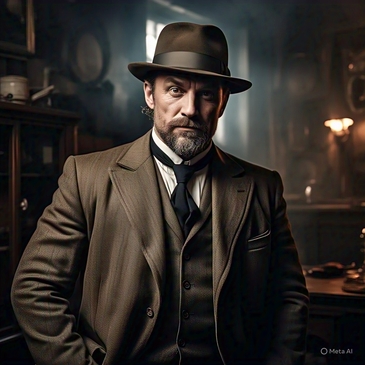
Dmitri
To make it worse, Marvin's girlfriend, Priscilla K. Snelson, was to be in attendance, and Marvin knew that under her watchful eye he would have not a chance in the world of having a pre-game beer. Marvin received a stern lecture, reminding him of a previous loss to Dmitri which Priscilla blamed squarely (and very likely correctly) on over-indulgence.

Priscilla
And so, here he was, sitting at the checkerboard in the center of the enormous, fan-packed Checkerdrome, facing Dmitri once again, and not having had any beer for almost 48 hours. Huge American and Soviet flags flew from the ceiling of the Drome, as Belcher's went all-out to set the mood of conflict and rivalry.
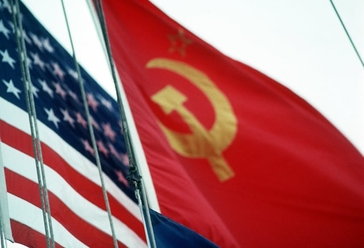
Picryl CC0
Dmitri, for one, had no problem with such a theme, even though he was an emigre. "American Checkers Boy will lose again to superior Russian skills," he crowed loudly. "Checkers Boy is no match for champion like Dmitri."
Marvin seethed inwardly but did not respond, only mumbling under his breath, "Yeah, you'll see what Checkers Boy can do, you old Commie..." But to make things even worse, Marvin had been given the tough end of a very difficult opening ballot. Even though Marvin received draw odds, meaning that if he could but draw the game the match was his, he knew he had a very hard evening in front of him.
At that moment the referee blew his whistle, starting the game clocks, and the match was underway.
12-16 23-19 16x23 27x18 11-16 26-23 16-20 32-27 8-11 30-26 4-8 18-14 9x18 23x14 10x17 21x14 11-15 22-17 8-11 25-21 6-9 26-23 9x18 23x14 11-16 29-25 2-6 17-13 16-19 31-26 6-9 13x6 1x17 21x14 7-10 14x7 3x10 25-21 10-14
Dmitri was gloating and not trying in the slightest to hide it. "Game is over for Checkers Boy," he said. "Checkers Boy has only bad move and loses to Dmitri. Of course, Dmitri is not surprised because Checkers Boy is just inferior American amateur."
Now, there are limits. Marvin expected Dmitri's taunts, but being called an amateur was a bit too much. As a top professional Marvin felt he was owed at least a certain amount of respect.
He was about to lash out angrily and call Dmitri all sorts of names, when Priscilla, sitting in the front row, caught Marvin's eye and simply wiggled her left index finger. That was all it took to silence Marvin, who knew what kind of chewing out he would get later if he failed to heed the warning. Instead, he went back to mumbling. If you listened carefully, you might have heard words such as "old goat," "blowhard," and "beer"; but Marvin realized that the game was at a critical point and knew that he had better come up with something right now, right away.
The position that was on the board is shown below.
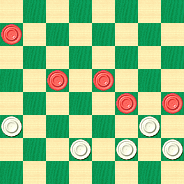
WHITE
White to Play and Draw
W:W28,27,26,24,21:B20,19,15,14,5.
Can you give Dmitri his comeuppance and find a move that gives White a draw? Or is all lost and Black will be the winner? Keep your cool, forget about mumbling, and work out the position before clicking on Read More to see how things turned out.
You can email the Webmaster with your comments on this article.
Happy New Year 2011
Happy New Year to everyone! 2010 is history and 2011 has arrived. The Checker Maven hopes this year will be everything that you might wish it to be; and to start our year off with a bang, we've chosen a problem that isn't too hard if you can figure out the first move--- but then again, that's the hard part!
Here's the situation.
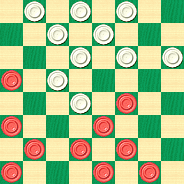
BLACK
Black to Play and Draw
B:W32,31,30,27,26,23,22,21,19,15:B20,14,12,10,8,7,6,4,2,1
Things seem fairly tame until you take a closer look and realize that Black is suffering from a definite lack of moves that don't lose! But there is one ... can you find it?
Clicking on Read More will show you the surprising solution. Enjoy the holiday and once again, Happy New Year!
You can email the Webmaster with your comments on this article.
Happy Holidays 2010
Christmas Day 2010 falls on a Saturday, so most everyone will have a long weekend to celebrate or just relax according to your own traditions and preferences. It's time for family and friends and lots of activities, but we know that if you're a checker player, you'll be looking for something from The Checker Maven to make checkers part of your holiday weekend.
To that end, we've chosen a special problem that is very engaging (often this is another word for 'difficult') and bound to hold your interest. It requires skill and considerable planning, but we think you're up to the challenge.
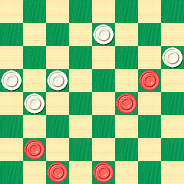
BLACK
Black to Play and Win
B:W26,21,20,19,16:B17,14,8,3,2.
Black has more mobility than White; that's always an advantage in checkers, but is it enough to turn into a win? We'll warn you; definitively proving the win is a long process and requires very careful play. It's something you might want to take on when dinner is over and the company has left, when you might have an hour or so to devote to checkers.
Clicking on Read More will as usual show you the solution. Happy Holidays to one and all from The Checker Maven.
You can email the Webmaster with your comments on this article.
Up The Creek Without A Paddle
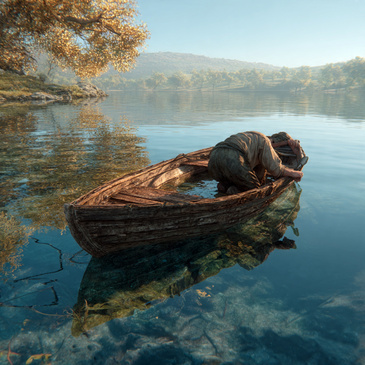
The guy in the photo above has got a real problem: he's literally up the creek without a paddle. Luckily he seems close enough to shore to maybe wade, swim, or paddle with his hands. But that old boat doesn't like like it will stay afloat a lot longer.
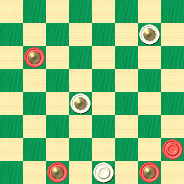
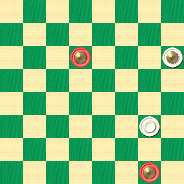
In today's Checker School lesson, life and limb may not be at risk, but the outcome of the game certainly is. In the first diagram below, attributed to our old checker friend from last month, A. Sheehan, White seems to be in the same predicament as our hapless hero above. In the second diagram, credited to Charles Hefter, things look a little better but White is still not out of the water, so to speak.
BLACK
WHITE
White to Play and Draw
W:WK8,K18,31:BK9,28,K30,K32.
BLACK
WHITE
White to Play and Draw
W:WK12,24:BK10,K32.
The solution to the first problem is anything but easy, so we'll give you a hint: solve the second problem first, then see if you can work out play from the first diagram to end up at the position of the second. And if you're still up the creek, paddle your mouse to Read More to see the solutions, detailed notes, sample games, and a bonus feature.
You can email the Webmaster with your comments on this article.
Buchanan's Block
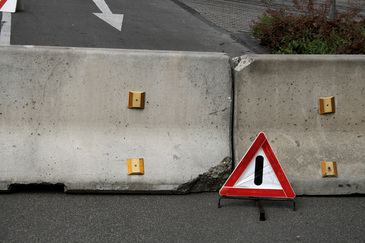
Sometimes, progress is simply blocked. For example, in our photo above, we're not going to be able to travel any further along this road, given the rather substantial looking roadblock that's right in front of us. But at least we have the option of turning around and trying another route.
In the game of checkers, a "block" means something similar. Our pieces might be blocked from going in a certain direction, and we have to seek another (though unless they're kings they can't turn around and go back). But if all of our pieces are blocked in all directions, we have a problem for sure: we've lost the game!
In his famous Tricks Traps & Shots of the Checkerboard, author Willie Ryan serves up various examples of blocks for our entertainment and tuition. Here's an over-the-board example that we'll let Willie tell us about it personally.
"Former American Champion Edwin F. Hunt, of Nashville, Tennessee, once defined Checkers as a "battle of ideas." The more ideas or strategic devices the learner can create or anticipate as he plays a game, the more skillful and versatile he becomes. Here is an artistic game I played several years ago with Basil Case, in which I managed to save what appeared to be a hopeless position by utilizing a block or smother idea.
| 9-14 | 18-15 | 6-10 |
| 22-18 | 7-11 | 24-20 |
| 5- 9 | 29-25 | 16-19 |
| 24-19 | 11-18 | 20-16 |
| 11-15 | 23-14 | 19-24 |
| 18-11 | 8-11 | 16-12 |
| 8-24 | 25-22 | 10-15 |
| 28-19 | 11-16 | 11-8 |
| 4- 8 | 14-10---2 | 2-7 |
| 25-22 | 6-24 | 8-4 |
| 9-13---1 | 27-11 | 24-28 |
| 22-18 | 12-16 | 4- 8 |
| 14-17 | 31-27 | 7-11 |
| 21-14 | 1-6 | 8- 4---A |
| 10-17 | 27-24 |
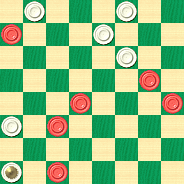
This brought about the diagrammed position.
BLACK
Black to Play and Draw
B:W32,30,26,22,12,K4:B28,17,15,13,11,3.
A---Forms a position with which the great George Buchanan of Scotland gained a draw against Thomas Ballantyne in the 1897 Scottish Championship Tourney."
1---Definitely not best; 8-11 would be good here---Ed.
2---Gives up the edge; 27-23 would have held on to a definite White advantage---Ed.
Can you find your way out of the situation and achieve a Black draw, or will you encounter a mental block? We hope not, but we won't try to block your mouse from clicking on Read More to reveal the solution.
You can email the Webmaster with your comments on this article.
Sixth Anniversary Edition
This weekend we celebrate six years of continuous publication of The Checker Maven. As we reach each new annual milestone, we marvel at how far we've come, and we know that it's all due to the support of our readers, without whom we would have gone out of business long ago.
It's become our tradition to try to offer a new work of checker fiction at each anniversary date. This year, we're happy to present a 1,900 word short story called Inferno. You'll understand why when you read the story and solve the associated checker problem.
We won't keep you waiting any longer. Here's our latest little story.
by Bob Newell
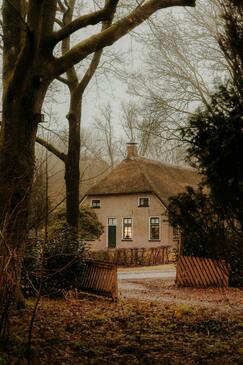
Pexels CC0
Billy and Joey had escaped from the house after lunch; the two cousins didn't want to remain under the watchful eye of old Aunt Edith, who seemed to automatically disapprove of anything they did. Now, they hadn't exactly sneaked out; it was more like they forgot to ask permission. At least, that's what they had agreed their story would be when the eventual reckoning with their respective parents, not to mention Aunt Edith, would take place.
But for now it was freedom, and for a couple of hours if their luck held, for the adults would surely be staying in the farmhouse and playing cards for the rest of the afternoon. Billy and Joey scurried across the farmyard and pulled up, out of sight of the house, behind the big barn on the other side.
"Whatcha wanna do?" asked Billy. He was a year older than his cousin, and it was his parent's farm, so he always acted like the one in charge and the one who knew what was going on, even though that was a fair distance from being correct.
"What about that spooky old house?" Joey asked. "You know, the one ..."
"Yeah, yeah, I know, 'course I know," Billy interrupted, "you always been wantin' to go over there. Pretty strange lookin' place if you ask me, an' I don't think you're up to it."
They were talking about one of the neighboring farmsteads, this one abandoned for many years since the death of the owners. Rumor was their estate had been in dispute for a long time, with little prospect of ever getting sorted out, so meanwhile, the farm had become more and more dilapidated as the years passed.
And the truth was, Billy was mighty scared of the place, though he would never admit that to his younger cousin. Billy had heard a lot of the stories that people in town told, and though at eleven years old he thought himself grown up, he still was more than a bit spooked.
But Joey was pushing him, and he had to appear brave, even nonchalant, if he wasn't to lose face.
"C'mon, Billy, I ain't scared, really I ain't, why can't we go there?" he complained. He could see that Billy was relenting.
Billy was clearly in a corner, with no way out. "Okay, okay," he said, trying not to let his voice show his inner fears, "we'll go. C'mon!"
It was nearly three-quarters of a mile to the old farmstead, and the afternoon sun was unrelenting. Joey looked pretty hot and tired, but he tried bravely not to complain. Billy almost asked Joey if he was too beat to go on, and if he wanted to turn back--- Billy certainly did, though he would never say as much--- but he thought it might show a crack in his facade, so he trudged on in silence.
They stopped a minute to rest under a small grove of birch
In answer, Joey stood up, brushed off leaves and debris from the seat of his pants, and resolutely headed back to the dusty road, Billy scrambling to follow him and regain leadership of the little expedition.
They were around the bend in a couple of minutes, and the old farmstead lay before them. What a sight it was. There was a large barn that had collapsed in upon itself, the roof failing and pulling down most of the walls with it. There were a few small outbuildings, all of them in a similar dilapidated state. There was the farmhouse itself, which, while much the worse for years of exposure to the elements and neglect, was at least still standing. It might even be possible to get inside without too much risk or danger.
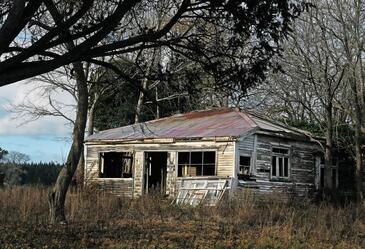
Freerange Stock CC0
"Hey, betcha there's a bunch of cool old stuff in that house over there," Joey said, once again stealing Billy's thunder.
"Na," replied Billy, "lots a kids been in there and there ain't nothin' left. Anyhow," he continued, trying to dissuade Joey from further speculation, "they say, you know, bad stuff happens in there."
"I don't believe none of that," Joey said. "I wanna go take a look." And again, he was the one to lead the way across the dusty, weedy ground, over the litter-strewn front yard, and up to the porch of the farmhouse.
The portico over the entryway had long since fallen. Rusted rain gutters, broken away from the eaves, lay around the ground. The floor of the porch was broken in places, but it looked solid enough at the foot of the front door. All of the clapboard
The front door looked to be ajar by just and inch or two.
"Careful!" shouted Billy but Joey was already by the door, the floor creaking and groaning but holding his weight. "Help me open this" Joey cried as he put the fingers of both hands around the edge of the door and tugged as hard as he good. The hinges were rusted and he wasn't strong enough to break the door loose.
Billy joined him and together they pulled. "One, two, three, PULL!" Billy shouted and all at once they were on their backs on the ground in front of the house, as the door yielded and they were thrown off by the force of their efforts.
Joey was already up, dusting off his shorts and tee shirt, and heading for the dark opening into the house, Billy following more slowly behind him. The light was dim just inside the door, a rectangle of light from the doorway illuminating a faded and tattered carpet, some furniture that smelled musty and looked even worse, and an old table with what looked like a checkerboard on it. Everything was covered in dust but that didn't hide the water damage, no doubt due to occasional prairie rainstorms sending torrents of water through holes in the roof and ceiling.
They stood and looked, waiting as their eyes adjusted from bright outdoor sunshine to the weak indoor light. About the only thing still fully standing was the old wooden table and a couple of chairs. Everything else was so broken down as to be completely unusable, and showed signs of vandalism: seat cushions were shredded, the walls were gouged in places and covered with graffiti nearly everywhere.
"I wonder," Billy said, "why nobody stole the checkerboard?"
Indeed, a checkerboard did sit on the table, with a faded set of red and white wooden checkers, all coated with dust. The board was of the leather folding type. The leather had peeled in many places; most of the squares had water stains, but it was otherwise intact.
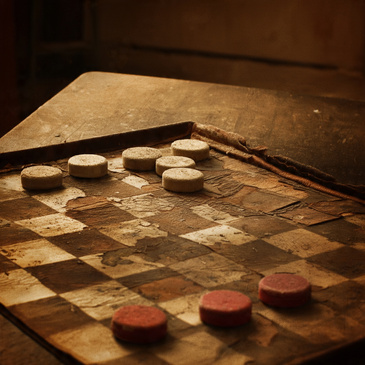
"I dunno," said Joey, "maybe kids like to play here."
"You crazy or what?" replied Billy. "Kids ain't gonna come to this creepy old dump to play checkers, fer cryin' out loud! What's wrong with you?"
"Aw, c'mon, let's play! Won't it be cool tellin' the kids at school how we played checkers in the old haunted place?"
Billy was getting more nervous by the minute, and trying hard to keep his cool. "Hey, don't be makin' up stuff like that!" he said. "Whaddya, scared?" Joey asked. "Let's play! Show me you ain't a-scared!"
It was too much for Billy. Having lost the lead already to his younger cousin, he wasn't about to act frightened, even though he was pretty close to scared witless. They both pulled rickety wooden chairs across the floor and up to the wooden table. They dusted off the checker pieces and the board, coughing in the billowing dust cloud they created. But everything soon settled down and they both found themselves sitting in front of a ready checkerboard, Joey grinning and wiggling in his chair, Billy looking something more than mildly annoyed and sitting stock still.
His mother was calling from the kitchen. "Bobby and Jimmy," she sang, "dinner's ready, come here and eat!"
"Aw, gee, Jimmy, I wanna just finish this game," Bobby said, looking down at the brightly-painted checkers on the brand new folding checkerboard.
"Nah, you know your mom gets impatient when food's gettin' cold," Jimmy replied, "we better go an' eat an' then play some more checkers later."
Just then there was a crash and a scream from the kitchen. "The gas tank!" they heard Bobby's mother cry out. "Run, boys!" and then there was the deafening roar of an explosion and hot flames streaming out the kitchen door.
"Mom, mom!" Bobby cried, and Jimmy was tugging on his arm, dragging him to the door and away from the heat of the flames. "No, no, I gotta get Mom!" Bobby screamed, and with a violent move, wrenched himself away and ran to the kitchen, blindly charging into the flaming inferno that raged there.
Jimmy had already run out yelling for help. The adults on the farm were fast to respond, pouring buckets of water and sand on the flames in a desperate effort to get into the kitchen. But it was too late. Though they had saved the rest of the house, the kitchen was completely destroyed. They found two badly charred bodies, one an adult female, the other that of a twelve-year old boy.
Billy was shaking Joey violently. "Wake up, wake up, are you OK, what's happening?" Joey's eyes opened slowly as he returned to awareness. "Huh?" Joey said. "The fire ... it was so hot ... I couldn't get away ...."
"What are you talking about, Joey?" asked Billy. "There ain't no fire ... we was goin' to play checkers an' you passed out an' fell on the floor. You was screamin' like you was havin' some kind of nightmare and I couldn't wake you up. You scared me Joey, don't do that!"
Joey was sitting up on the floor now, rubbing his eyes. "There was a fire," he kept saying. "In the kitchen ... and I ran in there to get Mom ..."
"Joey, come here, look, there ain't no fire!" Billy shouted. He pulled Joey to his feet and dragged him away from the table toward the kitchen. "Look, see ...." Billy didn't finish his sentence, his jaw agape as they both took in the sight of the charred floors and walls and the burned ceiling. There had certainly been a fire here long ago, and by the looks of it, a bad one.
There wasn't much left of the floor, but there were two large, ominous dark spots, as if the heat of the flames had burned two sizable objects.
"L..let's getta outta here," Joey said, and Billy didn't have to be told twice. Joey leaned on Billy for support and they made their way back through the living room.
"Look!" Joey shouted. "Look, there!" and his arm was pointing arrow straight to the old table and checkerboard.
There was no dust on the table, and the board and checkers looked like new. The checkers had been moved as if someone had been playing and had been interrupted in mid-game. But Billy was tugging again on Joey's arm, pulling him to the door and out into the yard.
They started to run, and they didn't stop until they were back to Billy's house.
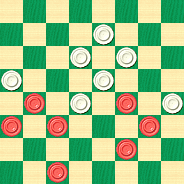
BLACK
Black to Play and Win
B:W26,23,22,20,18,15,13:B16,14,12,11,9,6,3.
Click on Read More to see the solution to the position shown above.
You can email the Webmaster with your comments on this article.
The Checker Maven is produced at editorial offices in Honolulu, Hawai`i, as a completely non-commercial public service from which no income is obtained or sought. Original material is Copyright © 2004-2026 Avi Gobbler Publishing. Other material is public domain, AI generated, as attributed, or licensed under CC1, CC2, CC3 or CC4 and the various CC options. Information presented on this site is offered as-is, at no cost, and bears no express or implied warranty as to accuracy or usability. You agree that you use such information entirely at your own risk. No liabilities of any kind under any legal theory whatsoever are accepted. The Checker Maven is dedicated to the memory of Mr. Bob Newell, Sr.