The Checker Maven
The World's Most Widely Read Checkers and Draughts Publication
Bob Newell, Editor-in-Chief
Published every Saturday morning in Honolulu, Hawai`i
A (Not So) Easy Problem
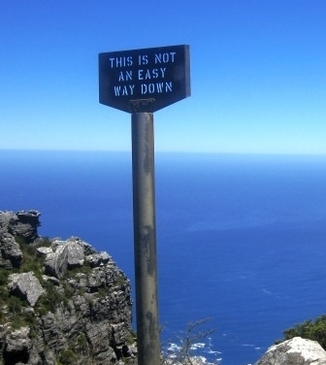
Public Domain Pictures CC0
On the first Saturday of the month we often have a speed problem, an easy problem, or a stroke problem. Today we have a (not so) easy problem.
WHITE
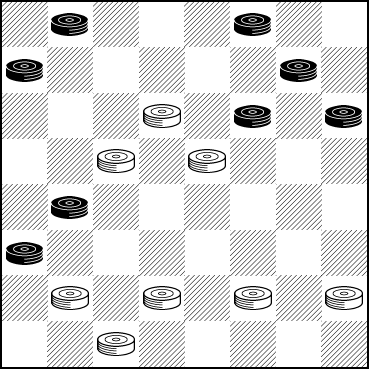
White to Play and Win
W:W30,28,27,26,25,15,14,10:B21,17,12,11,8,5,3,1.
This one in a way is in two parts. There's the easy part in the beginning, and chances are you'll see that right away, even though White is on the verge of losing a piece. But then there's the second part. You'll see what we mean when you work on solving it. In any event, this little study is a great demonstration of an important winning technique.
Will you find a winning way easily or (not so) easily? This week, we suggest you take as much time as you need, and then click on Read More to see the solution and explanatory notes.
You can email the Webmaster with your comments on this article.
Canadian Checker Class
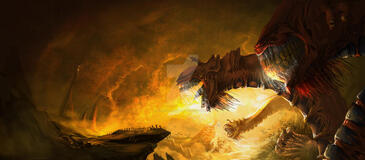
Professor W. R. Fraser was a Canadian champion who also published books and studies on checkers, mostly notably The Inferno of Checkers, in which he used Dante's Inferno as a metaphor. We won't delve further into that interesting literary area today; instead we'll emphasize Prof. Fraser's academic side, by presenting one of his studies from a group Tom Wiswell included in a small collection that Mr. Wiswell called Canadian Checker Class.
WHITE
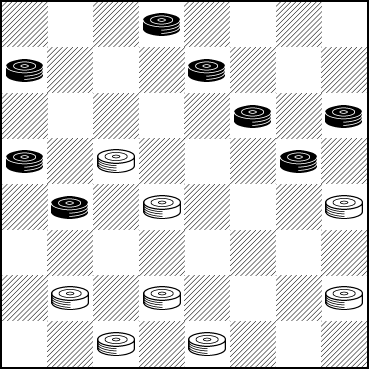
White to Play and Win
W:W31,30,28,26,25,20,18,14:B17,16,13,12,11,7,5,2.
We'd rate this one as fairly hard, though short of infernal. If you get the first move right and figure out the theme, you'll be able to solve it. Treat this as a professorial homework assignment rather than a descent into Hades, and see if you can get it, then burn your mouse on Read More to see the solution.
You can email the Webmaster with your comments on this article.
Schaefer is the ...

Internet Archive Public Domain
Was checkerist A. Schaefer in any way connected to the famous, and once family owned and New York based, F. & M. Schaefer Brewing Company? It's one of those things that are possible, but doubtful. In any case, Schaefer, like all New York City breweries, left the city many years ago, and is now owned by Pabst, who still operate the brand.
Schaefer used to advertise itself as "the one beer to have when you're having more than one." In all honesty, The Checker Maven doesn't think "having more than one" is always a good idea (we ourselves choose not to drink alcoholic beverages). If you've "had a few" as the saying goes, you're not likely to be able to solve interesting Checker School problems such as the one below.
WHITE
BLACK
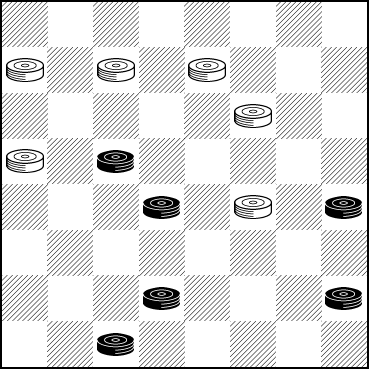
Black to Play and Win
B:W28,27,26,22,20,14:B19,15,13,7,5,3.
Black actually looks like he could lose if he's not careful. How is he supposed to win? But there is a way, and it's subtle and pleasing with a key move at a key moment. You won't need "more than one" checker problem today, as this one is very satisifying. Give it a try and then click your mouse --- just once --- on Read More to see the solution, sample games, and detailed notes.
You can email the Webmaster with your comments on this article.
The Tax Man
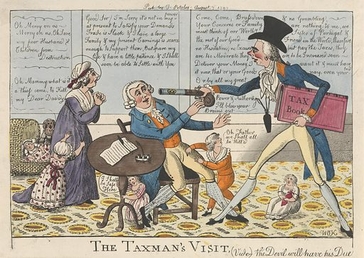
Public Domain
This column appears on April 15, 2017. April 15, in the United States, is the infamous day on which income tax returns are due, along with any money you might still owe. Checker Maven staff get hit pretty hard every year; we certainly hope that you do better, regardless what country you call home.
We have a slight reprieve, as when April 15 falls on a weekend, we're ever so generously allowed until Monday to pay up. So, let's enjoy a checker problem before we face the music two days hence.
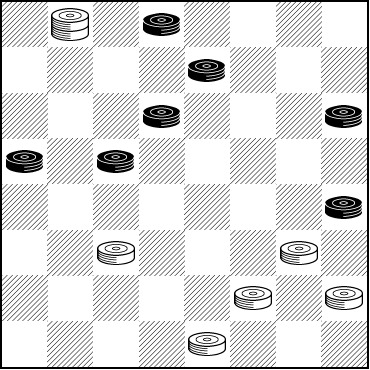
WHITE
White to Play and Draw
W:W31,28,27,24,22,K1:B20,14,13,12,10,7,2.
White is a piece down and it's not looking so good. Would you say it's kind of like the way the tax man hits us with a big bill when we can least afford it? But in this case, White can beat the tax man and break even (try to do that with the IRS)--- no cheating required.
Tax your brain instead of your wallet. The solution is elegant and pleasing, if every bit as hard to find as enough cash to pay that tax bill. See how you do, then file your return by clicking your mouse on Read More to get your refund--- or if not exactly a refund, a look at the solution and some explanatory notes.
You can email the Webmaster with your comments on this article.
Without
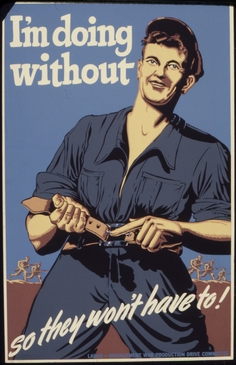
Public Domain
The picture above dates to World War II, when many did without in support of the war effort. Luckily, today, in the free world we generally don't have to do without, as a minimum, the basic necessities.
In checkers, there is "doing without" as well; in today's study, the winning side has to make do without "the move." This is called in textbooks, logically enough, "first position without."
We know that first position is a win with two kings against a king and a man, as long as the side with two kings has the move. But checkers is full of subtle twists, and there are wins in some of these positions without having the move on the stronger side, hence the name "first position without." There are supposedly twenty or so of these exceptions to the general rule. Below you'll find one of them.

BLACK
Black to Play and Win
B:W22,K5:BK15,K6.
There are a couple of ways to do this, depending on how White plays. One of them is as proposed decades ago in Dr. Call's book of "Midget" problems. Another line is preferred by our KingsRow computer engine.
Can you find the win here, or will you have to do "without"? See how you do, and then "without" hesitation, click on Read More to see the solutions.
You can email the Webmaster with your comments on this article.
April 1, 2017
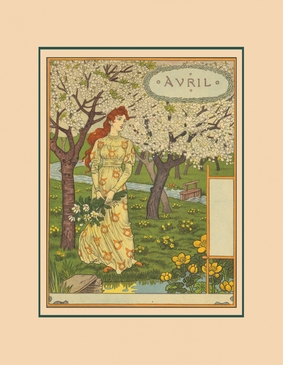
Public Domain
March is over and April has come around again, as it always does, with perhaps a promise of spring. This column is being first published on April 1, 2017, and you might do well to bear that in mind as you take a look at today's checker problem.
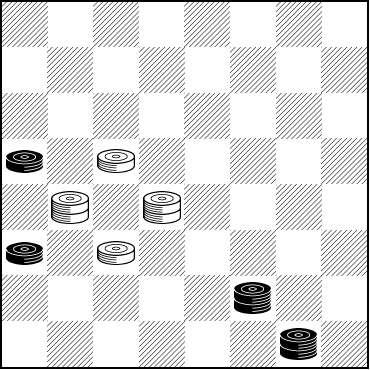
WHITE
White to Play and Win
W:W22,K18,K17,14:BK32,K27,21,13.
We rate this one as very easy. You can solve it in seconds if you get the idea. But it's almost surely impossible if you don't see what's going on.
Are you sharp today? Don't fool around; puzzle it out and then click your mouse on Read More to see the solution.
You can email the Webmaster with your comments on this article.
A Picture is Worth A Thousand Words
In a recent article we asked you about your preferences in board diagrams, and although there were various opinions, a clear (and nearly overwhelming) majority seem to prefer black and white diagrams with the corresponding side notations of "Black" and "White." So, as of today, we're switching over. A good picture is indeed worth a thousand words.
The problem is that we didn't think the black and white diagrams were of especially high quality. But we're happy to say that we've found a way to "port" the excellent black and white diagrams used in our print publications over to the web. We'll spare you the technical details, which involve rather arcane Linux knowledge, and instead hope that you like our new, larger, clearer diagrams. Do write and let us know what you think.
So, let's start off with a fine problem from Samuel Gonotsky. This one is taken from over the board play and it's quite a nice early endgame study.
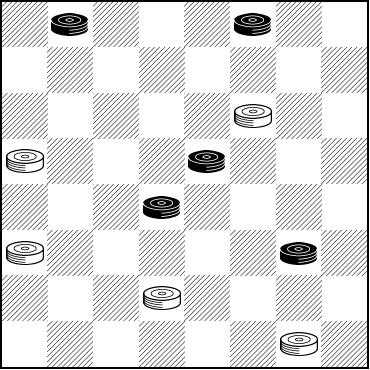
WHITE
White to Play and Draw
W:W11,13,21,26,32:B1,3,15,18,24.
Against best play by Black, White will have to work pretty hard to get the draw. Situations such as these are seldom pure black and white. Can you find your way through? Our computer found a neat move to make things much harder than we think Mr. Gonotsky intended, but that's the black and the white of it. Give it a try and then click on Read More to see the solution.
You can email the Webmaster with your comments on this article.
A Little Lesson
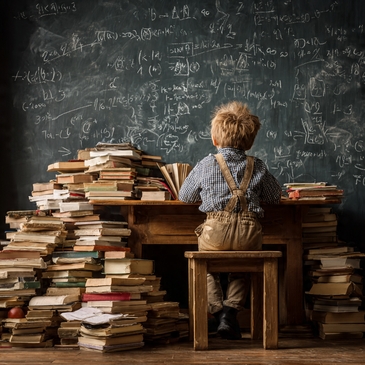
The young fellow above seems to be having some trouble with his lesson, at least judging by the state of the blackboard, the look on his face, and the number of books piled up beside him. Could those possibly be checker books, and might the bottom one be a library edition of Complete Checkers? We can't say for sure, but one can always hope.
In today's Checker School entry, we present a little lesson with a big payoff. The position is shown below.
BLACK
WHITE
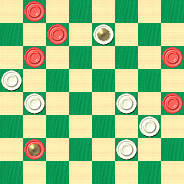
White to Play and Draw
W:W27,24,19,17,13,K7:BK25,20,12,9,6,1.
What can White do here? The man on 17 is doomed and apparently White can only shuffle his king around and wait to lose. Yet there is an astounding draw here, one most worthy of the Herd Laddie. We call this a "little lesson" because Ben Boland was unusually brief in his commentary and there is only one sample game. Nonetheless we're certain you'll love this study, which is now approaching 150 years in age.
Give it a little try and then click your little mouse on the little Read More button to see the larger than life solution.
You can email the Webmaster with your comments on this article.
Unpublished Variation(s)
The above quotation comes from the popular television series Downton Abbey, and surely it rings true for life in general.
But for our game of checkers, we suggest that the situation is different, and bringing to light unpublished play is sometimes instructive and revealing.
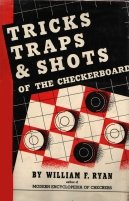
That's the case today, as we conclude our extended series on the Kelso taking from Willie Ryan's famed Tricks Traps & Shots of the Checkerboard, with something Willie calls "a fine unpublished variation."
Let's first give the entire run-up, without commentary.
| 1. | 10-15 | 22-18 |
| 2. | 15x22 | 25x18 |
| 3. | 6-10 | 18-14 |
| 4. | 10x17 | 21x14 |
| 5. | 9x18 | 23x14 |
| 6. | 1-6 | 29-25 |
| 7. | 12-16 | 26-23 |
| 8. | 16-19 | 24x15 |
| 9. | 11x18 | 28-24 |
| 10. | 8-11 | 24-19 |
| 11. | 4-8 | 31-26 |
| 12. | 6-9 | 19-15 |
| 13. | 11-16 | 26-22 |
BLACK
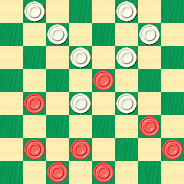
Black to Play and Draw
B:W32,30,27,25,23,22,15,14:B18,16,9,8,7,5,3,2.
The critical position. Willie gives the following spectacular clearance as his main line draw:
| 14. | 16-19 | 23x16 | |
| 15. | 7-11 | 16x7 | |
| 16. | 3x26 | 30x14 | |
| 17. | 9x18 | 27-23 | |
| 18. | 18x27 | 32x23 | |
| 19. | 2-7 | Drawn. | |
But let's go back to the diagram. Willie says, "If 9-13 is played, 14-10, 7-14, 15-10 will be good enough ..." and certainly after 2-7 22-15 the draw is on the board. Now, Willie goes on to claim: ... if 16-20 is selected, the following leads to a draw: ..." and then he gives J. P. Murray's previously unpublished variation.
So, from this position:
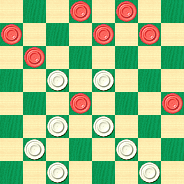
WHITE
White to Play and Draw
W:W32,30,27,25,23,22,15,14:B20,18,9,8,7,5,3,2.
can you find the White draw? This isn't especially easy, but what's interesting is that there are actually two drawing moves for White, one of which the computer discovered ... perhaps a whole new unpublished variation?
Give it your best effort, and the solution, which we'll certainly not leave unpublished, can be reached by clicking on Read More.
You can email the Webmaster with your comments on this article.
As Easy As Pie
Public Domain
We've often said that we present a range of problems in our Checker Maven columns; sometimes they're grandmaster tough, sometimes beginner easy, but most are usually somewhere in-between. We have readers with a very wide range of skills, and we try to provide something for everyone. We suggest the following: when you find a problem is tough, study the solution with a view to learning technique; when it seems easy, try for rapid sight recognition.
Today, though, we've got a truly easy-as-pie problem that even many early-stage checkerists will solve right away. See how quickly you can spot the solution!
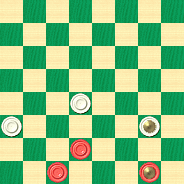
BLACK
Black to Play and Win
B:W15,12,K9:B7,3,K1.
By the time you read this line, you've probably already solved it, but just in case, you can ease over to Read More to check your answer.
You can email the Webmaster with your comments on this article.
The Checker Maven is produced at editorial offices in Honolulu, Hawai`i, as a completely non-commercial public service from which no income is obtained or sought. Original material is Copyright © 2004-2026 Avi Gobbler Publishing. Other material is public domain, AI generated, as attributed, or licensed under CC1, CC2, CC3 or CC4 and the various CC options. Information presented on this site is offered as-is, at no cost, and bears no express or implied warranty as to accuracy or usability. You agree that you use such information entirely at your own risk. No liabilities of any kind under any legal theory whatsoever are accepted. The Checker Maven is dedicated to the memory of Mr. Bob Newell, Sr.