The Checker Maven
The World's Most Widely Read Checkers and Draughts Publication
Bob Newell, Editor-in-Chief
Published every Saturday morning in Honolulu, Hawai`i
Barker's Bounce
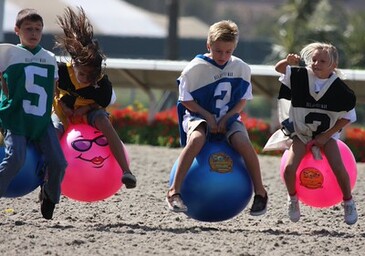
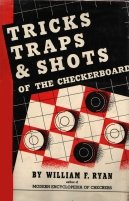
As each month we continue to republish Willie Ryan's masterful Tricks Traps & Shots of the Checkerboard, we can't help but notice that the situations presented are, at least in a general sense, increasing in difficulty.
But no matter. We have Willie at our electronic side to explain it all. Here's one he calls Barker's Bounce for reasons that we'll let him explain for himself.
"This useful study shows how Champion G. F. Barker gave the bounce to James P. Reed in their stubbornly fought American Championship battle of 1891. Ever since that time, the losing move at A has been carefully sidestepped by all alert generals of the board.
| 12-16 | 3- 8 | 15-19---A |
| 24-20 | 26-22 | 20-11 |
| 8-12 | 11-15 | 8-15 |
| 28-24 | 20-11 | 23-16 |
| 9-14 | 7-16 | 12-19 |
| 22-17 | 24-20 |
forming the diagram.

WHITE
White to Play and Win
W:W17,21,22,25,27,29,30,31,32:B1,2,4,5,6,10,14,15,19.
A---This is where Reed took the road to ruin. The only move that will produce a draw is: 5-9*, 20-11, 15-18, 22-15, 10-26, 30-23, 8-15, 17-10, 15-19, 23-16, 12-19, 10-7, 2-11, 25-22, 11-15, 31-26, 4-8, etc. Willie Gardner."
Will this problem give you the bounce too, or will you rebound and solve it? In any case you can roll along to Willie's solution just by clicking on Read More.
You can email the Webmaster with your comments on this article.
A Crowd Scene
Rawpixel CC0
We must admit that we're not all that fond of crowds (leaving aside baseball games, of course), preferring the tranquil solitude of the prairie, the desert, or the open sea. But at times, it's just impossible to avoid jostling with massed humanity as we go about our business in one urban environment or another.
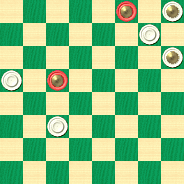
Today's problem presents us with a crowd scene of a different sort, as we view a checkerboard situation where the White forces are a full three men up on the Black side, yet a win seems elusive. This unexpected turn of events is due to some severe single-corner crowding, where a lone Black king is holding three White pieces completely at bay.
Here's the position:
WHITE
White to Play and Win
W:WK4,8,K12,13,22:BK3,K14.
White doesn't seem to have a single decent move, yet the game can still be won, though it's every bit as difficult as making your way along Kalakaua Avenue on a Saturday evening.
Try to solve the problem, but if your thoughts become overcrowded, relieve the congestion by clicking on Read More to see the solution.
You can email the Webmaster with your comments on this article.
Fine Summer Days

Pexels CC0
This time of year it is our wont to observe that in the Northern Hemisphere the days are long and hot, and folks are out enjoying summer. So our August speed problems this time are most definitely on the easy side, and solving them won't cut into your pool or picnic time.
In fact, just to be sure that you have plenty of time for the summer pursuits of your choice, we're setting the time limit for these problems to a mere ten seconds. Don't blink twice, you may be too late! Click on the links below to show the problems and start the clock on your ten second solving time.
August Speed Problem One (very easy)
August Speed Problem Two (very easy)
Check your solutions by clicking on Read More, and then go back to your enjoyment of a fine summer day.
Editor's Note: To our friends in the Southern Hemisphere, who are mired in the depths of winter, we can only point out that in less than six months the tables will be turned.
[Read More]You can email the Webmaster with your comments on this article.
Sturges the Great
Joshua Sturges was one of the early great teachers in the world of draughts; he published his "Guide to the Game of Draughts" in London, in 1800, and for nearly half a century it was the draughts primer. Even to this day, online bookseller Amazon lists the title in their catalog as Joshua Sturges's guide to the game of draughts: In which the theory and practice of that scientific recreation are clearly illustrated including one hundred and seventy-two critical positions. They list the date as 1881, for some reason (there were apparently numerous later editions and reprints), and note that the title is not currently available, and is not expected back in stock!
Information on Mr. Sturges isn't all that easy to come by, but we did find this historical record of a London jury that convened in July, 1801.
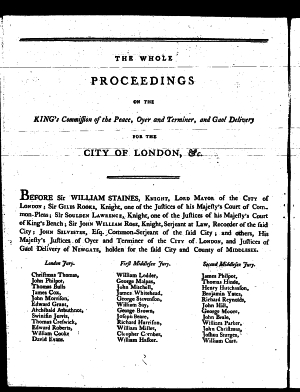
In the listing of jury members, a Joshua Sturges is shown as a member of the "Second Middlesex Jury." We don't know if this is the same Mr. Sturges of draughts fame, but given the date and location, it is certainly quite possible.
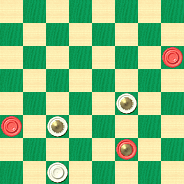
But today, in our continuing Checker School series, we're asking you to be both judge and jury of the following Sturges "situation."
BLACK
WHITE
White to Play and Win
W:WK19,K22,30:B12,21,K27.
Certainly, White is better off here, but demonstrating the win makes all the difference, and it will certainly require care and attention.
Weigh the evidence and come up with the verdict: can you prove that White wins or will there be a hung jury? After you've given it your best effort, click on Read More to see the solution, notes, and several example games, as provided by Ben Boland.
You can email the Webmaster with your comments on this article.
Horsefall's Stroke
Continuing with our ongoing series taken from Willie Ryan's Tricks Traps & Shots of the Checkerboard, this month we present a complex problem that Willie himself admired greatly, as he clearly states below.
"No compendium of classical coups would be complete without including the historical Horsefall Stroke, which I consider one of the great masterpieces of scientific play. Here's the run-up:
| 11-15 | 4-8 | 14-21 |
| 23-18 | 25-22 | 18-14 |
| 8-11 | 8-11 | 9-18 |
| 27-23 | 29-25 | 22-8 |
| 11-16 | 10-14 | 1-6* |
| 18-11 | 31-27 | 8-4 |
| 16-20 | 6-10---A | 6-10* |
| 24-19 | 19-15 | 4-8 |
| 7-16 | 10-19 | 3-7* |
| 22-18 | 21-17 | 8-11---B |
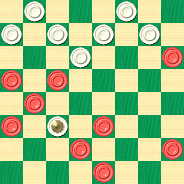
BLACK
Black to Play and Draw
A---Weak, but drawable. The following makes an easier draw: 3-8, 19-15, 2-7, 22-17, 7-10, 17-13, 10-19, 26-22, 19-26, 30-23, 14-17, 21-14, 11-15, 18-4, 9-18, 23-14, 6-9, etc.
B---Strongest, forming position illustrated. If instead of 8-11, white moves 25-22, the only moves to draw are: 7-11*, 8-6, 2-9, 22-18, 9-13*, 18-14, 13-17, 14-10 (23-18, 21-25, 30-21, 19-24 results in a draw), 5-9, 23-18, 9-13, 18-15, 17-22."
We're well beyond the introductory material in Mr. Ryan's classic book, so you can't expect an easy ride. Don't horse around; try to rein in the problem, and then click on Read More to gallop directly to the Willie's solution.
You can email the Webmaster with your comments on this article.
Checkers Has Been Solved
Checkers has been solved. This headline has appeared in many news articles in the past few days, as Dr. Jonathan Schaeffer announced on July 19, 2007, that his team at University of Alberta has completed their quest to develop a rigid proof that checkers is, with perfect play on both sides, a drawn game.
This proof is a monumental achievement in computer science and took years of work to develop. The proof is non-trivial, both in complexity and quality; Dr. Schaeffer's team not only proved that checkers is a draw, they've shown how to do it. Given that you have a very powerful computer, an enormous database, and some sophisticated computer code, you can draw all your games from now on.
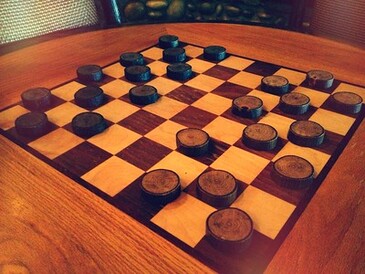
What's our reaction to this? As computer literates ourselves, we're most impressed with Dr. Schaeffer's work. As checker players and fans, we can only say, "Let's play checkers." In fact, this week your editor himself was quoted in Nature Magazine, when asked about the impact of this new proof on the checker playing public, as saying, "People will keep right on playing checkers."
And, of course, they will.
We note that, while checkers is now known definitively to be a draw, this coming week's U.S. National Tournament hasn't been canceled, and we in fact predict with great confidence that the tournament will produce some really fine games of checkers. Too, we have no plans to discontinue publishing The Checker Maven as we still think there are plenty of checker topics worthy of column space.
While the computer has had a profound influence on our game, mostly (but not entirely) for the good, checkers is in the end a game for people. Real, live people from all walks of life play checkers, and they won't stop now. From country picnic tables all the way to Las Vegas tournament halls, checkers will go on.
A draw? Yes, in theory, the game is a proven draw. In practice, it's still a great deal of fun and a tremendous intellectual challenge, and that's not going to change.
Editor's note: The photo at the top of this article is a file photo and is definitely not of Dr. Schaeffer and his laboratory.
You can email the Webmaster with your comments on this article.
Bastille Day Fireworks
PICRYL CC0
The publication date of today's article is July 14, which is the French national holiday, most popularly known here in the US as Bastille Day. The French certainly know how to throw a party, and music, dancing, liberally quaffed libations, parades, and much more take place throughout the country starting the evening of July 13 and continuing all through the next day. Capping it all off, of course, are spectacular displays of feu d'artifice--- fireworks.
We wanted to publish a French problem to celebrate the occasion, but high-level checkers as played in France is almost exclusively the international game, played on a 10x10 board with rules that differ in substantial ways from the Anglo-American game about which we write here. So instead, we're offering our own feu d'artifice display, featuring spectacular fireworks on the checker board. Here's the position, as composed by problemist T. Duncan.
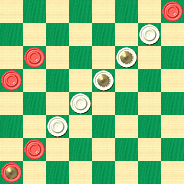
WHITE
White to Play and Win
W:W8,K11,K15,18,22:B4,9,13,25,K29.
With a setup such as this, you just know something extraordinary is about to happen. Can you work it out?
There's no need to explode, of course; clicking on Read More will rocket you to the crowd-pleasing solution.
You can email the Webmaster with your comments on this article.
An Interesting Combination
Albuquerque, New Mexico, is perhaps an hour's drive south on Interstate 25 from our Santa Fe offices. We go there frequently, and with our eye for the unusual, we've spotted some rather unique combinations during our visits.
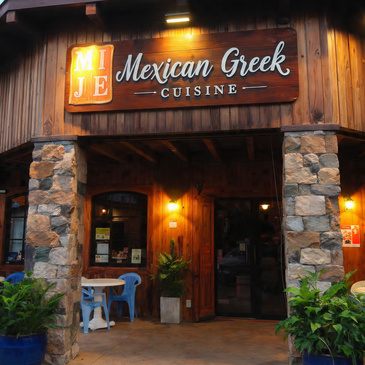
Where else will you find a Mexican-Greek restaurant?
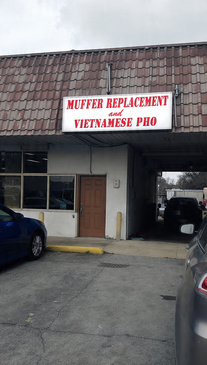
Or a muffler repair shop that also houses a Vietnamese lunch counter?
(Note: Not actual images of the referenced locations.)
It's not possible to top either of these eclectic melanges, but our checker problem today is a combination of a different sort.
For the sake of variety, on the first Saturday of each month we've alternated between speed problems and stroke problems. This time, we present a single problem that has aspects of both: you'll need to find the winning stroke in a rather short amount of time. The problem is fairly easy, and we think fifteen seconds should leave you with time to spare.
Of course, we're as infamous for our diabolical notion of "easy" as our Javascript clock is infamous for its unforgiving nature. But in any case, combine speed, clear thinking, and accurate play to solve this month's speed/stroke problem.
When you've worked it all out, click on Read More for the very pleasing solution paired with the actual game from which the position arose. Though we can't offer you tacos, gyros, a new muffler, or Vietnamese noodle soup, we do think you'll enjoy today's problem.
You can email the Webmaster with your comments on this article.
Konane Kane

Ed Gilbert generously sent along a copy of his 10-piece KingsRow endgame database (see previous story) for the use of The Checker Maven, and we've been having a few pleasant adventures getting it all set up and ready to use. We in turn send our thanks to Ed for supporting our ongoing work of bringing checkers to the public each and every week.
Our general policy is not to solicit donations and not to accept them if offered, as we believe that The Checker Maven should be free for everyone, and we don't want to have class distinctions between donors and non-donors. But Ed's offer was very special and very much appreciated. (We did also once accept a generous donation from Brian Hinkle, which is subsidizing a future electronic republication of a classic checker book.)
To install Ed's database, we really needed a faster and larger computer system, so, at Ed's advice, we built one from an assemblage of parts ordered from the component vendor Newegg. It took a little time and effort but our new system is running fine. We've called it Konane Kane which in Hawaiian roughly means Checker Dude. (The game Konane is sometimes called "Hawaiian Checkers.")
Here's a picture of the new system in the basement laboratory of our Santa Fe offices.

"Konane Kane" in our Santa Fe Computer Laboratory
Sometime later next year, Konane Kane will likely travel to "Hawai`i nei" and become the main computer at our Honolulu offices. In the meanwhile, we'll be using it and Ed's phenomenal database to bring you exciting new features and articles. It's a big win all around. Mahalo nui loa!
You can email the Webmaster with your comments on this article.
The Other Benjamin
PICRYL CC0
Who among us has not read The Autobiography of Benjamin Franklin, and derived untold benefit from the eminently practical wisdom and philosophy of its author? And who would be surprised to learn that Ben Franklin was himself a checker player, who praised the merits of the game as training for life?
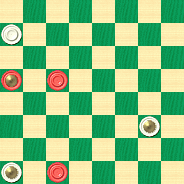
Today's Checker School problem, though, was composed by a different Benjamin: E. A. Benjamin, to be precise, but we think it's as practical and useful, at least in checker terms, as Ben Franklin's advice for living a successful life. The problem situation is shown below.
White
Black
Black to Play and Win
B:W28,K9,K4:BK20,19,3.
Taking a closer look, we see that White has a material advantage, having two kings to Black's one, but Black's mobility is clearly superior. Is it enough to turn the situation into a Black win? Try it out, and then click on Read More for the solution, notes, a sample game, and some words of wisdom from the better-known Benjamin.
You can email the Webmaster with your comments on this article.
The Checker Maven is produced at editorial offices in Honolulu, Hawai`i, as a completely non-commercial public service from which no income is obtained or sought. Original material is Copyright © 2004-2026 Avi Gobbler Publishing. Other material is public domain, AI generated, as attributed, or licensed under CC1, CC2, CC3 or CC4 and the various CC options. Information presented on this site is offered as-is, at no cost, and bears no express or implied warranty as to accuracy or usability. You agree that you use such information entirely at your own risk. No liabilities of any kind under any legal theory whatsoever are accepted. The Checker Maven is dedicated to the memory of Mr. Bob Newell, Sr.