The Checker Maven
The World's Most Widely Read Checkers and Draughts Publication
Bob Newell, Editor-in-Chief
Published every Saturday morning in Honolulu, Hawai`i
Noticing missing images? An explanation is here.
Subtle

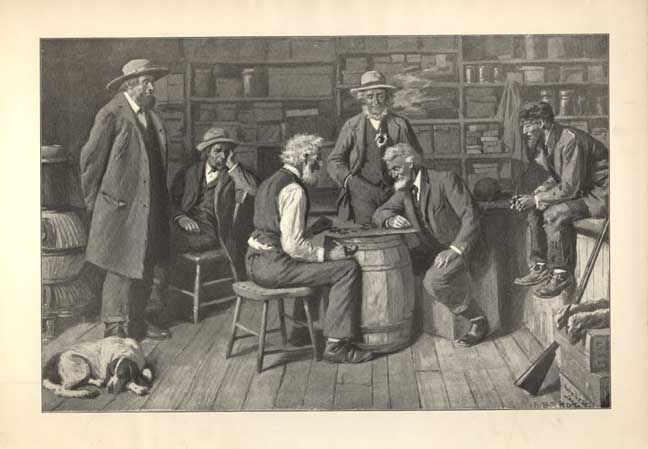
An image such as the one above, unusual though it may seem, is filled with deep and and often subtle symbolism and meaning, unraveled only through careful consideration and study.
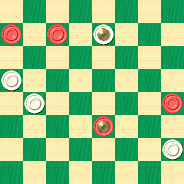
Today's entry in our Checker School series demonstrates once more that checkers too can be deep and subtle, with each move having its own meaning and significance. The problem shown below, first published over 140 years ago, is definitely not easy, but by any measure it is rewarding, satisfying, and entertaining, and we might even say, enlightening.
BLACK
WHITE
White to Play and Draw
W:W28,17,13,K7:BK23,20,6,5.
Can you unravel the subtleties of this difficult position? Think deeply, and be careful of seemingly small nuances that loom large in the end. When you've unraveled the meaning of the problem, click on Read More to see the solution, sample games, and detailed explanatory notes.
You can email the Webmaster with your comments on this article.
The Great Lewis Stroke
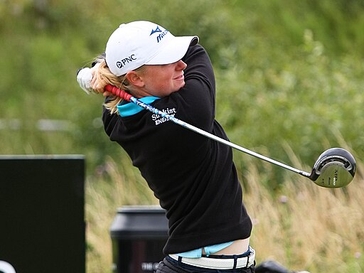
Golfer Stacy Lewis is executing quite a powerful and accurate stroke in the photo above, something that takes skill, strength, and timing.
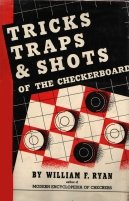
Today's excerpt from Willie Ryan's Tricks, Traps & Shots of the Checkerboard brings us a similar example from the game of checkers. Attributed to the late Lawrence Lewis, skill, strength, and timing are all part of the picture here too. Now, we doubt that checkerist Lewis and golfer Lewis are in any way related, but we don't know if golfer Lewis plays checkers or for that matter if checkerist Lewis played golf. What we do know is that you'll certainly enjoy today's problem. Let's let Willie tell us more.
| 9-13 | 15-18---A | 13-17 |
| 22-17 | 29-25---B, 1 | 19-15 |
| 13-22 | 6-9 | 1-6 |
| 25-18 | 24-19 | 24-20---2 |
| 10-15 | 9-13 | 12-16---E |
| 18-14 | 28-24 | Now look at the |
| diagram. |
WHITE
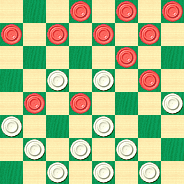
White to Play and Win
W:W14,15,20,21,23,25,26,27,30,31,32:B2,3,4,5,6,7,8,11,16,17,18.
"White now sweeps the board with one of the best concealed strokes recorded in checker literature. It was first shown by the late Lawrence M. Lewis of Wheeling, West Virginia, who sprang it on me in a match at Flint, Michigan, in 1928, throwing the gallery of spectators into an uproar!
A---Tescheleit's Master Play says this move 'leads to a critical draw for black.' The figures featured in this study should disperse that claim.
B---Very weak, as it permits black to work in 6-9, tying up white's single corner development. Tescheleit prescribes 21-17 as the potent element in white's formation, but black has an equal game against it, as follows: 21-17, 11-15*---C, 29-25, 8-11, 17-13, 11-16*---D, 24-20 (if white adopts 24-19, 15-24, 28-19, then 6-10* puts black on the right track), 16-19, 23-16, 12-19, 27-23, 18-27, 32-16, 15-19* (a one-move redeemer), 16-11 (31-27, 4-8, 27-24, 8-12, 24-15, 12-19, 15-11, 7-16, 20-11, 6-9, ends in a draw), 7-16, 20-11, 3-7, 31-27, 7-16, and white has nothing to play for but a draw.
C---Given to lose by Tescheleit, but it is probably the only move to draw! Tescheleit shows 11-16 to draw, then 29-25, 16-20, 26-22, 12-16, 22-15, 7-10, 14-7, 3-26, 30-23, 5-9; now, instead of 17-14 as given in Master Play, 25-22, 8-12, 23-18. Now black hasn't a leg to stand on, and white wins.
D---Corrects and improves Tescheleit's Master Play, where 4-8 is played, white winning with: 25-21, 6-10, 23-19, 10-17, 21-14, etc. Recommended move seems to promote the draw without any real difficulty, indicating that the 15-18 move at A is no lame duck when properly managed in the structural stage.
E---Fatal. The guileless player would never suspect that a paralyzing coup was in the offing. Neither did I! The correct moves to a draw here are: 6-9, 26-22*, 17-26, 31-22, 12-16---F, 30-26*, 9-13---G, 15-10*, 11-15, 20-11, 7-16, 10-6*, 2-9, 14-10, 9-14, 10-6, 8-12---3, 6-2, 16-20, 2-6, 3-8 (if 12-16 is moved, the shot by 21-17 gains the draw), 6-10, 8-11, 10-19, 11-16, 22-15, 14-18, 23-14, 16-30, 14-10. Wm. F. Ryan.
F---If 9-13 is played, then follow with 23-19 for an easy draw; if 2-6 is played, then 14-10, 7-14, 22-17 will win.
G---Or 16-19, 23-16, 8-12, 15-8, 12-19, 22-15, 4-18, 14-10, 7-14, 27-23, 18-27, 32-16, 14-17, 21-14, 9-18, 16-11, 5-9, 20-16, 9-13, 25-21. Wm. F.Ryan."
1---24-19 was certainly better, though the computer doesn't agree that White has more than a small advantage---Ed.
2---Very poor, probably losing for White; 23-19 would have maintained the balance---Ed.
3---This gives up the Black advantage. Willie missed this Black win: 8-11 6-2 16-20 32-28 4-8 2-6 8-12 6-10 3-8 10x17 12-16 23x14 15-18 22x15 13x29 15-10 8-12 21-17 29-25 17-13 25-30 26-22 16-19 10-6 11-16 and now white has no defense against the coming 19-24. Black Wins---Ed.
You'll have to uncover some pretty spectacular moves to solve this one, but take a swing at it and try to drive to the solution. When you're done, click your mouse on Read More to see strength, power, and timing in action.
You can email the Webmaster with your comments on this article.
Our Reasoning Powers
Pexels CC0
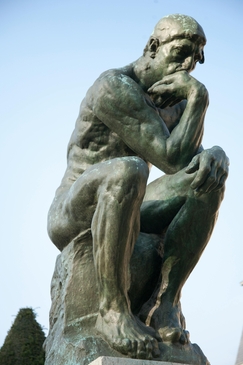
Certainly, the game of checkers is a great exercise of our thinking abilities and a terrific way to develop our reasoning powers. The problem shown below, based on a game played by 19th century checkerist J. P. Reed, will definitely stretch and grow your thinking and reasoning skills. It's this month's entry in our ongoing Checker School series, and comes from Ben Boland's classic work, Famous Positions in the Game of Checkers.
WHITE
BLACK
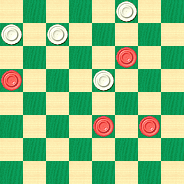
Black to Play and Draw
B:W30,28,27,18:B22,20,10,9.
Black has a severely limited choice of moves, always a sign of trouble. Yet the position can be drawn, although that will require quite an application of our reasoning powers. Can you reason it out? Think it through, and then click on Read More to see the solution, a sample game, explanatory notes, and a special insert on reasoning powers in checkers.
You can email the Webmaster with your comments on this article.
Sullivan's Catch
Pixnio CC0
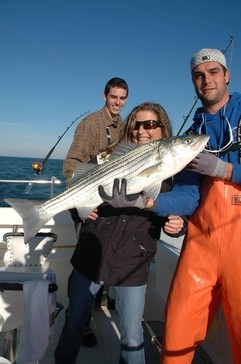
We're not certain that the happy lady shown above is named "Sullivan" --- though that's entirely possible --- but we're most sure that she's made quite a catch indeed, and we can appreciate why she's smiling so broadly.
Of course, the real question for us should be, "Does she play checkers?" and although that's another thing we can't know for sure, it's definitely within the realm of possibility.
Today's column, though, is about a different Sullivan and a different kind of catch, one that is just as tasty as the catch shown above. It comes from Willie Ryan's Tricks Traps and Shots of the Checkerboard, and Willie will tell us about it in his own words.
"When something new is found on an ancient opening like the Ayrshire Lassie, that's news. A few years ago, James Sullivan, a strong amateur from St. Louis, Missouri, hatched a new twist on the Ayrshire Lassie by 21-17 at the fourteenth move of the game below. He subsequently sprung it on Newell Banks and me, and, like two babes in the woods, we both fell for the sucker bait by 9-13 in reply. This trap is a 'natural,' and will catch even experienced players.
| 11-15 | 15-18---A | 11-18 |
| 24-20 | 22-15 | 21-17---1 |
| 8-11 | 11-18 | 9-13---B, 2, which |
| 28-24 | 26-22 | leads to the |
| 4-8 | 7-11 | diagrammed |
| 23-19 | 22-15 | placements. |
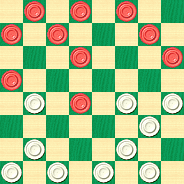
WHITE
White to Play, Black to Draw
W:W32,31,30,29,27,25,24,20,19,17:B18,13,12,10,8,6,5,3,2,1.
A---If you want a short, fast game, play 9-13. Your opponent, no doubt, will reply 20-16, 11-20, 22-17, 13-22, 25-4, winning fast and leaving you short.
B---Newell Banks and Author Ryan slept here! Of course, the trap that follows this move is best avoided, but 9-13 does not lose, as erroneously claimed by Sullivan. The safest course for black at B is: 18-23---2, 27-18, 9-14, 18-9, 5-21, 32-28,10-15,19-10, 6-15, 31-27, 8-11, 27-23, 1-6, 25-22, 3-7, 23-19, 6-10, 22-18, 15-22, 19-16, 12-19, 24-8, 10-14, 8-3, 7-10, 3-8, 14-18, 8-11, 18-23, etc., consummating a draw. Wm. F. Ryan."
1---30-26 or 32-28 would be much better here. While not calling this necessarily a loss, the computer deems 21-17 as quite poor, giving Black a solid advantage---Ed.
2---After 9-13, the game indeed evaluates as a draw. After 18-23, as recommended in Note B, the game also evaluates as a probable draw, as Willie demonstrates. However, the computer thinks the correct move is instead 9-14, which preserves Black's substantial advantage, for instance KingsRow gives 9-14 17-13 2-7 31-26 7-11 27-23 18x27 32x23 3-7 25-22 14-18 23x14 10x17 29-25 5-9 19-15 11x18 22x15 9-14 and White is all but lost---Ed.
Now, as you try to resolve this position, we feel it only far to warn you: Just as Willie missed a trick or two at Notes 1 and 2 above, he also misses a trick in his proposed solution. So in one sense, we're asking you to do a little better than Willie; that's quite a demand to make. But this problem is well worth your time. Can you "catch" the solution, or will it be the one that got away? When you're finished, hook your mouse on Read More to see some detailed analysis.
You can email the Webmaster with your comments on this article.
Conroy's Slider
Public Domain Pictures CC0
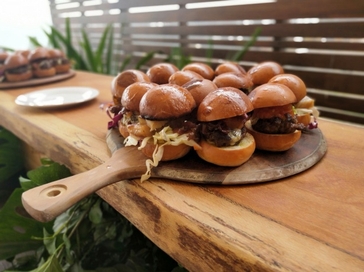
Our Research Department told us, when asked to find a theme for today's entry in our ongoing Checker School series, that there is a bar on Conroy Road in Orlando, Florida, that serves sliders, those small hamburgers that simply slide on down. In fact, they continued, there is a catering establishment in the selfsame Conroy area that features sliders ... we asked them to stop there, that's quite enough, thank you.
We're certain that old-time checker editor J. A. Conroy, after whom the position shown below is named, never had a slider in his life, whether at a bar or catered or in any other form. He lived about 150 years too early for that, and we can speculate that he was likely the better for it. Why the position is called a "slider" will be clear when you work out the solution, and we suppose you've already guessed that hamburgers have nothing to do with it.
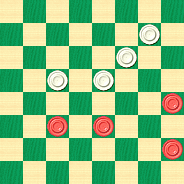
BLACK
Black to Play and Draw
B:W25,22,19,18:B13,11,10,5.
Can you slip through this one, or will you get stuck on the way? Try it out--- it goes down easy--- and then slide your mouse over to Read More to see the solution, notes, and sample games.
You can email the Webmaster with your comments on this article.
A Denny Dandy
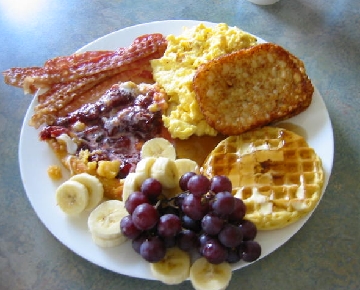
What could be as dandy as breakfast at Denny's, that great American "breakfast at any hour" institution? We're sure nearly all of us who live in the U.S. can confess to indulging in such an extravagant "count no calories" morning feast at least once in recent memory.
But there is something just as dandy as Denny's, and that's today's Denny Dandy in our latest excerpt from Willie Ryan's Tricks Traps & Shots of the Checkerboard. We're sure you'll enjoy it, and it's guaranteed to be calorie free. Here's Willie to tell us all about it.
"Very often it is necessary to force a win by the constant threat of a shot without ever actually executing it. In other cases, execution of a shot may be the final product of much preliminary forced play. Here we have a good example of white developing a structural advantage (formational win) in such a manner as ultimately to force black into a staggering stroke. It should be noted that in this case the stroke is the final phase of play, with white's preceding moves forcing black into the inevitable crackup.
| 10-14 | 20-16 | 1-5 |
| 24-20 | 12-19 | 24-20 |
| 7-10 | 23-16 | 5-9 |
| 22-18 | 14-18---A | 32-27 |
| 9-13 | 29-25 | 9-14 |
| 18-9 | 8-12 | 27-24 |
| 5-14 | 16-11 | 3-8---3, |
| 25-22 | 12-16---2 | to the |
| 11-15 | 27-24 | diagram. |
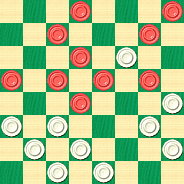
WHITE
White to Play and Win
W:W31,30,28,26,25,24,22,21,20,11:B18,16,15,14,13,10,8,6,4,2.
A---I took this move against Jesse B. Hanson in the Eighth American Championship Tourney and managed to draw with it. Later, in analyzing the formation, I discovered it would lose, white subsequently driving black into the shot, as indicated. The correct play at A for a draw is: 2-7---1, 16-12, 15-19, 22-18, 14-23, 27-18, 8-11, 18-14, 10-17, 21-14, 1-5, 32-27, 6-9, etc. Wm. F. Ryan."
1---8-12 is also good for a draw and is the computer's choice---Ed.
2---A bit surprisingly, the natural-looking 3-7 loses something like this: 3-7 26-23 7-16 23-7 2-11 21-17 6-9 27-23 4-8
31-27 15-19 23-18 19-23 17-14 1-5 14-10 16-19 18-15 11x18 22x15 White Wins---Ed.
3---Loses at once, whereas 16-19 would have held on longer---Ed.
We'd like to egg you on: ham it up a little and bring home the bacon on today's problem. Or will you be toast? We won't try to butter you up; simply clicking on Read More will get you out of a jam and over to the solution.
You can email the Webmaster with your comments on this article.
Surprise, Surprise
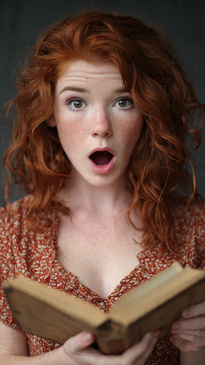
The young lady in the photo above is obviously studying checkers and has just come across the problem that forms the subject of today's Checker School column. The solution to the problem is one that we too found surprising, and we'll bet you'll feel the same way.
Here's the position:

WHITE
White to Play and Win
W:WK30,22,16,K2:B21,14,13,K10.
In a game in which White had and lost the advantage several times, we've arrived at a position where White has one last chance to bring it home. Can you find the surprise move that leads to White victory, or will you be surprised that your solution wasn't the correct one? Try the problem, and then get one last surprise by clicking the mouse on Read More to see the solution, a sample game, and detailed notes.
You can email the Webmaster with your comments on this article.
Wyllie's Waterloo
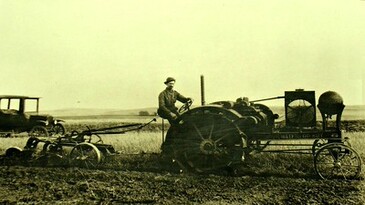
Surely you were expecting us to have chosen a dramatic image of the famed Battle of Waterloo, but we like to keep our readers guessing, and we came up instead with a Waterloo tractor made in Waterloo, Iowa, one hundred and six years after Napoleon's defeat on June 18, 1815. The person on the tractor perhaps played checkers in his leisure time, and we hope he did well and didn't meet his own Waterloo over the board. But we can surely excuse him if he did, for even the checker greats had their own bad days. Willie Ryan, in his book Tricks Traps & Shots of the Checkerboard, tells us about a bad day that one of the greatest of all, James Wyllie, endured.
"It is sheer fallacy to believe that when James Wyllie ruled the boards 80 years ago, he had no worthy contemporaries. On the contrary, Wyllie lived and competed in an era that produced most of the game's outstanding players and personalities, including Andrew Anderson, John Drummond, Robert Martins, John Robertson, Henry Spayth, and Robert D. Yates, to name just a few. Wyllie's predominant fame and popularity stemmed from his prolific activities, his inimitable wit, and his fearlessness as a champion. While others were vainly striving to defend reputations they did not have, jocular James took them all on, in good season and bad, acquitting himself on all occasions with admirable poise. The "Herd Laddie" had his bad innings at the board, as indicated by this reverse at the hands of Robert McCulloch, of Glasgow, best known for his revised publication of McCulloch's Edition of Anderson's Guide. The game proceeded as follows:
| 11-15 | 25-22---B,1 | 9-14 |
| 24-20 | 18-25 | 28-24---3 |
| 8-11 | 29-22 | 5-9 |
| 28-24 | 7-11 | 26-23 |
| 4-8 | 30-25 | 9-13 |
| 23-19 | 2-7 | 31-26---4 |
| 15-18 | 19-15---2 | 7-11---5 |
| 22-15 | 11-18 | 26-22---C, |
| 11-18 | 22-15 | to the posi- |
| 32-28---A | 14-18 | tion in the |
| 10-14 | 24-19 | diagram. |
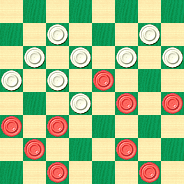
BLACK
Black to Play and Win
B:W27,25,24,23,22,21,20,19,15:B18,14,13,12,11,8,6,3,1.
A---Wyllie's favorite line of the Ayrshire Lassie, and one that lends itself to a wide variety of "soupy" formations.
B---26-23 is equally good. Charles Hefter of Kankakee, Illinois, is the distinguished author of the following coup on that line: 26-23, 9-13, 19-15, 7-11, 31-26, 3-7, 24-19, 5-9, 26-22,1-5, 28-24, 7-10, and now comes the cut-up by 20-16, 11-20, 15-11, 8-15, 21-17, 14-21, 23-7, 2-11, 19-1, 9-14, 22-17, 13-22, 25-9, 5-14, 1-6, 11-16, 6-10, 14-18, 10-14, 18-23, leading to a draw.
C---This is where Wyllie went wild. The game had been adroitly contested by both players to this point. Wyllie could have drawn easily here, by 15-10, 6-15, 19-10, 13-17, 23-19, 11-15, 20-16, 3-7*, 10-3, 1-5, 19-10, 12-28, 3-12, 28-32, 27-24, 32-27, 10-6, 27-20, 6-1, 20-24, 1-6, 24-27, 6-9, 18-23, 26-19, 27-24, 9-18, 24-29. Wm. F. Ryan."
1---Despite the natural look of this move, the computer scores 25-22 as not so good for Black, giving White a definite edge---Ed..
2---27-23 is preferred here---Ed.
3---This move is a probable loss. 20-16 might have kept White in the game, but Black is still strong---Ed.
4---White is now completely lost. Better was 31-26 though the situation remains bad---Ed.
5---This very bad move allows a draw. A winning line for Black might have been 13-17 15-10 6x15 19x10 8-11 24-19 18. 17-22! 26x17 11-15 27-24 18x27 20-16 27-3 17-13 3-8!10x3 31-27 19x10 27x11 25-22 11-7 22-17 7-2 13-9 14-18 17-14 18-23 21-17 23-27 9-5 2-7 17-13 27-31 13-9 7-2 Black Wins. White is completely out of safe moves---Ed.
Will you meet your own Waterloo here? Willie seemed to have a mini-Waterloo of his own in not catching the blunder pointed out at note 5 above. Battle the problem and then march your mouse to Read More to see the solution.
You can email the Webmaster with your comments on this article.
What Is Checkers?
Based on the photo above, we suppose our column's title should have been "What are Checkers?" as a plural subject requires a plural verb. But of course, the intended meaning of the phrase references "checkers" as a game, in the singular, and so the singular verb is correct after all.
Although we could go on at length about syntax and other matters grammatical, we're sure you didn't come here for a language lesson. In fact, it's time for an installment of Checker School, and while good grammar and usage are highly recommended, good checker moves are what we're really after.
Today we have an interesting position which is not particularly easy to solve; in fact Ben Boland himself went wrong when he published it in Famous Positions in the Game of Checkers.
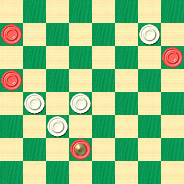
WHITE
White to Play and Draw
W:W8,17,18,22:B5,12,13,K26.
Mr. Boland's premise is correct; the game can be drawn by White, even though the position looks anything but favorable. Can you find the correct "checker usage" that leads to a draw? Or will you be sentenced to fail? Don't worry; you won't get graded on your answer, and you can always click on Read More to see the solution, notes, a sample game, and the reason why today's column is titled What is Checkers?.
You can email the Webmaster with your comments on this article.
Reed's Delayed Brooklyn
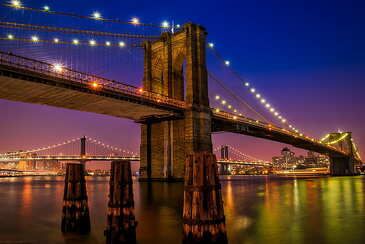
PickPik CC0
The Brooklyn Bridge is certainly a New York City icon, famed in poem, song, and urban legend. You probably are wondering about our title, which contains the words "Delayed Brooklyn"; more typical for New York would be "Brooklyn Delay" as many a rush-hour traffic jam plays itself out every week, if not every day, on the Brooklyn Bridge.
But in today's installment from the classic Willie Ryan book Tricks Traps & Shots of the Checkerboard we'll find out just what "Reed's Delayed Brooklyn" is all about. Let's hear it in Willie's own words.
"The following brilliant crossboard game was contested by James P. Reed and Alfred Jordan when Reed visited the British Isles many years ago to do battle with the leading boardsmen in John Bull's domain. When the diagrammed situation was reached, Jordan continued 21-17 and had to give up soon thereafter. When the game was over, the brilliant Pittsburgher astonished Jordan, as well as the gallery, by pointing out how Jordan could have drawn by a delayed form of the Brooklyn shot. We consider this one of the finest and most deceptive examples of the Brooklyn in embryo:
| 11-15 | 5-9 | 7-11 |
| 22-18 | 18-14 | 22-18 |
| 15-22 | 9-18 | 11-16---B |
| 25-18 | 22-15 | 27-23 |
| 12-16 | 10-19 | 3-7 |
| 29-25 | 24-15 | 26-22 |
| 9-13 | 8-12 | 7-10---C. |
| 26-22---A | 23-19 | Diagram. |
| 16-20 | 4-8 | |
| 30-26 | 25-22 |

WHITE
White to Play and Draw
W:W32,31,28,23,22,21,19,18,15:B20,16,13,12,10,8,6,2,1.
A---If you still think it can't happen to you, look at these figures showing how the great William Strickland, blindfolded, polished off a victim while playing six opponents simultaneously! Continue at A: 25-22,16-20, 24-19, 5-9, 28-24, 8-11, 32-28---1, 4-8, 19-15—B, 10-19, 23-16, 6-10, 26-23, 1-5, 30-26, 9-14, 18-9, 5-14, 22-18^ 14-17, 21-14, 10-17, 26-22, 17-26, 31-22, 8-12, 23-19; then the finish, with: 3-8*, 18-14, 7-10*, 14-7, 11-15*, 19-10, 12-19, 24-15, 2-25, and black wins.
B---The loser. From here to the end, Strickland kept his win well in hand, never giving his opponent a chance to draw. The correct play for a draw at B is 30-25, 10-14, 18-15, 11-18, 22-15, 1-5, 15-10, 6-15, 19-10, 14-18, 23-14, 9-18, 26-22, 7-14, 22-15, 2-6, 24-19, 14-18, 27-24, 20-27, 31-24, 6-9, 15-11, 8-15, 19-10, 9-14, 10-6, 13-17, 6-2,17-22, 2-6, 22-29, 6-10, 5-9, 10-17, 9-13,17-14, 18-22, 14-17, 22-26, 17-22, 26-30, 24-19, 30-25, 22-26, 25-22, etc. F. Tescheleit vs. J. M. Dallas.
C---This is where Jordan fell. One would never suspect that white had a Brooklyn in the offing. At the time this game was played, Jordan was champion of England, and the fact that he missed a draw by 31-27 proves how games may be drawn by stroke strategy that otherwise would be hopeless. In short, Jordan missed the Brooklyn idea and lost the game."
1---30-25 is perhaps a better move here---Ed.
2---This move is fine, but 6-9 would have been at least as good---Ed.
Can you find the solution, or will your resolution be delayed? When you're ready, cross over the bridge to Read More to see the snappy solution.
You can email the Webmaster with your comments on this article.
The Checker Maven is produced at editorial offices in Honolulu, Hawai`i, as a completely non-commercial public service from which no income is obtained or sought. Original material is Copyright © 2004-2026 Avi Gobbler Publishing. Other material is public domain, AI generated, as attributed, or licensed under CC1, CC2, CC3 or CC4 and the various CC options. Information presented on this site is offered as-is, at no cost, and bears no express or implied warranty as to accuracy or usability. You agree that you use such information entirely at your own risk. No liabilities of any kind under any legal theory whatsoever are accepted. The Checker Maven is dedicated to the memory of Mr. Bob Newell, Sr.
.jpg)