The Checker Maven
The World's Most Widely Read Checkers and Draughts Publication
Bob Newell, Editor-in-Chief
Published every Saturday morning in Honolulu, Hawai`i
A Real Fooler
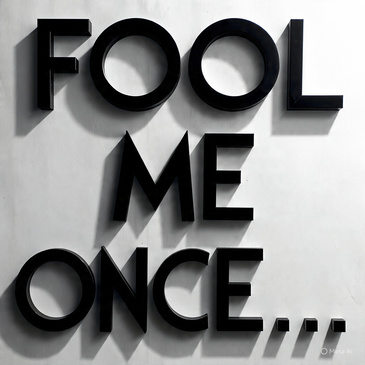
Everyone knows the old saying "Fool me once, shame on you; fool me twice, shame on me."
But in our game of checkers, and especially in the realm of checker problems, we're willing to be fooled over and over again, and we react not with resentment but with enjoyment--- and thanks.
Who isn't pleased to be fooled by a problem composed by someone as great as Tom Wiswell? See what you think of the one below.
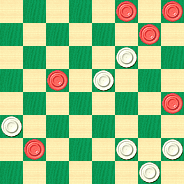
WHITE
White to Play and Draw
W:W11,15,21,27,28,32:B3,4,8,14,20,25.
We warn you that this is a difficult problem, though it has at its heart a simple theme. Will you be fooled but delighted? Or will you fool around enough to find the solution? Give it a try, and then give a no-fooling click on Read More to see the solution. 
You can email the Webmaster with your comments on this article.
In Like a Lion
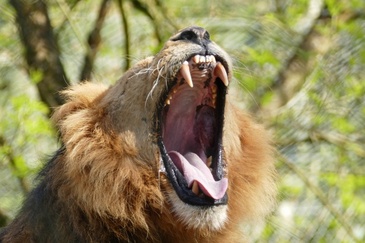
Public Domain Pictures CC0
It is sometimes said that in the Northern Hemisphere, the month of March roars in like a lion with winter storms featuring high winds, snow, and cold temperatures. What a prospect to contemplate! We have a better idea, and so for our top-of-the-month column, we're bringing you a stroke problem that roars like a lion, but has the courtesy to at least do so indoors, where a warm fire and a hot drink are just the right accompaniments.

WHITE
White to Play and Win
W:W27,23,18,17,14,13,11,7:BK32,K22,K21,9,6,5,2.
When you have yourself roared through the problem, click on Read More to see the solution.
You can email the Webmaster with your comments on this article.
Blither's Advice
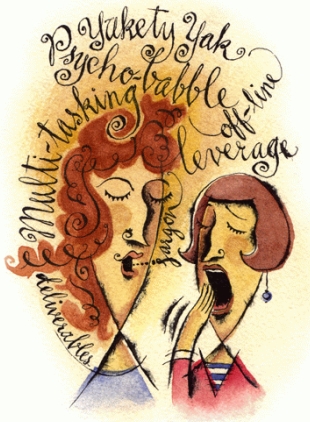
There are people who talk a lot, and despite our illustration above, we don't at all mean to stereotype this behavior. Copious yakking knows no boundaries of gender, group, or anything else.
At times, wordiness can be most beneficial. For instance, our monthly Checker School columns usually contain rather verbose advice and explanation, and we think that's a good thing, as it makes the lessons easier to learn and apply. But this month, Ben Boland, the original source of our current pedagogical series, is untypically laconic. Is it because the material is easier than usual? Or was Mr. Boland having an especially quiet day? We can't know the answer, but we can have a look at the subject study, which traces back to a certain L. J. Vair.
WHITE
BLACK
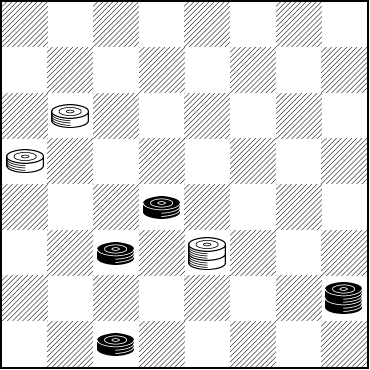
Black to Play and Win
B:W24,20,K10:B15,11,K5,3.
You might say that the position speaks for itself; Black is a man up and ought to be able to win. Yet, it's trickier than you might think at first glance. Can you get the last word on this problem or will it leave you speechless? We're only going to say that clicking on Read More will bring you to the solution, a sample game, and explanatory notes.
You can email the Webmaster with your comments on this article.
Moving Day

Pexels CC0
During the coming week, The Checker Maven is relocating full-time to Honolulu, Hawai`i.

Our Santa Fe offices closed permanently on February 26, 2010. Business will resume in our Honolulu office on March 8 at partial capacity; we expect to be back to full operation before the end of March.
We will of course publish a new column each Saturday morning during the transition, without interruption or delay.

We've had a great run in Santa Fe, but it's time to move on and consolidate in the interests of reduced costs and efficiency.
Catch you soon at our Honolulu office.

You can email the Webmaster with your comments on this article.
Scott's Scorcher
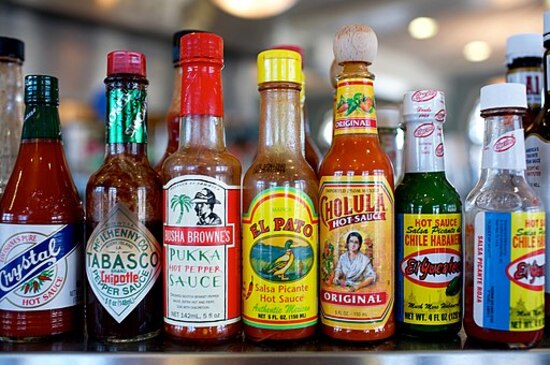
The expression "hot stuff" has a number of different meanings and uses, and our photo above definitely shows a number of one type of scorcher. Scorchers exist as well in our game of checkers, and who else is as uniquely qualified as Willie Ryan to discuss them? Mr. Ryan, who was "hot stuff" of the checker sort in his own day, calls the following play "Scott's Scorcher" in his book Tricks Traps & Shots of the Checkerboard. Let's let Willie tell us more.
"We found the Dyke game and stroke, described here, hidden in an old tome, credited to W. Scott, and it is altogether too good to pass by unnoticed. In this example, the winning clearance is effected by employing one of those peculiar in-and-out devices so widely used in stroke strategy.
| 11-15 | 27-23 | 9-14 |
| 22-17 | 4- 8 | 23-19 |
| 15-19 | 23-16 | 11-15 |
| 24-15 | 11-20 | 19-16---3 |
| 10-19 | 29-25 | 15-19---4 |
| 23-16 | 7-10 | 31-27---A |
| 12-19 | 17-13 | 3-8 |
| 25-22 | 8-11 | 16-12---B |
| 8-11 | 26-23 | See the |
| diagram. |
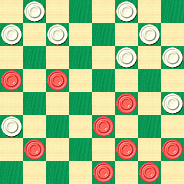
BLACK
Black to Play and Win
B:W32,30,28,27,25,22,21,13,12:B20,19,14,10,8,6,5,2,1.
A---White dares not play 16-11, as black will force white into this crushing coup: 16-11, 10-15, 31-27---5, 14-17*!, 21-14, 19-23, 27-18, 6-9, 13-6, 1-26, 30-23, 15-29. A very unusual 'double-take.'
B---The beginning of the end. However, white still can pull out with a draw, by: 30-26*---6, 10-15, 13-9*, 6-13, 16-12, 8-11, 27-24, 20-27, 32-7, 2-11, 26-23, 11-16, 28-24, 16-20, 23-19, 20-27, 19-10, 27-31, 10-7, 31-26, 7-2, 26-17, 2-7, 1-6, 12-8, 5-9, 7-11, 17-22, 25-18, 14-23, 11-15, 23-26, 8-3, 26-30, 3-7, 9-14, 7-2, 6-9, 2-6, 30-26, 15-10. Wm. F. Ryan."
3---This move may actually lose. 32-27 is much to be preferred here---Ed.
4---Gives back the edge; 20-24 would have retained the substantial advantage for Black---Ed.
5---White would do better here with 22-17, although the game may still be lost---Ed.
6---In a line of play that probably only a computer would find, KingsRow shows that the surprising move 13-9 will also draw here as White pulls off a stroke of his own: 13-9 6x13 16-12 8-11 27-24 20x27 32x7 2x11 etc. Drawn---Ed.
Are you "hot stuff" yourself? (Remember, we're talking checkers here.) Demonstrate your elevated temperature by solving the problem; but if you get overheated, clicking on Read More will take you straight to the solution.
You can email the Webmaster with your comments on this article.
V for Victory
Public Domain Wikimedia Commons
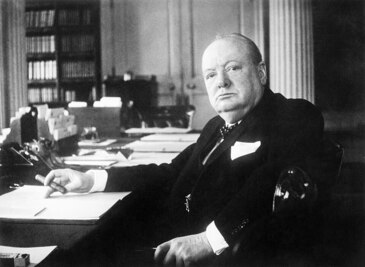
History will forever remember Sir Winston Churchill as the man who lead England to victory in the dark days of World War II. Sir Winston was a writer, painter, statesman, and politician; but above all, he was a leader who inspired and encouraged his people to endure, survive, and ultimately triumph. The Checker Maven has long admired the steadfast courage of the British people, and Sir Winston was its mainstay and embodiment.
We were reminded of Sir Winston when we saw the tutorial problem below; Black is to play and win, and Sir Winston's famous "V for Victory" seems to appear when the board is viewed from the White side, as shown below.

However, for the purpose of our study, since the terms specify Black to play, let's look at this the other way round.

BLACK
Black to Play, What Result?
B:W25,24,20,17,16:B10,7,6,3,1.
The terms given are not "Black to Play and Win" but since we are talking about "V for Victory" and Black has a nice V formation, you might make an assumption here. (Of course, you know what they say about assumptions.)
In any case, keep your courage, stay the course, find the way to potential victory, and then click on Read More to see the solution.
You can email the Webmaster with your comments on this article.
Fearful Feburary

February, of course, is the shortest month of the year, weighing in at just 28 or 29 days; and those days seem to rush by, especially if you've got bills that come due the first of every month. No sooner have you paid February's bills, it feels like the ones for March are coming due. Things can get tough and February can be a fearful month.
To alleviate February fright, we propose a short and fast checker problem with nothing at all fearlful about it. But can you solve this one in ten seconds? We consider it moderately easy. Click below to show the problem and start the clock; then have no fear and click on Read More to confirm your solution.
February Speed Problem (moderately easy)
You can email the Webmaster with your comments on this article.
Checkersland
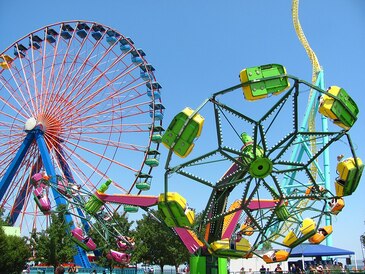
The amusement park in Cedar Point, Ohio, isn't known as Checkersland, though it could well have been so named, instead of bearing the much less orignal title of Cedar Point Amusement Park. We're certain that it's a fine amusement park, though we doubt that it honors the history of Cedar Point as the home of a series of high-level championship checker tournaments some decades back. More's the pity; we could envision some sort of checker-themed roller coaster as a major attraction.
However, there really is a Checkersland; but it's a relatively new checker-playing computer program. In recent years we've come across very few new checker playing programs that were intended to be more than toys, but Checkersland certainly is a serious effort. It plays a very wide variety of checker games, running the gamut from American-British "straight" checkers, to Russian, to pool, and even Turkish and Sri Lankan and many more. The graphics are attractive and there are a number of useful features, such as reading PDN, position set-up, and the like. Best of all: Checkersland is coded in Java and so will run on Windows, Linux, Mac, and in fact on just about any computer that boasts a conformant Java implementation. The Checkersland web site can be found here.

Screenshot from Checkersland
We were more than anxious to try out this latest checker-playing effort, and pleased to see that it featured many levels of play, from "easy" right through "impossible." So we carried out our standard test, playing Checkersland at its highest level, "impossible," against Martin Fierz's Simple Checkers We gave Simple Checkers five seconds per move to match up with the time that Checkersland seemed to take on our laboratory test system, Konanekane, a dual-core 2.5 Ghz machine with 4GB of memory.

To make a long story short, our testing showed that Checkersland is a work in progress, at least with respect to "straight" checkers; even at its "impossible" level, it was handily defeated by Simple Checkers.
You can see the full game in animated form, with brief comments, by clicking here. But first, we'd like to show you a position from the game. Checkersland has just made a weak move, and now Simple Checkers, playing Black, can play a winning line.
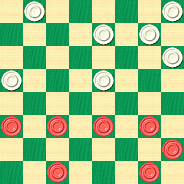
BLACK
Black to Play and Win
B:W32,29,26,25,21,20,18:B12,11,10,9,5,3,1.
Our challenge to you is to find the win for Black. It's certainly not at the "impossible" level, but it does require a bit of thought and follow-through. After you've done the possible, or found it not possible, click on Read More to see one possible winning line, or else go back and view the animation to see the solution in the context of the entire game.
We hope that the Russian author of Checkersland continues to work on his product, as we believe it has a lot of unrealized potential. And, by the way, Cedar Point Amusement Park take note: we'd still like some day to ride on a checker-themed roller coaster.
You can email the Webmaster with your comments on this article.
McCullough's Draw
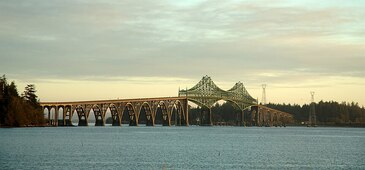
The McCullough Memorial Bridge spans Coos Bay in Oregon, and not surprisingly was called the Coos Bay Bridge when it was completed in 1936. No, it's not a draw bridge; it's what's known as a cantilever bridge. It was renamed some years later, not after checkerist R. McCullough, but instead in honor of the designer, Conde McCullough. We were unable to determine if the latter Mr. Mccullough was a checker player, but we can surely speculate that he might have been.
Today, in our Checker School lesson, we hark back to the days of checkerist McCullough, who is credited with a very practical checker draw (which has little if anything to do with a cantilever). The subject position is shown below.
BLACK
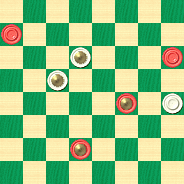
WHITE
White to Play and Draw
W:W20,K14,K10:BK26,K19,12,5.
It's another of those situations that the average checker player might write off as a loss, but in which the expert would see drawing possibilities. Can you leverage your skills and find a draw for White? When you've spanned the gap, cross over to the solution by clicking on Read More.
You can email the Webmaster with your comments on this article.
Ryan's Bell Ringer
PxHere CC0
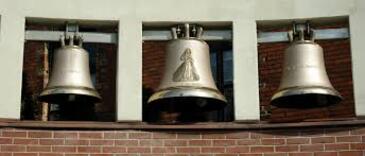
The words "bell ringer" may evoke all sorts of images, from the classic sculpture above, to the chiming of the Liberty Bell, to the exquisite sound of handbells in a church choir. In its simplest form, though, a "bell ringer" is some sort of spectacular or noteworthy positive happening. Bell ringers abound on the checkerboard, and surely one of the most knowledgeable on this topic had to have been Willie Ryan. Today, in an excerpt from his book Tricks Traps & Shots of the Checkerboard, Willie shows and tells about a "bell ringer" that is definitely worth our time. Willie tells us about it below, modestly referring to his study as "better than average"!
"Among my collection of checker papers, I came across the better than average example on the Ayrshire Lassie, played out on the next page, which is good enough to inveigle even champion players, as the trap occurs on a line of play favored by the heavyweights.
| 11-15 | 5-9 | 14-18---A, 3 |
| 24-20 | 17-13 | 32-27 |
| 8-11 | 11-16 | 9-14---B |
| 28-24 | 20-11 | 26-22 |
| 3-8 | 7-23 | 4-8---C |
| 23-19 | 27-11 | 31-26 |
| 9-14 | 8-15 | 15-19---D |
| 22-17 | 24-20 | forming |
| the diagram |
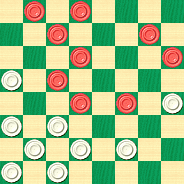
WHITE
White to Play and Win
W:W13,20,21,22,25,26,27,29,30:B1,2,6,8,10,12,14,18,19.
A---A weak move. The following play will earn a draw easily: 4-8, 25-22, 15-18, 22-15, 10-19, 29-25, 1-5, 25-22, 14-17, 21-14, 9-25, 30-21, 8-11, 26-22. Wm. F. Ryan.
B---Forced, as 10-14 loses to 26-23, while 1-5 goes down to 20-16, 12-19, 26-23, 19-26, 30-7, 2-11, 21-17, etc., with white winning. Wm. F. Ryan.
C---All that's left. 2-7 allows white to clean up with: 13-9, 6-13, 22-17,13-22, 27-23,18-27, 25-2. Again at C, if 1-5 is played, white rings the bell with this bright play: 1-5, 31-26, 2-7, 26-23, 4-8, 13-9, 6-13, 22-17, 13-22, 21-17, 14-21, 23-14, 10-17, 25-2, 8-11, 29-25, 11-15, 27-23, 5-9, 2-6, 9-14, 6-10, 15-18, 10-15*, 18-27, 20-16, 12-19, 15-31, 14-18, 31-26. Wm. F. Ryan.
D---A promising move that collapses. Black's only line of play for a draw is 2-7*---4, 26-23, 15-19*, 23-16, 12-19, 22-15, 7-11*, 30-26, 11-18, 20-16, 8-12, 16-11, 12-16. Wm. F. Ryan."
3---The computer however thinks this move is a likely draw, although computers don't distinguish the between the practical reality of an easy draw vs. a hard draw---Ed.
4---The computer prefers an alternative drawing line in which Black goes a man down for a little while: 8-11 27-24 18-23 26x19 14-18 22-17 18-23 17-14 10x17 21x14 23-27 19x10 6x15 25-22 27-32 14-10 32-28 10-7 28x19 7-3 19-23 3-8 etc. to a draw. This is a line of play that a human player would be most unlikely to select in the presence of a more straightforward option---Ed.
Can you ring the bell and solve the problem, or will you just hang around ringing the chimes? Let your mouse sound the Read More note to see Willie's solution.
You can email the Webmaster with your comments on this article.
The Checker Maven is produced at editorial offices in Honolulu, Hawai`i, as a completely non-commercial public service from which no income is obtained or sought. Original material is Copyright © 2004-2026 Avi Gobbler Publishing. Other material is public domain, AI generated, as attributed, or licensed under CC1, CC2, CC3 or CC4 and the various CC options. Information presented on this site is offered as-is, at no cost, and bears no express or implied warranty as to accuracy or usability. You agree that you use such information entirely at your own risk. No liabilities of any kind under any legal theory whatsoever are accepted. The Checker Maven is dedicated to the memory of Mr. Bob Newell, Sr.

.jpg)