The Checker Maven
The World's Most Widely Read Checkers and Draughts Publication
Bob Newell, Editor-in-Chief
Published every Saturday morning in Honolulu, Hawai`i
Noticing missing images? An explanation is here.
Reservation Deadline Approaching

Gerry Lopez has reminded us again that the National GAYP tourney will be held at the Plaza in Las Vegas from July 23-27, and players need to make their hotel reservations no later than the 15th of June.
Reserve now, and avoid having to find another hotel at the last minute. The reservation number is 1-800-634-6575. Make sure that you ask for the special checker rates of only $29 plus tax from Sunday through Thursday and $65 plus tax for Friday and Saturday. Tournament entrants will also be required to pay $60 to help cover the cost of the large playing room. Gerry invites you to call him with your questions at (951) 695-2499.
Rustic Charm

We always appreciate the beauty of simplicity, such as the rustic charm of a country inn, where basic, down-to-earth dishes are served up with a special kind of elegance. We think you'll agree that today's little problem shares that simple charm; it's a practical situation requiring straightforward yet precise play.
WHITE
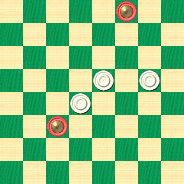
White to Play and Win
W:W18,16,15:BK22,K3.
White is a man up, but Black has two kings and seems to be in control. Can you find the way for White to come through with a win? We're not talking about the type of play that resembles haute cuisine, just honest country cooking leading to a satisfying repast.
The problem is quite a bit easier than it might appear at first glance. Work out the solution (without a board and pieces, if possible), but be sure to avoid the inelegance of frustration; clicking on Read More will give you an annotated run-down of the winning procedure.
Playing Like A Robot

We're sure you know one or even more checker players that play checkers like a robot. They might mechanically play their "book" moves, with no understanding of the ideas supporting the moves; or they might get a notion in their head and stick to it like an automaton, no matter what the situation on the board might call for.
In today's column, we'll consider the latter situation; a player who, in a classic "Dyke" formation decides to run off the attacking piece and can't be dissuaded from that pre-programmed course of action. Let's look at the game.
BLACK: Skilled Player
WHITE: Robot-Like Player
| 1. | 11-15 | 22-17 |
| 2. | 15-19 | 23x16 |
| 3. | 12x19 | 24x15 |
| 4. | 10x19 |
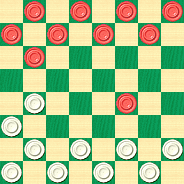
We now have a classic Dyke position:
WHITE
Diagram 1: White to Play
W:W32,31,30,29,28,27,26,25,21,17:B19,9,8,7,6,5,4,3,2,1.
| 4. | ... | 27-23 |
White wants to run off the attacking piece. This move doesn't lose but it isn't the best. Question 1: What's a better move at Diagram 1 for White?
| 5. | 8-12 | 23x16 |
| 6. | 12x19 |
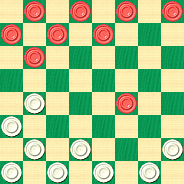
WHITE
Diagram 2: White to Play
W:W32,31,30,29,28,26,25,21,17:B19,9,7,6,5,4,3,2,1.
Guess what White does next...
| 6. | ... | 32-27 |
Preparing once more to go after the "Dyke" piece. As before the move doesn't lose but isn't best. Question 2: What's a better move at Diagram 2 for White?
| 7. | 4-8 |
WHITE
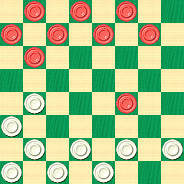
Diagram 3: White to Play
W:W31,30,29,28,27,26,25,21,17:B19,9,8,7,6,5,3,2,1.
| 7. | ... | 27-24 |
White carries out his plan and makes a weak move. Had he played 27-23 instead, he would have lost quickly by 19-24 28-19 9-14 17-10 6-24, and White can't hold out against Black's freely roaming king.
But White could have held the game with a different move altogether. Question 3: What should White have played at Diagram 3?
| 8. | 7-10 | 24x15 |
| 9. | 10x19 |

WHITE
Diagram 4: White to Play
W:W31,30,29,28,27,26,25,21,17:B19,9,8,7,6,5,3,2,1.
| 9. | ... | 31-27 |
The robot continues unthinkingly on its course, and seals its own doom. Question 4: How could White have held out longer at Diagram 4?
| 10. | 19-23! | 27x18 |
If instead 26-19 then 9-14 17-10 6-31 wins for Black.
| 11. | 9-14 | 18x9 |
| 12. | 6x31 |
Black wins. The robot-like player of the White pieces has a real lesson to learn from this game! You, too, might learn something: click on Read More for all the answers.
Footnote: We'll be closing the Checker Maven offices for a few weeks as we ourselves encounter a much different type of robot. Thanks to computerization, our Saturday morning articles will continue to appear on schedule each week. However, we may not be able to respond to your emails for a period of time. We do expect to return to business as usual at some point in June, 2007.

First Issue of Draughts Razoo Now Available Online
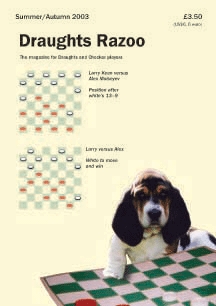
Nick McBride, British checkerist and publisher, has generously made available an electronic version of the inaugural issue (Summer/Autumn 2003) of Draughts Razoo. You can download your free copy here.
Draughts Razoo, though only a handful of issues ever made their way into print, was a real marvel of excellent writing, first-class typography, and quality content. As publishers ourselves, we know what it takes to produce work of this type: an enormous investment of time and effort backed by not inconsiderable skill and judgment.
Our hats are off to Nick, both for what he accomplished with Draughts Razoo and for his giving it away, free, in a new electronic version. Enjoy!
Once More Around the Block
To add still more variety to our "first Saturday of the month" columns, in addition to speed problems and stroke problems, we'd like to offer an occasional "block" problem. Now, we've likely already given away a bit too much, but today's offering does require a bit of visualization skill, so just this once we'll forgo our unforgiving Javascript clock, and allow you as much time as you need.
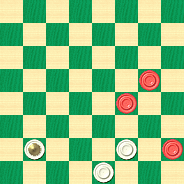
Here's the position:
WHITE
White to Play and Win
W:W31,27,K25:B28,19,16.
Try to work it out without moving pieces on a board, but if you can't get around a mental block, just click on Read More to see how it's done.
Checker School: Cowie's Position

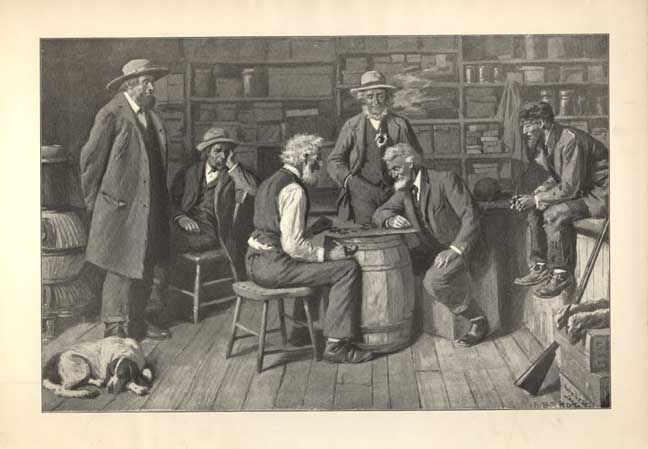
While the photo above certainly depicts an interesting position (although one which we're most unlikely to attempt ourselves), our title, and today's lesson in our ongoing Checker School series, refers to a position of a much different nature.
WHITE
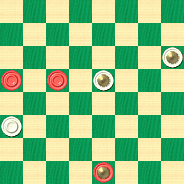
White to Play and Win
W:WK12,K15,21:B13,14,K31.
It's three against three, but White has two kings and seemingly the upper hand. But the twists and contortions necessary to score the win will require much flexibility of thought. See if you can master this surprisingly intricate position; but don't get tied up in knots; clicking on Read More will definitely ease the strain by bringing you the full solution, a sample game, and Ben Boland's detailed notes and commentary.
A Message from Gerry and Alan

Our postal mail today brought us a very nice letter from none other than Gerry Lopez, who is a top player and a tireless organizer and promoter of our great game. Gerry is a major force behind this year's Nationals, coming up sooner than you think in July, 2007.
Gerry enclosed two short notes, one from himself and the other from American Checker Federation President Alan Millhone. We're pleased to be able to reproduce these messages here.
From Gerry: "It took a lot of work to get a good deal at the Plaza in Las Vegas for the GAYP National. Now the ACF needs help with pledges to meet the bid that we made to get it there. Anything you can do to help with a check or pledge will be much appreciated. Please help our game by mailing your check or pledge to: Gerry Lopez (ACF Nat'l), 41959 Corte Selva, Temecula, CA 92591. My phone number: (951)-695-2499. Email: prof237@netzero.net."
From Alan: "The National Tourney is coming up in July. Unfortunately, for many people, one of the measuring sticks for the value of a game is its prize fund. Checkers, one of the most beautiful games in the world, is not understood by most people. They think it's a game for children. When they read that the National Champion of the game receives a first prize of only $1,000, their conception is strengthened. It's high time to support our game. If every checker player contributes something, that terrible misconception can be changed. Let's do something to affect that change with your contribution, big or small, to this year's National. To support the game, please mail your check to Gerry Lopez, GAYP 2007, at 41858 Corte Selva, Temecula, CA 92591. All contributions will be credited in the ACF bulletin. Let's get more respect for our game!"
We couldn't agree more, and The Checker Maven encourages you to help out in any way you can. We'll be sending in a little something ourselves, and we challenge you to do the same if at all possible.
The Legendary Tinsley
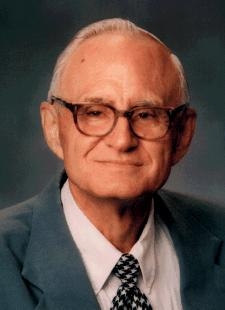
We once again have the privilege of presenting a new book by grandmaster Richard Pask. It's his exhaustive compilation of the checker career of Dr. Marion F. Tinsley, arguably the greatest checker player who ever lived, and is entitled simply The Legendary MFT.
The book is filled with games, commentary, and notes, and contains thorough indexing by opening and opponent, and much, much more, including an introduction by none other than Richard Fortman. It's simply too rich to fully describe here, so we invite you to download the book at once, by clicking here, or visiting our Richard Pask page as linked in the downloads section of the right hand column. The book is completely free thanks to the generosity of Mr. Pask.
To get you in the mood, as if that were necessary, we've chosen a situation covered in the book from the legendary Hellman-Tinsley match. This contest of titans started out with 24 draws, and then Mr. Hellman made a slip resulting in this position (having just played 17-14).
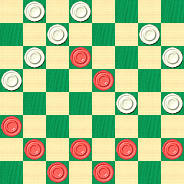
BLACK
Black to Play and Win
B:W32,31,27,25,24,21,20,14,13:B23,18,12,8,7,6,5,3,2.
You will not be surprised to know that Dr. Tinsley found the winning line of play, and drew first blood, going on to take the championship with three wins by the conclusion of the match.
Can you match wits with The Legendary Tinsley and find the winning line on your own? Can you correct Mr. Hellman's play and show how he could have held the draw?
A tall order, to be sure, but answers are just a click away; pressing Read More will bring you the entire game with annotations and comments, and, of course, the answers to our questions.
We're delighted that The Checker Maven has interested and attentive readers. After publication of this article, we heard from long-time correspondent Brian Hinkle, an analyst with a keen eye for position. He consulted with Ed Gilbert, and the fruits of their collaboration may have overturned history, not to mention the results of our proposed problem. Click on Read More for the rest of the story.
[Read More]
Tombstones for Tyros

In this installment from Willie Ryan's classic Tricks Traps & Shots of the Checkerboard, Willie pulls no punches in his characterization of the lions devouring their weaker prey. Let's listen in as Willie speaks.
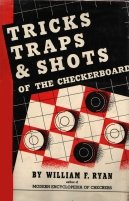
"The Cross opening is a perpetual favorite with all classes of players. For some unexplainable reason, it is infested with more early pitfalls than any other opening on the board. Here, in one concise arrangement, you will find four of the best-known and most commonly employed 'shockers' that experienced players are constantly using to slay the innocents.
| 11-15 | 23-18 |
| 8-11 | 27-23 |
| 4-8 | 23-19 |
| 9-14---A | 18-9 |
| 5-14 | 22-17 |
| 15-18 | 26-22 |
| 11-15---B,C | 17-13 |
| 7-11 | 13-9 |
| 6-13 | 24-20 |
| 15-24 | 22-6 |
| 1-10 | 28-19 |
| 11-15 | 31-26 |
| 15-24 | 26-22 |
| 13-17---D | 22-13 |
| 2-6---E. |
See the diagram.
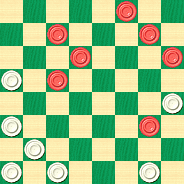
WHITE
White to Play and Win
W:W13,20,21,25,29,30,32:B3,6,8,10,12,14,24.
A---Another early demise follows 9-13, which loses as follows: 9-13, 26-23, 6-9, 30-26, 9-14, 18-9, 5-14, 32-27, 1-5, 19-16, 12-19, 23-16, 11-20, 22-17, 13-22, 25-4, and white wins.
B---If 18-23 is employed, then counter with 19-15, 10-19, 24-15, 11-18, 22-15, 14-18, 31-27, 7-10, 17-14. At this stage, 10-17, 21-14, 6-10 is drawable, but 10-19 allows the shot by 14-10, 6-15, 25-22, 18-25, 27-4, with which white wins.
C---A natural-looking move is 11-16, but it cracks up quickly by 22-15, 16-23, 31-27, 10-19, 17-10, 7-14, 27-9, 6-13, 24-15, and white wins.
D---This has been erroneously rated a losing move, but it produces a draw as shown in Note E. The accepted draw moves at this point are: 14-17, 21-7, 3-10, 22-17, 13-22, 25-18, 8-11, 29-25, 2-6, 25-22, 6-9, 22-17, 24-28, 17-13, 10-15, 13-6, 15-22, 6-2, 11-15, 2-7, 15-18, 7-10, 18-23, 10-15, 22-26. Andrew Anderson.
E---This is the real loser, since it allows the shot which follows. Black can still draw at E by playing: 14-18, 25-22, 18-25, 29-22, 8-11, 13-9 (best chance), 10-15, 9-5---F, 15-19, 5-1, 19-23, 1-5, 11-15, 5-9, 3-7, 9-13, 12-16, 20-11, 7-16, 13-17, 15-19, 22-18, 24-27; a draw. Wm. F. Ryan.
F---If 22-17 is used, follow with: 15-19, 17-13, 19-23, 9-6, 2-9, 13-6, 24-27, 6-2, 27-31, 2-6, 11-15, 6-10 (21-17, 23-26, 30-23, 31-26 ends in a draw), 3-8, 10-26, 31-22, 32-27, 8-11, 27-23, 12-16, 30-25, 22-29, 21-17; a draw. Wm. F. Ryan."
You needn't have this problem become your tombstone; avoid the hungry lions by clicking on Read More to see the short and snappy solution.
With Deliberate Speed
Today's speed problem is a little different; it's really not a "speed" problem per se, in that it needs to be solved in seconds. Instead, we present a problem that's a good deal harder than the usual "find the tactics" speed problem, though it really isn't so difficult as problems go.
Your challenge in this month's speed offering is to find the solution within the "regulation" five minute time limit. Are we perhaps being too easy on you? Only you can decide; try out the problem, and then click on Read More to see the solution and a sample game which leads to the problem position. Make haste slowly!
The Checker Maven is produced at editorial offices in Honolulu, Hawai`i, as a completely non-commercial public service from which no income is obtained or sought. Original material is Copyright © 2004-2026 Avi Gobbler Publishing. Other material is public domain, AI generated, as attributed, or licensed under CC1, CC2, CC3 or CC4. Information presented on this site is offered as-is, at no cost, and bears no express or implied warranty as to accuracy or usability. You agree that you use such information entirely at your own risk. No liabilities of any kind under any legal theory whatsoever are accepted. The Checker Maven is dedicated to the memory of Mr. Bob Newell, Sr.