The Checker Maven
The World's Most Widely Read Checkers and Draughts Publication
Bob Newell, Editor-in-Chief
Published every Saturday morning in Honolulu, Hawai`i
Noticing missing images? An explanation is here.
Reed's Rattler

While the rattler similar to the one shown above can often be seen in the countryside near our Santa Fe offices, in this month's chapter of Willie Ryan's Tricks Traps & Shots of the Checkerboard, we're talking about a different kind of rattler; namely, a position that leaves you feeling, well, rattled. And, in Willie's example, who better to be the "rattlee" than that checker pedantic of yore, Harvey L. Hopkins, who, based on his writing, certainly seemed to be more than a little on the stodgy side. We can just imagine him becoming rattled indeed in the very odd position which arises below. Of course, Willie's remarks on "Chop Suey Checkers" and "Chinese checker games" might not pass muster in today's environment of political correctness, but we hope you'll allow the allusions; they're rather colorful and certainly well intended.
And now, here's Willie.
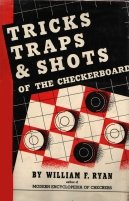
"Old-timers say that Champion James P. Reed was unbeatable when he was sober. His uncanny ability to penetrate the possibilities of play in complicated situations won him the distinction of being the greatest crossboard player of his day. Reed's main dish was 'Chop Suey Checkers,' a term he used to describe positions in which the pieces became entangled in complete confusion. The game below shows what happened to Harvey L. Hopkins, of Chicago, when Reed caught him in one of his Chinese checker games many years ago."
| 11-16 | 18-15 | 10-14 |
| 24-20 | 5-9 | 27-24 |
| 16-19 | 25-22 | 18-23 |
| 23-16 | 9-14 | 22-18---B |
| 12-19 | 29-25 | See the |
| 22-18 | 14-18 | diagram. |
| 9-13---A | 20-16 |
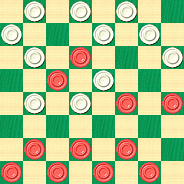
BLACK
Black to Play and Win
B:W32,31,30,28,26,25,24,21,18,16,15:B23,19,14,13,8,7,6,4,3,2,1.
A---This enigmatic move was a great favorite with Mr. Reed, and one which led opponents into a maze of complicated formations so dense that even seasoned masters often became hopelessly lost in their kaleidoscopic patterns.
B---It should be noted that 31-27 also loses here, by 6-9, 27-18,14-23,15-10 (forced), 7-14, 24-15, 23-27, 32-23, 8-11,15-8,4-20, 22-18,1-5, etc., and black wins. Wm. F. Ryan. White's best move at B is 24-20, then 7-10*---C, 16-12---D, 14-18, 21-17, 2-7, 28-24, 19-28, 26-19, 18-23, 25-21 (31-27, 23-26, 30-23, 7-11, 20-16*, 11-20,*, 23-18*, 8-11, etc., a draw), 8-11, 15-8, 4-11, 15-8, 4-11, 19-16, 11-15, 16-11, 7-16, 20-11, 15-18, 22-15, 13-22, 31-27, 10-19, 27-18, 19-23, leading to a draw. Wm. F. Ryan.
C---If 14-18 is used, white will win with 16-11*, 7-16, 20-11, 6-10 (forced; if 1-5, then 31-27, 19-24, 27-20), 15-6, 8-15, 21-17*, 1-10, 17-14, 10-17, 28-24, 19-28, 26-10, 17-26, 30-14, 13-17, 25-22, 18-25, 29-22, 4-8, 14-9. Wm. F. Ryan.
D---If 22-18 is used, then the following moves will produce a draw: 1-5, 18-9, 5-14, 31-27, 14-18, 16-12, 2-7 (8-11 draws too), 15-11, 7-16, 20-11, 8-15, 25-22, 18-25, 27-11, 10-15, 32-27, 6-10, 11-7, 13-17, 21-14, 10-17, 30-14, 3-17, 27-23, 17-22. Wm. F. Ryan. Again at D, if 16-11 is used, black will win with 14-18, 21-17, 1-5*, 20-16, 8-12, 31-27, 3-8, 27-24, 5-9, 24-20, 9-14."
Can you make your way through this one without getting rattled yourself? No need to hiss; just click on Read More to slither over to the solution.
A Checker Hutzler

We're not personally acquainted with any modern-day checker analogue to the traditional pool hustler, but we know for sure that, at least in times past, such a thing did in fact exist, and no doubt exists somewhere today. Old Bennie Newell himself (your editor's grandfather) hustled checkers in his tavern in Newark, New Jersey, many decades ago, and there certainly were many others.
We don't know if the author of today's problem, a checkerist of yore named Henry Hutzler, was a hustler in anything but homonymous surname, but his composition makes a fitting entry for our Checker School series. It's deceptively simple, though not as hard as some others, and most of all, it's eminently practical and it or its like turns up in many an over-the-board contest.
BLACK
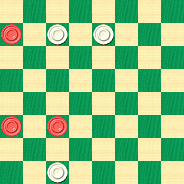
WHITE
White to Play and Win
W:W6,7,30:B5,21,22.
Forces are even, but White has a recognizable positional advantage. Is it enough to win? Mr. Hutlzer says it is, and no doubt he would have been willing to bet on it. What do you say? Make your call and then prove it before clicking on Read More to see the solution, a sample game, explanatory notes, and a most interesting quotation.
Block Construction

This month, instead of the usual speed problem or stroke problem which is our traditional month opener, we're bringing you an example of a rarer species: the block problem. And this is not just any block problem; it's a block construction problem.
Having nothing at all to do with the building trades, a block construction problem challenges you to reconstruct the moves leading up to a block position. Let's take a closer look: our target position is shown below.
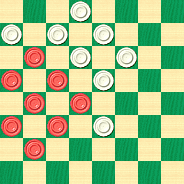
BLACK
Black to Play; White has Won
B:W31,28,27,26,23,22,18,10:B24,20,19,16,15,12,11,8.
In this position, Black is to move and the game is lost. Black is completely blocked and has no move. Your challenge is to come up with a full game, composed only of legal moves, that will lead to the block position shown. This is much more difficult than you might think, and could take an expert player an hour or more to do.
Are you up to the challenge, or are your mental processes blocked? Show your prowess as a builder by solving today's problem, then click on Read More to see how our position arose in an actual published game.
The ACF Nationals
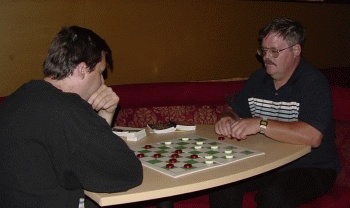
Checker Action at the 2007 Nationals
Virtually every week The Checker Maven brings you a puzzle or a problem to solve; something to enjoy and learn from, and which demonstrates the endless depths of our game of checkers. But this week is a little different. Today instead we present for your pleasure two excellent games from last year's U.S. National tournament, which took place in July 2007 in the fabled city of Las Vegas. We're also shamelessly pitching the 2008 National tournament, in the hopes that you will attend if you can or donate a little something if you can't.
Our spotlighted games from the 2007 tournament were sent along by Colorado Springs checker expert Bob Murr, whom we're proud to say has been a reader and supporter of The Checker Maven since the very beginning. In the 2007 tournament, Bob played a pair of games against the Irish expert Tommy Canning, famed for his skill as a correspondence player, but equally formidable in an over-the-board contest. The games below were annotated by Bob. We hope you enjoy them.

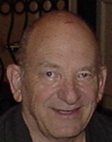
2007 Nationals Contestants Tommy Canning and Bob Murr
[Event "US National 2007"]
[Date "2007-07-25"]
[Black "Bob"]
[White "Tommy C"]
[Result "1/2-1/2"]
| 1. | 11-15 | 23-19 |
| 2. | 8-11 | 22-17 |
| 3. | 9-14 | 17-13 |
| 4. | 4-8 | 25-22 |
| 5. | 15-18 | 22x15 |
| 6. | 11x18 | 29-25 |
| 7. | 7-11---A | 26-23 |
| 8. | 10-15---B | 19x10 |
| 9. | 6x15 | 23-19---C |
| 10. | 14-17---D | 21x14 |
| 11. | 18-23 | 19x10 |
| 12. | 2-6 | 27x18 |
| 13. | 6x29 | 14-10 |
| 14. | 12-16 | 24-20---E |
| 15. | 16-19 | 32-27 |
| 16. | 11-15 | 20-16 |
| 17. | 8-12 | 16-11 |
| 18. | 12-16 | 11-7 |
| 19. | 16-20 | 27-24---F |
| 20. | 20x27 | 31x24 |
| 21. | 19-23 | 7-2 |
| 22. | 23-27 | 10-7 |
| 23. | 3x10 | 2-7 |
| 24. | 10-14 | 7-10 |
| 25. | 15-19 | 24x15 |
| 26. | 27-31 | 10x17 |
| 27. | 31-26 | 30x23 |
| 28. | 5-9 | 13x6 |
| 29. | 1x26---G | Drawn. |
A---This move has a bad record strongly favoring White; the 10-15 exchange is favored here, followed by either 26-23 or the 24-19 exchange to an even game.
B---11-15 seems better.
C---30-26 is the power move here followed by 2-6, 26-22, 3-7, then the 24-19 exchange appears to win.
D---During the game, I thought this would equalize but it offers White a powerful advantage.
E---31-27 is the power move although this also appears to win.
F---This allows Black an even game, 7-2 wins by 19-24, 28-19, 15-24, 2-7, 24-28, 7-11, 28-32, 31-26, etc. WW.
G---Black was very fortunate indeed to escape.
Click here for an animated version of this game.
[Event "US National 2007"]
[Date "2007-07-25"]
[Black "Tommy C"]
[White "Bob"]
[Result "0-1"]
| 1. | 11-15 | 22-18 | |
| 2. | 15x22 | 25x18 | |
| 3. | 8-11 | 29-25 | |
| 4. | 4-8 | 24-20 | |
| 5. | 10-15 | 26-22---A | |
| 6. | 9-14---B | 18x9 | |
| 7. | 5x14 | 22-17 | |
| 8. | 6-10---C | 25-22---D | |
| 9. | 2-6---E | 23-18 | |
| 10. | 14x23 | 27x18 | |
| 11. | 15-19 | 17-13 | |
| 12. | 1-5---F | 22-17 | |
| 13. | 10-15 | 18-14 | |
| 14. | 7-10---G | 14x | |
| 15. | 3x10 | 17-1 | |
| 16. | 10x17 | 21x14 | |
| 17. | 15-18 | 31-26 | |
| 18. | 12-16 | 26-23 | |
| 19. | 18x27 | 32x23 | |
| 20. | 19x26 | 30x23 | |
| 21. | 16-19 | 23x7 | |
| 22. | 6-10 | 7-3 | White Wins. |
A---25-22 is more common as in the trunk line of Duffy's Single Corner (DSC).
B---As taken in Duffy's variation 33.
C---New to me; Duffy recommends either 7-10 or 15-19 as in note C of variation 33 of DSC.
D---Or 15-19, even game.
E---15-19 looks easier.
F---19-23 and 12-16 also fail the test 19-23, 21-17, 12-16, 18-14, 1-5, 31-27 etc.
G---Or 6-10, 13-9, 12-16, 9-6 etc. Black doesn't have many options.
Click here for an animated version of this game.
Did you like these games? We hope so, and we hope you'll consider attending the 2008 Nationals, to be held at the Vegas Club in downtown Las Vegas. This year an incredible checker triple-header will take place!
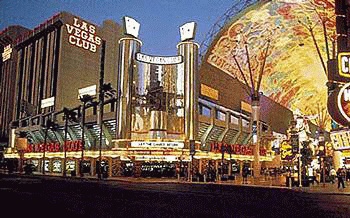
The Vegas Club, Downtown Las Vegas
First, there is the "Arthur Niederhoffer" National Youth Tournament, running from July 19th-20th , 2008 This event is for youth 21 and under. Full information can be found here:
http://usacheckers.com/tournamentannouncements.php#186.
Then, the "Gene Lindsay" 3-move US National will be held from July 21st-25th. This will be a three-move restriction event using the 156-opening deck and played in a Swiss system format. Additional information can be found here:
http://usacheckers.com/tournamentannouncements.php#184.
Finally, the District 9 Open (Western States Championship) will be held from July 27th-28th with a playoff on the 29th if necessary. Further details can be found here:
http://usacheckers.com/tournamentannouncements.php#185.
The Vegas club is offering checker players a very inexpensive room rate at $55 plus tax for Friday and Saturday nights, and only $29 plus tax for Sunday through Thursday nights. Players will also need to add an additional $15 per day of play to help with the costs of the playing room.
Legendary organizer Gerry Lopez is accepting donations for the Nationals prize fund. A contribution of $10 or more will bring a copy of 50 selected Masters' Division games direct to your mailbox. Please be generous and send your donation to:
Gerry Lopez, ACF Representative
41858 Corte Selva, Temecula CA 92591.
You will also receive credit in the ACF bulletin and the Missouri Newsletter.
Imagine it --- ten days of top-quality checkers in fabulous Las Vegas. It's a checker player's dream!
Andy's Annihilator

In our latest installment from Willie Ryan's Tricks Traps and Shots of the Checkerboard, we present what has to be the most stunning and spectacular position thus far--- and that's saying a lot. Without further ado we'll let Willie tell us about it.
"World's Champion Andrew Anderson is generally conceded to be the discoverer and early coach of James Wyllie, although there is no evidence on the records to indicate that the 'Herd Laddie' ever acknowledged Anderson as his teacher. The great Anderson played five torrid matches with Wyllie between 1837 and 1847, winning four of them, losing one. This may explain why the caustic Wyllie was reluctant to bestow any credit upon his master. A refined and quiet-mannered gentleman, Anderson was versatile as a player and as an analyst. It has been said that none of the trunk games in his Guide has ever been corrected. Among Anderson's best known analytical sparklers is this instructive sortie on the Souter opening. Proceed with:
| 9-14 | 23-19 | 11-16 |
| 22-17 | 6- 9 | 17-14 |
| 11-15 | 17-13 | 16-23* |
| 25-22 | 2- 6 | 31-26---F |
| 8-11 | 22-17 | 10-17 |
| 29-25 | 14-18 | 21-14, |
| 4-8---A | 26-22---E | arriving at |
| the diagram. |
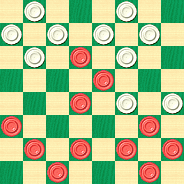
BLACK
Black to Play and Win
B:W32,30,28,27,26,25,24,22,14,13:B23,18,15,12,9,8,7,6,5,3,1.
A---In a match game between Robertson and Wyllie, the former used 11-16 at this point, and the following sensational play ensued:
| 11-16 | 27-23 | 11-15 | 31-27 | 11-27 | 26-23 |
| 24-20 | 19-24 | 19-16 | 5-9 | 19-15 | 19-26 |
| 16-19 | 28-19 | 7-11 | 27-24 | 10-19 | 30-7---D, |
| 23-16 | 15-24 | 16-7 | 15-18 | 17-10 | resulting |
| 12-19 | 32-28 | 2-11 | 23-19 | 6-15 | in a draw. |
| 17-13---B | 8-11 | 22-17 | 8-12---C | 13- 6 | |
| 4-8 | 28-19 | 3-8 | 20-16 | 1-10 |
B---White dare not attack the piece 27-23, as 5-9, 23-16, 9-13, in reply, ends all organized resistance, and black wins.
C---At this move, one of Wyllie's cronies, Peter Rule, entered the playing room, and after hastily taking inventory of the situation on the board, exclaimed, 'My, Mr. Wyllie, how did you ever get into such a scrape as this?'
'I am a piece ahead,' was the pert reply. Then Wyllie moved 20-16, proceeded to give away six men as fast as Robertson could take them, and acquired a draw amidst loud salutes of general admiration.
D---A splendidly played crossboard game, which is worthy of close analytical study by all grades of players.
E---A tricky but untenable move, which requires black to meet it with exacting play. The correct move here is 26-23, as exemplified in Mclndoe's Slingshot (previously published here --Ed.).
F--21-17, at this point, would be crushed by 23-26, 30-23,15-19, 23-16, 12-19, 24-15, 10-19, 22-15, 9-18, 31-26, 7-10, etc., with black winning."
Make no mistake, this one is a real shocker, and a genuine challenge even to a top player. Can you do it? Don't get annihilated; click on Read More to blast your way to the incredible solution.
Second Position

Our ballerina above is showing good form in demonstrating Second Position. We'll wager that ballet's Second Position is known to more of the general public than checker's Second Position--- but we'll bet the margin is small.
We continue with our review of the basics in this month's Checker School column, drawn as usual from the erudite pages of Ben Boland's Famous Positions in the Game of Checkers. And what can be more basic than Second Position? You may ask why we even bother with such an old warhorse, as it's been presented in virtually every basic checker textbook since time immemorial.
If you've mastered this position, we'll accept your argument, and you can browse on over to your favorite alternate checker site. But how many of us have really mastered all the nuances? Today, we take you on the backstage tour of Second Position, and by the time you're done, you'll be able to literally dance your way through this tricky but important ending.
Try your hand at the following progressively more difficult three examples.
W. PAYNE
WHITE
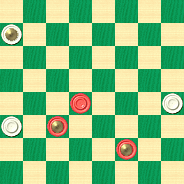
BLACK
Black to Play and Win
B:WK28,13,12:B15,K11,K6.
J. STURGES
WHITE
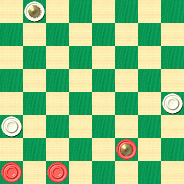
BLACK
Black to Play and Win
B:WK32,13,12:BK6,4,3.
A. ANDERSON
WHITE
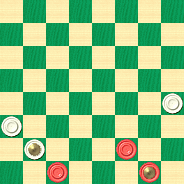
BLACK
Black to Play and Win
B:W13,12,K8:B6,3,K1.
Can you solve them all? Never have a "second" thought about clicking on Read More to see detailed notes, a sample game, and virtually all that you'll ever need to know.
A Bit Too Advanced
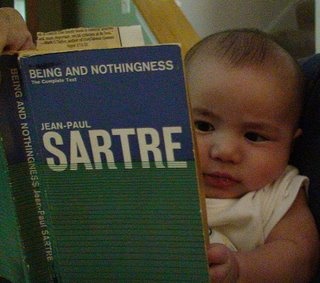
Sartre's L'Être et le Néant is a bit too advanced for most folks, let alone for the reader pictured above. We feel that there is an apt analogy to some stroke problems, which seem every bit as complex as the French philosopher's famous work on l'ontologie phénoménologique. This month's selection certainly can be described as complex; or again, making further reference to the existentialist canon, perhaps incomprehensible.
Fortunately, you can try out our problem without need for a French to English translation.
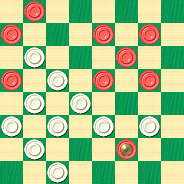
WHITE
White to Play and Win
W:W30,25,24,23,22,21,18,17,14,9:BK27,16,15,13,11,8,7,5,1.
Can you find the answer, or does it all come to nothing? We posit, however, that a solution indeed exists, and that it can be definitively determined by clicking on Read More.
Elegance and Style

Little can match British architectural style and elegance as demonstrated in the photo above. Neither too simple nor too complex, blending historical charm with enduring utility, we can't help but be impressed. Yet in the world of draughts, for something comparable we always turn to the American master of checker problem elegance and style, Tom Wiswell. This week's offering is neither too difficult nor too easy, and combines charm and style with practicality and instructiveness. It's a tour-de-force of which few other than Mr. Wiswell would be capable. Here's the position.

WHITE
White to Play and Win
W:W13,31,32:B4,21,28.
Try your hand at this one, and then click on Read More for the solution and explanatory notes. Take your time and enjoy it to the fullest; it's sheer elegance on the draughts board.
The 11-Man Ballot Game

Most of us--- we're talking about the casual, average checkerist here--- are very happy with "Go As You Please" (GAYP) checker play, in which the choice of opening moves is completely at our own discretion. We find more than enough challenge and entertainment in this most basic form of our game.
But, as we're sure most of you know, at the highest levels of play, GAYP tends to be drawish, and games tend to repeat, especially when the players are unwilling to take risks with a championship or prize at stake. That's why "2-move restriction" and later on, "3-move restriction" checker play came into being. In these forms of the game, the first two or three moves are chosen at random, by "ballot," and a pair of games is played from the chosen ballot, each player trying his luck at each side of the opening. The idea is to force the game into different lines of play and avoid drawish repetition.
Of course, the reason that 3-move restriction arose is that 2-move restriction play was highly analyzed and drawishness crept into even this form of the game. 3-move restriction, which is today the common mode of play at major tournaments, does somewhat better, but it too has been analyzed a great deal.
There is another form of play, invented many years ago by champion Newell W. Banks, which provides literally thousands of possible opening combinations, far too many to easily analyze, and certainly too many to memorize. That form of play is called "11-man ballot." In this game, a ballot is chosen which eliminates at random one man from each side (hence the 11-man idea) and then chooses the opening move for each side, just as in 2-move restriction. There are some limitations and additional rules, but we're sure you get the idea.
11-man ballot hasn't been very widely played. There have been a few 11-man ballot matches and tournaments, but not very many. Only recently have we seen revived interest in this form of play, with 11-man ballot games and tournaments taking place at the GoldToken internet site, and a recent live contest held in North Carolina and won by Tim Laverty. A match championship is scheduled for summer 2008 between Tim and reigning 3-move world champion Alex Moiseyev.
11-man ballot makes for exciting and often unpredictable play, as unusual starting positions require the players to exercise their over-the-board skills to a very high degree. It has much to recommend it and we'll guess that 11-man ballot has a renewed and bright future.
Today, though, let's go back in time to the classic 11-man ballot title match between champions Asa Long and Newell Banks. Here's one of the better games from that historical match, which took place many years ago.
| Black: Asa Long |
| White: Newell W. Banks |
| Ballot pieces off squares 6 and 24 |
| Two Move Ballot---9-13, 23-19 |
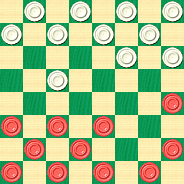
BLACK
Starting Position; Black to Play
| 9-13 | 23-19---a | 11-15 | 28-24 |
| 8-11 | 26-23 | 5-9 | 22-18 |
| 15-22 | 25-18 | 11-15---b | 18-11 |
| 7-16 | 29-25 | 9-14 | 25-22 |
| 1-5 | 22-18 | 16-20 | 18-9 |
| 5-14 | 23-18---c | 14-23 | 27-18 |
| 20-27 | 31-24 | 3-7 | 18-14 |
| 10-17 | 21-14 | 4-8 | 14-9 |
| 8-11 | 9-5 | 13-17---d | 5-1 |
| 7-10 | 24-20 | 11-15 | 32-28 |
| 15-24 | 28-19 | 17-22 | 1-5 |
| 2-7 |
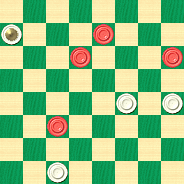
WHITE
White to Play and Win
W:W30,20,19,K5:B22,12,10,7.
Original notes are by Newell W. Banks.
a---Opens a beautiful position with the advantage to White, yet a sound defense seems possible.
b---Banks played 1-5 here against Long and should have drawn without much trouble.
c---Forms a magnificent ending which abounds with hidden possibilities.
d---7-10 looks best here and escapes with a narrow draw, thus 24-20, 11-15, 32-28, 15-24, 28-19, 20-16, 10-14, 6-1, 14-18, 1-6, 18-23, and Black just escapes.
Can you win the position shown above? Vote for your choice of move and then elect Read More to see the solution, the rest of the game, and additional explanatory notes.
Down Low, Too Slow

Our site hosting performance has gone down low, and The Checker Maven has become too slow!
For the last little while, you've probably noticed that it can take a while to surf over to The Checker Maven. This is an issue with what is properly known as page loading time, and there have been some real problems. It's cost us a lot of readers as, after waiting for a while, they decide to go elsewhere or think our site is out of service.
We've tried working with our hosting company, but frankly, they've not been helpful. We think, though, that we've worked out the nature of the problem, and have put a fix in place. We'll know over the next few days if the fix has corrected the situation.
Meanwhile, we apologize if you're having problems with our site and thank you for your patience.
The Checker Maven is produced at editorial offices in Honolulu, Hawai`i, as a completely non-commercial public service from which no income is obtained or sought. Original material is Copyright © 2004-2026 Avi Gobbler Publishing. Other material is public domain, AI generated, as attributed, or licensed under CC1, CC2, CC3 or CC4. Information presented on this site is offered as-is, at no cost, and bears no express or implied warranty as to accuracy or usability. You agree that you use such information entirely at your own risk. No liabilities of any kind under any legal theory whatsoever are accepted. The Checker Maven is dedicated to the memory of Mr. Bob Newell, Sr.
.jpg)