The Checker Maven
The World's Most Widely Read Checkers and Draughts Publication
Bob Newell, Editor-in-Chief
Published every Saturday morning in Honolulu, Hawai`i
McCullough's Draw
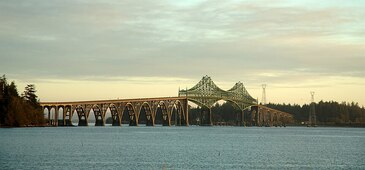
The McCullough Memorial Bridge spans Coos Bay in Oregon, and not surprisingly was called the Coos Bay Bridge when it was completed in 1936. No, it's not a draw bridge; it's what's known as a cantilever bridge. It was renamed some years later, not after checkerist R. McCullough, but instead in honor of the designer, Conde McCullough. We were unable to determine if the latter Mr. Mccullough was a checker player, but we can surely speculate that he might have been.
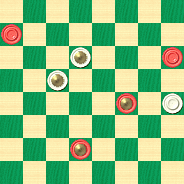
Today, in our Checker School lesson, we hark back to the days of checkerist McCullough, who is credited with a very practical checker draw (which has little if anything to do with a cantilever). The subject position is shown below.
BLACK
WHITE
White to Play and Draw
W:W20,K14,K10:BK26,K19,12,5.
It's another of those situations that the average checker player might write off as a loss, but in which the expert would see drawing possibilities. Can you leverage your skills and find a draw for White? When you've spanned the gap, cross over to the solution by clicking on Read More.
You can email the Webmaster with your comments on this article.
Ryan's Bell Ringer
PxHere CC0
The words "bell ringer" may evoke all sorts of images, from the classic sculpture above, to the chiming of the Liberty Bell, to the exquisite sound of handbells in a church choir. In its simplest form, though, a "bell ringer" is some sort of spectacular or noteworthy positive happening. Bell ringers abound on the checkerboard, and surely one of the most knowledgeable on this topic had to have been Willie Ryan. Today, in an excerpt from his book Tricks Traps & Shots of the Checkerboard, Willie shows and tells about a "bell ringer" that is definitely worth our time. Willie tells us about it below, modestly referring to his study as "better than average"!
"Among my collection of checker papers, I came across the better than average example on the Ayrshire Lassie, played out on the next page, which is good enough to inveigle even champion players, as the trap occurs on a line of play favored by the heavyweights.
| 11-15 | 5-9 | 14-18---A, 3 |
| 24-20 | 17-13 | 32-27 |
| 8-11 | 11-16 | 9-14---B |
| 28-24 | 20-11 | 26-22 |
| 3-8 | 7-23 | 4-8---C |
| 23-19 | 27-11 | 31-26 |
| 9-14 | 8-15 | 15-19---D |
| 22-17 | 24-20 | forming |
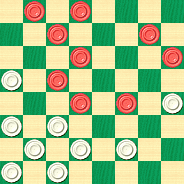
| the diagram |
WHITE
White to Play and Win
W:W13,20,21,22,25,26,27,29,30:B1,2,6,8,10,12,14,18,19.
A---A weak move. The following play will earn a draw easily: 4-8, 25-22, 15-18, 22-15, 10-19, 29-25, 1-5, 25-22, 14-17, 21-14, 9-25, 30-21, 8-11, 26-22. Wm. F. Ryan.
B---Forced, as 10-14 loses to 26-23, while 1-5 goes down to 20-16, 12-19, 26-23, 19-26, 30-7, 2-11, 21-17, etc., with white winning. Wm. F. Ryan.
C---All that's left. 2-7 allows white to clean up with: 13-9, 6-13, 22-17,13-22, 27-23,18-27, 25-2. Again at C, if 1-5 is played, white rings the bell with this bright play: 1-5, 31-26, 2-7, 26-23, 4-8, 13-9, 6-13, 22-17, 13-22, 21-17, 14-21, 23-14, 10-17, 25-2, 8-11, 29-25, 11-15, 27-23, 5-9, 2-6, 9-14, 6-10, 15-18, 10-15*, 18-27, 20-16, 12-19, 15-31, 14-18, 31-26. Wm. F. Ryan.
D---A promising move that collapses. Black's only line of play for a draw is 2-7*---4, 26-23, 15-19*, 23-16, 12-19, 22-15, 7-11*, 30-26, 11-18, 20-16, 8-12, 16-11, 12-16. Wm. F. Ryan."
3---The computer however thinks this move is a likely draw, although computers don't distinguish the between the practical reality of an easy draw vs. a hard draw---Ed.
4---The computer prefers an alternative drawing line in which Black goes a man down for a little while: 8-11 27-24 18-23 26x19 14-18 22-17 18-23 17-14 10x17 21x14 23-27 19x10 6x15 25-22 27-32 14-10 32-28 10-7 28x19 7-3 19-23 3-8 etc. to a draw. This is a line of play that a human player would be most unlikely to select in the presence of a more straightforward option---Ed.
Can you ring the bell and solve the problem, or will you just hang around ringing the chimes? Let your mouse sound the Read More note to see Willie's solution.
You can email the Webmaster with your comments on this article.
The Varsity Team
Public Domain
Tommy was, as usual for a Saturday morning, visiting with Uncle Ben on Uncle Ben's porch. Southern Florida winters are mild, and there were few Saturdays that Tommy and Uncle Ben didn't meet on the porch for Tommy's weekly checker lesson, and a glass or two of Uncle Ben's world famous lemonade--- or at least, Tommy thought it was good enough to be world famous.
Tommy was in great spirits and had just shared some fantastic news with Uncle Ben: a place had opened on the varsity checker team, and Coach Hovmiller had chosen Tommy to fill the position!
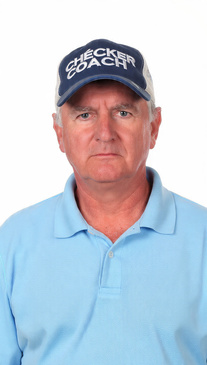
Coach Hovmiller
"Well, Tommy," Uncle Ben said, "you've worked long and hard for this. I know you were disappointed last year when you didn't quite make varsity, but you did very well as captain of the junior varsity, and I'm sure your coach felt you were ready for the 'big time.' Congratulations, young man!"
Tommy was all smiles--- who would not be? "Thank you, sir," he replied.
"Of course, Tommy, now you'll face some very tough competition. Middle-school varsity checkers in Florida is no piece of cake, no indeed. There are some very strong teams and some very good players, and you'll have to be at the top of your game. Now, you're already a fine player, but you will surely meet up with other boys and girls who are top notch as well. So, each week, we're going to work on problems and positions that are a little harder each time. How do you feel about that?" Of course, Uncle Ben always gave Tommy a little wink when he asked him difficult questions.
"I'm so pleased to have you helping me," Tommy said. "Not everyone is so fortunate as to get private lessons from a famous checker author! So, whatever you say, Uncle Ben, and I'll do my best!" (Ben, naturally, wasn't really Tommy's uncle, but all the young checkerists called him that, just out of courtesy and respect.)
"Then shall we begin?" asked Uncle Ben. "I have a very practical situation set up on the board here ... and of course, there's some lemonade as an aid to thinking!" So saying, he poured out two glasses and handed one to Tommy.

Pexels CC0
"Thank you Uncle Ben," Tommy said, but his voice drifted as he started to concentrate on the following position.

WHITE
White to Play and Win
W:WK14,K19,21:B12,13,K22.
Several minutes passed and Tommy had gotten through most of his glass of lemonade before he finally said, "Wow, Uncle Ben, that's a tricky one! But here's how I think White can win it ..."
Can you keep up with the newest member of the varsity team? When you've worked out the solution, click on Read More for the solution, a sample game, and numerous additional examples of the winning theme.
You can email the Webmaster with your comments on this article.
Happy New Year 2010
NARA & DVIDS Public Domain
Today's publication date is the day after New Year's Day, 2010. The parades and bowl games are over, and if you celebrated a little too enthusiastically on New Year's Eve, you're likely to be fully recovered and ready to face the year.
It sounds to us like a good time to take a moment to contemplate a checker problem. Checkers may not have the external glitz and flash of the Rose Bowl Parade, and there isn't going to be a crowd of thousands in the stands watching the game (that only happens in Marvin J. Mavin's world). But as all avid checker fans know, there is an excitement of a different nature. Today, we present a problem that is tough indeed but guaranteed to be a great and entertaining way to open your checkeristic year.
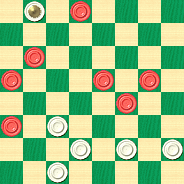
WHITE
White to Play and Win
W:W30,28,27,26,22,K1:B21,19,16,15,13,9,2.
It's hard to believe, but even a man down, White can win this position! Experts on both sides of the Atlantic thought it to be no better than a draw for many a year. To borrow from the late Margaret Farrar, this is a two-cups-of-coffee problem, if you can get it at all. But perhaps you can start the year with a bang, who knows until you try? In any case, one thing is this same this year and every year: clicking on Read More will bypass the coffee pot and take you right to the solution.
You can email the Webmaster with your comments on this article.
Happy Holidays 2009
Jim.henderson CC0 Wikimedia Commons
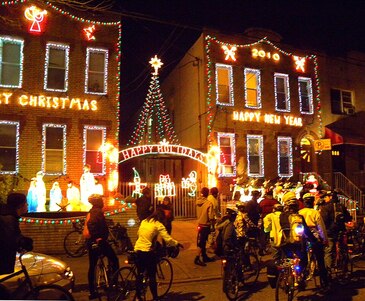
Just about everyone enjoys this most festive season of the year, and you don't have to belong to any particular group to participate in the good times. If the holidays are part of your personal traditions, you're surely already in the mood; and if the holidays aren't part of your traditions, there's no reason not to share in the celebrations of friends. In short, there's something here for everyone!
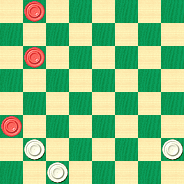
For today's Checker Maven column, we took that idea of "something for everyone" and picked out a checker problem that every checkerist will find challenging and useful. We're sure that, in the midst of your holiday schedule, you'll want half an hour out for a little checkers, and the problem below is just the thing.
WHITE
White to Play and Win
W:W25,28,30:B1,9,21.
Forces are even in a 3-per-side endgame. Often in such a situation the player with "the move" has a potential advantage. But White doesn't have "the move" (or, as it might be best expressed, "the opposition"). Yet White can win with careful and precise play.
Earn yourself an extra slice of holiday pie or cake by solving this one. Can you make the moves even without "the move"? Give it the old holiday try and then click on Read More to check your solution.
You can email the Webmaster with your comments on this article.
Quigley's Rule
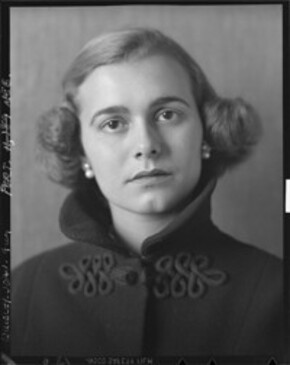
Astrologer Joan Quigley had her moments of fame as astrologer to nothing less than the White House during the years of the Reagan presidency in the United States. President Reagan's wife, Nancy, made the acquaintance of Ms. Quigley on a television show, and apparently was quite impressed. Ms. Quigley claimed, at least indirectly, in some respects to "rule" the White House by advising the President on key matters and protecting him from the "curse" that supposedly befell U.S. presidents elected in years whose number was evenly divisible by twenty.
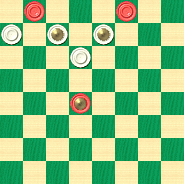
We certainly can't comment in any authoritative manner on Ms. Quigley's claims, though we do recommend a certain amount of scientific skepticism. But one thing we can comment upon is the game of checkers, and in today's episode from our Checker School series, we present a position credited to G. Rule and P. Quigley, which we've chosen to call "Quigley's Rule"; perhaps not quite the same as "Quigley Rules," but we will have to make do.
BLACK
WHITE
White to Play and Win
W:W5,K6,K7,10:B1,3,K18.
We would definitely call this a "stellar" problem. White has an extra man but it's stuck in the double corner, and Black has what seems like a strong bridge position. This type of position will surely come up again and again in your own games, so align your stars and work it through. When you've predicted the right moves, click on Read More to see the solution, sample games, and explanatory notes, taken as usual from Ben Boland's Famous Positions in the Game of Checkers.
You can email the Webmaster with your comments on this article.
Basil's Bonanza
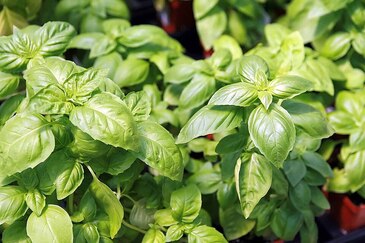
What we seem to have in our photo above is not Basil's Bonanza but perhaps a Bonanza of Basil --- basil leaves, that is; the wonderfully-flavored herb that pairs so well with tomato; that is a staple of the Mediterranean kitchen; and which, in a different variety, features as well in many an Asian dish.
But as usual, we need to remind our sometimes over-enthusiastic Research Department that this is, after all, a checker column; and today we're on to a different case: to wit, Basil Case, who is credited with today's theme in our ongoing series of extracts from Willie Ryan's Tricks Traps & Shots of the Checkerboard. Willie himself will tell us more.
"Basil Case, of Russellville, Alabama, has long been one of America's foremost players and analysts. A major prize winner in several national tournaments, and six times Southern States Champion, Case has milled out a considerable quantity of brilliant analysis during his checkered career. The spectacular stroke recorded here is a representative product from his robust bag of tricks.
| 11-16 | 22-17 | 10-17 |
| 24-20 | 6-10 | 21-14 |
| 16-19 | 29-25 | 15-18 |
| 23-16 | 8-11 | 32-27 |
| 12-19 | 25-22 | 1-5 |
| 22-18 | 14-18 | 28-24 |
| 9-14 | 27-23---A | 2-6 |
| 18-9 | 18-25 | 24-19 |
| 5-14 | 23-16 | 6-10 |
| 25-22 | 25-29 | See the |
| 10-15 | 17-14 | diagram |
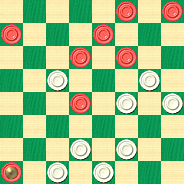
WHITE
White to Play and Draw
W:W14,16,19,20,26,27,30,31:B3,4,5,7,10,11,18,K29.
A---Introduced by Champion Case as a worthy alternative to the usual 30-25---2."
2---A few minutes of analysis on a fast computer rate 30-25 as a somewhat better move; but after nearly an hour of analysis, the computer validates Mr. Case's 27-23 as being nearly as good. Mr. Case's brain, in about five minutes of thinking time, proved every bit as good as 60 minutes on a modern computer!---Ed.
Will this be your "bonanza" problem and will you solve it forthwith, or will you be entangled in its leaves? Get on the case, and when you're ready, click on Read More to see the solution.
You can email the Webmaster with your comments on this article.
5th Anniversary Edition
This week The Checker Maven marks five years of continuous, uninterrupted, on-time publication. It's a milestone reached by just the smallest fraction of web sites, and we take what we believe is justified pride in our achievement.
Our original business plan called for ten years of publication. We're halfway there, and G-d willing, we'll travel the rest of the distance, and perhaps even continue on past that point. We can't predict the future, so we'll just keep publishing, one week at a time, for as long as fate and fortune allow.
Some very big changes are coming, but hopefully you won't notice them. No, we're not going to change our format (though we've thought about it); we know you like the familiar appearance of our weekly columns and we aren't going to "modernize" our look or create confusion by moving everything around. Neither are we going to abandon our weekly Saturday morning schedule--- you've told us how you look forward to the weekend and your Saturday cup of coffee with The Checker Maven.
But we are going to close our Santa Fe office, and transfer all of our operations to our Honolulu location. This will happen around March 2010. Like so many companies in America these days, our corporate parent, Mr. Fred Investments, is "reducing its footprint" as they say, and the bottom line is that we can no longer maintain two office locations for an operation that produces only very limited indirect revenue.
We're grateful to you, our reader, for staying with us for so long. The Checker Maven would be pointless if no one ever visited our pages. But you do visit, several thousand of you each and every week, and that keeps us going. Thank you to every one of you for five great years, and here's to the next five!
And now, as a special fifth anniversary feature, we present a new work of checker fiction, a 3,000 word short story entitled "Once Again to Knighton." We hope you enjoy it.
You can email the Webmaster with your comments on this article.
Once Again to Knighton
A Short Story

The draughts championship of Wales was coming up in less than a month, to be played, as always, at the Bowling Club in Knighton; and he wanted very much to play there one more time. Indeed, he had played there many a year, and often taking home the trophy, too; and though he had missed the last year or two, he wished to go back, for he knew that he would not have many more opportunities.
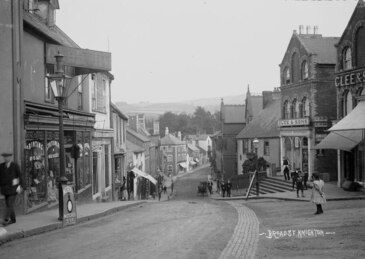
Percy Benzie Abery CC0 Wikimedia Commons
He wanted to see his old friends, and gather with them in the Horse and Jockey for drinks and chats in the evening after the games were over. He wanted to stay at Mrs. Bythell’s lovely rooming house, and have her fuss over him as she did with all the draughtsmen, pouring their tea and buttering their scones and wishing each of them luck— as if they all of them at once could win the title!
He wished to walk the narrow alleys and peer in the quaint shops, and see the clock tower and enjoy watching the sun emerge after the inevitable Knighton rain showers. He wanted one more reprise of all those delicious sensations that he had come to associate with the annual competition. But this year, he didn’t know how, or if, it could come to be.
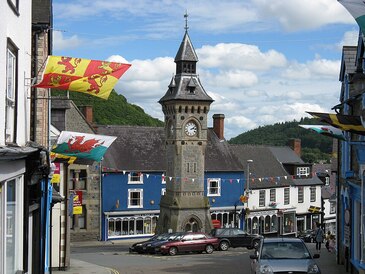
His health, never robust in the first instance, had declined this year, and some said markedly so, although they thought they whispered it softly so he would not hear. But the expressions on their faces and their quick glances in his direction conveyed the message as clearly as words could have done. Yes, he was not doing as well as he once had nor as well as they, or he, would have wished. Yet still, he wished to go to Knighton.
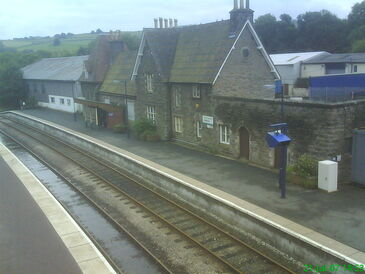
“Five hours on the train, how ever will you stand it!” his wife would exclaim, for even he would admit that it was inadvisable if not downright unsafe for him to attempt to drive. “And the dampness, and the strain! You’ll catch your death, or worse!” she would say, and he would try to imagine her ideas of what might be worse.
His doctor, of course, stood with his wife. “But Mr. Edwins,” he would insist, “as your medical adviser I simply cannot condone such exertion and exposure to the elements, not to mention the risks of infection on public conveyances ...”
It went on and on. When he became stubborn about the idea, he would get sudden calls from his children, at first merely urging him to take care, and then in later calls insisting outright that he not be foolish and strong-headed.
Today, at least, he would have a bit of diversion. His old friend John had made the long trip down from Manchester to pay him a visit, share a beer and conversation, and enjoy a friendly game or two at draughts after enjoying one of his wife’s fine dinners. John, too, was getting older, and couldn’t visit as often as either of them might have liked; but he was grateful and happy to see him, even though the occasions were not frequent.
John had arrived just a bit after one in the afternoon, a little tired out from almost three hours of driving. But the first glass of beer, served in the parlour, soon revived him, and the two men talked at length about a number of topics, although to no one’s surprise the discussion always returned to draughts and draughtsmen. Naturally enough, after a while they began to talk about next month’s tournament in Knighton. And so, he decided to make his plea to John.
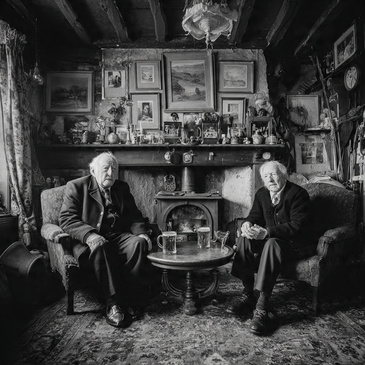
“I haven’t played there the last few times, and I’m thinking of going this year,” he said, attempting nonchalance.
John gave him a look that was at once quizzical and knowing. “I’m guessing that your idea isn’t so well received on the home front,” he said quietly, eying the light reflected from his beer glass through the parlour window. He leaned forward a bit on his seat. “You know, Linton, it might not be the best idea, all things considered. It’s a long enough trip and playing several games a day ... well ... your blood pressure and all that ... ”
“There’s many a time I’ve won, you know, and not just in my earlier years,” he interrupted, clearly ignoring the substance of John's remarks, “and I think I’ve still got it in me to play again ... I don’t have to win, you know, just play ... ” His chair creaked as he straightened his back for emphasis. “I’m certain I could do it ... ”
“Indeed, won you have, and more than once,” said John, “and I know you take well-earned pride in that. You don’t need to prove anything to anyone ... you were the best ... everyone knows.”
Yes, he thought, that’s how they know me. I was the best, in the day. But today ... well, old Linton just isn’t up to it any more, pity, but in any case the younger players are coming on strong and time marches on ...
A has-been; a very fine has-been, but a has-been none the less. That’s what they all think.
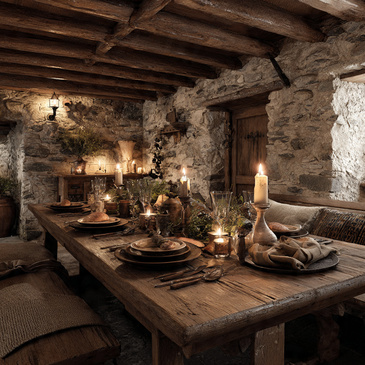
But of course, he said none of it, just kept his own council, though John surely saw his expression, the hurt and sadness in his eyes, yet John, too, remained silent. They both sipped at their beer, saying little more, until they were called in for dinner.
When John visited, his wife went all-out to put on an excellent meal. This time was no exception, and from the minute he and John tasted the soup, the mood began to lighten and the old conviviality returned. His wife, easily guessing what the matter had been, simply smiled, not feeling the need to do or say more than that.
They all talked of the weather and football and taxes, the state of the world, and all those things that people talk about at dinners among friends. Shadows began to grow longer, and she served them coffee, knowing that they wished to play a few games before John began the drive home; John didn’t like to be out that late these days, and normally would be off before nine o’clock. Even at that, he wouldn’t be home much before midnight.
So the table was cleared of dinner dishes and replaced with a pot of coffee, cups, and the draughts board.
John and he played informally; they’d play some go-as-you-please, and they’d try the odd three-move ballot, often to experiment with interesting lines of play. Little was at stake, after all; and they would say in jest that “the loser pours the coffee.”
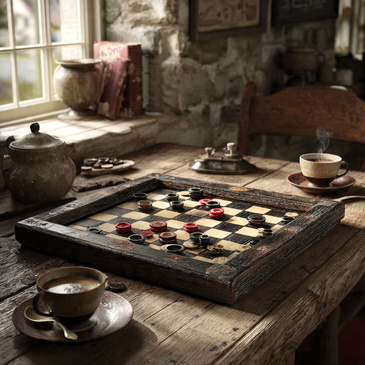
Was it the appearance of the draughts board on the table that turned his thoughts back to Knighton, or was that just an inevitability once dinner was done and his wife had retired to her sitting room?
"John, let's play a serious game," he began, "you know, just for a little practice, before you play at Knighton.
It wasn't hard for John to grasp the real intent. "Linton," he said, "you really should let it go ..."
"Just one game with the clock! It's for you, after all!" he said, knowing full well that it wasn't. "After all, you won't be able to get in a lot of practice ..."
"All right, then, we can play a game with the clock, but you must promise me that you won't then continue to pursue this idea of yours any further, what with your medical advice and so on."
He didn't reply; after all, he was an honorable man and even in small things didn't wish to give his word without meaning in his heart to keep it. So he just got the clock out of an end-table drawer and set it up next to the checker board.
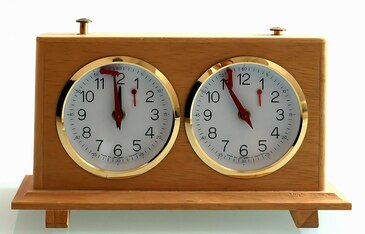
"Sixty minutes a side," he said quietly, knowing full well that this was the time limit used in the tournament.
"Sixty minutes!" John exclaimed. "Why, it will be nigh on time for me to drive home before we're finished, and we'll only have played one game! And besides, it will tire you so and you shouldn't ..."
"No worries, John. You'll enjoy a good game and I can go to bed soon after we're done." Not waiting for an explicit agreement, he set the clock and made his first move. John just shook his head slightly and said no more.
And so they played, John fretting a bit more than usual over his moves, he sipping at his coffee. After a little while, his wife came in to see if they needed anything. Upon seeing the clock and the serious looks on their faces, she said, "Why, whatever is the matter here? I've never seen the two of you with such long looks!"
John shrugged his shoulders, ever so slightly, looking a bit sheepish. "I think Linton's just trying to show me something," he said at last, and, seeing that she looked neither convinced nor satisfied, added, "but he promised me ..."
He sat up quickly, breaking his concentration. Had he become a little angry? "I didn't!" he said with a force that was hardly customary. "I did not make any promises! I only said I would like to play a good, serious game, and for your benefit at that!"
"Yes," John replied, "for my benefit, if you wish. But still, I thought it was a condition that you drop the idea of going to Knighton."
"Well, I never agreed to that!" he said, and there was a catch in his voice as he continued. "All of you ... you're denying me something that you know I want ... it's not right! And I know I'm up to it! You're just ... just ..." but he could not go on. There was a tear in the corner of his left eye and he brushed at it, trying to hide his reaction. But his wife knew him too well.
"There, dear, I'll freshen the coffee and you just play the rest of your game, so Mr. John can drive home to Manchester," she said, and bustled quickly off into the kitchen, as much to avoid further embarrassment as anything else.
And so the game went on. Nearly fifty minutes passed by, with both of them once again completely absorbed in the contest. Soon the game reached a critical point. But the hour was advancing, and John started stealing occasional quick glances at his watch. "Don't you think you should ..." John began, but it was clear that Linton, lost in concentration, was not going to reply.
The position on the board was this:
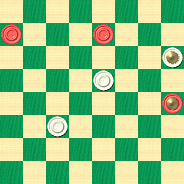
WHITE
White to Play and Win
W:WK12,15,22:B5,7,K20.
It was his turn to play. The patterns of the checker pieces evolved in his mind's eye, and his thoughts swirled with them, thoughts and pieces mingling, intertwining, red and white becoming one. Memories flooded in, combining with men and squares, forming intricate patterns, turning about in a cacophony of color. Until ...

He was twenty years younger and he was playing in for the second or third time in Knighton. Light streamed in from the window next to his table; he could hear the ticking of the clocks in the busy hall, and he was alert, and feeling strong and confident. A few spectators walked about the room, whispering comments about the games to each other and nodding sagely. But he didn't notice. It was the next to last round and a victory would give him a clear chance at his first title.
The game had been long and hard. He had arrived for the second round of the day early in the afternoon after a nice light lunch at Mrs. Bythell's rooming house, and visited for a little while with the other players. "Eh, lad," one of his older friends said, "quite a run of luck you're having this year!" But of course both of them knew it wasn't merely the results of good fortune that had lead to his standing near the top of the chart. And then it was time for him to find his assigned table, greet his next opponent, exchange good-luck wishes, and begin the contest.
So, after more than an hour, all was going well. He briefly regarded his opponent and saw the signs. His opponent was surely thinking that the game might soon end in a draw. He had no idea that Linton was calculating a combination of moves that could spell victory after a long afternoon of gentlemanly combat. Linton was not to be put off. A bit more concentration, visualizing the results of this move, followed by that move ... and there it was. He saw the path, and he would take it ... he reached out his arm ...
Rawpixel CC0
A clatter and a crash brought him back to the present day, and he realized with shock that he had dropped his coffee cup onto the floor, where it had shattered into pieces, a brown liquid stain spreading across the carpet. "Are you all right?" John exclaimed in surprise, as Linton's wife came running from the sitting room, her face quickly turning pale, and then just as rapidly growing red.
"What on this earth ..." was all she could say, and then hurried to the kitchen to fetch towels, her dish-washing gloves, and a wastebasket. Giving her husband a rather severe look, she began to clear up the mess. "My carpet!" she said, "I'll need to have it cleaned now!"
"I'm terribly sorry," he said, directing his words to John as much as to her. "This game ... it was so very like one I played in Knighton one time ... and for a moment ..."
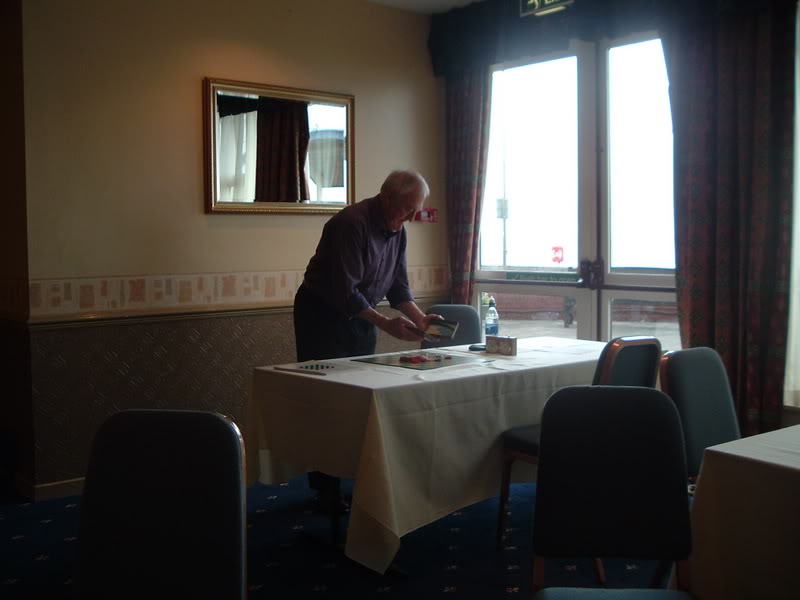
"Oh, enough about Knighton!" his wife cried in frustration. "Your foolishness will be the end of both of us!" John, clearly a bit embarrassed, said quietly, "Perhaps I should be off and driving now ... in any event, our game has been long and has surely become a draw."
"No, no!" Linton replied, "not just yet! Here, here, look at this!"
And so saying, he made a few moves on the draughts board.
John looked down, and then froze where he stood. His mouth open, he sat in his chair and simply stared at the board. Then he shook his head and said in a rather quiet voice, "Why ... that's ... brilliant! Who ever could have seen … "
"Oh, brilliant indeed," Linton's wife began, but John waved his arm as if asking for silence. Then, realizing what he had done, he said in an apologetic tone, "I don't mean to be rude, Mrs. Edwins, really I don't, but this is just astounding. Most amazingly, your husband has produced victory in a position that I took for a certain draw!"
Mrs. Edwins did not seem terribly impressed by this as she finished picking up the broken pieces of china and blotted up the rest of the coffee from the carpet. The two men went over the final moves once again, and there was no doubt as to the outcome. Linton had won.
John was smiling and shaking his head at the same time. "Truly amazing, it is!" he said. "Whoever would have thought ..."
His expression changed. "I hardly can believe what I'm about to say," he stated, "but, Mrs. Edwins, I think we really must let Mr. Edwins go to the tournament at Knighton. I knew that your husband is a fine draughtsman, but I had no idea ... his skills have grown, not decreased ... it would be a shame for him, indeed, a loss for all of us, if he were not to take one more turn at vying for the championship."
"But ... but Mr. John, his doctor says ... and you saw what just happened, he's so unsteady ... and you yourself were just saying ..."
Linton, seeing a chance, wisely enough did not speak as the dialog spun its way out.
"I think ... I think he was only lost in thought," John said, and was that a wink that he directed at Linton? "And besides, if we all looked after him ... I know, yes, I was opposed to the idea perhaps as much as you are, but look at this!" and he pointed meaningfully toward the draughts board. "Anyone who can produce play like this ... !"
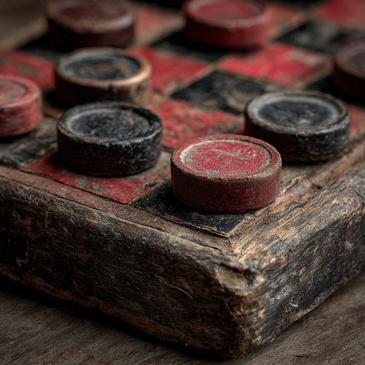
"Well, I'm surely no draughtsman," she replied, "and whatever you're showing me, I can't fathom the meaning." She paused for a moment. "Do you really think he should ..."
Linton could keep it in no longer. "Yes, yes!" he said. "I can do it! Listen to John, please! I know I can play again!"
"Mrs. Edwins, I really must be driving home now," John said, "but I do surely hope you'll give it consideration. As much as it surprises me to do so, I'm adding my own plea to that of your husband. Please do allow him to play, just this one more time."
Was she beginning to soften? "Well, well, now, I suppose I should think on it overnight, then. But no promises, and you, Linton, don't get your hopes up too high only to be let down!"
John had put on his sweater and was headed toward the front door, Linton and his wife following behind. Thank-yous and good-byes were said as always, but Linton's thoughts were elsewhere. After so many decades together, he knew his wife well, and he knew what it meant when she was going to "think on it overnight."
He would be going to Knighton this year, and he only had to wait until morning for his wife to tell him so.
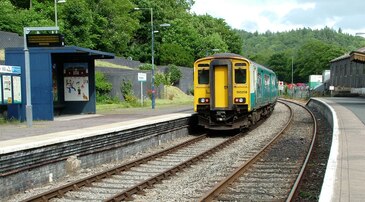
For the solution to the diagrammed position, click on Read More.
You can email the Webmaster with your comments on this article.
Thanksgiving: Time for Coffee and Cake
PICRYL CC0
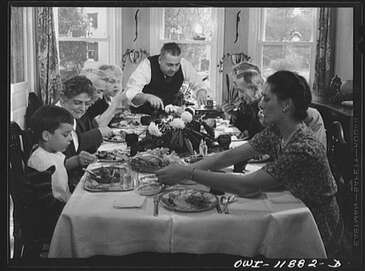
It's Thanksgiving time in the United States, and as we remark on each such occasion, this has got to be our favorite holiday, combining as it does food, family, and an air of happy contentment.
During this season, we also like to hearken back to the first days of our Checker Maven columns, which featured an excellent "coffee and cake" problem. Such a problem, you might recall, is one that is so good you'd be willing to bet your checker friends a serving of coffee and cake that they can't win it.
This year's "coffee and cake" problem is a fine one indeed. As we see below, White is up a man but is going to have to work for the win.
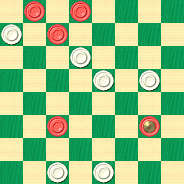
WHITE
White to Play and Win
W:W31,30,16,15,10,5:BK24,22,6,2,1.
Can you find your way to the table, so to speak, where coffee and cake await? Or will you be treating your friends instead? Give it a gander, and here's our Thanksgiving treat to you: if you can solve it, and if some day we should meet in person, coffee and cake are on us. When you're ready, click on Read More to check your answer.
You can email the Webmaster with your comments on this article.
The Checker Maven is produced at editorial offices in Honolulu, Hawai`i, as a completely non-commercial public service from which no income is obtained or sought. Original material is Copyright © 2004-2026 Avi Gobbler Publishing. Other material is public domain, AI generated, as attributed, or licensed under CC1, CC2, CC3 or CC4 and the various CC options. Information presented on this site is offered as-is, at no cost, and bears no express or implied warranty as to accuracy or usability. You agree that you use such information entirely at your own risk. No liabilities of any kind under any legal theory whatsoever are accepted. The Checker Maven is dedicated to the memory of Mr. Bob Newell, Sr.