The Checker Maven
The World's Most Widely Read Checkers and Draughts Publication
Bob Newell, Editor-in-Chief
Published every Saturday morning in Honolulu, Hawai`i
Noticing missing images? An explanation is here.
Buchanan's Block
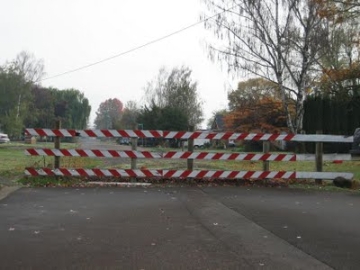
Sometimes, progress is simply blocked. For example, in our photo above, we're not going to be able to travel any further along this road, given the rather substantial looking roadblock that's right in front of us. But at least we have the option of turning around and trying another route.
In the game of checkers, a "block" means something similar. Our pieces might be blocked from going in a certain direction, and we have to seek another (though unless they're kings they can't turn around and go back). But if all of our pieces are blocked in all directions, we have a problem for sure: we've lost the game!
In his famous Tricks Traps & Shots of the Checkerboard, author Willie Ryan serves up various examples of blocks for our entertainment and tuition. Here's an over-the-board example that we'll let Willie tell us about it personally.
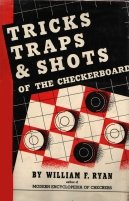
"Former American Champion Edwin F. Hunt, of Nashville, Tennessee, once defined Checkers as a "battle of ideas." The more ideas or strategic devices the learner can create or anticipate as he plays a game, the more skillful and versatile he becomes. Here is an artistic game I played several years ago with Basil Case, in which I managed to save what appeared to be a hopeless position by utilizing a block or smother idea.
| 9-14 | 18-15 | 6-10 |
| 22-18 | 7-11 | 24-20 |
| 5- 9 | 29-25 | 16-19 |
| 24-19 | 11-18 | 20-16 |
| 11-15 | 23-14 | 19-24 |
| 18-11 | 8-11 | 16-12 |
| 8-24 | 25-22 | 10-15 |
| 28-19 | 11-16 | 11-8 |
| 4- 8 | 14-10---2 | 2-7 |
| 25-22 | 6-24 | 8-4 |
| 9-13---1 | 27-11 | 24-28 |
| 22-18 | 12-16 | 4- 8 |
| 14-17 | 31-27 | 7-11 |
| 21-14 | 1-6 | 8- 4---A |
| 10-17 | 27-24 |
This brought about the diagrammed position.
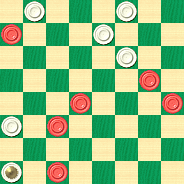
BLACK
Black to Play and Draw
B:W32,30,26,22,12,K4:B28,17,15,13,11,3.
A---Forms a position with which the great George Buchanan of Scotland gained a draw against Thomas Ballantyne in the 1897 Scottish Championship Tourney."
1---Definitely not best; 8-11 would be good here---Ed.
2---Gives up the edge; 27-23 would have held on to a definite White advantage---Ed.
Can you find your way out of the situation and achieve a Black draw, or will you encounter a mental block? We hope not, but we won't try to block your mouse from clicking on Read More to reveal the solution.
You can email the Webmaster with your comments on this article.
Sixth Anniversary Edition
This weekend we celebrate six years of continuous publication of The Checker Maven. As we reach each new annual milestone, we marvel at how far we've come, and we know that it's all due to the support of our readers, without whom we would have gone out of business long ago.
It's become our tradition to try to offer a new work of checker fiction at each anniversary date. This year, we're happy to present a 1,900 word short story called Inferno. You'll understand why when you read the story and solve the associated checker problem.
We won't keep you waiting any longer. Here's our latest little story.
by Bob Newell

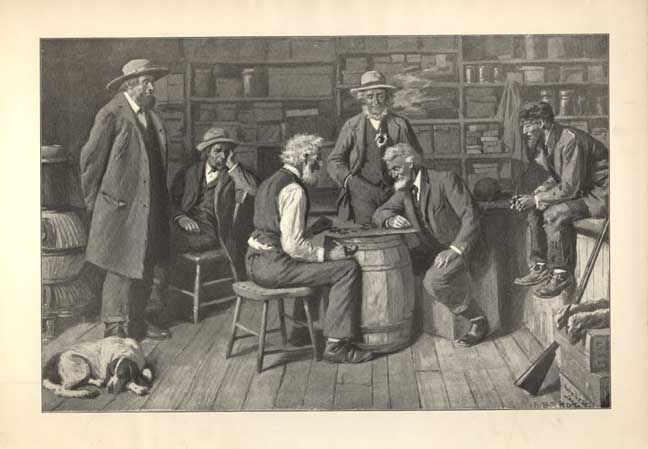
Billy and Joey had escaped from the house after lunch; the two cousins didn't want to remain under the watchful eye of old Aunt Edith, who seemed to automatically disapprove of anything they did. Now, they hadn't exactly sneaked out; it was more like they forgot to ask permission. At least, that's what they had agreed their story would be when the eventual reckoning with their respective parents, not to mention Aunt Edith, would take place.
But for now it was freedom, and for a couple of hours if their luck held, for the adults would surely be staying in the farmhouse and playing cards for the rest of the afternoon. Billy and Joey scurried across the farmyard and pulled up, out of sight of the house, behind the big barn on the other side.
"Whatcha wanna do?" asked Billy. He was a year older than his cousin, and it was his parent's farm, so he always acted like the one in charge and the one who knew what was going on, even though that was a fair distance from being correct.
"What about that spooky old house?" Joey asked. "You know, the one ..."
"Yeah, yeah, I know, 'course I know," Billy interrupted, "you always been wantin' to go over there. Pretty strange lookin' place if you ask me, an' I don't think you're up to it."
They were talking about one of the neighboring farmsteads, this one abandoned for many years since the death of the owners. Rumor was their estate had been in dispute for a long time, with little prospect of ever getting sorted out, so meanwhile, the farm had become more and more dilapidated as the years passed.
And the truth was, Billy was mighty scared of the place, though he would never admit that to his younger cousin. Billy had heard a lot of the stories that people in town told, and though at eleven years old he thought himself grown up, he still was more than a bit spooked.
But Joey was pushing him, and he had to appear brave, even nonchalant, if he wasn't to lose face.
"C'mon, Billy, I ain't scared, really I ain't, why can't we go there?" he complained. He could see that Billy was relenting.
Billy was clearly in a corner, with no way out. "Okay, okay," he said, trying not to let his voice show his inner fears, "we'll go. C'mon!"
It was nearly three-quarters of a mile to the old farmstead, and the afternoon sun was unrelenting. Joey looked pretty hot and tired, but he tried bravely not to complain. Billy almost asked Joey if he was too beat to go on, and if he wanted to turn back--- Billy certainly did, though he would never say as much--- but he thought it might show a crack in his facade, so he trudged on in silence.
They stopped a minute to rest under a small grove of birch
In answer, Joey stood up, brushed off leaves and debris from the seat of his pants, and resolutely headed back to the dusty road, Billy scrambling to follow him and regain leadership of the little expedition.
They were around the bend in a couple of minutes, and the old farmstead lay before them. What a sight it was. There was a large barn that had collapsed in upon itself, the roof failing and pulling down most of the walls with it. There were a few small outbuildings, all of them in a similar dilapidated state. There was the farmhouse itself, which, while much the worse for years of exposure to the elements and neglect, was at least still standing. It might even be possible to get inside without too much risk or danger.
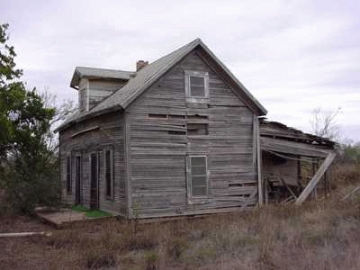
"Hey, betcha there's a bunch of cool old stuff in that house over there," Joey said, once again stealing Billy's thunder.
"Na," replied Billy, "lots a kids been in there and there ain't nothin' left. Anyhow," he continued, trying to dissuade Joey from further speculation, "they say, you know, bad stuff happens in there."
"I don't believe none of that," Joey said. "I wanna go take a look." And again, he was the one to lead the way across the dusty, weedy ground, over the litter-strewn front yard, and up to the porch of the farmhouse.
The portico over the entryway had long since fallen. Rusted rain gutters, broken away from the eaves, lay around the ground. The floor of the porch was broken in places, but it looked solid enough at the foot of the front door. All of the clapboard
The front door looked to be ajar by just and inch or two.
"Careful!" shouted Billy but Joey was already by the door, the floor creaking and groaning but holding his weight. "Help me open this" Joey cried as he put the fingers of both hands around the edge of the door and tugged as hard as he good. The hinges were rusted and he wasn't strong enough to break the door loose.
Billy joined him and together they pulled. "One, two, three, PULL!" Billy shouted and all at once they were on their backs on the ground in front of the house, as the door yielded and they were thrown off by the force of their efforts.
Joey was already up, dusting off his shorts and tee shirt, and heading for the dark opening into the house, Billy following more slowly behind him. The light was dim just inside the door, a rectangle of light from the doorway illuminating a faded and tattered carpet, some furniture that smelled musty and looked even worse, and an old table with what looked like a checkerboard on it. Everything was covered in dust but that didn't hide the water damage, no doubt due to occasional prairie rainstorms sending torrents of water through holes in the roof and ceiling.
They stood and looked, waiting as their eyes adjusted from bright outdoor sunshine to the weak indoor light. About the only thing still fully standing was the old wooden table and a couple of chairs. Everything else was so broken down as to be completely unusable, and showed signs of vandalism: seat cushions were shredded, the walls were gouged in places and covered with graffiti nearly everywhere.
"I wonder," Billy said, "why nobody stole the checkerboard?"
Indeed, a checkerboard did sit on the table, with a faded set of red and white wooden checkers, all coated with dust. The board was of the leather folding type. The leather had peeled in many places; most of the squares had water stains, but it was otherwise intact.

"I dunno," said Joey, "maybe kids like to play here."
"You crazy or what?" replied Billy. "Kids ain't gonna come to this creepy old dump to play checkers, fer cryin' out loud! What's wrong with you?"
"Aw, c'mon, let's play! Won't it be cool tellin' the kids at school how we played checkers in the old haunted place?"
Billy was getting more nervous by the minute, and trying hard to keep his cool. "Hey, don't be makin' up stuff like that!" he said. "Whaddya, scared?" Joey asked. "Let's play! Show me you ain't a-scared!"
It was too much for Billy. Having lost the lead already to his younger cousin, he wasn't about to act frightened, even though he was pretty close to scared witless. They both pulled rickety wooden chairs across the floor and up to the wooden table. They dusted off the checker pieces and the board, coughing in the billowing dust cloud they created. But everything soon settled down and they both found themselves sitting in front of a ready checkerboard, Joey grinning and wiggling in his chair, Billy looking something more than mildly annoyed and sitting stock still.
His mother was calling from the kitchen. "Bobby and Jimmy," she sang, "dinner's ready, come here and eat!"
"Aw, gee, Jimmy, I wanna just finish this game," Bobby said, looking down at the brightly-painted checkers on the brand new folding checkerboard.
"Nah, you know your mom gets impatient when food's gettin' cold," Jimmy replied, "we better go an' eat an' then play some more checkers later."
Just then there was a crash and a scream from the kitchen. "The gas tank!" they heard Bobby's mother cry out. "Run, boys!" and then there was the deafening roar of an explosion and hot flames streaming out the kitchen door.
"Mom, mom!" Bobby cried, and Jimmy was tugging on his arm, dragging him to the door and away from the heat of the flames. "No, no, I gotta get Mom!" Bobby screamed, and with a violent move, wrenched himself away and ran to the kitchen, blindly charging into the flaming inferno that raged there.
Jimmy had already run out yelling for help. The adults on the farm were fast to respond, pouring buckets of water and sand on the flames in a desperate effort to get into the kitchen. But it was too late. Though they had saved the rest of the house, the kitchen was completely destroyed. They found two badly charred bodies, one an adult female, the other that of a twelve-year old boy.
Billy was shaking Joey violently. "Wake up, wake up, are you OK, what's happening?" Joey's eyes opened slowly as he returned to awareness. "Huh?" Joey said. "The fire ... it was so hot ... I couldn't get away ...."
"What are you talking about, Joey?" asked Billy. "There ain't no fire ... we was goin' to play checkers an' you passed out an' fell on the floor. You was screamin' like you was havin' some kind of nightmare and I couldn't wake you up. You scared me Joey, don't do that!"
Joey was sitting up on the floor now, rubbing his eyes. "There was a fire," he kept saying. "In the kitchen ... and I ran in there to get Mom ..."
"Joey, come here, look, there ain't no fire!" Billy shouted. He pulled Joey to his feet and dragged him away from the table toward the kitchen. "Look, see ...." Billy didn't finish his sentence, his jaw agape as they both took in the sight of the charred floors and walls and the burned ceiling. There had certainly been a fire here long ago, and by the looks of it, a bad one.
There wasn't much left of the floor, but there were two large, ominous dark spots, as if the heat of the flames had burned two sizable objects.
"L..let's getta outta here," Joey said, and Billy didn't have to be told twice. Joey leaned on Billy for support and they made their way back through the living room.
"Look!" Joey shouted. "Look, there!" and his arm was pointing arrow straight to the old table and checkerboard.
There was no dust on the table, and the board and checkers looked like new. The checkers had been moved as if someone had been playing and had been interrupted in mid-game. But Billy was tugging again on Joey's arm, pulling him to the door and out into the yard.
They started to run, and they didn't stop until they were back to Billy's house.
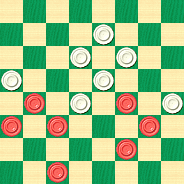
BLACK
Black to Play and Win
B:W26,23,22,20,18,15,13:B16,14,12,11,9,6,3.
Click on Read More to see the solution to the position shown above.
You can email the Webmaster with your comments on this article.
Thanksgiving, 2010

All across America, from Hawai`i to Maine, from Alaska to Florida, it's Thanksgiving weekend, surely one of our favorite times of the year. It's an opportunity for families both large and small to gather together to celebrate all that's good in our lives, and of course, to enjoy the usual fabulous Thanksgiving dinner.
As checkerists, we also have much in addition to be thankful for, such as the many fine players who have gone before us and made our game richer and more enjoyable. And with such thoughts in our minds, how can we help but turn to the master himself, Tom Wiswell, for this week's problem?
As usual, before you have that second helping of pie, we invite you to take a look at the diagram below.
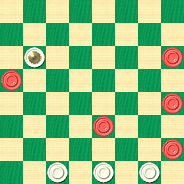
WHITE
White to Play and Win
W:W32,31,30,K9:B28,23,20,13,12.
Can you work it out? Would you bet your slice of pie on it? Give it a try, then click on Read More to see the solution. And enjoy your weekend. Happy Thanksgiving from The Checker Maven to one and all.
You can email the Webmaster with your comments on this article.
Saving the Bacon

In this month's lesson in our Checker School series, we look at two positions in which White is about to fry Black's bacon ... yet Black is expected to save it. In both instances, Black is a man down and the fat is in the fire. Let's have a look at the diagrams below, attributed respectively to A. Sheean and F. O'Melay, and the famous Dr. T. J. Brown.
WHITE
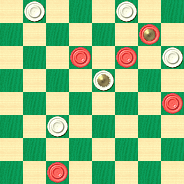
BLACK
Black to Play and Draw
B:W32,30,21,K18,11:BK25,23,22,13,3.
WHITE
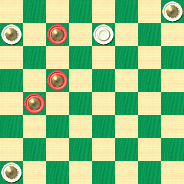
BLACK
Black to Play and Draw
B:WK29,K28,26,K4:BK27,K19,K16.
Can you save the bacon in these two cases? We must warn you the first problem is at the higher end of the difficulty spectrum, and while the second is a bit easier, it's all relative. In any case, grease your thinking cap and don't get fried; you can always click on Read More for the tasty solutions, which are served up with detailed notes and a sample game.
You can email the Webmaster with your comments on this article.
Searight's Escape

Houdini was arguably the greatest (or at least the most famous) escape artist of all time. Some of his daring feats, like the water-tank escape shown above, are definitely not recommended for trial at home; not, at least, if you value your life.
Checkerist Searight most probably never did a water-tank exhibition, but his checkerboard feats are as classy in the checker world as Houdini's were his own realm. Today, we quote Willie Ryan in Trips Traps & Shots of the Checkerboard, as he describes one of Mr. Searight's more amazing checkerboard escapes.
"You'll never be a champion at checkers unless you thoroughly familiarize yourself with all the better-known losses that have been the undoing of great players in the past. By studying the mistakes of the masters, you can avoid the costly errors they made, and gain knowledge that would take years to acquire by practical experience. Among the 'must' positions is Searight's draw. The game mapped out below was contested by Champion Newell W. Banks and me. When Banks reached the diagrammed stage, he 'muffed' a draw, losing the game and the match."
| 11-16 | 9-18 | 7-10 |
| 22-17 | 23-14 | 22-18 |
| 16-20 | 1-6 | 3-7 |
| 17-14 | 24-19 | 13-9 |
| 10-17 | 15-24 | 5-14 |
| 21-14 | 28-19 | 18- 9 |
| 9-18 | 6-10 | 11-15 |
| 23-14 | 30-26 | 32-28 |
| 8-11 | 10-17 | 15-24 |
| 25-22 | 22-13 | 28-19 |
| 11-15 | 4-8 | 7-11 |
| 29-25 | 25-22 | 27-24 |
| 6- 9 | 8-11 | 20-27 |
| 26-23 | 26-23 | 31-24---1 |
1---Impeccable play up to this point---Ed.
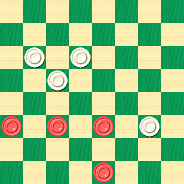
BLACK
Black to Play and Draw
B:W9,19,23,24:B2,10,11,12.
Can you escape with your life in this position, or will you pay the price of failure? We won't say there's an easy out; some struggling is necessary, but it's worth it. Get on with the show, and then slip out to Read More to see the solution and notes.
You can email the Webmaster with your comments on this article.
No Winter Slowdown Here
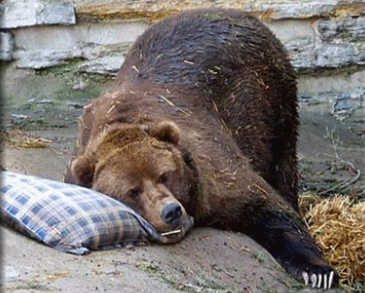
Winter is often thought of as a time of slowing down, and for some large animals, the deep sleep of hibernation. Well, winter is arriving in much of the North American continent, but there's certainly no slowdown, let alone hibernation, of checker activity. And with today's speed problem, snoozing will not be an option, because you've only got 15 seconds to pull off a solution.
Put on your indoor running shoes and get ready for a real wake-up call, When you're ready, click on the link below; then come back and awaken the Read More button to check your solution. Solve now, sleep later!
November 2010 Speed Problem (easy)
You can email the Webmaster with your comments on this article.
Win One For Uncle Ben
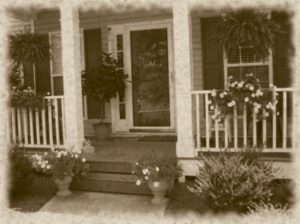
Public Domain
It was Saturday morning, the time of the week that Tommy would head over to Uncle Ben's porch for a checker lesson and some of Uncle Ben's famous lemonade.
But Tommy wouldn't be doing that today. Yesterday, Uncle Ben had been taken to Community Memorial Medical Center.

ajay_suresh CC BY 2.0
When Tommy heard the news, he was absolutely determined to pay his beloved checker mentor a visit at the hospital. There were just two problems with that. The biggest problem was that Tommy was still thirteen, and the minimum visiting age was fourteen. Second, Tommy's mother didn't exactly approve of him "bothering poor Uncle Ben while he's ill." Well, she didn't quite tell him he couldn't go ... and so, before she could actually utter those irrevocable words of prohibition, Tommy was on his bicycle, pedalling furiously downtown, making the trip in near-record time.
Tommy Wagner
The ward nurse, of course, asked Tommy about his age. Tommy was not one to tell lies, so he told the nurse that he was "almost fourteen" and kind of didn't say the word "almost" in quite as loud a voice as he said the word "fourteen." The nurse told him that she'd let him visit, but he'd have to keep it to ten minutes.
Uncle Ben was sitting up in his bed when Tommy went into his room. "Ah, what a nice surprise!" he exclaimed with a smile when he saw his young student. "I didn't expect to see you this morning! How ever did you get past the head nurse?" he asked, but then added, "Oh ... no matter. You're a resourceful checker player, after all."
"How are you doing, sir?" Tommy inquired.
"I'll be just fine, Tommy," Uncle Ben said, "I had a bit of a fall and they are just keeping me a little longer for observation. No real harm done. But I'm afraid we won't have any lemonade this morning."
"Oh, no, sir, I didn't come for a checker lesson. I just wanted to see how you were, and let you know that our school team has a big match this week against our rivals, Sunshine Middle, and I'll be playing second board!"
"Oh, you'd better practice up, then," replied Uncle Ben. "Second board --- I see Coach Hovmiller has moved you up rather quickly. You'll not have an easy game, but I'm sure you'll be ready." Uncle Ben turned to reach for something on his bedstand. "Here," he said, "I've got just the thing for you to try out."
Uncle Ben handed the object to Tommy; it was a sheet of paper with a hand-drawn diagram of a checker problem!
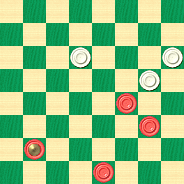
BLACK
Black to Play and Win
B:B2,9,14,K8:W21,23,17.
"Now, I know you didn't expect a lesson, nor will they let you stay here much longer, so how about you just take this problem home and practice with it?"
Tommy was all smiles. How could Uncle Ben have guessed that he would visit? But just at that moment, the ward nurse stuck her head through the door and said, "Time's up, young man!"
"Thank you, Uncle Ben," said Tommy as he turned to leave. "I'll surely study this problem carefully. And," he went on, "I'm going to win my game this week ... just for you!"
Now it was Uncle Ben who was all smiles. But the ward nurse had an insistent look. "Get well soon!" called Tommy as he left. "See you next week!"
Can you win one for Uncle Ben? He's counting on you! Solve the problem and then click on Read More to see the solution, a sample game, and no less than seventeen additional examples.
You can email the Webmaster with your comments on this article.
The Twins, Bowen's, Of Course

We don't know a whole lot, we confess, about old-time checkerist R. E. Bowen. To be specific, we're not sure if he ever had twins in his family, such as the twins shown above. We do know, though, that Mr. Bowen created twins, or more accurately, wrote about them; but they are decidedly twins of the checker variety, in the form of a "twin" position as shown in the first diagram below. In this situation, it all depends who plays first; but in the related positions shown in our second and third diagrams, Black will definitely win.
It's a classic lesson from the pages of our current Checker School textbook, Ben Boland's Famous Positions in the Game of Checkers. The lesson may be known to you, in name if not in detail, and this is your opportunity to learn just about everything about it.
WHITE
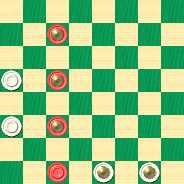
BLACK
Black Plays, White Draws
White Plays, Black Wins
B:W20,12,K2,K1:BK27,K19,K11,3.
W:W20,12,K2,K1:BK27,K19,K11,3.
E. CLARK
WHITE
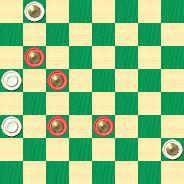
BLACK
Black to Play and Win
B:WK32,20,12,K5:BK24,K19,K11,K10.
D. KIRKWOOD
WHITE
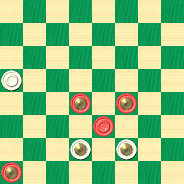
BLACK
Black to Play and Win
B:W20,K7,K6:BK15,K14,10,K4.
There are really four distinct problems here, so you might think of it as a pair of twins. Twins squared? We won't speculate further, but we do know that clicking on Read More will show you the solutions, sample games, detailed notes, and a surprise bonus feature.
You can email the Webmaster with your comments on this article.
Fuller's Brushdown!
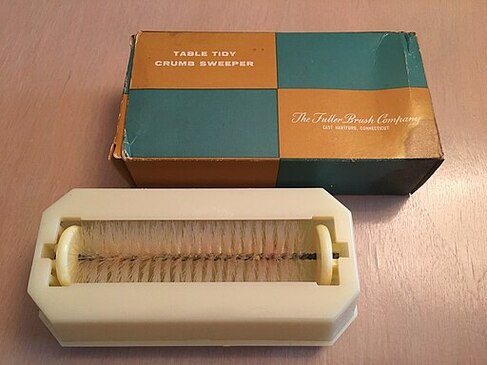
Who among us who is, shall we say, above a certain age, can fail to remember the Fuller Brush Man? Selling door-to-door, with his signature case of Fuller Brush Company wares--- they were sold with a unique lifetime guarantee--- he was a part of American culture, and was even immortalized in a Red Skelton movie in 1948. The Fuller Brush Man is perhaps no longer the icon he once was, but the company itself lives on, having relocated to Kansas in 1973. The photo above is of one of the company's unique products from back in the day.
During Willie Ryan's days, the Fuller Brush Man was still a well-known figure, and hence it's no surprise that Willie makes a punning reference in his book Tricks Traps & Shots of the Checkerboard while describing a position attributed to checkerist Everett Fuller. But Willie can tell us about it much better than we can.
"Now and then, Everett Fuller of Milwaukee, Champion of Wisconsin, introduces a sparkling problem or an unusual game. Everett is the father of the following stroke, which, as strokes go, deserves a blue ribbon for its subtlety and bizarre character:
| 11-16 | 22-17 | 15-24 |
| 24-20 | 6-10 | 27-23 |
| 16-19 | 17-13 | 3- 8---4 |
| 23-16 | 8-11 | 23-18---5 |
| 12-19 | 26-22 | 8-12 |
| 22-18 | 14-18---1 | 30-26---6 |
| 9-14 | 21-17---2 | 12-16---7 |
| 18- 9 | 18-25 | 13- 9 |
| 5-14 | 29-22 | 4- 8 |
| 25-22 | 19-24---3 | 17-13. |
| 10-15 | 28-19 | See the |
| diagram." |
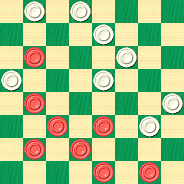
BLACK
Black to Play and Draw
B:W32,31,26,22,20,18,13,9:B24,16,11,10,8,7,2,1.
Notes by the Editor using KingsRow.
1---The computer gives Black a small edge here.
2---30-26 was better and now Black gets a significant lead.
3---Black should have played 4-8 to keep his advantage.
4---KingsRow prefers 24-28. After the text move the game is actually just a bit in White's favor.
5---13-9 was necessary to keep the White edge.
6---Just about loses. 13-9 was still best here.
7---The game continues to see-saw; 10-15 would have kept Black's superiority.
Can you solve this one, or will it give you the brush-off? In any case we offer a lifetime guarantee: clicking on Read More will always show you the solution.
You can email the Webmaster with your comments on this article.
Principles of Strategy

Checkers is sometimes compared to a war game, with the players taking on the role of opposing Generals, commanding their respective forces of Red and White warriors. Fortunately, this analogy only goes so far; although checker combat can be sharp and demanding, it is happily of a peaceful, intellectual nature.
But much as war has its well-evolved principles of strategy, checkers too is a game of a highly strategic nature (though tactics often come to the fore). Checker strategy, however, is a topic that has generally not been well elaborated in checker literature. Literally only a handful of books have dealt in-depth with this facet of the game.
One of these books is Principles of Strategy in the Game of Checkers, the only published book by the late Brooklyn champion Louis Ginsberg. Dealing with the critically important Dyke positions, and published over 65 years ago, the book remains relevant and vital today with its insightful notes and clear elucidation of strategic principles.
This little book has long been out of print, but today we are releasing a newly-typeset electronic edition, which you can download at once here. We owe thanks to a mysterious "Mr. T." who provided us with carefully corrected interpreted scans of the original and helped greatly in moving the project forward. The book is available in PDF format and can easily be printed on plain letter paper if you prefer hard copy.
Let's take a quick peek at one of the positions in the book. It arises from the following play. Notes are taken from the book; notice the remarkable clarity and insight the author provides.
11-16---A 24-20 16-19---B 23x16 12x19 22-17---C 10-15---D 25-22---E 8-12---F 27-24---G 7-10---H 20-16---I 2-7---J 32-27---K 4-8 27-23 9-14---L 30-25---M 5-9---N; forms diagram
A---The Bristol opening which often assumes a "Dyke" formation.
B---Black takes command of 19 and expects to develop the "Dyke" if the opportunity offers.
C---A weak move, but generally made by the uninformed. Again the importance of 22-18 is noted, for if Black has visions of the center, the man on 18 must be removed by the 9-14 exchange (10-14, although sound, leads to a complicated formation of a different nature).
D---Black begins to mass his pieces as shown in previous examples.
E---White must try to establish his position and break up the coming "Dyke."
F---This move must eventually be made to support the piece on 19. If 7-10, trying to establish the formation too quickly, White goes 20-16 and spoils the "Dyke" as pointed out in Example 1.
G---The ever present defense in these formations, to be followed by 32-27, when the time comes, as explained before.
H---The text move is given to illustrate how a strong formation can be wrecked. It is proper to go 4-8 for if 32-27 comes next, 7-10 and the "Dyke" is very strong. If White tries 20-16 after 7-10 then 3-7 is the key move for the attack, eliminating the trunk game.
I---Threatening square 11, explained in Example 1.
J---Black gets ready to attack the piece on 16, having in mind 4-8 followed by 8-11. If White plays 16-11, 7-16, 24-20, then 3-8, 20-11, 19-23, etc.
K---White's destination is 18.
L---It is quite evident something must be done to stop the impending attack against the man on 15.
M---Threatening the three for two. This type of move in similar positions should always be considered as a threat against 18, a strategic point.
N---Nothing else to be done.
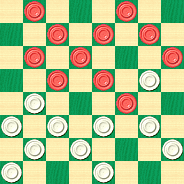
WHITE
White to Play and Win
W:W31,29,28,26,25,24,23,22,21,17,16:B19,15,14,12,10,9,8,7,6,3,1.
It's not as hard as it looks; can you break the Dyke or will the position hold water? It's up to you; solve the position and click on Read More to "leak" the solution.
You can email the Webmaster with your comments on this article.
The Checker Maven is produced at editorial offices in Honolulu, Hawai`i, as a completely non-commercial public service from which no income is obtained or sought. Original material is Copyright © 2004-2026 Avi Gobbler Publishing. Other material is public domain, AI generated, as attributed, or licensed under CC1, CC2, CC3 or CC4 and the various CC options. Information presented on this site is offered as-is, at no cost, and bears no express or implied warranty as to accuracy or usability. You agree that you use such information entirely at your own risk. No liabilities of any kind under any legal theory whatsoever are accepted. The Checker Maven is dedicated to the memory of Mr. Bob Newell, Sr.