The Checker Maven
The World's Most Widely Read Checkers and Draughts Publication
Bob Newell, Editor-in-Chief
Published every Saturday morning in Honolulu, Hawai`i
Famous Shots IV

This month brings the fourth entry in our Famous Shots series, taken from Ben Boland's Famous Positions in the Game of Checkers. As always, the challenge is to solve the shot, and, if you wish, identify the "shot" pictured above.
Here's the run-up:
11-15 21-17 9-13 25-21 8-11 17-14---A 10x17 21x14 6-10 22-17 13x22 26x17 15-18 24-20---B 2-6 28-24 4-8---C 29-25 11-15 30-26 6-9---D
A---30-25 is better; Black now gets a small but noticeable advantage.
B---23-19 is better. Black's advantage is now significant.
C---6-9 would retain the Black advantage. The game is now about even.
D---Loses. 15-19 was correct.
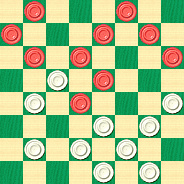
WHITE
White to Play and Win
W:W32,31,27,26,25,24,23,20,17,14:B18,15,12,10,9,8,7,5,3,1.
Aw, shoot; we're pretty much out of "shot" puns, so all we'll say is to see if you can solve it and then click on Read More to see the solution.
You can email the Webmaster with your comments on this article.
A Short Speedster
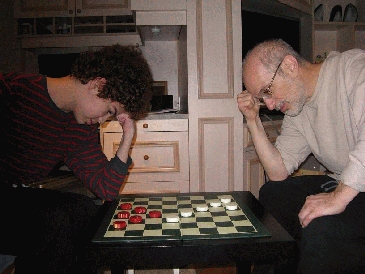
For February, the shortest month, we're pleased to present another short speed problem from father and son team Lloyd and Josh Gordon of Toronto, Ontario, Canada. It features a practical over-the-board situation and is relatively easy (hence a 10 second time limit).
We invite other readers to submit similar problems, suited for solving in anything from five seconds to one minute. Meanwhile, a big "mahalo" (thanks) to Lloyd and Josh.
When you're ready, click on the link below; then come back and click on Read More to verify your solution.
February Speed Problem (Easy, 10 seconds)
You can email the Webmaster with your comments on this article.
Man Up
"Man up!" is an expression that is probably out of favor these days as it refers specifically to masculinity. We won't get into debates about this and we'll say no more than that we believe in all forms of equality. However "man up" in checkers is a different concept. When you are a "man up" you're quite likely to win--- if you know how.
Today's Beginner's Corner episode deals once again with that "you've got to win it" idea. A man up is usually a win, but short of the expert level, the other player isn't just going to concede; you'll have to show that you know how to win it.
Here's one such situation.
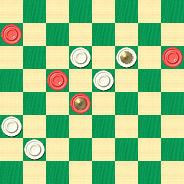
WHITE
White to Play and Win
W:W25,21,15,K11,10:BK18,14,12,5.
Can you "man up"* and win with a man up? We think you can. Prove us right by solving the problem and then clicking on Read More to see the solution.
*Editor's Note: Obviously both men and women play and excel at checkers.
You can email the Webmaster with your comments on this article.
Hobson's Choice
Public Domain
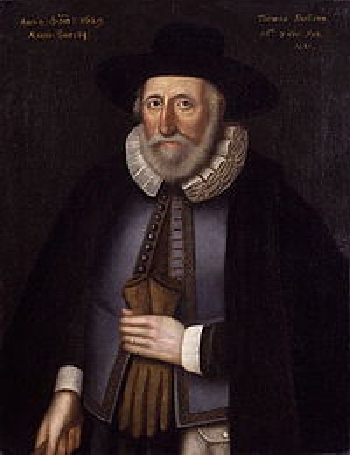
The phrase Hobson's Choice, named for 16th century English stable owner Thomas Hobson, is often used to describe a no-win situation. In checkers, that would occur when any move available would be bad; in other words, a player would be left to choose only among various losing options.
That usage, though frequently employed, is incorrect, as Hobson's Choice really means "take it or leave it"; you have but one option and there really is no choice except that of refusal. (Mr. Hobson reputedly offered his customers a choice of but one horse, which was no choice at all.) In checkers, however, you've got to make a move, so the phrase Hobson's Choice doesn't seem to apply.
We think, in the position below, as published by Ben Boland in Familiar Themes in the Scientific Game of Checkers, the author meant to use the term dilemma, which accurately refers to a choice among undesirable alternatives. Contrast this with Morton's Fork, which is a choice among equal or equivalent alternatives.
Confusing? Perhaps simply looking at the diagram is the best option.
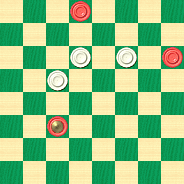
WHITE
White to Play and Draw
W:W14,11,10:BK22,12,2.
White indeed seems to face a dilemma; he's going to lose a man no matter what choices he makes. But a draw is still possible with perceptive play; can you find it?
Of course, for you, the reader, the choice is certainly Hobson's; you can choose to solve the problem, or just leave it! We do hope, though, that you'll try it, and then click on Read More to verify your solution.
You can email the Webmaster with your comments on this article.
Famous Shots III

Public Domain Pictures
Checker School today brings us the third in our series of famous shots, taken from Ben Boland's Famous Positions in the Game of Checkers. As is the case with the other entries in this series, experienced players should recognize it by sight, while less experienced players would do well to learn the position.
Here's this week's run-up:
11-15 23-19 8-11 22-17 4-8 17-13 15-18 24-20 11-15 28-24 8-11 26-23 9-14 31-26 6-9 13x6 2x9 26-22 9-13---A
A---Loses. 3-8 or 1-6 would be correct. White to play and win.
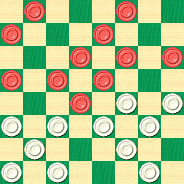
WHITE
White to Play and Win
W:W32,30,29,27,25,24,23,22,21,20,19:B18,15,14,13,12,11,10,7,5,3,1.
We're not sure which looks more interesting: the checker position or the attractive concoction shown in the photo at the top. Right now, though, let's go for the checker position. Find the solution, name the shot (both of them!), and then click on Read More to see the solution.
You can email the Webmaster with your comments on this article.
The Holidays Sped By
The holidays have sped by as they always do; there's the long run-up, a week or so of family fun and frolics, and then--- it's over, and we face that winter letdown and months of solid, virtually uninterrupted work, school, or what-have-you.
Fortunately, there's a bright spot for readers of The Checker Maven. For some little while, the father and son team of Lloyd and Josh Gordon, of Toronto, Ontario, Canada, have been replenishing our stock of speed problems, with positions from their own games and of their own design. We're presenting the first of these today.
Photo by Mrs. Lloyd Gordon
Josh and Lloyd generally assemble problem positions that vary from easy to medium in difficulty, making them perfect for speed problems. This month we'll start with an easy one. You won't have a lot of trouble solving it, and it's quite clever and pleasing. Ten seconds will be plenty of time, we think, although perhaps you may disagree!
When you're ready, click on the link below to show the problem and start the clock. Then come back here and click on Read More to verify your solution.
January 2014 Speed Problem Easy; 10 seconds
Thank you, Josh and Lloyd, for sending these problems, and we hope that the rest of your Eastern Ontario winter won't be too tough.
You can email the Webmaster with your comments on this article.
Problem Composition Contest 14 Completed

Public Domain
Bill Salot's outstanding series of checker problem composing contests continues to thrive, attracting talented problem setters from around the world. Contest 14 has just concluded, and the winner is from the Netherlands. Check it all out by clicking on the Compositions link in the left-hand column.
You can email the Webmaster with your comments on this article.
New Year's Edition 2014

There are just a couple of days left in 2013 and then 2014 will be upon us. The years pass by; it seems like we've hardly turned the clock on 2000 and now Y2K is almost ancient history! In any event, The Checker Maven hopes that 2013 was a good year for you and yours, and that 2014 will bring every good thing you might wish for.
To celebrate the coming New Year, how about an A. J. Heffner problem from way, way before Y2K? This one is close to 100 years old but it's never lost its practical appeal. Willie Ryan says he's seen it come up in play more than once ... and doubtless it's occurred many times since.
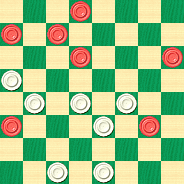
WHITE
White to Play and Win
W:W31,30,23,19,18,17,13:B24,21,12,10,6,5,2.
What's up here? Black is going to get a king and there's nothing White can do about it, although White can get one of his own if he wishes. Where's the White win, though? Can you find it?
The problem isn't particularly easy, and the solution is fairly long, but hey, you've got the rest of the year to solve it! When you've figured it out, click on Read More to see the solution.
You can email the Webmaster with your comments on this article.
Happy Holidays 2013
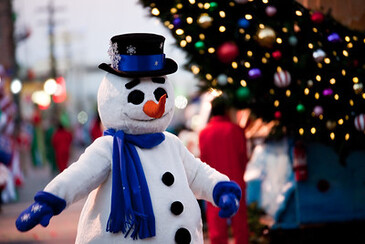
It's the holidays once again, and The Checker Maven offers best wishes for a wonderful season to you and yours.
At this festive time, the checkerboard often gets set aside as we all become busy indeed, perhaps more so than we ought. So we invite you to take a step back and relax with an entertaining checker problem. It's one that you can easily share with relatives and friends as a sort of mini holiday present, a nowadays all-too rare gift of time and attention.

The problem comes from our old friend Willie Ryan, who calls it a simple problem and yet in the class of gems, because it comes up often in practical play and many times is missed over the board.
Here's the situation.
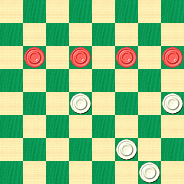
WHITE
White to Play and Draw
W:W32,27,20,18:B12,11,10,9.
Forces are even at four men each, but White is obviously cramped, and in checkers, mobility is key. How can White save the game?
Follow the path we proposed at Thanksgiving this year. Reward yourself and friends and family for tackling the problem with an extra slice of holiday pie.
You can email the Webmaster with your comments on this article.
Famous Shots II

This month's Checker School column continues to feature famous shots. As we did last time, we ask you to not only solve the problem (figure out the shot) but also to identify the shot by name. These shots should be known by experienced players, and learned by aspiring ones.

BLACK
Black to Play and Win.
B:W32,31,30,28,26,24,23,22,21,20,18:B16,15,11,9,8,7,6,5,3,2,1.
Do you know your shots? Try this one out and then click on Read More for the answers.
You can email the Webmaster with your comments on this article.
The Checker Maven is produced at editorial offices in Honolulu, Hawai`i, as a completely non-commercial public service from which no income is obtained or sought. Original material is Copyright © 2004-2026 Avi Gobbler Publishing. Other material is public domain, AI generated, as attributed, or licensed under CC1, CC2, CC3 or CC4 and the various CC options. Information presented on this site is offered as-is, at no cost, and bears no express or implied warranty as to accuracy or usability. You agree that you use such information entirely at your own risk. No liabilities of any kind under any legal theory whatsoever are accepted. The Checker Maven is dedicated to the memory of Mr. Bob Newell, Sr.