The Checker Maven
The World's Most Widely Read Checkers and Draughts Publication
Bob Newell, Editor-in-Chief
Published every Saturday morning in Honolulu, Hawai`i
Noticing missing images? An explanation is here.
Capers on the Kelso - Part 1
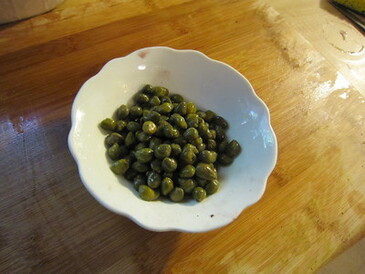
Capers are the berry of the bush known as Capparis Spinosa; they're used extensively in Mediterranean cuisine, though they can be found elsewhere in the world, including Australia and various Pacific islands.
Of course, the word capers is used in several other ways, and it's the meaning that refers to antics which gives rise to our title.
Today we start a multi-part article taken from the Capers on the Kelso entry in Willie Ryan's famed Tricks Traps & Shots of the Checkerboard. Mr. Ryan will show us quite a number of interesting situations that occur in this classic opening. Without further ado, here's Willie.
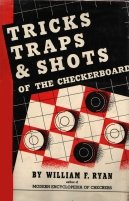
"I have always been of the opinion that the only effective way to teach scientific checkers is to take games actually played by expert performers, and to annotate them, step by step, explaining the strategic and objective points of the play. As a sample lesson in detailed dissection of scientific play, I am presenting a game I contested with Andrew J. Banks, of Washington, D. C., when I put on a simultaneous exhibition in the Capital City a few years ago.
| Andrew J. Banks---White | Wm. F. Ryan---Black |
| 10-15 | 17-13 | 15-18---L | 24-8 | 17-26 |
| 22-18 | 9-14 | 26-23 | 3-12 | 30-7 |
| 15-22 | 29-25 | 14-17---M | 28-24 | 2-11 |
| 25-18 | 6-10---C | 23-14 | 7-11 | 27-24; |
| 11-15---A,1 | 24-20---D | 17-21---O | 24-19---P | drawn. |
| 18-11 | 1-6---E | 32-28 | 6-10 | |
| 8-15 | 28-24 | 10-17 | 19-16 | |
| 21-17---B | 8-11---J | 19-16 | 12-19 | |
| 4-8 | 23-19---K,2 | 12-19 | 25-22 | |
Editor's Note: Variations 1 and 2 will be presented in future columns.
A---For play on the alternative defense by 6-10, see Variation 1.
B---The favorite reply to 11-15, although 29-25 and 24-19 are also acceptable moves.
C---In a Southern State Championship Tourney, Florida Champion Earl Ingram tried 7-10 here against Basil Case, and almost won. After 7-10, the game continued 24-20, 2-7, 25-21 (to dodge the dyke by 15-19 if 27-24 or 28-24 is played), 8-11, 28-24, and reached the position discussed in Note E.
D---Much stronger than 23-19, 8-11, 27-23,15-18,19-15,18-27, 15-8, 12-16, 32-23, 8-12, 24-20, 10-15, 20-11, 7-16, 23-19, 15-24, 28-19, 16-23, 26-19, at which point 2-7 creates an easy draw; but I have won often against 5-9, 13-6, 1-10, then 25-22, 2-7, 31-27, 7-11, 30-25*, 11-15, 27-24, 14-18, 24-20; white wins.
E---If the play goes 2-6, then proceed with: 25-21, 8-11, and we arrive at the position (discussed in Note C) reached in the game between Ingram and Case, although in that game the position developed from a different order of moves. After 2-6, 25-21, 8-11, the Ingram-Case game proceeded: 28-24, 14-17, 21-14, 10-17, 32-28---F, 6-10, 23-19,1-6, 27-23, 5-9, 19-16---G, 12-19, 23-16, 9-14, 26-23, 17-22---H, 23-19, 15-18, 16-12,11-15, 20-16,14-17, 24-20, 15-24, 28-19, 17-21, 30-26, 21-25, 26-17, 25-30, 19-15, 10-19, 16-11,7-16, 20-11, 18-23, 17-14, ending in a draw.
F---Something new. Here is how James P. Reed played the white pieces against Wm. Beattie, many years ago: 23-19, 15-18, 32-28,
17-22, 26-17, 11-15, 19-10, 7-21, 31-26, 5-9, 20-16, 12-19, 24-15, 9-14, 15-11, 14-17, 26-23, 18-22, 23-19, 22-25, 27-23, 25-29, 23-18, 3-7, 11-2, 1-5, to a draw.
G---Apparently all that white has left. If 26-22 is used, then 17-26, 31-22, 9-14, 23-18, 14-23, 22-17, 12-16, 19-12, 23-27,
30-25, 27-31, 25-21, will leave black with a promising ending.
H---When the Ingram-Case game first came to my attention I went over it very carefully (so I thought), announcing that Mr. Ingram could have won here by this play: 15-18, 24-19---I, 18-27, 31-24, 17-22, 16-12, 11-15, 19-16, 22-26, 30-23, 15-19, etc. Wm. F. Ryan.
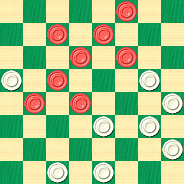
I---But Mr. Case popped up and saved his reputation by demonstrating the following remarkable draw (See diagram.)
WHITE
White to Play and Draw
W:W31,30,28,24,23,20,16,13:B18,17,14,11,10,7,6,3.
J---A very weak move. Remember, this was an exhibition game! The time to impose hardships on yourself and the time to improve your game is when it won't count against you. In other words, when you play for fun, any line of play will do for a test. When you play an important match, that is the time to play your best. Many players will never reach the top because they make no effort to broaden their concept of formations and structures. Their knowledge is restricted to the conventional processes of book play. To be a real headliner, you must cultivate an appetite to defend as well as to attack any critical position with equal zeal. Of course, the double trade by 15-19 at J gives black an easy game, but I was inviting originality by 8-11, and got it!
K---The situation at this point has been faced by all the checker greats of the past. Mr. Banks' 23-19 appears to be an innovation, but it was probably shunned by the early masters because of its mediocrity. Variation 2 shows some fine play on 32-28 here, which no student of the game can afford to disregard.
L---At the time this game was played, I had the idea 14-18 would lose for black if it was met with 25-21. Hence I moved 15-18. On later examination, I discovered that it would lead to a draw with the following play: 14-18, 25-21, 5-9, 26-23, 18-22, 21-17, 22-25*, 30-21, 9-14, 32-28, 14-18, 23-14, 11-16, 20-11, 7-32. Wm. F. Ryan. A progressive student always spends more time reviewing the games he has played, in search of improvements or errors, than in playing new games.
M---In a formation of this kind it is usually fatal for black to "pack" the structure by 11-15, particularly when there is no piece on square 5. The "slip" theme by 14-17, as employed here, is generally applicable for a draw when there are no opposing pieces on squares 26 and 29. Reverting to M again, the fill-in via 11-15 will produce a draw in this case: 11-15, 20-16---N, 14-17*, 23-14, 6-9, 13-6, 2-18, 24-20, 15-24, 16-11, 7-16, 20-11, 17-22, 27-20, 22-29, 11-7, 10-14, 7-2, 5-9, 2-6, 9-13, etc.
N---If 30-26 is used, proceed with: 14-17, 23-14, 6-9, etc.; if 32-28 is played, black will win with: 14-17, 23-14, 17-22!, 25-11, 7-32, 14-7, 2-11; if 31-26 is moved, the draw is established with: 6-9, 13-6, 2-9, 32-28, 14-17, 23-14, 9-18, 25-22*, 18-25, 30-14, 10-17, 19-10, 7-14, 20-16. Wm. F. Ryan.
O---This was my first and only bad move. I should have played 6-9, 13-6, 2-18, 31-26, 11-15*, 25-22*, making the draw shown in Note N."
Note P and subsequent commentary will presented in the next column in this series---Ed.
Can you solve the problem diagrammed above, at Note I? Don't beat around the bush; it's an interesting caper, so do your berry best and then click on Read More to see the solution.
You can email the Webmaster with your comments on this article.
The Fastest Ever
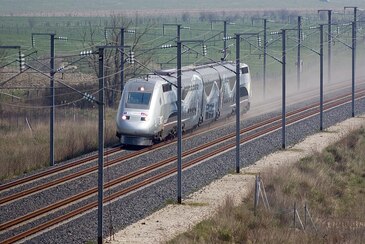
Just amazing. This train is going at about 357 miles per hour, setting a record for the fastest ever. It's the French Train Grande Vitesse and it's a marvel of rail technology.
This month's speed problem is also the fastest ever; though very easy and far from a checker marvel, it's a test of checker intuition. The trick will be to spot the solution within the allowed time limit. This is a "solve at a glance" problem for a player with even moderate experience.
But if you're a newcomer to our game of checkers, you may take a little longer to see how it's done. That's fine, too; it's the process of looking for a solution that's important.
Here we go: click below and think fast! Then come back and click on Read More to see the easy answer to our "fastest" ever speed problem.
October Speed Problem (Very easy; 5 seconds)
You can email the Webmaster with your comments on this article.
A Familiar Position
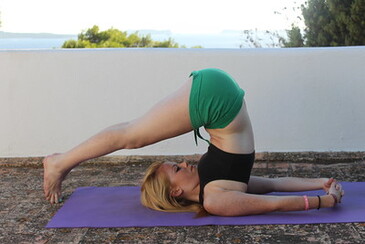
The yoga position shown above, we must opine, looks like rather a difficult one, yet the person in the photo seems to have taken it on quite willingly.
In checkers, difficult positions are generally avoided rather than sought. In the diagram below, Black is definitely in such a situation, and may have to go through contortions to find the way to a draw. But, like the yoga position, there is a way to do it.
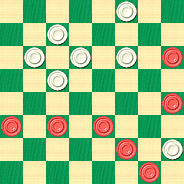
BLACK
Black to Play and Draw
B:W30,27,24,23,22,19,5:B21,13,12,11,10,6,1.
Can you make the necessary twists and turns? If you're a knowledgeable "book" player, the position may indeed look familiar, and you'll likely know how to do it. If it's not familiar to you (yet), it is a good one to learn, so either way, give it a try. If you find yourself in knots, you can always click on Read More to see the run-up, solution, and notes. While you're at it, just for a little additional fun, you might also try to name the yoga position in the photo.
You can email the Webmaster with your comments on this article.
The Fugitive Companion

It looks like these fugitive companions didn't get very far. They're all on their way back to the big house, and they'll probably stay there for a long time.
Today's Checker School column features a pair of related problems, neither of them especially easy, but as usual, quite instructive. You'll see where the title comes from when you work them through.
F. DUNNE
WHITE
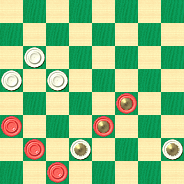
BLACK
Black to Play, White Draws
B:W24,20,19,K7,K5:BK14,12,K10,8,3.
Diagram Two
McKEAN - WARDROP
WHITE
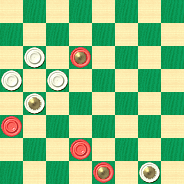
BLACK
Black to Play and Win
B:W24,20,19,K16,K1:BK23,12,7,K2.
Can you solve these problems, or will you just flee, with or without a companion? While not easy, they may not be as hard as you might think at first glance. Recapture your solutions and then click on Read More to see a sample game and the solved problems with detailed notes.
You can email the Webmaster with your comments on this article.
Checker Poetry
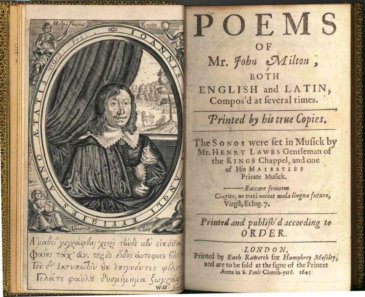
Public Domain
The Checker Maven has, we believe, has written and published more original checker fiction than anyone else has ever done. But we've produced very little checker poetry.
Checker poetry used to grace checker books and checker columns, and some of it was very good indeed. The poems often cleverly incorporated problem situations in their verses.
The poem below, kindly provided by Liam Stephens and John Reade, and originally penned by one William Brogan, has been edited slightly to remove an inappropriate ethnic reference and to correct an obvious printer's error.
by Wm. Brogan
There used to live a player
In the town where I was born
Who studied checkers late at night
And early every morn.
This chap was never known
To do a tap of work,
And the neighbours all described him
As a useless lazy jerk.
But opportunity they say
Knocks once at every door.
And Jake was soon to have a chance
To put some gold in store.
A stranger with great riches
Came to this little town,
And he claimed to be a player
Of considerable renown.
He had a roll of greenbacks
That looked like a load of hay,
Said he “This roll I’ll gamble
‘Gainst Jake if he will play.”
Then the town folks they got busy
And they mortgaged home and land,
And they covered every dollar
That the stranger had in hand.
Then the old town hall was hired,
And they called on Lazy Jake.
Saying “ Come and beat the stranger
And we’ll give you half the stake.”
The mayor of the little town
Declared a holiday,
So all the interested ones
Could come and see the play.
The game was quickly started,
Deep silence ruled the place,
And a look of stern defiance
Hovered o’er each player’s face.
The stranger moved quite rapidly
As though he knew his stuff,
While Jake was playing slowly
For he found the going tough.
The following position
Came up and all was done.
So if you are a checkerist
Then show how Jake has won.
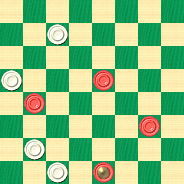
WHITE (Jake)
White to Play and Win
W:W30,25,13,6:BK31,24,17,15.
(Originally published in Wood’s Checker Player, Vol 6, No 3, October 1942.)
And two points White will score
So when you are all finished
Below click on Read More.
You can email the Webmaster with your comments on this article.
Clapham Common Draughts Club
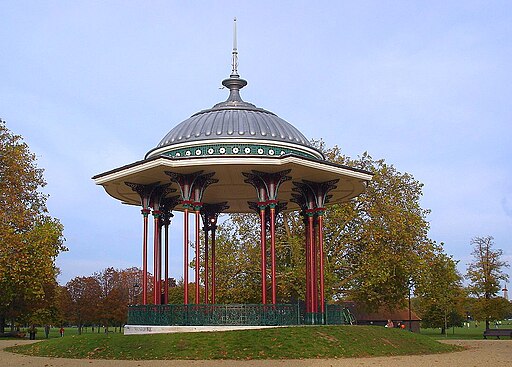
Ptamb CC0
Clapham Common is part of the Clapham area of south London, but more importantly, at least to us, is that it was the home of the Clapham Common Draughts Club.
While an inquiry to the community booster group called "Love Clapham" went unanswered, former member David Harwood informed us that the club used to meet near Clapham Common's famed bandstand (shown above in its original form in the late 19th century). As far as Mr. Harwood knows, the club hasn't met in at least 20 years, and most of its members have regrettably passed on.
The club, though, will be remembered forever in all of checkerdom for The Clapham Common Draughts Book, a tutorial for beginners through intermediates that focuses on tactics and tactical themes. As with Reisman's Checkers Made Easy, diligent study of this book can't help but significantly improve your play.
The book was written by one G. E. Trott in 1947, but wasn't published until years later. Sometime in the 1960s, it was serialized and (we presume) printed in a newpaper. A little later on the Club published it in booklet form.
Today, we're pleased to offer a newly typeset electronic edition, designed and edited by Mel Tungate. It features clear color diagrams, an easy to read typeface, and Mel's additional notes and commentary. It's a really fine effort and The Checker Maven thanks Mel for putting this together. You can download it here or from a soon-to-appear link in the right-hand column.
Naturally, this week's problem is taken from the book, and it's a nice one. We'd say it's at an approximate intermediate level of difficulty.
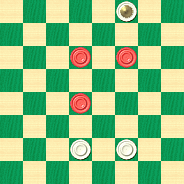
WHITE
White to Play, What Result?
W:WK3,26,27:B10,11,18.
We'll give you a tip: In many of the situations in the book, the obvious move is not necessarily the correct move.
When you've come up with your solution, "Trott" your mouse to Read More to verify your line of play.
You can email the Webmaster with your comments on this article.
Labor Day 2014

Public Domain Pictures CC0
Labor Day 2014 will be on Monday, September 1, and each year The Checker Maven takes the opportunity to join in honoring American workers, the men and women who work hard day in and day out to make America the great nation that it is. Whether you're a business executive, police officer, gardener, nurse, construction worker, or belong to any of the thousands of other occupations that make up the American workforce, you're worthy of our salute. In America, all honest work is respected, and rightly so.
Checkers was once the mind sport of the working class and many of the great masters were American workers. One of them was steelworker Asa Long, and today we present a position taken from one of his games.
| 1. | 11-15 | 23-19 |
| 2. | 9-14 | 22-17 |
| 3. | 7-11 |
Forms the Whiltier opening.
| 3. | ... | 25-22 |
| 4. | 11-16 | 26-23 |
| 5. | 5-9 | 17-13 |
| 6. | 3-7 | 29-25 |
| 7. | 7-11 | 24-20 |
| 8. | 15-24 | 28-19 |
| 9. | 11-15 | 20-11 |
| 10. | 15-24 | 27-20 |
| 11. | 8-15 | 30-26 |
| 12. | 4-8 | 20-16 |
Book play up to here, where the KingsRow engine now gives 31-27 instead.
| 13. | 12-19 | 23-16 |
| 14. | 8-11 | 16-7 |
| 15. | 2-11 | 26-23 |
| 16. | 11-16 | 31-26 |
| 17. | 15-18 | 22-15 |
| 18. | 10-19 | 25-22 |
| 19. | 1-5 | 22-17 |
| 20. | 14-18 | 23-14 |
| 21. | 9-18 | 17-14 |
| 22. | 16-20 |
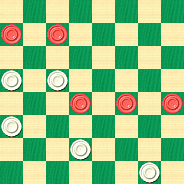
WHITE
White to Play and Draw
W:W32,26,21,14,13:B20,19,18,6,5.
You definitely have your work cut out for you in this one. Can you labor hard enough to find the White draw? When you've completed the job, clock out by clicking on Read More to see the solution.
You can email the Webmaster with your comments on this article.
Busb(o)y
Pexels CC0
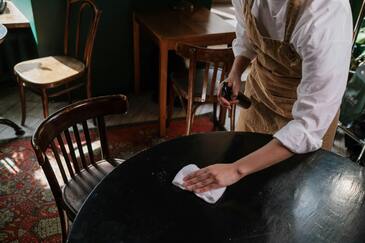
The occupation of busboy is often regarded as a humble one, but The Checker Maven respects work and ambition in every form, and we'll wager that many a successful person once did this or a similar job. Everyone has to start somewhere, and they deserve credit for being willing to take on such a job as they work their way up. The next time you go out to a restaurant or cafe, give the busboy a smile and a kind word.
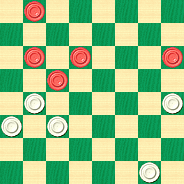
We don't know if the author of today's Checker School offering, J. S. Busby, was himself ever a busboy, though he might have been, nor do we know if the busboy in the photo is himself a checker player, though he might be. In any event, the following study is both interesting and practical. It's taken from Ben Boland's Famous Positions in the Game of Checkers.
BLACK
WHITE
White to Play and Win
W:W32,22,21,20,17:B14,12,10,9,1.
We'd rate this one as difficult, and there are a couple of star moves for White, but you can solve if you try. See if you can carry it away, and then dish your mouse onto Read More to see the solution, detailed notes, and no less than four sample games.
You can email the Webmaster with your comments on this article.
A Bristol Broadside, Part 4
You've surely heard the expression, "Can't hit the broad side of a barn," and it's apt for the play on today's theme, as various erroneous moves cause the balance of the game to change often. It seems as if the players couldn't hit the broad side of the checkerboard, so to speak.
It all takes place in this, the fourth and final part of A Bristol Broadside, as found in Willie Ryan's incomparable study, Tricks Traps & Shots of the Checkerboard.
Here's the run-up to this variant.
| 1. | 11-16 | 24-20 |
| 2. | 16-19 | 23-16 |
| 3. | 12-19 | 22-18 |
| 4. | 10-14 | 18-15 |
| 5. | 7-10 | 20-16 |
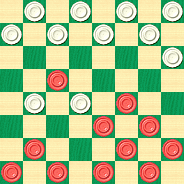
BLACK
Black to Play
B:W32,31,30,29,28,27,26,25,21,16,15:B19,14,10,9,8,6,5,4,3,2,1.
From this point, Willie looks at the move 9-13. But we're going to present things a little differently today. Here's the actual play for the next couple of moves:
| 6. | 9-13 | 16-12 |
| 7. | 5-9 | 27-23 |
From here, Black should win. But the challenge for you, our reader, is not just to find the Black win, but to critique the line of play given just above, starting with 9-13.
Willie had his own ideas, and they were mostly right. The KingsRow computer engine, as usual, has its ideas, and they diverge from Willie's at various points.
What are your ideas? Can you hit the broad side of the checkerboard? Take your time here; this is most definitely not an easy setting. When you've completed your analysis, click on Read More to see some detailed analysis.
You can email the Webmaster with your comments on this article.
Kingless

England was kingless (and queenless, for that matter) for a few brief periods in a history of otherwise unbroken monarchy. One of those times was during the rule of Oliver Cromwell, who took the title of Protector.
Bill Salot has given a new meaning to "kingless" in his latest checker problem composition contest, in which all problems are to consist of single men only; no kings are allowed. We doubt that Mr. Salot has ambitions to be another Cromwell; his fame as a promoter of modern-day problem composition is already assured.
You won't want to miss the entries in this contest; you can see them here. Be sure to try them out and vote for your favorite.
You can email the Webmaster with your comments on this article.
The Checker Maven is produced at editorial offices in Honolulu, Hawai`i, as a completely non-commercial public service from which no income is obtained or sought. Original material is Copyright © 2004-2026 Avi Gobbler Publishing. Other material is public domain, AI generated, as attributed, or licensed under CC1, CC2, CC3 or CC4 and the various CC options. Information presented on this site is offered as-is, at no cost, and bears no express or implied warranty as to accuracy or usability. You agree that you use such information entirely at your own risk. No liabilities of any kind under any legal theory whatsoever are accepted. The Checker Maven is dedicated to the memory of Mr. Bob Newell, Sr.