The Checker Maven
The World's Most Widely Read Checkers and Draughts Publication
Bob Newell, Editor-in-Chief
Published every Saturday morning in Honolulu, Hawai`i
Taking On The Champ, Part 2
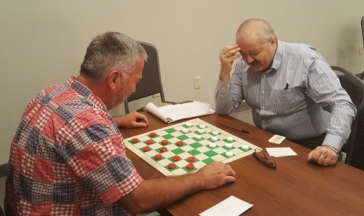
Last month we presented the first game of Watson's exciting match against Alex Moiseyev, which ended in a draw. This month we'll look at the second game of the round. Will Alex come roaring back?
Watson says: "This game I took the white. I actually like the white side in this opening. We began the game. No unexpected moves. Again, I felt good about the game."
| 1. | 11-15 | 24-19 |
| 2. | 15x24 | 28x19 |
| 3. | 8-11 | 22-18 |
| 4. | 10-14 | 25-22 |
| 5. | 11-16 | 29-25 |
22-17 or 27-24 should be played here instead.
| 6. | 6-10 |
Loses the advantage; 16-20 would have retained it.
| 6. | ... | 27-24 |
Watson thinks this is a key moment: " ... the turning point in this game came at move 12 (27-24). This set up was what my Dad used to play all the time against me. He liked it. I never thought much about it. However, when this move came up, I was thinking my Dad was watching. I could almost hear him saying, 'Move there, Watty.'"
| 7. | 1-6 | 31-27 |
32-28 is considerably better.
| 8. | 16-20 |
7-11 was better. The game is now back in the KingsRow opening book.
| 8. | ... | 32-28 |
| 9. | 4-8 | 19-15 |
Watson now thinks the game is decided: "The next move to change the game in my opinion was 19-15 exchange. To me, this was the winning move. He never recovered."
| 10. | 10x19 | 24x15 |
| 11. | 9-13 | 18x9 |
| 12. | 5x14 | 22-18 |
| 13. | 6-9 | 15-10 |
| 14. | 8-11 |
May lose; 12-16 was correct. But let's let Watson describe what happened:
"The next key move, in my opinion, was 15-10 ... By this time, Alex was in serious trouble ... I did not see a single good move for Alex. I saw my win. I was happy. I think Alex saw no way out.
| 14. | ... | 28-24 |
| 15. | 11-16 |
11-15 was a little better.
| 15. | ... | 24-19 |
"I do not know why, but it seemed like someone was nudging me. The voice was saying 'offer the draw.' I was thinking the game is almost over. I have it ... But I kept thinking I needed to offer (the) draw. I cannot fully explain why I offered the draw except to say at that point, I was very happy to get a draw against the World Champion. I knew three things. It had been a long day and I was tired. I knew that Frank and Mary (the hosts) had been very patiently waiting for us to finish. I knew I had a 700 mile trip ahead of me that day ... So I said to Alex, 'Would you like the draw?' Alex looked up at me, surprised. Alex could see it was over. He smiled and said, 'Yes, I would. Thank you.' We shook hands and that was it. It was a very good feeling for me."
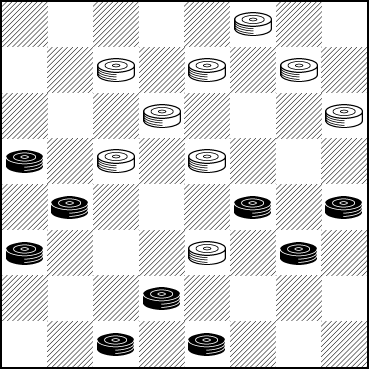
BLACK
Black to Play; What Result?
B:W30,27,26,25,23,21,19,18,10:B20,16,14,13,12,9,7,3,2.
What do you think? Should Watson have taken the draw, or is there a White win? What is Black's best continuation? Is there a way for White to go wrong and allow a Black win?
Take on both Watson and Alex and see what you can come up with, then click on Read More to see what might have happened had the game gone on. And be sure to read Watson's full story here.
You can email the Webmaster with your comments on this article.
A Couple of Surprises

Pexels CC0
Surprise! Some surprises are good, some others are not, but in today's Checker School entry, we think you'll find a nice surprise ... two of them, in fact.
BLACK
WHITE
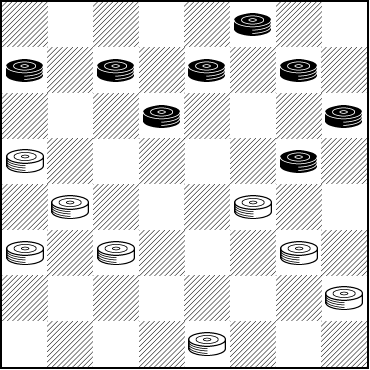
White to Play and Draw
W:W31,28,24,22,21,19,17,13:B16,12,10,8,7,6,5,3.
We found this study very interesting in that the game is played quite flawlessly on both sides, yet White ends up with a draw that could prove difficult to find over the board, requiring two "surprises."
Will you find the solution or just be surprised? Either way, it's no surprise that clicking on Read More will show you the solution, a sample game, and some explanatory notes.
You can email the Webmaster with your comments on this article.
A Trap With a Tale, Part 3: An Easy Tale
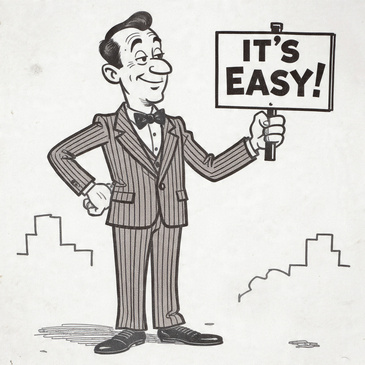
"It's easy when you know how" could also be the theme of today's little study, but we think the deeper truth is found in another adage: When someone makes something look easy it's because they've worked hard.
We're continuing with one of the final chapters of Willie Ryan's Tricks Traps and Shots of the Checkerboard with a problem that's easier than usual, "An Easy Tale" if you wish; at least, it's easy if you've worked hard enough at your visualization skills.
Let's begin with a run-up that we've already seen a couple of times, so no further commentary is required.
| 1. | 11-16 | 24-19 |
| 2. | 8-11 | 22-18 |
| 3. | 16-20 | 25-22 |
| 4. | 9-13 | 29-25 |
| 5. | 11-15 | 18-11 |
| 6. | 7-16 | 22-18 |
| 7. | 20-24 | 27x11 |
| 8. | 10-15 | 19x10 |
| 9. | 6x29 | 28-24 |
| 10. | 29-25 | 32-27 |
| 11. | 1-6 | 24-19 |
Recall that Willie said this move draws, but last time we showed that if Black plays the odd-looking 25-29, Black would have actually won. However Willie gave this as the next move:
| 12. | 6-9 |
which only draws (even if the White draw is very narrow). We'll follow that path further next time, rather than stopping here with "White to Play and Draw." Instead, we'd like to look at what happens if White makes this seemingly feasible move:
| 12. | ... | 23-18 |
resulting in the position below.
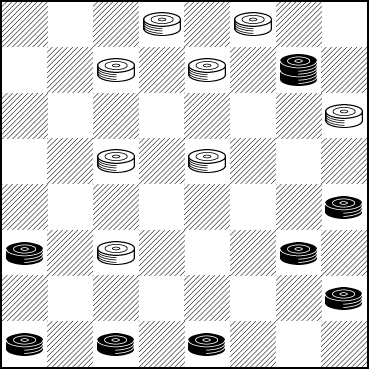
BLACK
Black to Play, What Result?
B:W31,30,27,26,21,19,18,11:BK25,13,12,9,5,4,3,2.
We're pretty sure you know what the outcome will be, but can you show it? It truly isn't all that difficult, but it's definitely a lot of fun. Tell the tale and then click on Read More to verify your solution.
You can email the Webmaster with your comments on this article.
Medium Problem
No, we don't mean that kind of "medium" and we don't expect you to divine the solution to today's checker problem; rather, we consider it "medium" in difficulty. It's a nice setting sent to us by Toronto's intrepid checkerists, Lloyd and Josh Gordon.
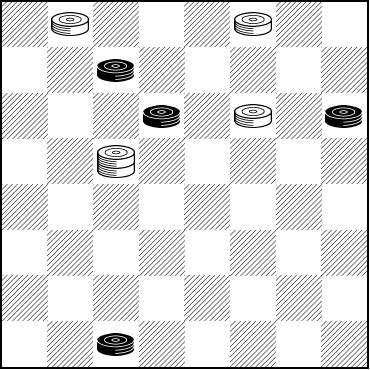
BLACK
Black to Play and Draw
B:W32,30,22,K19:B27,23,21,3.
The stars tell us you'll be able to solve this one, as long as you keep your thinking channels open. It won't take a seance, though, to check your solution; all you need do is wave your mouse on Read More to see how it's done.
You can email the Webmaster with your comments on this article.
Increased Hosting Costs for Checker Maven
When we launched The Checker Maven years back, web hosting costs were a lot lower. But with the passage of time, costs have risen and now our web hosting alone runs well above $200 a year, and we haven't even begun to tally other costs, nor do we wish to.
The Checker Maven is free, and free from outside advertising, and always will be. We will never charge for our content and we will never accept advertising from anyone. Period.
However, we still (and always) will never accept advertising or seek revenue from the site. And we are not considering a change in our policy on accepting donations. We won't accept them even if offered; while we would appreciate the thought, the site will remain free for everyone and will not establish classes of users based on donations.
Thank you for being a reader of The Checker Maven and for your understanding.
You can email the Webmaster with your comments on this article.
Taking On The Champ, Part 1
Suppose you're a Master level checker player. You're at a tournament and suddenly you find yourself matched with someone who held the World Championship for many years. An intimidating prospect? Certainly you're good, but this guy is good.
Now, imagine instead that you're in the Minor category? You're still in all likelihood a pretty good player, but ... two games against Alex Moiseyev?
Would your instinct be to make a hasty exit from the tournament room, maybe even to catch the next flight to some remote location? Or would you stick it out, expecting to take your lumps and just hope you don't look too bad?
This was almost exactly the prospect faced by Watson Franks, who told us a story of courage and accomplishment from which we can all learn something. Watson didn't run; he sat down and played.
Watson sent us a very interesting and detailed account of his adventure, and while we can't run it all in our weekly columns, we'll put it online in its entirety at the conclusion of this two-part series.
How did this all come about? Watson tells us:
"This past October, 2016, my wife encouraged me to go to the Alabama State Tournament ... at the beginning of the tournament ... they decided they wanted to do a Round Robin ... The Master Players realized that in order to have a Round Robin Tournament, they would need to have eight players ... they only had seven signed up ... I volunteered to move up ... They were appreciative ... very few thought I would get a draw, much less a win against any of the master players."
But Watson did quite well in the early rounds, surprising everyone with his results, including, we believe, himself: he racked up six draws and six losses against six different Master players. (If you don't think that's fantastic, try getting even one draw against one of these champs.)
In the final round, though, he was inevitably matched with Alex Moiseyev. Did he panic?
Here's a little of Watson's narrative:
"Everyone knew I would play Alex the final round. I remember, one of the contestants told me in joking, 'If you were to beat Alex, that would be more of an upset than Trump beating Clinton.' I told him, 'Strange things can happen ... on any given checker board.'
"Alex and I sat on the far side of the room. There was no one around us. It was very quiet. Alex shuffled the 3-move opening cards. In my mind, I knew it would be a good opening. By good opening, I mean one that I was very familiar with. Sure enough, the opening was 11-15, 24-19, 15-24. A 'Go As You Please' opening!"
In the first game, Watson had Black and Alex had White.
| 1. | 11-15 | 24-19 |
| 2. | 15x24 | 28x19 |
| 3. | 8-11 | 22-18 |
| 4. | 9-14 | 18x9 |
| 5. | 5x14 | 26-22 |
| 6. | 11-15 | 22-18 |
| 7. | 15x24 | 18x9 |
| 8. | 6x13 | 27x20 |
| 9. | 4-8 | 25-22 |
| 10. | 8-11 | 30-26 |
| 11. | 2-6 | 31-27 |
End of KingsRow opening book.
| 12. | 11-15 | 23-18 |
May lose; 20-16 was correct.
| 13. | 15-19 | 18-14 |
| 14. | 10x17 | 21x14 |
| 15. | 19-24 | |
Gives away the advantage; 6-10 might likely win.
| 15. | ... | 27-23 |
| 16. | 24-27 | 20-16 |
14-9 would have been a sure draw.
| 17. | 12x19 | 23x16 |
The game was left here as a draw. Watson tells us:
"The game reached a turning point. I thought I had (a) decent position. I was pleased with my shape. I knew what my next move would be. It looked very good for me. He (Alex) looked at me and said, 'Would you like a draw?' I looked at the board for a bit. I said to him, 'If you think this is a draw, then it’s a draw. But I think I have very good shape.' He said, 'It looks drawish.' Of course, I could have kept playing if I had wanted to do so. It was my choice to accept (the) draw. I could have made a bad move and lost the game. But at the point of draw, I realize now that I had (a) winning position. I was very proud of that game."
So what do you think? Could Watson have won the game? What about his fear of possibly making a poor move and losing?
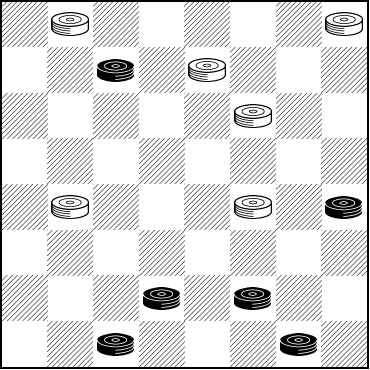
BLACK
Black to Play, What Result?
B:W32,29,26,22,16,14:B27,13,7,6,3,1.
Study the position, and when you're done, click on Read More for the answer to these intriguing questions.
You can email the Webmaster with your comments on this article.
Double Arrow

Onward and upward! Do these two arrows point the way to success? And will that success be on the checkerboard?
Today's Checker School entry, a position attributed to William Strickland, certainly looks like two arrows pointing upward -- from the Black side. (From the White side, the arrows point in a quite different direction.) Let's take a look.
WHITE

BLACK
Black to Play and Draw
B:W26,23,22,21,19,17,13:B14,12,10,9,6,2,1.
In the interest of fairness, we presume, the terms are Black to play and draw, and that would certainly be a success in such an awkward position. As for White, it's his game to win ... if he can.
Will your arrow hit the mark? Solve the problem and then shoot your mouse onto Read More to see the solution, explanatory notes, and seven--- yes, seven--- sample games.
You can email the Webmaster with your comments on this article.
Hard Fall Problem

The first day of fall is just a few days away at the time this column will be published, and it's time to get serious. All the students are back in school and all regular activities have likely resumed by now. With cold weather ahead, it's time to sharpen your checker skills to prepare for the busy checker season ahead.
Of course, The Checker Maven is always willing to help, so we've got a problem today that's somewhat tougher than last week's entry.

WHITE
White to Play and Win
:WK18,K17,14,6:BK27,K25,7,3.
Will you solve it or fall down on this one? You should be able to solve it, but you can always let your mouse fall on Read More to see the solution.
You can email the Webmaster with your comments on this article.
Easy Summer's End Problem

Pexels CC0
Fall in the Northern Hemisphere is not far off, and if you live in a so-called "temperate" climate zone, you're probably out enjoying the last of the warm weather. So today, we won't keep you from your outdoor pursuits for long; our problem definitely falls into the "easy" category, and you'll solve it in short order. The position was provided by regular contributors Josh and Lloyd Gordon of Toronto.

WHITE
White to Play and Win
W:W30,K27,20:B21,18,12.
You've probably already solved it, but just in case, ease your mouse on to Read More to easily check your solution.
You can email the Webmaster with your comments on this article.
Labor Day 2017

On every Labor Day holiday, we pay tribute to the common man and woman. Yes, we've said it before, but it's worth saying again: These are the people who, through honest hard work, make our nation what it is. Whatever you do, be proud of it and celebrate your contribution. We believe that all occupations are honorable, and that the farmer in the field and the laborer on the construction site can take pride of place right alongside the business executive and the real estate tycoon. We all have our job to do, and all of it is important.
Checkers is a great equalizer. Great players have come from humble origins. Over the board, it makes no difference if you're rich or poor, famous or unknown; only your skill and ability count for anything.
We don't know what your life's calling may be, but if you're here, you must be a checker fan, and today, as we recognize Labor Day together, we hope we've got something pleasing for you. Naturally, we've turned to that great problemist and American patriot, Tom Wiswell, with a composition he called "The Pocket."

BLACK
Black to Play and Draw
B:W25,19,K13:B23,11,9.
This is a very practical problem, showing a way to get a draw when things look rather difficult. Would you be able to find the draw over the board? Labor away at it--- checkers is an honorable pursuit if there ever was one--- and then work your mouse over to Read More to see the solution.
You can email the Webmaster with your comments on this article.
The Checker Maven is produced at editorial offices in Honolulu, Hawai`i, as a completely non-commercial public service from which no income is obtained or sought. Original material is Copyright © 2004-2026 Avi Gobbler Publishing. Other material is public domain, AI generated, as attributed, or licensed under CC1, CC2, CC3 or CC4 and the various CC options. Information presented on this site is offered as-is, at no cost, and bears no express or implied warranty as to accuracy or usability. You agree that you use such information entirely at your own risk. No liabilities of any kind under any legal theory whatsoever are accepted. The Checker Maven is dedicated to the memory of Mr. Bob Newell, Sr.