The Checker Maven
The World's Most Widely Read Checkers and Draughts Publication
Bob Newell, Editor-in-Chief
Published every Saturday morning in Honolulu, Hawai`i
Noticing missing images? An explanation is here.
How Fast Can You Win It?
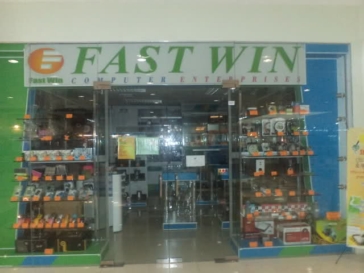
"Fast Win" is, it seems, a computer shop on the island of Cebu in the Philippines. We can't explain how the name came about, and frankly it would seem to apply more to checkers or some other game than to computers. We have seen so-called "fast win" computerized slot machines, but we suspect that the fast winner there would be the operating venue.
Now, every once in a while we publish an "oddball" problem. This one is original, although it is inspired by something published long ago. The idea is to find a "fast win."
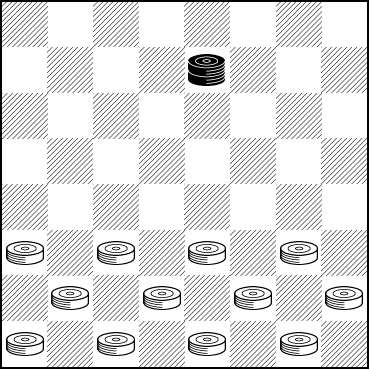
WHITE
White to Play and Win
W:W32,31,30,29,28,27,26,25,24,23,22,21:BK7.
Well, sure, it's completely obvious that White wins, but what's the fastest way to win, given an effort by Black to hold out as long as possible?
It's not all that difficult, and we'll give you a large hint: we found a 5-move win. Can you go us one better?
Give it a try, and see if you can either make Black hold out longer or White win more quickly. You can see our own solution by clicking on Read More.
Lucky 13

For reasons that we won't go into here, the number 13 is considered unlucky by some. Yet, for us, it's always been just the opposite, and in fact, this week The Checker Maven completes 13 years of uninterrupted, no-fail on-time weekly publication. It's a record we're proud of, and we hope to be able to carry on until our projected wrap-up at the 15 year mark.
To celebrate our 13th anniversary, we turn to Richard Fortman's Basic Checkers and explore one aspect of Ballot No. 13: 9-13 23-19 5-9. It's a reasonably balanced ballot, with maybe a little advantage to White.
| 1. | 9-13 | 23-19 |
| 2. | 5-9 | 27-23 |
(22-18 also a good choice instead of 27-23.)
Black is lucky; there are actually four moves to draw at this point. Mr. Fortman gives 11-15, which is arguably the best, but it isn't the only one. 9-14 or 11-16 or 10-14 instead of 11-15 also draw.
Fortman calls the first two probable White wins but they are all draws, though perhaps rather narrow ones.
For the purpose of today's study, let's consider 11-16 with the likely reply 22-18.
| 3. | 11-16 | 22-18 |
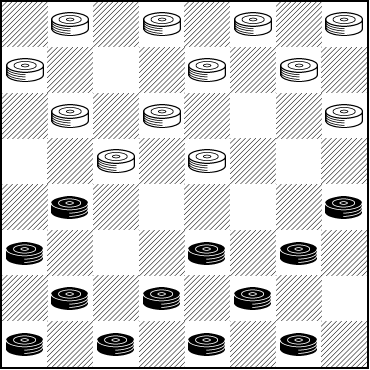
BLACK
Black to Play and Draw
B:W32,31,30,29,28,26,25,24,23,21,19,18:B16,13,12,10,9,8,7,6,4,3,2,1.
In the book, Mr. Fortman gives 16-20 as Black's next move. This gives White a substantial edge, and though we wouldn't yet call it a White win, Black is going to face a hard time.
What should Black play instead to ensure a draw? Can you sketch out a possible line of play?
We're asking you to match wits with one of the great checker analysts of all time. But it's a great exercise, and, luckily, clicking on Read More will show you the solution.
Thanksgiving Weekend 2017
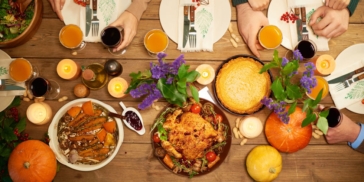
Every year we express our delight when our favorite family holiday, Thanksgiving, rolls around on the calendar. What's not to like? It's uniquely American in origin, it appeals to all faiths and creeds, and it's a great time to show our gratitude for the things we have in our lives, and there are more of those than you might think at first glance.
On special occasions we like to turn to Tom Wiswell. Today we present one of his traditional "coffee and cake" problems, developed years ago over that very same pair of treats with Milton Loew. Mr. Loew at the time was just 16 years old and already the U.S. Junior Champion. Here's the position, which came from one of Mr. Loew's tournament games.
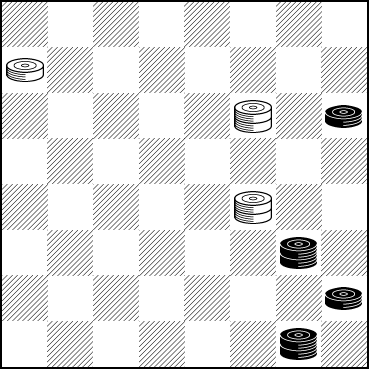
WHITE
White to Play and Draw
W:WK19,K11,5:BK32,28,K24,12.
White is a piece down and is under attack. But Black has some problems, too. Can you win "coffee and cake" from your checker friends with this one? It's not as hard as you may think. Give it a try, and be thankful that you can always click on Read More to see the solution.
Pretty as a Picture (Frame)
A pretty picture deserves a pretty frame. In our experience very often the frame, if it is one of quality, is more costly than the picture itself.
There's a picture frame in checkers, too, or more precisely, a picture frame position, and it's the subject of this month's Checker School column. Here's the pretty as a picture position.
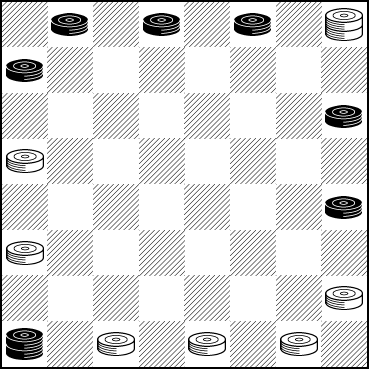
WHITE
White to Play and Draw
W:W32,31,30,28,21,13,K4:BK29,20,12,5,3,2,1.
As you'll see in the solution notes, it was once thought that this was a win for whoever played first, but actually, it's a draw either way. It's somewhat complex, and in fact we've corrected a couple of errors in Ben Boland's published solution. But, you get the picture.
In fact, we invite you to stay in the picture and try to solve the problem. And picture this: clicking on Read More will show you the solution, sample games, and comments and corrections.
Robertson's Tool
If you've ever lived in Canada, you'll know about the Robertson screwdriver, invented by Canadian P. L. Robertson around 1908. Robertson screws and screwdrivers supposedly have many practical advantages, though we won't go into them here.
Would P. L. Robertson be related to D. Robertson of Glasgow? Probably not, but if the Canadian Robertson was known for practicality in tools, Glasgow Robertson might equally be known for practicality in checker settings.
Consider the problem below.
WHITE
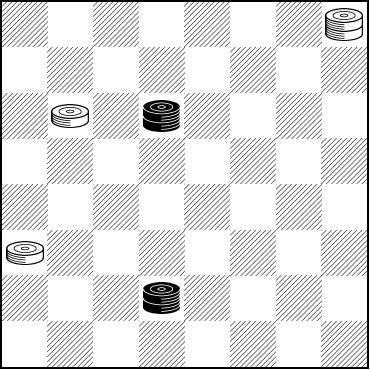
BLACK
Black to Move and Draw
B:WK29,24,12:BK23,K7.
This is, indeed, a practical situation; Black has two Kings but is down a piece. Pulling off a draw in this situation would be rather a success.
Can you do it? Keep your grip on your best checker tools, and give this one a turn or two. You can see the solution by applying your mouse to Read More.
Spectacular Finale
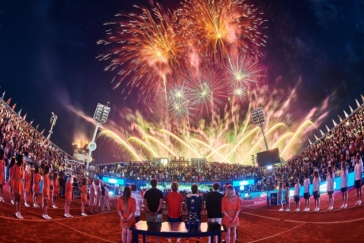
A spectacular finale: It's the goal of many a concert, show, or special event, and it sends everyone home just as pleased as might be, often with an unforgettable memory.
Does checkers offer the same level of excitement? Certainly! Today we bring you a problem that will make you sit up in your seat.
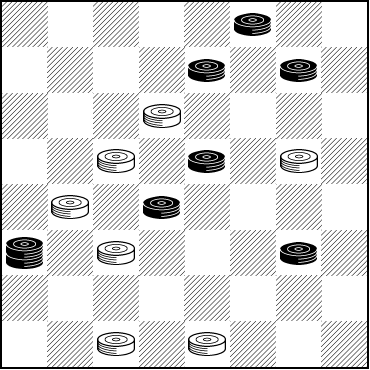
WHITE
White to Play and Win
W:W31,30,22,17,16,14,10:B24,K21,18,15,8,7,3.
This is a stroke problem that is supposed to an "easy" one, but we have our doubts about that unless your powers of visualization are very well developed. We'd call it at least "medium" in difficulty, but as a pleaser, it surely rates way up there.
Stroke problems may not be practical, but they are great fun, and they develop our ability to look ahead. Give this one a try and see if you aren't just a little taken in by the spectacular conclusion. As always, clicking on Read More will show you the winning moves.
Taking On The Champ, Part 2
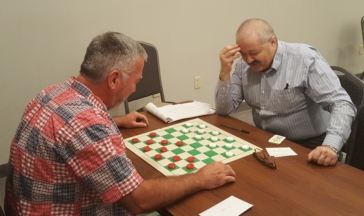
Last month we presented the first game of Watson's exciting match against Alex Moiseyev, which ended in a draw. This month we'll look at the second game of the round. Will Alex come roaring back?
Watson says: "This game I took the white. I actually like the white side in this opening. We began the game. No unexpected moves. Again, I felt good about the game."
| 1. | 11-15 | 24-19 |
| 2. | 15x24 | 28x19 |
| 3. | 8-11 | 22-18 |
| 4. | 10-14 | 25-22 |
| 5. | 11-16 | 29-25 |
22-17 or 27-24 should be played here instead.
| 6. | 6-10 |
Loses the advantage; 16-20 would have retained it.
| 6. | ... | 27-24 |
Watson thinks this is a key moment: " ... the turning point in this game came at move 12 (27-24). This set up was what my Dad used to play all the time against me. He liked it. I never thought much about it. However, when this move came up, I was thinking my Dad was watching. I could almost hear him saying, 'Move there, Watty.'"
| 7. | 1-6 | 31-27 |
32-28 is considerably better.
| 8. | 16-20 |
7-11 was better. The game is now back in the KingsRow opening book.
| 8. | ... | 32-28 |
| 9. | 4-8 | 19-15 |
Watson now thinks the game is decided: "The next move to change the game in my opinion was 19-15 exchange. To me, this was the winning move. He never recovered."
| 10. | 10x19 | 24x15 |
| 11. | 9-13 | 18x9 |
| 12. | 5x14 | 22-18 |
| 13. | 6-9 | 15-10 |
| 14. | 8-11 |
May lose; 12-16 was correct. But let's let Watson describe what happened:
"The next key move, in my opinion, was 15-10 ... By this time, Alex was in serious trouble ... I did not see a single good move for Alex. I saw my win. I was happy. I think Alex saw no way out.
| 14. | ... | 28-24 |
| 15. | 11-16 |
11-15 was a little better.
| 15. | ... | 24-19 |
"I do not know why, but it seemed like someone was nudging me. The voice was saying 'offer the draw.' I was thinking the game is almost over. I have it ... But I kept thinking I needed to offer (the) draw. I cannot fully explain why I offered the draw except to say at that point, I was very happy to get a draw against the World Champion. I knew three things. It had been a long day and I was tired. I knew that Frank and Mary (the hosts) had been very patiently waiting for us to finish. I knew I had a 700 mile trip ahead of me that day ... So I said to Alex, 'Would you like the draw?' Alex looked up at me, surprised. Alex could see it was over. He smiled and said, 'Yes, I would. Thank you.' We shook hands and that was it. It was a very good feeling for me."
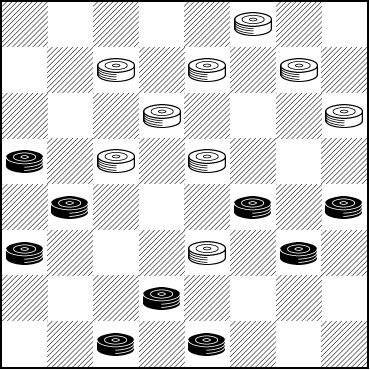
BLACK
Black to Play; What Result?
B:W30,27,26,25,23,21,19,18,10:B20,16,14,13,12,9,7,3,2.
What do you think? Should Watson have taken the draw, or is there a White win? What is Black's best continuation? Is there a way for White to go wrong and allow a Black win?
Take on both Watson and Alex and see what you can come up with, then click on Read More to see what might have happened had the game gone on. And be sure to read Watson's full story here.
A Couple of Surprises
Surprise! Some surprises are good, some others are not, but in today's Checker School entry, we think you'll find a nice surprise ... two of them, in fact.
BLACK
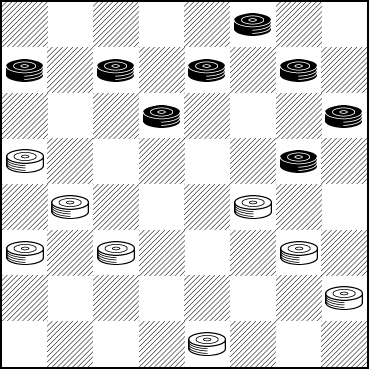
WHITE
White to Play and Draw
W:W31,28,24,22,21,19,17,13:B16,12,10,8,7,6,5,3.
We found this study very interesting in that the game is played quite flawlessly on both sides, yet White ends up with a draw that could prove difficult to find over the board, requiring two "surprises."
Will you find the solution or just be surprised? Either way, it's no surprise that clicking on Read More will show you the solution, a sample game, and some explanatory notes.
A Trap With a Tale, Part 3: An Easy Tale
"It's easy when you know how" could also be the theme of today's little study, but we think the deeper truth is found in another adage: When someone makes something look easy it's because they've worked hard.
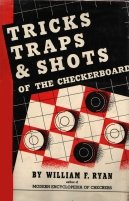
We're continuing with one of the final chapters of Willie Ryan's Tricks Traps and Shots of the Checkerboard with a problem that's easier than usual, "An Easy Tale" if you wish; at least, it's easy if you've worked hard enough at your visualization skills.
Let's begin with a run-up that we've already seen a couple of times, so no further commentary is required.
| 1. | 11-16 | 24-19 |
| 2. | 8-11 | 22-18 |
| 3. | 16-20 | 25-22 |
| 4. | 9-13 | 29-25 |
| 5. | 11-15 | 18-11 |
| 6. | 7-16 | 22-18 |
| 7. | 20-24 | 27x11 |
| 8. | 10-15 | 19x10 |
| 9. | 6x29 | 28-24 |
| 10. | 29-25 | 32-27 |
| 11. | 1-6 | 24-19 |
Recall that Willie said this move draws, but last time we showed that if Black plays the odd-looking 25-29, Black would have actually won. However Willie gave this as the next move:
| 12. | 6-9 |
which only draws (even if the White draw is very narrow). We'll follow that path further next time, rather than stopping here with "White to Play and Draw." Instead, we'd like to look at what happens if White makes this seemingly feasible move:
| 12. | ... | 23-18 |
resulting in the position below.
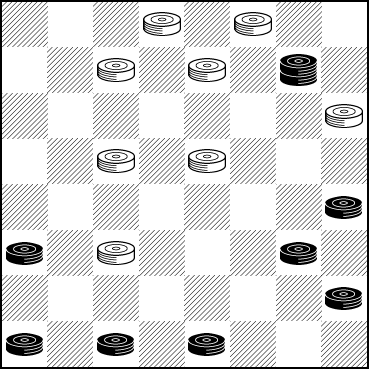
BLACK
Black to Play, What Result?
B:W31,30,27,26,21,19,18,11:BK25,13,12,9,5,4,3,2.
We're pretty sure you know what the outcome will be, but can you show it? It truly isn't all that difficult, but it's definitely a lot of fun. Tell the tale and then click on Read More to verify your solution.
Medium Problem
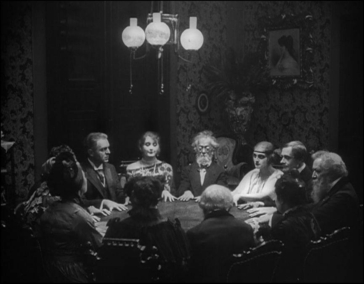
No, we don't mean that kind of "medium" and we don't expect you to divine the solution to today's checker problem; rather, we consider it "medium" in difficulty. It's a nice setting sent to us by Toronto's intrepid checkerists, Lloyd and Josh Gordon.
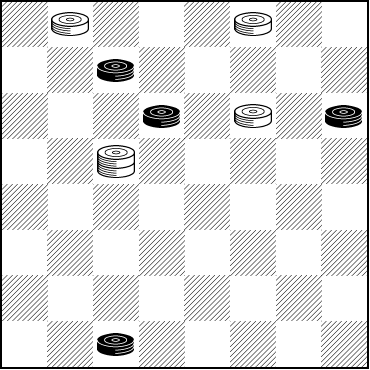
BLACK
Black to Play and Draw
B:W32,30,22,K19:B27,23,21,3.
The stars tell us you'll be able to solve this one, as long as you keep your thinking channels open. It won't take a seance, though, to check your solution; all you need do is wave your mouse on Read More to see how it's done.
The Checker Maven is produced at editorial offices in Honolulu, Hawai`i, as a completely non-commercial public service from which no income is obtained or sought. Original material is Copyright © 2004-2026 Avi Gobbler Publishing. Other material is public domain, AI generated, as attributed, or licensed under CC1, CC2, CC3 or CC4. Information presented on this site is offered as-is, at no cost, and bears no express or implied warranty as to accuracy or usability. You agree that you use such information entirely at your own risk. No liabilities of any kind under any legal theory whatsoever are accepted. The Checker Maven is dedicated to the memory of Mr. Bob Newell, Sr.