The Checker Maven
The World's Most Widely Read Checkers and Draughts Publication
Bob Newell, Editor-in-Chief
Published every Saturday morning in Honolulu, Hawai`i
Noticing missing images? An explanation is here.
Uncle Ben's Porch: Girl Trouble
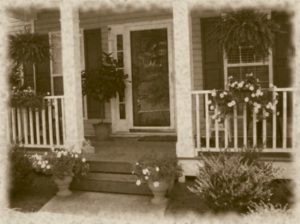
Tommy Wagner had girl trouble, and as a ninth grader, he had never expected any such thing.
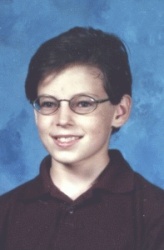
Tommy
It all started when he had a match-up against rising star Letitia Wong (see previous Checker Maven story). Tommy won his game, but he was especially impressed with Letitia's sportsmanship and gentle manner. It had given him a funny feeling that was hard to describe.

Letitia Wong
So a week later, even though he knew maybe he shouldn't be doing it, he gave Letitia a call. Despite his nervousness, Letitia had been very receptive and friendly and even suggested that they go to a movie together on the following Sunday afternoon.
Tommy didn't know how to refuse--- he wasn't even sure that he wanted to refuse--- and that's when the trouble began.
The problem was this: Tommy had been keeping company with another girl, Tina, for quite some little while. They had gone to grade school together and were close friends.

Tina
It was just Tommy's luck, or maybe it was fate, that Tina and her older sister went to the very same movie at the very same theater on the very same Sunday. Naturally, she saw Tommy and Letitia together. Tina immediately burst into tears, and after the movie both she and her sister confronted Tommy and Letitia.
It was not a pretty scene and Letitia, mortally embarrassed, was quite angry with Tommy--- although maybe not as angry as Tina was. In the course of not even five minutes, Tommy went from two girlfriends to none, with Tina and her sister stomping off angrily and Letitia telling Tommy pointedly that she'd take the bus home by herself.
Tommy was in a down mood all week, and it persisted into his Saturday morning checker lesson with Uncle Ben, a retired checker professional and Tommy's long-time mentor.
Tommy dragged up the steps to Uncle Ben's front porch and plopped into a chair with only the barest of greetings.
"Something's wrong, isn't it?" Uncle Ben asked. He could have chided Tommy for his lack of manners, but Uncle Ben was too kindly for that.
"No, sir," Tommy muttered. "Everything's fine."
"I don't think so," Uncle Ben said firmly. "Now, you don't have to tell me about it, but please don't deny it. After all these years I think I know you pretty well."
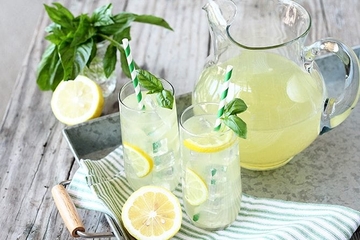
Tommy sat silently while Uncle Ben, wishing to put Tommy at ease, poured out tall glasses of his deservedly famous lemonade.
Tommy couldn't help but relax, if only a little, after his first sip. "Thank you, Uncle Ben," he said, and then, at all once, launched into the story of his girl trouble.
It was Uncle Ben's turn to sit silently for a few moments. Then he said, "Well, Tommy, and who do you suppose is to blame for this situation?"
"If Letitia hadn't asked me to go to the movie with her ..."
"Just a minute! There are three things wrong with that. First, Letitia didn't know anything about Tina. Second, you didn't have to accept her invitation. And third, you're the one who called Letitia to begin with."
"Um ... yeah ... kind of looks like I brought this on myself, doesn't it?"
Uncle Ben didn't need to reply.
"But now, I don't know what to do about it!"
"What does someone do when they've hurt or offended someone else?"
"Er ... well ... they say 'sorry'?"
"Exactly. You've taken the first step by admitting responsibility. That's a big thing. But it's not enough by itself. Now you have to do something even harder. You have to face the people you've hurt and apologize. Do you think you can do that?"
"I don't know ... but I have to, don't I? So I guess ... well, I just have to. Right away."
"Very good, Tommy, the sooner the better. But not quite right away. You can do what you must this afternoon. I think it will go better if you do a little checker study first to clear your head and focus your thoughts."
Uncle Ben pointed to the checkerboard he had set up on a little porch table. "Today we're going to study something known as the back shot. Take a good look at this position. Push everything else out of your mind and focus. Then tell me how to solve it."
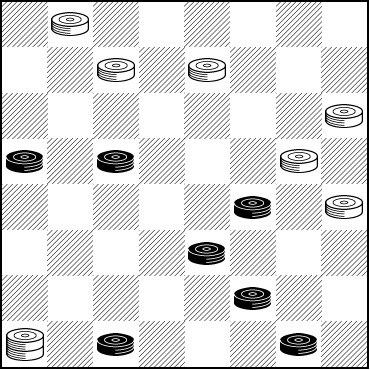
BLACK
Black to Play and Win
B:WK4,13,17,21,26,27,32:B1,3,6,10,14,19,20
Tommy took a deep breath, then another, and began to concentrate. After about five minutes, he said, "I'm ready, Uncle Ben."
Do you need a checker problem to clear your head and put you in a frame of mind for doing ... whatever you need to do? We certainly hope you don't have girl (or boy) trouble! Do give the position a good try and then click on Read More to see the solution, notes, and numerous additional examples of the theme.
Return to The Beacon
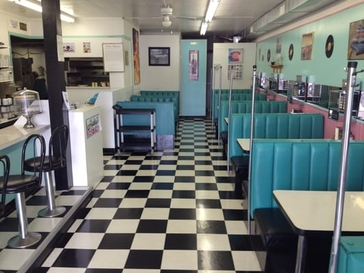
It was September and the Coffee and Cake Checker Club was meeting for the first time after the usual summer hiatus. There was a good turnout this week with Sal and five of the boys present: Wayne, Delmer, Louie, Dan, and Mike. The "boys" were all over 50 years old, but nevertheless that's how Sal Westerman, the club's leader, thought of them.
Sal should have been happy. He loved these Saturday afternoon gatherings at The Beacon Cafe more than just about anything else. It was September, 1955, and the weather in Bismarck, North Dakota had started to turn cooler.
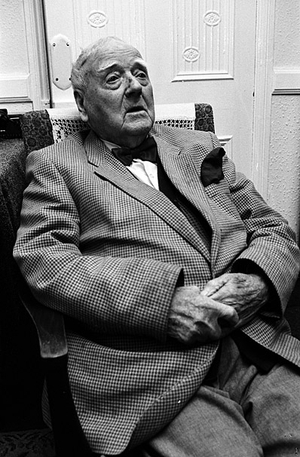
Sal Westerman
So it might surprise you to hear that Sal wasn't the least bit happy.
It all started when Deana, the proprietor of the Beacon Cafe in Bismarck, North Dakota announced that she had fresh lemon bars this afternoon, and Sal frowned. More like scowled, because Sal didn't like lemon bars, not one little bit. He just plain didn't like them, no matter how good they were.
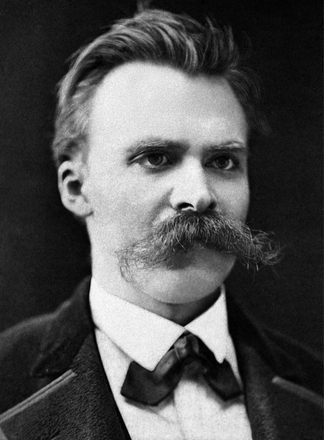
Dan Kemper
"Lemon bars, Sal!" Dan Kemper, one of the boys, said in a teasing tone. "Don't you want to win one?"
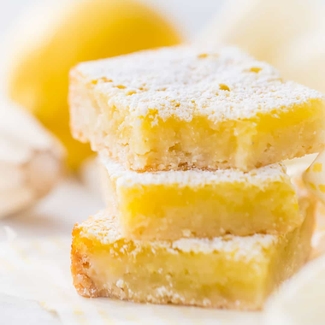
"No, I do not," Sal said emphatically. He looked over to Deana's service counter. "Deana, don't you have anything else?" he asked her.
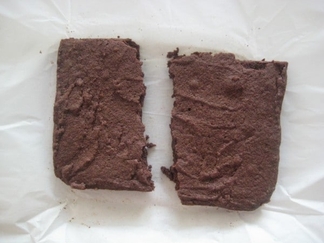
"Got some fudge brownies left over from yesterday," she said. "Half price for day-old. But the lemon bars are fresh and good." She frowned in turn. Sal had been coming to the Beacon for so long she knew exactly what he liked and didn't like, but she always felt a little insulted when her customers didn't care for her baked products. Everyone said she had the best desserts in town. Even Mayor Lips came here often for coffee and treats with his political pals.
Dan continued, "Come on, Sal, I know you've got a coffee and cake problem for us. Heck, you don't have to eat lemon bars if you don't want to--- more for us!" Dan said, and the rest of the boys added their agreement.
"Okay, okay," Sal said, "it just happens that Ed sent me a nice one." Ed was Sal's checker pen pal in Pennsylvania. "Guess I'll have to settle for those day-old brownies when you boys can't solve it."
They all laughed. "Hey, how about if we do solve it you have to eat a lemon bar?" Dan suggested.
"That's not even funny," Sal replied.

Deana Nagel
Deana wasn't laughing, either. "You make fun of my food, you leave," she threatened. Deana didn't get upset very often but when she did, you had better watch out.
Sal realized that things were going into the ditch in a hurry. "Okay, okay!" he said. "Let there be peace! I'll show you Ed's problem, and whether you solve it or not, I'll buy lemon bars for everyone and a brownie for myself! How's that sound?"
Everyone now smiled, even Deana. The tension was relieved and Sal set out the following position on one of the checkerboards in the big booth that the club always occupied.
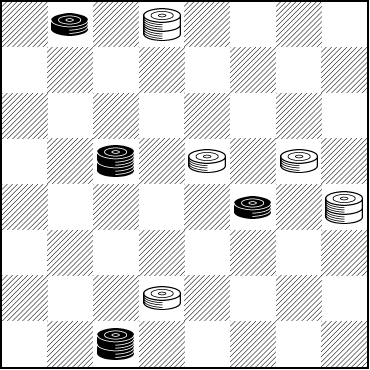
WHITE
White to Play and Win
W:WK2,15,16,K20,26:B1,K14,19,K30
"Ed calls this one Sweet Spot," Sal said. "What do you boys think?"
Five minutes passed with everyone scratching their heads and looking puzzled. "Five more minutes," Sal announced.
Can you win this one? And what's your take on lemon bars? (Be careful what you say; Deana might hear you.) When you've given this one a good try, click on Read More to see the solution and the conclusion of today's story.
Logical Checkers Vol. 3: Two-Move Expert
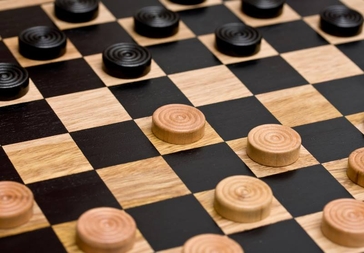
Today we're delighted to announce the immediate availability of the third volume of Grandmaster Richard Pask's Logical Checkers series, subtitled Checkers for the Two-Move Expert. In this new book, which runs to close to 300 pages, Mr. Pask presents new material on endgames, landings, and a vast array of tactical themes, as well as a survey and analysis of two-move ballots (as a stepping-stone to eventual study of three-move ballots).
You can get the book from the Richard Pask page as linked in the right-hand column, or directly here. The book is of course completely free of charge thanks to the generosity of Mr. Pask.
As a bit of a teaser, here's a position found in the book. It's one of Mr. Pask's own devising which he calls Life's Not Fair.
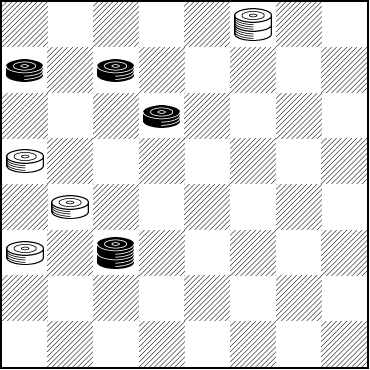
WHITE
White to Play and Win
W:WK3,13,17,21:B5,6,10,K22
To see the solution, download the book and go to Diagram 391 on page 92.
The Checker Maven thanks Mr. Pask for the continuing privilege of editing and presenting his work.
A Cakewalk
The Cakewalk goes back a long way, and is intimately connected with Black history and pre-Civil War southern plantation life. But today, a Cakewalk is something of a carnival game, something like musical chairs but with a cake as the prize. The word has also come to mean something that is extremely easy to do or accomplish.
And no, today's column doesn't have anything to do with our ongoing Coffee and Cake series; we've chosen the title Cakewalk because today's problem is very easy indeed. It's so easy that we've resurrected our long-neglected Javascript timer.
Expert players will take longer to read the terms of the problem than they will to solve it; an instant solution is likely. Even intermediates will solve it just about at once. Beginners may have to reflect a few seconds but they too should not have much trouble.
Why such an easy problem? Well, we present hard ones week after week and once in a while we think it's good to go in the other direction. Players of all levels should find a home in our columns. The position was sent to us by regular contributors Lloyd and Josh Gordon of Toronto and arose over the board.
So here we go. Click below to show the problem and start the clock.
Cakewalk (very easy)
Got it? Of course you did. But click on Read More all the same, just to be sure.
Season Opener

It was Opening Day for the National Checker League as the 2019-2020 season was about to begin, and Marvin J. Mavin, Captain of the defending champion Detroit Doublejumpers, was ready.
Marvin J. Mavin
August training camp had been rough, with lots of physical and mental training. But Marvin had to admit it felt good to be in top shape, even though he thought the coaches had been pretty tough on him. No beer for a whole month, and running laps constantly.
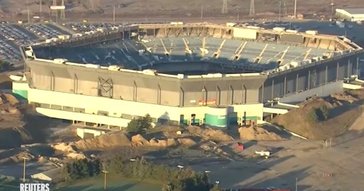
This afternoon, the Doublejumpers were facing the Seattle Single Corners at Starbugs Stadium in Seattle. A sellout crowd of over 50,000 was on hand to see what promised to be an exciting contest.

Marvin, on first board, was paired up against the Seattle captain, a short, squat fellow that just went by the name Sluggo. In high school and college, Sluggo was a champion weight lifter and wrestler, but he was so good at checkers that he decided to take a pro contract. Still, one look at him told you that he had definitely kept up the physical training.
Word had gotten around the League about Marvin's experiences in training camp this year, and Sluggo started to ride Marvin as soon as they took their places across the checkerboard.
"Heard you had to run some laps," Sluggo said. "Must a been tough for a wimp like you." Sluggo laughed, a deep, nasty sound that had intimidated many an opponent both over the board and in the ring.
"Yeah, well, unlike you I got a brain," Marvin said.
"Not very original," Sluggo replied, "and anyhow you won't have one yourself after I bust up your head."
"Hey! Are you threatening me? You can't do that!"
Sluggo looked Marvin right in the eye. "Really? Whatcha gonna do about it?" Sluggo raised his clenched fists to chest level.
Marvin involuntarily took a step back, but just then the referee's whistle blew and the call "Play checkers!" resounded across the field.

Sluggo stuck out his hand for a handshake, but Marvin didn't take it. He was afraid Sluggo would break his fingers. That got another low laugh from Sluggo. "Have it your way, little boy," he said. "I'll beat you on the board, over the board, and into the board."
The game proceeded as follows. Marvin had Black and Sluggo had White.
| 1. | 11-16 | 23-18 |
| 2. | 10-15 | 18x11 |
| 3. | 8x15 | 24-19 |
| 4. | 15x24 | 27x11 |
| 5. | 7x16 | 28-24 |
| 6. | 4-8 | 22-18 |
| 7. | 8-11 | 26-23 |
| 8. | 16-20 | 31-27 |
| 9. | 6-10 | 18-14 |
| 10. | 10x17 | 21x14 |
| 11. | 9x18 | 23x14 |
| 12. | 11-15 | 30-26 |
| 13. | 3-7 | 26-23 |
| 14. | 1-6 | 25-21 |
Loses. 25-22 was correct.
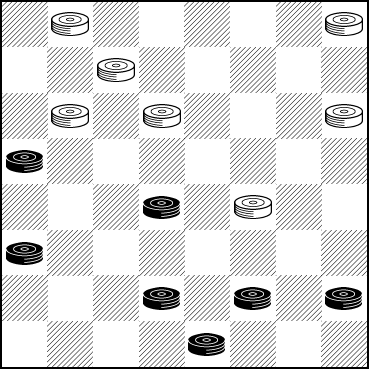
BLACK
Black to Play and Win
B:W14,21,23,24,27,29,32:B2,5,6,7,12,15,20
Marvin chuckled. "Hey, you did pretty well up to now--- for a lamebrain. But that last move is gonna cost you the game."
"Oh yeah?" replied Sluggo. "Sez who?"
"Sez me, Marvin J. Mavin."
"You're dead meat. Nobody beats Sluggo."
Marvin chuckled again. "We'll see about that," he said, and made his move.
Can you beat Sluggo? No, not on a wrestling mat, but over the board? See if you can find the win and then slam your mouse on Read More to see the solution and the conclusion of our story.
Hogan's Heros
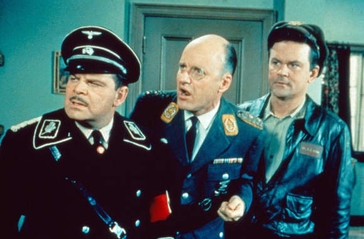
Hogan's Heros was an American television program that ran from 1965 through 1971. It was pretty popular in its time, although today's politically correct, looking-to-be-offended crowd would find it unacceptable.
But there was a different and earlier Hogan, namely E. W. Hogan of Emo, Ontario, who is a hero to us in a checker sort of way. Some time in the latter part of the 1930s he published a problem that to this day is a bit resistant to computer solution. Take a look at the diagram below.
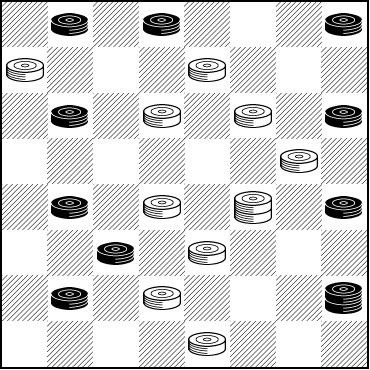
WHITE
White to Play and Win
W:W5,7,10,11,16,18,K19,23,26,31:B1,2,4,9,12,17,20,22,25,K28
Yes, the KingsRow computer engine found the solution ... but it did have to think about it for a few seconds (normally KingsRow solves positions virtually instantaneously).
So we think you'll find it to be an interesting challenge. Don't worry about being politically correct; become one of E. W. Hogan's heros and try to solve it. When you're ready, click on Read More to see the solution.
One Last Gem
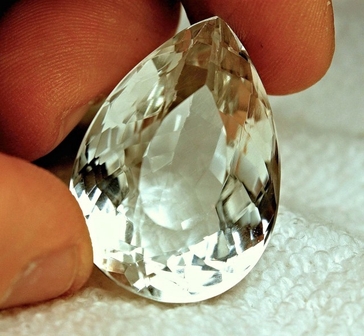
For the last several months our monthly Checker School columns have been featuring "gem" problems. Whether or not they were all truly "gems" is for you, our reader, to decide, but we have one last entry in the current series to present to you today. It's by S. J. Pickering and apparently first made its appearance in the old (and excellent) checker magazine Elam's Checker Board.
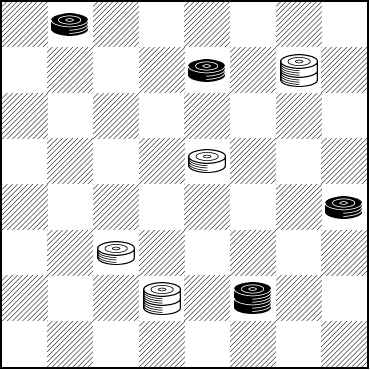
WHITE
White to Play and Win
W:WK8,15,22,K26:B1,7,20,K27
White has two kings to Black's one and has a centralized position. Should be easy, shouldn't it? But checkers is subtle and complex, and the win may not be so simple.
Does this one sparkle for you? Can you appreciate its facets? See if you can solve it and then let your mouse shine on Read More to see the solution and notes.
You Did What?
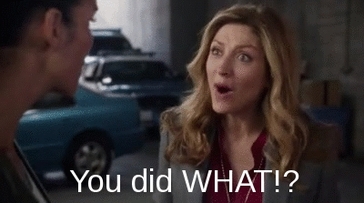
Uh-oh. Someone is in deep trouble. That fellow is going to have to work very hard and very quickly to find a draw and avoid a loss, so to speak.
Of course, things like this come up in checkers all the time. We make a move and then wish we had made another. Sometimes the draw is still there, and sometimes not. Take a look at the position below.
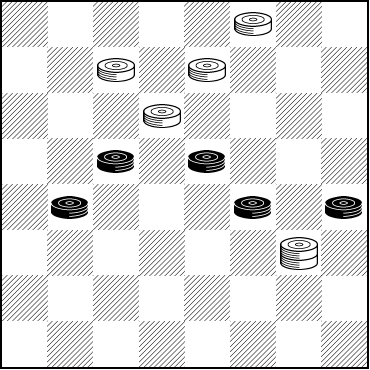
BLACK
Black to Play, White to Draw
B:WK9,23,26,27,30:B13,14,16,18,19
White has just played 6-9. It looks logical at first glance, doesn't it? Actually, the move is sound if maybe not optimal, but as usual, playing it out over the board is the real issue. This quick little study is based on a position sent to us by regular contributors Josh and Lloyd Gordon of Toronto. It's not quite a speed problem, but it isn't too hard if you keep your wits about you.
Stay out of trouble; solve the problem and be able to say the much more positive phrase, "I did it!" You can always click on Read More to check your solution.
Shardlow: Checker Friendy?
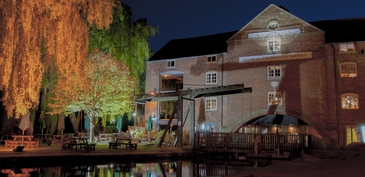
Shown above is what is now a pub called The Clock Warehouse in Shardlow, Derbyshire, England. The pub is said to be dog-friendly. We're not quite sure what that means. We would rather have heard that the pub was checker (draughts) friendly.
Today, we consider a problem by a checkerist named Shardlow who didn't come from England, but from Marshall, Minnesota. What was his connection, if any, with the town in England? Most likely there is none, though we'll probably never know.
Mr. F. C. Shardlow published a number of problems in various newspapers; the one below appeared in The Winnipeg Free Press in 1938. All we were able to turn up about the author was that his full name was Frederick Cromwell Shardlow, that he was born in 1874, passed on in 1948, and had a wife and two daughters. We didn't find anything additional about his checker career, although he obviously must have been quite good.
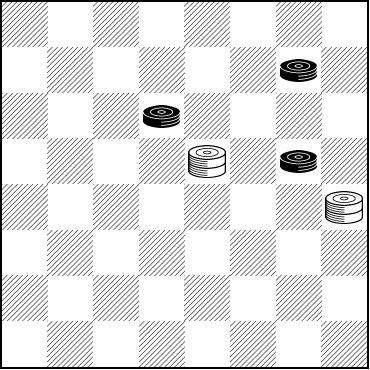
WHITE
White to Play and Win
W:WK15,K20:B8,10,16
A checker friendly problem? We think so. Try to solve it, and then give a friendly click of the mouse on Read More to see the solution.
Summer's End
It was the end of summer, and Sal had really missed the weekly gatherings of the Coffee and Cake Checker Club. Saturday afternoons just weren't the same without stopping by the Beacon Cafe for a couple of hours of checker fun with the rest of the boys. But summers in Bismarck, North Dakota were short, and most indoor activities knocked off from just before Memorial Day until just after Labor Day.
Sal
On the last Saturday of August, 1955, Sal just couldn't resist grabbing a checker magazine and walking over to the Beacon. He didn't expect anyone else from the Club to be there, but he'd be content to enjoy some of Deana's coffee and cake on his own. Deana was the proprietor of the Beacon and her desserts were the best in town.
He sat down in a small booth and was soon occupied with a cup of coffee and some of the games and problems in the August edition of All Checkers Digest.
He was deep into an article about the big July tournament in Las Vegas, which had drawn over a thousand players from all over North America, when he felt a tap on his shoulder.
"Hey, what are you doing here?" a voice said.

Louie the Flash
Sal looked up, and gosh-darn if it wasn't Louie from the Club!
"Could ask you the same," Sal said with a grin.
"I was painting the guest bedroom all morning," Louie said, "and my girlfriend told me, 'Go treat yourself to something at the Beacon.' Well, couldn't pass that up now, could I?"
Sal chuckled. "Another girlfriend? How many does that make this year?" That elicited a small frown from Louie. "Hey wow man," Louie said, "a fellow has to make an effort."
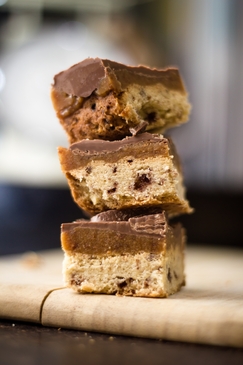
Rawpixel CC0
"Deana's got chocolate chip bars," Sal continued. "Want to buy me one, Flash?" Louie had somehow gotten the nickname "Louie the Flash" and it had stuck.
"Me buy you one?" Louie replied. "Come on, dig a problem out of that there magazine and we'll see who buys!"
Sal chuckled. "Just happens there's one in here from my pal Brian," he said. "Coffee and cake on you when you can't win it?"
"Coffee and cake on you when I do win it," Louie said. But he wasn't really so sure. Brian always sent Sal problems, but the ones that he had published in a major checker magazine with nearly a million readers were usually pretty tough.
"Well, then, Flash old boy, here you go."
Sal set up the following position on his board.
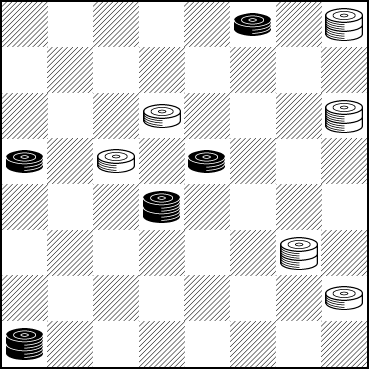
WHITE
White to Play and Win
W:WK4,10,K12,14,K24,28:B3,13,15,K18,K29
After a few minutes, Louie said, "You gotta be kidding me."
"Can't do it, can you?" Sal said. But then he noticed Louie's big grin. "What's the deal with the smile, Flash?"
Louie started to move the checkers.
Did Louie find the problem too hard or to easy? He probably wouldn't be grinning if he hadn't solved it. How about you? Will you grin or frown? See what you can do and then click on Read More for the solution and the conclusion of the story.
The Checker Maven is produced at editorial offices in Honolulu, Hawai`i, as a completely non-commercial public service from which no income is obtained or sought. Original material is Copyright © 2004-2026 Avi Gobbler Publishing. Other material is public domain, AI generated, as attributed, or licensed under CC1, CC2, CC3 or CC4. Information presented on this site is offered as-is, at no cost, and bears no express or implied warranty as to accuracy or usability. You agree that you use such information entirely at your own risk. No liabilities of any kind under any legal theory whatsoever are accepted. The Checker Maven is dedicated to the memory of Mr. Bob Newell, Sr.