The Checker Maven
The World's Most Widely Read Checkers and Draughts Publication
Bob Newell, Editor-in-Chief
Published every Saturday morning in Honolulu, Hawai`i
Noticing missing images? An explanation is here.
New Year's Day 2022
This column is being published on New Year's Day, 2022, and The Checker Maven wishes that the New Year will bring everyone health, happiness, and everything that you might wish for.

We don't know if or how you might have celebrated on New Year's Eve, but we know that it can often be a time of ... er ... a bit of overindulgence. If you did ... er ... overindulge a little, perhaps today you aren't ready to take on a grandmaster level checker problem. So instead, we'll take it easy on you and present a very nice, but not too difficult problem sent along by regular contributors Josh and Lloyd Gordon of Toronto.
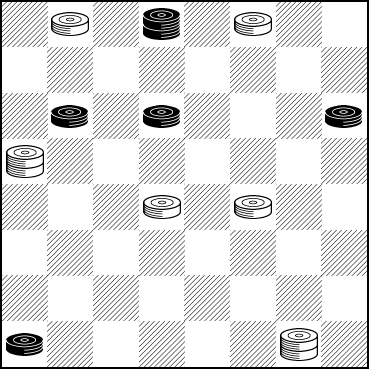
BLACK
Black to Play and Draw
B:WK1,14,15,K20,30,32:B4,21,23,24,K31
This one may take a short moment of thought but shouldn't tax you too much, and might help you to clear your head if that's necessary for you today. Give it a try and then click on Read More to check the solution.
Merry Christmas 2021

This column will appear on Christmas Day, 2021, and whatever holiday you celebrate, in whatever way you celebrate it, The Checker Maven wishes everyone the best of the season. Even in these days of extreme political correctness, we have no hesitation to say "Merry Christmas to one and all," and if you find that friendly wish offensive, that's on you.
On major holidays we like to present problems from great composers of a bygone day. Today, we feature a prize problem by the great Fausto Dalumi. The problem was first published back in 1929, going on a hundred years ago.
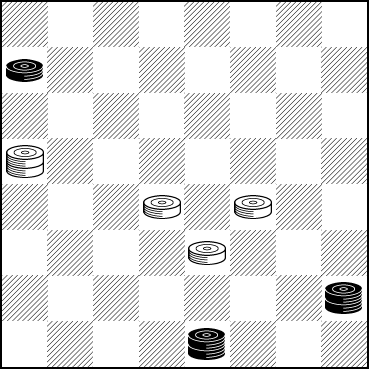
WHITE
White to Play and Win
W:WK13,18,19,23:B5,K28,K31
White is a piece up but winning a won game isn't always easy. We think you'll really enjoy the challenge of this problem. Solve it with good cheer and then merrily click on Read More to celebrate the solution.
Marvin's Holidays
The holiday season was coming up, and the National Checker League took a two week winter break. So Marvin J. Mavin, superstar captain of the many-time World Champion Detroit Doublejumpers, would have a welcome vacation.
His long-time girlfriend, Priscilla K. Snelson, also decided to take two weeks off. As an important C-level executive at the multibillion dollar conglomerate, Rust Belt Holdings, it was something she almost never did. But she had an ulterior motive. It had all started on Thanksgiving Day, when at a disastrous dinner with Marvin at the Grosse Pointe home of her parents, her father had said one thing that stuck with her. It was time to move her relationship with Marvin forward. Quite far forward.

She and Marvin had been keeping company for nearly ten years, since a time when Marvin had yet to become captain and she had yet to move to the executive suite. Although they had never really discussed the matter, she agreed with her otherwise strident father that it was time for them to get married, and in fact had been waiting for Marvin to propose for some little while. She was getting impatient and decided to set the stage on her own.
They were visiting one evening in Priscilla's upscale condo. Her staff had just cleared off the dinner dishes and Marvin was enjoying a beer (what else?), trying to solve a Brian Hinkle checker problem published in All Checkers Digest, while Prisilla was sipping a first flush Darjeeling tea from a renowed estate.
"Have you thought about where we should go on our vacation, dear?" she asked in as innocent a tone as possible.
"What? I've almost got this one ..."
"Put your magazine down and talk to me. I asked you about our winter vacation."

"Uh, yeah," replied Marvin, "it's been kinda cold here and I was thinkin' maybe we could go to Tahiti, you know, warm up a little, sit on the beach with a couple of Hinanos ... "
"Sounds great. Sitting and watching you drink beer. How original. No, I was thinking of somewhere else."
"Where? Hawai`i? I sorta didn't like it the last time I was there."
"Yes, you got yourself into trouble as I recall. No, I want to go to Las Vegas."
At that, Marvin did put his magazine down. "Las Vegas? I never heard of you gambling or nothing. What's in Vegas besides gambling and a bunch of expensive shows?"
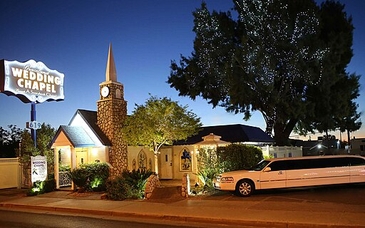
"Marvin, they have a lot of nice chapels there. Very fancy. I'd ... like to see one of them."
"Just one of 'em? There must be dozens! And there are better churches in Europe so why ... oh." Marvin turned pale. "You're not thinking ... "
"I'm not thinking what, exactly, dear?"
"I mean ... uh ... in Vegas ... people ... they go there to ... oh, no. Are you serious?"
"Marvin, we've been seeing each other for how long now? I'll tell you. Ten years. That's a long time for a girl to wait. A very long time." Priscilla's tone had become more stern. "So, Marvin, what will it be?"
"You mean ... you mean I have choice?"
"You certainly do."
"Okay, then, let's just go to Tahiti, that would be my choice." He smiled but it was rather weak.
"Tahiti may be your choice but it isn't my choice," said Priscilla.
"I thought you said I could choose?"

"I said you had a choice, not that you could choose where we're going." It was Priscilla's turn to smile, but hers was an ironic smile.
"Uh, I don't get it ... "
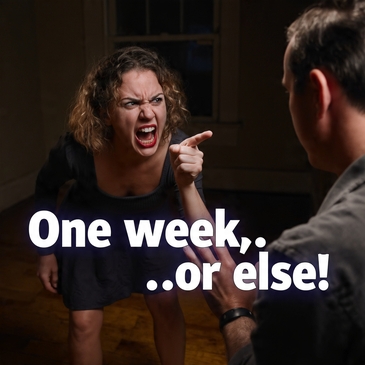
Priscilla stood and put her hands on her hips. That was never a good sign. "Well, if you don't get it, then how about you go home right now, and don't call me until you do get it. Take your stupid magazine and leave! And just to be clear, you've got one week to get it ... or else!"
Marvin knew better than to ask "or else what." Silently he picked up his magazine and put on his winter jacket, which the butler conveniently proffered at just the right moment.
"Priscilla, won'tcha ... "
"Good night, Marvin!"
Knowing he had best cut his losses, Marvin hurried out the front door. Fortunately, as he and Priscilla had had a few previous rows, he knew where to find the nearest bar.
Public Domain
Marvin never did get to finish solving Brian's problem, and All Checkers Digest only prints the best compositions.
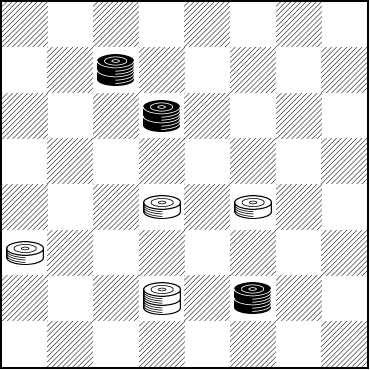
WHITE
White to Play and Win
W:W18,19,21,K26:BK6,K10,K27
See if you can solve it, and then click on Read More to check your solution. But be careful. If, while you're solving, your significant other wants your attention, it might be wise to listen.
Beacon Cafe: A Gift for Joyce
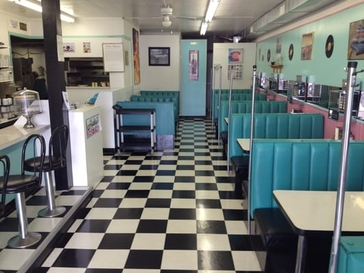
It was a Saturday afternoon just two weeks before the holidays, and Sal Westerman had a problem. His daughter, Joyce, was coming home to Bismarck, North Dakota, to visit for ten days, something she wasn't able to do very often because of her work as a lawyer at the Washington D.C. firm of Dark, Darker, and Darkest, a high-end and very busy litigation practice. Sal wanted to get her a nice holiday gift but just didn't know what it should be.

Joyce Westerman
Now, Saturday afternoons were when Sal's club, the Coffee and Cake Checker Club, gathered at the Beacon Cafe for an afternoon of checker fun among checker friends. It was normally Sal's favorite part of the week, and he always looked forward to it. Today, though, he was preoccupied and his friends noticed.
Wayne, Delmer, Dan, Louie the Flash, Sam, and Tom were all on hand today, although another regular, Mike, wasn't able to make it. Deana, the proprietess of the Cafe, had announced that she had baked a couple of trays of festive cherry bars, and her baked treats were the best around.
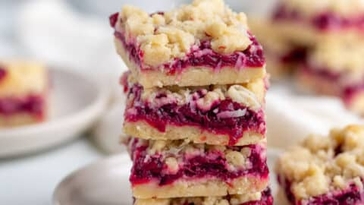
Sal knew he should be happy and at his ease, but he just wasn't.
"Come on Sal, what's up?" Louie asked. "You're just not yourself today. Heck, you haven't even challenged us with a checker problem yet."
"I ... well, I forgot to pick one out," Sal said, a bit sheepishly.
"You forgot?" Dan said. They were all rather surprised. Sal never forgot anything to do with the club. "Gosh, something must be really wrong."
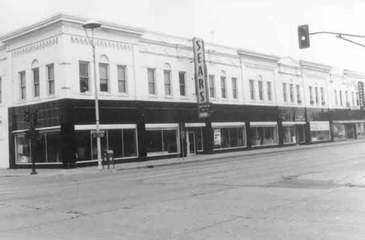
Veteran's Memorial Public Library CC0
"It's like this," Sal said, realizing that he'd have to explain. "You all know my daughter Joyce? Well, she'll be here in a week for a holiday visit, and I just don't know what gift to give her. I've gone through all the department stores; Sears, A. W. Lucas, everywhere, and I couldn't find a single thing to get her. Not even in the Sears catalog, although it's a little late to order now."
"Hmm," said Wayne, "I never know what to get for my kids, either. Most of them farm and there's nothing that they really want. I always end up with a gift certificate to the farm supply store or something practical like that."
"Wouldn't help Joyce much," Sal said. "I guess I could get a Sears gift certificate but she doesn't really have time for much shopping, and I wanted something more personal."
"What kind of things does she like?" asked Tom.
"She likes to read," Sal said, "at least when she has time. Maybe a book or something?"
Then Sam spoke up. "Hey, I've got an idea. But tell you what, let's do a problem and have some treats first. I'll even buy!"
"Hey, nice of you," Sal said, "and I'd love to hear your idea. But as I said, I didn't remember to bring a problem today."

Pexels CC0
"Well, I've got one," Sam said. "At least I'm pretty sure I can remember it. I heard about it on late night radio this past week. You know that show where they give those hard checker problems and then have a commentator talk about the solution?"
"Sure," Dan said, "'The Midnight Checker Show.' Too late to stay up for me. And you have to get a board out to follow along with the moves."
"Well, here, take a look."
Sam set up the following position.
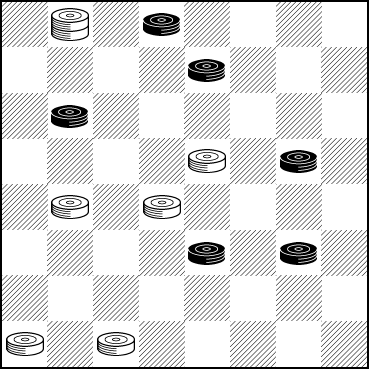
WHITE
White to Play and Win
W:WK1,15,17,18,29,30:B2,7,9,16,23,24
Sam smiled. "Now, Sal, I'll tell you my gift idea ... if you and the boys solve the problem."
"You strike a hard bargain," Sal said. "But I guess we really had better figure this one out."
Sam went to Deana's counter to order a dozen cherry bars and refills on coffee while Sal and the boys studied his checker problem.
Finding the right holiday gift can sometimes be pretty difficult, especially for people really close to you. You're luckier than Sal, though, as you'll be able to learn about his idea whether you can solve the problem or not. But do give it a good try and then click on Read More to see the solution and read the conclusion to our story.
17th Anniversary
Today marks the 17th anniversary for The Checker Maven. We celebrate 17 years of no-fail on-time weekly publication, something we once would have never thought possible. We reach thousands of checker fans and bring them a consistent message that checkers is challenging, fun, and as relevant today as it ever was.
Our success wouldn't have been possible without the support of our loyal readers, and we can't thank you enough. We once thought to stop publication after 10 years, and then 15, but your encouragement and support has led us to continue on. We can't say how long we'll continue as health and age are increasingly a factor, so let's just say that we look forward to providing more quality checker entertainment in the years to come.
State of the Art
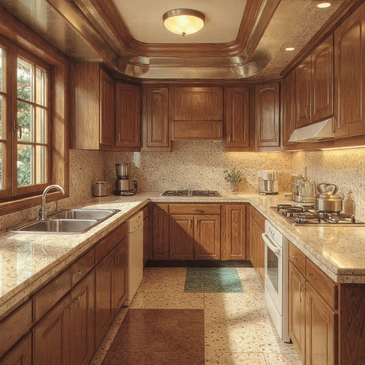
Shown above is what's said to be a "state of the art" kitchen. At least, that's what it was perhaps fifty years ago. But things move ahead. Fifty years is a long time. A lot can change.
In recent times, there have been some significant developments in the field of computer checker engines. Machine learning arrived in KingsRow and later in Cake. That was a huge accomplishment, but it wasn't quite the last chapter of the story.
When today's latest computer engines didn't solve Brian Hinkle's "Prize Problem" world class checker programmers Ed Gilbert and Martin Fierz both looked into the issue. Their conclusions were similar and reasonable. Computer engines are set up for maximum strength during practical play, not for solving highly unusual problems.
But of course Ed and Martin didn't stop there. Ed created a selectable "solver mode" for KingsRow while Martin made some changes to the search function in the Cake engine. The Prize Problem was now solvable. (These new program versions have yet to see public release at the time this article was written.)
But Brian didn't stop his work, either, and went on to create a series of more and more unusual problems which took longer and longer for computers to solve..
So what was the outcome? There may always be problems which it simply isn't practical to program computers to solve in any reasonable amount of time. But the state of the art for checker engines has definitely advanced with the intriguing new work done by both Ed and Martin.
Here's one that Brian sent to Ed and Martin. We warn you, it's not easy.
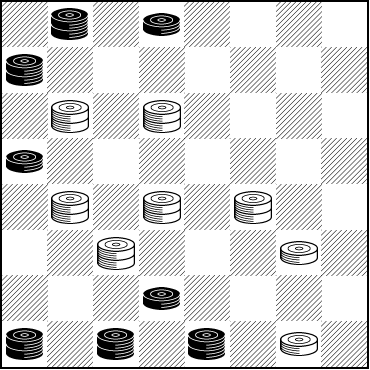
WHITE
White to Play and Win
W:WK9,K10,K17,K18,K19,K22,24,32:BK1,2,K5,13,26,K29,K30,K31
Do attempt a solution on your own before clicking on Read More to see how it's done. These problems are a great deal of fun and definitely test your thinking. Best of luck!
Marvin's Thanksgiving
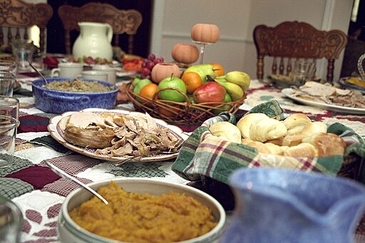
It's Thanksgiving weekend, and Thanksgiving has long been our favorite holiday. It's a great day to reflect upon the many things we have to be thankful for. Yes, we've lived in difficult times, but we can give thanks for lifesaving vaccines, for caregivers and first responders who give their all, and for so much more.
Usually we present a problem from a great American composer. Today we have one from a prolific composer of yesteryear, Bert Berry. It's all part of a story about our iconic character, Marvin J. Mavin, and how he spent his Thanksgiving.

Marvin J. Mavin
Marvin J. Mavin, the superstar captain of the Detroit Doublejumpers of the National Checker League, had to make a decision. But there was little question about what decision he was going to make.
In our previous story, Marvin embarrassed himself and his team by violating protocol during a showcase match in Japan. He was fined $10,000 by his Coach, another $10,000 by the League, and in lieu of suspension was sent to the Doublejumper's Rookie League Farm Team in Bayonne, New Jersey, where he was made to spend a month waiting things out as a substitute player.

Priscilla Snelson
But worst of all was the trouble he had gotten into with his long-time girlfriend, business executive Priscilla Snelson. Priscilla wouldn't even talk to Marvin for two weeks, and when she finally did, Marvin wished she hadn't.
In any event, Thanksgiving was coming up. Marvin generally spent that holiday with his parents in Berkeley, California. Sometimes Priscilla joined him, sometimes he went alone. But this year Priscilla asked Marvin to join her with her own parents in Grosse Pointe, Michigan. Except she didn't exactly ask, and Marvin was hardly in a position to bargain or plead.
Hence, Marvin's decision as to what to do about Thanksgiving was pretty much a done deal.

Mrs. Hermione Snelson
The trouble was, Marvin didn't get along with Priscilla's parents. Or rather, they didn't get along with him. It wasn't very good with Priscilla's mother, Mrs. Hermione Snelson. But it was much worse with Prisilla's father, Mr. Winston Snelson, who was a partner at the Detroit law firm Snelson, Nelson, Kelson, and Delson, a high-end outfit whose rates started at $3,000 per hour for junior staff and rose to $10,000 per hour for partners. Mr. Snelson also thought himself to be rather good at checkers, and in fact had played while at law school years ago, but went on to a law career when he didn't get selected for a pro team in the amateur draft. He continued to play to this very day in the Metro Detroit Super Suers League, a rather strong amateur organization for players at law firms.
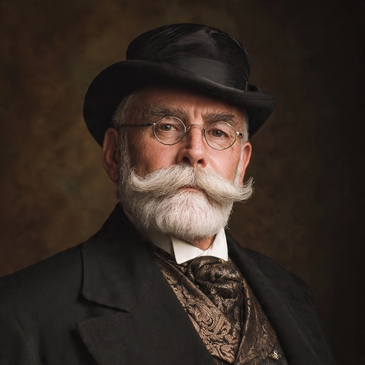
Mr. Winston Snelson
Priscilla's parents lived on a large estate in Grosse Pointe, in a home with 10 bedrooms, 14 baths, a 10 car garage, a horse stable, two guest houses, and around a dozen full-time staff.
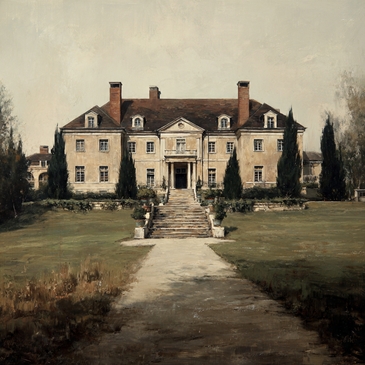
On Thanksgiving Day, Winston sent one of his Rolls-Royce limos to pick up Priscilla and Marvin. As usual, Marvin was running behind schedule and Priscilla, waiting in the car, was getting more frustrated by the minute. Finally, Marvin strolled out of the entrance of his apartment building.
"Will you hurry up, Marvin?" Priscilla called through the open car window. "You know how my father hates us to be late."
The look on Priscilla's face told Marvin enough, and he hustled over to the car and quickly got in. "Okay, Prissy, okay, we'll be pretty close ..."
"Don't call me Prissy! And no, we're going to be fifteen minutes late!"
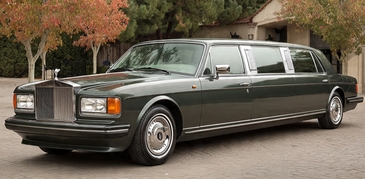
The car sped along but there was some traffic and didn't pull up to the front of the Snelson mansion until 4:30, a full half an hour late.
Mrs. Snelson met the couple at the huge, ornate door, held open by two liveried footmen. She gave Priscilla a hug and Marvin a cold stare. "Don't make excuses," she snapped at him. "You've made Priscilla late and my husband is very angry."
"Aw, gee, Mrs. Snelson, it ain't that late ..."
A nudge from Priscilla was all it took to stop Marvin from saying anything further.
"Dinner will be at five o'clock precisely," Mrs. Snelson said. "That will give you adequate time to ... clean up." She eyed Marvin from head to foot. "If that's possible."
"However," she continued, "you have missed the cocktail hour so you will have to go without drinks. You may have some wine at dinner, but that will be all."
"No beer ... ?"
Priscilla gave Marvin another nudge, this time a little harder. "Please, Marvin," she said, "keep the peace and go wash up a little. For me, okay?"
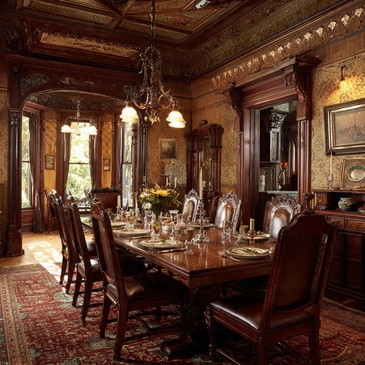
Half an hour later, Marvin, Priscilla, and Mr. and Mrs. Snelson gathered in the mansion's huge formal dining room. Winston merely nodded at Marvin and didn't offer to shake hands.
"At least your dad didn't chew me out this time," Marvin whispered to Prisilla.
"What did you say, young man?" Mr. Snelson said in a commanding voice. "Speak up so everyone can hear you. We don't have private conversations at our table."
"Uh, nothing, sir, I didn't say nothing," Marvin said sheepishly. "Just, you know, asking where to sit."
"You know very well where to sit, and you may all be seated now."
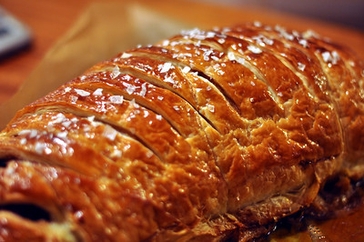
The staff began to serve dinner. There were courses of mock turtle soup, Salade Nicoise, and Dover sole, followed by the main course, Beef Wellington, accompanied by Pommes Anna and a medley of fresh steamed vegetables. Crusty French bread served with Lille butter completed the offerings.
"Ain't we havin' turkey?" Marvin asked. "Thanksgiving, you gotta have turkey. It just ain't American ..."
"I decide the menu at this table, not you," Mrs. Snelson said.
"I told you we should never have invited him," Mr. Snelson said.
"Father," Priscilla said, "please, give Marvin a break. You're awfully hard on him."
Marvin gave Priscilla a look of gratitude but Mr. Snelson went on, "Well, my daughter, if that's how you feel, why don't you insist that this --- person --- marry you instead of leading you on for so many years? Not that I want him for a son-in-law, mind you, when there are so many good men who would wish to court you if you would only let them."
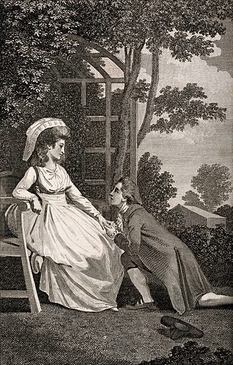
"Hey, Mr. S., I make lotsa money! I ain't so bad ... and Priscilla's my honey." He put his arm around Priscilla's shoulders. She beamed until Mr. Snelson's scowl made Marvin pull his arm quickly away.
"Priscilla has plenty of money in her own right, both from her highly successful career and her family. You may be a checker superstar, and you may get a superstar's wages, but look at you. At heart you're nothing but a bum. When was the last time you took a shower or brushed your teeth?"
"Hey, Mr. S., just because you couldn't make it in the pro ranks don't mean ..."
"Enough of this!" Priscilla's voice was loud and sharp. "Father, Marvin is my intended and you need to accept that gracefully. And Marvin, don't you go throwing gasoline on the fire. Come along, we're leaving now."
"Aw, Prissy, I'm still kinda hungry!"
"Marvin! Now!"
Mr. and Mrs. Snelson were stunned. Priscilla had never been so forceful with them. They said nothing as Priscilla took Marvin's elbow and steered him toward the front door.
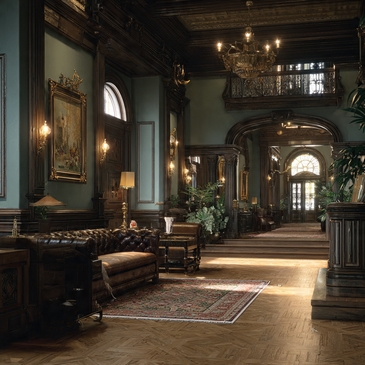
They were putting on their winter jackets in silence when Marvin noticed a checkerboard on a side table in the entryway. It had been said up with the following position.
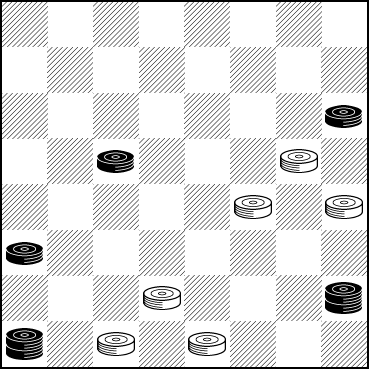
WHITE
White to Play and Win
W:W16,19,20,26,30,31:B12,14,21,K28,K29
"Hey, kinda cool," Marvin said. "Looks like all you need to do is ... hmm ... yeah, maybe not ... oh, how about ..."
"Marvin!"
"Lemme just take a picture, willya? I kinda want to figure this one out ..."
But before Marvin could reach into his pocket for his cell phone, Priscilla had him out the door and on the way to her waiting car and driver.
After they were seated and the car departed, Priscilla said, "We'll stop for turkey at a diner. Just you and I." She smiled. "I think that will be nice, don't you?"
Marvin's only reply was to pull her close and kiss her cheek.
Evidently Mr. Snelson, despite his somewhat supercilious nature, enjoyed a good checker problem, too. A shame that Marvin never got to solve it. Can you? Give it a try; you won't have anyone rushing you out the door. It's some good Thanksgiving fun. When you're ready, click on Read More to see the solution.
[Read More]Problem Composing Contest 59: Compound Strokes

Public Domain
In Chinese calligraphy, characters are formed from basic strokes and compound strokes of the writing instrument. The basic stroke involves one movement of the instrument while the compound stroke involves more than one.
In checkers, there are compound strokes as well. We'll let Mr. Bill Salot explain them as part of Unofficial World Championship Problem Composing Contest #59, which is now active and available on the contest page. Four tantalizing and action-packed problems by some of today's finest and most talented composers await your solving pleasure.
Be sure to vote for the one you think best.
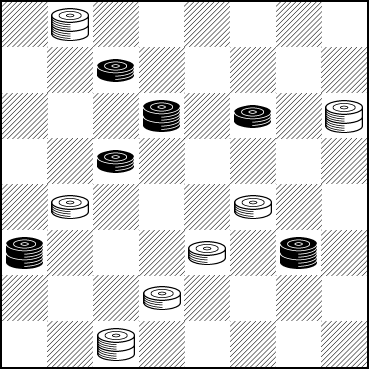
Here's a sample of a compound stroke problem. It was the winner of Contest #44.
Leo Springer
BLACK
WHITE
White to Play and Win
W:WK1,K12,17,19,23,26,K30:B6,K10,11,14,K21,K24
See if you can sight solve it; lacking that, set it up on your board and try moving the pieces around. But there's no need to compound your frustration; pounding your mouse on Read More will show you the solution.
Beacon Cafe: Among Friends
Thanksgiving was coming soon, and after today, the Coffee and Cake Checker Club would only have one more Saturday afternoon meeting before the 1955 Thanksgiving break.
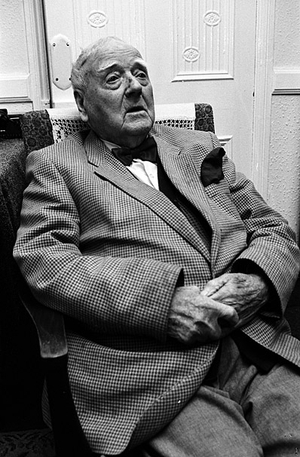
Sal Westerman
That break wasn't very long--- only one Saturday session would be missed, on Thanksgiving weekend--- but Sal Westerman loved his checkers and loved his little club. He had become a sort of minor celebrity around Bismarck, North Dakota after winning the North Dakota State Checker Championship last month, but he didn't care about fame. More important to him was the camaraderie and companionship he shared with the "boys" of the Club (all of whom were over 50).
It was a crisp and clear afternoon with temperatures in the low 30s and a bit of a wind starting to come up. Sal was the first one to arrive at the Beacon Cafe, where the club met.

Deana Nagel
"Going back to Gackle for the holiday?" he asked of Deana Nagel, who was the Cafe's proprietess and one of the best bakers anywhere around.
"Yep," Deana replied. "Closing for five days. A little vacation for me." Deana was a hard worker, keeping the Cafe open every day but Sunday and getting up early to make the delicious baked goods that everyone craved.
"What's fresh for today?" Sal said.
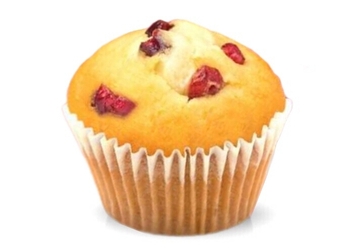
"Cranberry muffins," Deana said. "You and the boys are going to have a real treat."
Just then, Wayne, Dan, Tom, and Delmer arrived. "Ron and Larry can't make it today," Wayne said. "I ran into both of them at the hardware store. Ron's got to fix his furnace and Larry has a backed-up kitchen sink."
"Well, there's still the five of us," Sal said, "and I know one of you will be buying those cranberry muffins that Deana has."
"You mean you, don't you?" Dan said with a smile. "We might just beat whatever problem you're going to show us. You might be State Champ but you can still buy us muffins and coffee."
"We shall see!" Sal replied, smiling back. "Take a look at this. It's from Ed in Pennsylvania."
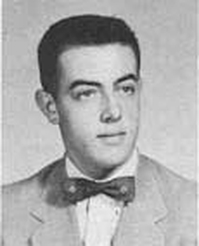
Ed
With permission
The boys weren't smiling any longer. Ed, one of Sal's checker pen pals, was a grandmaster problem composer, and his creations were always a challenge.
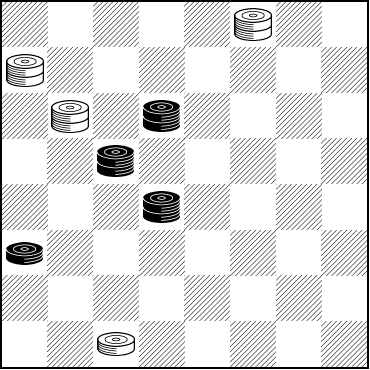
Sal set up the following position on one of the checkerboards.
WHITE
White to Play and Win
W:WK3,K5,K9,30:BK10,K14,K18,21
"How about I give you ... oh ... 30 minutes?" he said.
"Aw, Sal, how about an hour?" said Tom.
"45 minutes and not a second more," Sal answered.
With a quick glance at the clock, the boys started to work on the problem.
Cranberry muffins as a pre-Thanksgiving treat, with a hot cup of coffee to go with them? Sounds pretty good. Well, you'll have to supply your own muffins (and coffee) but the problem is there for you to enjoy. Do the best you can and then click on Read More to see the solution and the rest of the story.
Complete Checkers: Insights

Today marks a milestone in the history of checker publications as we announce the release of Grandmaster Richard Pask's monumental Complete Checkers: Insights.
Insights contains in one volume the newly edited and revised series of five books originally published electronically as the Logical Checkers series. Insights is available as a completely free PDF download or as a modestly priced print book, available from Amazon US as well as other Amazon sites worldwide. The print book is an 8" x 10" trade paperback, 630 pages, double column, with 1,024 diagrams comprising 366 lessons.
Insights provides everything the student needs to go from complete novice to accomplished expert, fully prepared for master level studies. We believe there has never been a checker book like this one in the entire history of the game.
We further contemplate the release of Complete Checkers: Repertoire as a companion volume in the same format at some point in 2022. Repertoire will be an edited reissue of the original Complete Checkers, 3rd Edition.
But for now you can download Insights here, or from the Richard Pask page linked in the right-hand column. Please do consider ordering a print copy if your means and desires so permit, as it will help us to recover the costs of producing this volume.
As always our thanks go out to Grandmaster Pask for his hard work and great generosity.
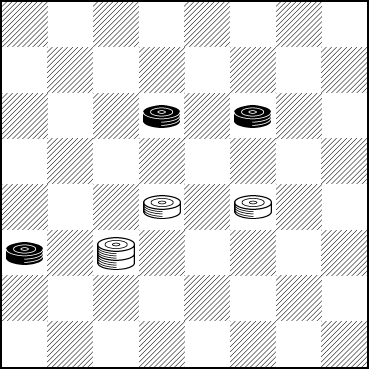
Here's a position from the book, credited to one H. Byars. Can you solve it? Give it a try and download or buy the book to see the solution.
WHITE
White to Play and Win
W:W18,19,K22:B10,11,21
The solution is found under Diagram 872 on page 474.
The Checker Maven is produced at editorial offices in Honolulu, Hawai`i, as a completely non-commercial public service from which no income is obtained or sought. Original material is Copyright © 2004-2026 Avi Gobbler Publishing. Other material is public domain, AI generated, as attributed, or licensed under CC1, CC2, CC3 or CC4. Information presented on this site is offered as-is, at no cost, and bears no express or implied warranty as to accuracy or usability. You agree that you use such information entirely at your own risk. No liabilities of any kind under any legal theory whatsoever are accepted. The Checker Maven is dedicated to the memory of Mr. Bob Newell, Sr.
.jpg)