The Checker Maven
The World's Most Widely Read Checkers and Draughts Publication
Bob Newell, Editor-in-Chief
Published every Saturday morning in Honolulu, Hawai`i
KingsRow Digs Into the Last of the "Lost" 3-Move Ballots
In the 1930s, the 3-move restriction style of play was introduced as a follow-on to 2-move restriction and the earlier go-as-you-please (unrestricted) play, in order to hopefully "energize" tournaments and reduce the number of drawn games. Leaving out duplicates and immediate losses, there are 174 possible 3-move ballots; initially, 137 of them were considered "playable."
Over time, that number went up to 144, and recently, 12 additional ballots have been added to the deck (see Richard Pask's book, The Golden Dozen, available for download on this site). Now, openings formerly thought to be overly one-sided, such as the Skunk, the Black Hole, the Twilight Zone, and others, are being seen in high-level competition.
This still leaves 18 ballots believed to be unplayable. But Ed Gilbert, author of the world-class KingsRow computer checker engine, is doing deep automated analysis to test this assumption.
Having recently completed calculation of a 10-piece endgame database (some 250 or more gigabtyes in size, including every possible position with 10 or fewer pieces on the board), Ed thought that intensive "book" analysis was the order of the day. After all, computer analysis, (along with skilled human analysis, of course) was a major factor in bringing the latest 12 ballots into play. Could there be hidden secrets in the remaining 18 ballots still thought to be a loss?
Ed expects book analysis of these last openings to take a few months. He doesn't necessarily expect to find that one of these is indeed playable, but he'll know the answer one way or the other in due course.
Ed explains his procedure and motivation as follows, with an interesting reference to Italian checkers: "I set up a computer to work on a book for the 18 'lost' ballots with KR 10 (KingsRow with the 10-piece database). I will let it run until all are confirmed lost. The reason I started this is that I just finished the 9-piece and partial 10-piece databases for the Italian game. What I found interesting is that I played out the 9 Italian ballots that I had labeled as probable losses, and in one of them it dropped out of book and instantly showed a database draw! I probed some of the other 'winning' attacks and think I might have found a draw for another one. I will have to build books to really confirm this, but it's possible that the 8-piece book was wrong about some of these lost ballots. Wouldn't it be neat if something similar happened with English checkers? If course I have already played out the 18 lost ballots with KR10 and did not find any obvious draws, and I think it is a lot less likely." (Playing out a position is a less conclusive but faster type of analysis than building a book.)

KingsRow Author Ed Gilbert
Photo: Carol Gilbert
Ed followed up later: "The book generator has only been working for about 3 days, but already most of the lost ballots have scores around 90 (meaning they are indeed losses). While it will probably take a couple of months to fully complete this job, if there are any that have drawing chances I may know much sooner than that. There are three left that still have low scores--- the Shark, the Cheetah, and the cousin to the Black Widow (12-16 23-19 16-23). While it is not very likely, I am hoping for a draw in one of these!" (In KingsRow, scores approaching 100 are just about certain losses. The lower the score, the more balanced the position. Scores of around 30 show a definite advantage but short of a sure win; scores around 10 or lower are highly likely to indicate drawn positions.)
We'll report further on Ed's results as they become available.
You can email the Webmaster with your comments on this article.
Checker School: Coming From Behind, Part 2

Pexels CC0
Today we present the second in our series of three lessons on classic "man down draw" positions. No one who has played more than a few games has failed to encounter some of these seemingly lost situations, and, most likely, missed out on a possible draw.
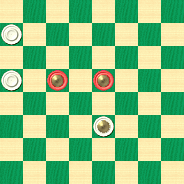
The position below is attributed to Dr. T. J. Brown, and found in Ben Boland's classic, Famous Positions in the Game of Checkers:
BLACK
Black to Play and Draw
We immediately note a similarity to last month's lesson: a single Black king is holding two White men at bay on the edge of the board. Once again, there is hope, and with careful play, Black can save the draw. (And we do mean careful play; a typical learner's attempt, 18-15, loses at once to 28-24.)
Work this one out for yourself, and then click on Read More for a detailed solution.
You can email the Webmaster with your comments on this article.
Time Flies
Needpix.com CC0
Time certainly does fly by, and all the faster when the clock is running on this month's speed problem. We'll allow you a full five minutes, or 300 seconds, to crack this one. It isn't really that hard if you find the key move. Click below to show the problem and start our relentless, unforgiving timer. Then click Read More to check your solution.
November Speed Problem (medium difficulty)
[Read More]You can email the Webmaster with your comments on this article.
Black to Move and Crown
Public Domain
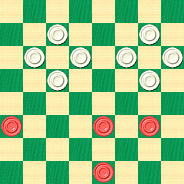
Here's one that's a little different, and although out of the mainstream of checker problems, we think you'll find it an interesting exercise in visualization. Here's the situation:
BLACK
Black to Move and Crown
For this puzzle, in which play adheres to the normal rules of checkers, Black is to crown a man while White is to prevent the attempt. Can you guide a Black man to the ranks of royalty? When you're done, click on Read More to see if your solution is truly noble.
You can email the Webmaster with your comments on this article.
The Electronic Works of Richard Pask
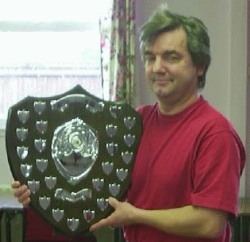
We've gathered together the free electronic publications of Grandmaster Richard Pask on a special page link shown in the Downloads section in the right-hand column (or just click here). All items (currently eight in number) are in PDF format for easy access without special fonts, and have been slightly edited to print correctly on both US letter and European A4 paper sizes. A small number of minor emendations have also been made to Mr. Pask's latest book, The Golden Dozen. Please enjoy these fine works, yours without charge due to the generosity of Mr. Pask.
You can email the Webmaster with your comments on this article.
The Double Steal
Rawpixel CC0
As we write this article, the 2005 World Series of baseball has begun, although when you read it, the title may already have been decided. Did the Astros complete their "Double Steal" and go all the way?
Regardless of the answer to that question, though, we invite you to "go all the way" to the solution of today's feature problem, a "double steal" theme by Tom Wiswell. You're sure to have an easier time of it than the Cards had with the Astros!
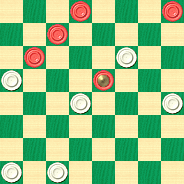
WHITE
White to Play and Win
White is a man up, but Black is going to even the score on his next move. Still, there is a way for White to recover the win.
Keep your eye on the ball, work out the answer, and then click on Read More when you've reached home plate in your solving.
You can email the Webmaster with your comments on this article.
Checker School: Coming From Behind, Part 1
PICRYL CC0
It's happened to any checkerist who has ever played beyond the starting position. We've gone a man down and we're looking for a way to at least save the draw. In the next few articles in our Checker School series, we'll have a look at some classic man-down draw positions. Now, depending on where you are in your checker career, this may be new material or just review. But either way, we're certain that knowledge of these positions will pull you out of many a predicament.
This month we'll start with a position attributed to A. Sinclair. Our solution and commentary is from Boland's classic work, Famous Positions in the Game of Checkers.
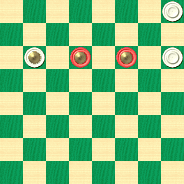
BLACK
Black to Play and Draw
Black is a man down, but he has two kings, to White's one, and the two White men are jammed on the single-corner side of the board. So Black might have a chance to rescue the situation.... but how?
Try this one out, and then click on Read More to nail down the technique.
You can email the Webmaster with your comments on this article.
A Bit of a Break --- for Coffee and Cake?
Public Domain
We'll give you a bit of a break with this month's easier stroke problem --- or will we?
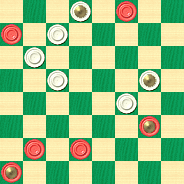
WHITE
White to Play and Win
You be the judge. Try out this puzzler, decide for yourself whether or not we've been easy on you, click on Read More to verify your solution, and then give yourself a break. We recommend that most delectable staple of checkerdom, coffee and cake.
You can email the Webmaster with your comments on this article.
Another Two Not So Easy Pieces
BLACK
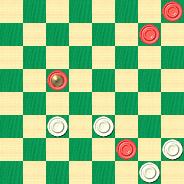
WHITE
White to Play and Win
'Ordinarily,white's cause in Example 15 would be hopeless. With the pieces even, and black's king on square 14 in a powerful center-of-the-board position, and the black piece on square 27 about to be crowned, further play seems to be futile. Despite all these symptoms of distress, white can engineer a flashy cul-de-sac in four of his own moves by resort to a "hook-up triple" or "aligned triple take." Alignment is the chief implement of all stroke and shot play. It means using ideas to force pieces onto certain squares by squeezing or pitching, so as to align (place) several pieces in position for successive capture. Can you force a triple take in Example 15? That's all there is to it!
BLACK
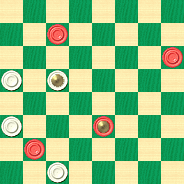
WHITE
White to Play and Win
Nothing so delights the beginner as a sweeping coup in which a number of pieces are swept from the board in one series of jumps. A casual glance at Example 16 does not impart the slightest suggestion of an impending coup, but nevertheless a "delayed long range triple" is in the offing. The white king on square 14, with the help of the piece on 21, makes a few well-forced preliminary moves and then, presto! the game is suddently climaxed with a ripping three-for-one shot, using what is known as a "throwback" technique. This give-away hint should enable rookie readers to develop some crafty ideas on how to handle the white pieces to make a win.'
You can email the Webmaster with your comments on this article.
A Turning Point?
Found on the web, in an otherwise serious and rather well done review of the Chessmaster for Xbox product:
"There comes a time in a person’s life where they feel the urge to make the leap from checkers to chess. This is considered a turning point in an individual’s mental development - the move from king me’s (sic) to En Passant’s (sic) is huge and requires excellent coaching and practice, practice, practice."
The Checker Maven isn't about to launch into one of those hackneyed checkers-vs.-chess debates; we play both games, and find depth and challenge enough for a lifetime in either one.
But, a turning point in one's mental development?
We'd wager a month's beer that the reviewer has never experienced checkers at anything much beyond the toybox level. In fact, we've personally invited him to drop by The Checker Maven website and try out a few of our simpler problems.
That just might turn out to be, in fact, a turning point in one individual's mental development.
You can email the Webmaster with your comments on this article.
The Checker Maven is produced at editorial offices in Honolulu, Hawai`i, as a completely non-commercial public service from which no income is obtained or sought. Original material is Copyright © 2004-2026 Avi Gobbler Publishing. Other material is public domain, AI generated, as attributed, or licensed under CC1, CC2, CC3 or CC4 and the various CC options. Information presented on this site is offered as-is, at no cost, and bears no express or implied warranty as to accuracy or usability. You agree that you use such information entirely at your own risk. No liabilities of any kind under any legal theory whatsoever are accepted. The Checker Maven is dedicated to the memory of Mr. Bob Newell, Sr.

.jpg)