Bob Newell
The World's Most Widely Read Checkers and Draughts Publication
Bob Newell, Editor-in-Chief
Published every Saturday morning in Honolulu, Hawai`i
Noticing missing images? An explanation is here.
Avi Gobbler Publishing
Avi Gobbler Publishing, the successor to Avi Gobbler Productions, and formerly a division of Mr. Fred Investments, now operates independently.
Created in 1987, Avi Gobbler Productions was formed to do professional audio recording and sound engineering. That part of the business was sold in 1996, but Avi Gobbler Publishing continues as a web and print content provider and publisher.
Avi Gobbler Publishing offers services to a select, limited clientele, and does not solicit business from the general public. For more information, write info@avigobblerpublishing.com.
You can email the Webmaster with your comments on this article.
Palm Computing
The Palm handheld computing platform, driven by the Palm operating system PalmOS, seems to be fading, but we often catch on to things a bit late in their life-cycle. We've been Palm users for about two years now, and have spent some time learning about these devices and putting together information and utilities, including some of our own.
This page is intended to present this information; it will develop as time permits.
For the moment, we have but a single offering. It's a Perl script, run on the desktop side, which does compaction of the Palm memopad database (MemoDB.pdb). We only recently discovered just how much wasted space can be found in this database, and our initial attempt reduced our own memopad from over 2.2 megabytes to just over 500 kilobytes, an unexpectedly enormous amount.
Download the script here and follow the directions provided.
You can email the Webmaster with your comments on this article.
Chess, Checkers, and Go: A Short Comparison
Editor's Note: We intend, at some point, to add a Xiang Qi section to this article.
I've been an on-and-off fan of abstract strategy games for as long as I can remember. My father, of blessed memory, taught me to play checkers when I was three or four years old. I learned chess at about age six. I didn't discover Go until graduate school.
I played chess pretty seriously during high school but ran out of spare time in college. Recently, as is obvious from this web site, I've taken a real interest in checkers. And, I've spent some time at Go a little while back.
So inevitably someone asks the age-old, hackneyed questions:
- Which game is best?
- Which game is hardest?
- Which game requires the most skill?
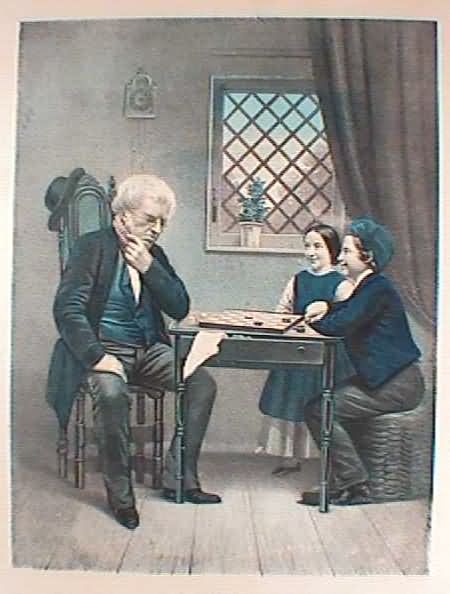
These are questions without answers. Each game is very different, one from the other, and each game has its own strong points. They are all the best, they all require a great deal of skill to play at an expert level, and they are all "hard" in a certain sense. Let's have a look.
Checkers has the easiest rules to learn. There are but a few. There are only two kinds of pieces and movement and capture is nearly uniform. The game's objective is easily expressed and easily understood: if you can't move, you lose.
Go probably is next easiest in terms of rules. Placing stones and capture is learned very quickly. The idea of "liberties" takes a bit of understanding, especially the idea of chains of stones and the liberties shared by a chain. But it still isn't very hard. The game's objective is easily expressed, but scoring is not really all that simple, especially given the myriad rule sets for scoring. (Chinese scoring is probably the easiest to grasp at first; Japanese scoring is a bit harder.) All in all, the game is relatively easy to learn but less so than checkers.
Chess is harder because there are many different types of movement and three kinds of capture (counting en passant separately). There are a few movement exceptions (e.g. castling) that need to be learned. The objective of the game, to capture the king, is easily expressed and understood. But overall, I'd have to say that chess has the most complex rules and likely takes the longest to learn the mechanics of play.
Checker and chess play is that of reduction: as the game continues the number of pieces decreases from an initial maximum or full setup. By contrast, Go is a game of accretion; it starts with an empty board and the number of stones on the board increases more or less steadily through the end of the game (with minor fallbacks for infrequent large captures).
Calculations as to move permutations will likely show checkers lowest, chess next, and Go after that. I base this on a simple observation: checkers has 32 playing squares and 24 pieces; chess has 64 playing squares and 32 pieces; Go has 361 playing points and up to an equal number of stones.
But in all cases the numbers are large enough to be effectively unlimited in human terms. So instead let's look at how the games are played in practice, with a very revealing note about computer play.
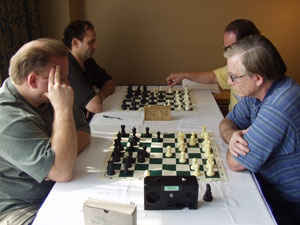
Checkers has been analyzed a great deal over the decades in terms of opening moves and opening move combinations. It is safe to say that these are reasonably well understood for the most part (with notable and very interesting exceptions). To some degree, computer analysis has really accelerated a more complete understand of checkers opening play. The number of opening lines is understandably fewer than in chess, where much analysis has also taken place and the published literature is phenomenal in volume.
In over the board play at a master level, a very good understanding of opening lines in both chess and checkers is an absolute requirement. At a less than master level, a good understanding is useful, more so, it seems, in chess than in checkers. In this respect, we'd say checkers is "simpler" because there are fewer opening lines to learn about.
Go is another matter. There are certainly opening patterns that need to be understood, but the whole feel is different. There isn't the same notion of "the 9-14 variation of the Ipswich" or "the Impossible variation of the King's Gambit Accepted." Go has patterns (joseki) and tactics (fuseki) that need to be learned, but it isn't quite the same.
Does this mean that Go is simpler? Certainly not. The variety of possibilities is so large that deep conceptual understanding is vital. And achieving that depth of understanding takes much time, study, and practice.
What does all of this say about play depth? Checkers has been characterized as narrow and deep; chess as broad and deep; and Go has a depth of its own, very different from checkers or chess. All three games have enough depth of play to last a lifetime. My own experience tells me that checkers is amenable to focused study; chess requires broader study due to increased "width"; while Go requires much patience and dedication.
This is borne out by the relative success of computer programs to play these games. Checkers programs have become extremely strong and play at the very highest levels of skill, and may in fact be the equal or near-equal of the best human players. Chess programs are likewise quite strong, but, despite the celebrated success of "Big Blue" aren't generally as good as the best human players. Go programs are another matter; the best of these is maybe as good as an intermediate human player, but no better. Go playing programs are very far from a master level of play.
This tells us two things: first, there is the obvious statement about depth of play, at least based on permutations of possible positions and moves. Second, it tells us that Go is more about global understanding and comprehension than it is about pure calculation; and this is probably why Go mastery seems (prodigies excepted) to be a longer-term affair than mastery of checkers or chess.

But let's address a final question, a more meaningful variation of "which game is best," and that is:
Which game do I like the most?
I can immediately say that, having once played chess seriously at a lower intermediate level of skill, I dropped out literally for decades, and only recently returned to competitive play. It had become hard work instead of pleasure. I had reached a point at which lots of study of opening lines was really necessary to move to a higher level, and, frankly, I didn't want to do it. Now, upon returning after such a long absence, I've learned how to balance my approach so that it's still fun. But I doubt I will rise above the intermediate category unless I devote a lot more time to the game.
I've only relatively recently begun serious checker play, and I'm still at a fairly low skill level. But I enjoy it immensely. I appreciate the economy of the rule set and game principles. While I need to study some opening theory, I'm not at a level where it's become so vital that it's a job or a chore in itself. And there's a certain nostalgia: it's a grand old game, one I learned from my father, and I think I honor his memory by keeping it up. It also requires less time to play a single game than chess or go, and given a busy life with limited spare time, this is no small matter.
Consider this: I might have an hour or so each evening to spend on-line, sometimes a little more, often less. A game of Go on a 19x19 board will take over an hour, maybe as much as 90 minutes. A game of chess is over half an hour, maybe even as long as an hour. A game of checkers is more like 15 minutes or less. It really makes a difference.
Go, for me, is a long-term project. It's fun to read books, solve problems from Go problem books, and build my knowledge slowly. But it takes too much time to quickly take the plunge. Games are long; there is much to learn; and I must be patient. I think Go will be a continued interest, but it will take a back seat to checkers.
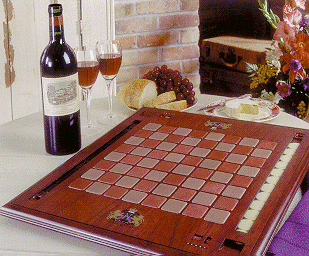
Bob Newell, Santa Fe, New Mexico, USA: last revision 14 April 2006.
You can email the Webmaster with your comments on this article.
The Two Cultures
I am a former, somewhat serious tournament chess player (even though it was quite a few years back). I am also a semi-serious, limited-talent checker player. Then, at the end of January 2004, I learned to play backgammon, expecting a familiar experience on a different board.
I got nothing of the kind.
While I took to backgammon reasonably quickly, moving out of the novice phase and into the varying beginner stages in rapid order, the backgammon experience was totally new and differed from chess and checkers in more ways than I ever would have suspected.
Now, I must qualify my remarks. Today, given my geographical location, most all of my play of any game is over the Internet. I do some turn-based play and some real-time play, but very little live play, if any. Additionally, I don't claim to be a good player at any of the games in question. But I do have decades of experience with board games of all types, in all venues.
So, for better or worse, here is a summary of my observations to date. These are just things as I see them. Feel free to disagree, make corrections, or simply blow it all off. But I think there really are "Two Cultures" and it came as a bit of a surprise.
I'll make my comparisons between backgammon and checkers, my two current interests. But the same applies to Chess, Go, Xiang Qi, and other abstract board games of strategy.
Determinism
The first thing a transplanted checker player notices with backgammon is the presence of dice: a randomizing element which throws our beloved determinism out the door.
In checkers, you're in control of your destiny. You make whatever move you wish, and your opponent may do the same. No such thing in backgammon. You move according to the possibilities allowed by the roll of the dice. In other words, there is a substantial luck factor.
Now, I found out quickly that backgammon is inherently very much a game of skill; a superior player won't win all the time, but will in the long run win much of the time. It's the short run, though, that makes backgammon both fascinating and frustrating.
In checkers, you might spend twenty or thirty moves building up a narrow edge. Slowly but surely, through careful play, the narrow edge widens. Eventually you bring through a hard-earned win.
In backgammon, you might have built up a substantial lead. You played carefully and correctly. Then all of a sudden your opponent rolls double sixes twice in a row and the game is over. You've lost. Your hard work and effort were to no avail. (It works in reverse, too, but we tend to forget those instances.)
Checkers is deterministic; backgammon is probabalistic. There's all the difference in the world, and I believe that it is this very difference that drives the rest of the cultural divergences that I'm about to describe.
Depth of Analysis
A common question asked of an expert checker player is, "How many moves ahead do you look?" While the answer depends on the situation, master checker players can visualize play quite far in advance, sometimes twenty or more moves per side, or forty or more plies, to use computer game programming terminology.
In backgammon, a lookahead of such range would involve an intractable number of potential situations. In checkers, only a single move is made per ply, and the range of possible moves can be easily enumerated.
But in backgammon, not only is more than one piece moved, as a rule, but the range of possible moves is described by the range of possible dice rolls, twenty-one in all. So each ply might involve a universe of something like 300 possible moves (in rough terms, seven or so checkers, times two possible moves each, times 21 possible dice rolls). A 3-ply analysis is already pretty large (perhaps twenty million or more positions to consider).
In addition, these potential moves have associated probabilities, a complication not faced by checker players. In backgammon, you might play the odds, making a certain move because a potential damaging reply is of low probability. Not so in checkers!
This makes the approach to play very different indeed, and calls into play a different skill set; in addition to visualization, mathematical calculation and intuition are required, plus a certain element of daring.
The Cube
It is said that the invention of the doubling cube has had a profound effect on backgammon, and indeed, skill with the cube is one of the most difficult aspects of the modern game. It is a device found in no other classic board game that I know about.
Could you picture a doubling cube in checkers? You get an advantage of some kind, perhaps an early king, and you say "double" and the opponent folds quietly? I can't picture it either. Why, then, does it work so well in backgammon?
I think there are two major reasons. One is the previously discussed probabalistic nature of the game. Making, taking, or passing on a double is in effect an evaluation of your odds of winning or losing, given the fact that dice are involved. A double when leading is often an attempt to bypass the dice, saying, I'm likely to win, do you care to risk twice the score on my being wrong? There simply isn't any such concept in checkers. (But doubles and redoubles exist in bridge, another probabalistic game.)
The second reason will be treated at more length below, but is based on backgammon being played in two modes, either "money" or "match." In a money game, doubling increases the stakes. In a match game, the stakes are likewise increased but in terms of match points rather than cash. Checkers is played a game at a time, for a point at a time, period. If there is a match, it will be a certain number of games, and a certain number of wins and draws will take the match. Each game counts the same. In, say, an 11 point backgammon match, doubling can make an enormous difference. With a couple of doubles, a single game could amount to four or eight of the 11 points, or in an extreme case, even the whole match.
Speed of Play
What is amazing to a transplanted chess or checker player is the speed at which backgammon is played (in head-to-head competition) and the impatience most players have with slow play. Tournament checkers might require 50 moves in an hour in modern play; vintage era checkers required just one move in five minutes. No such thing with backgammon. Averaging ten seconds on a move is considered slow play and five seconds per move is closer to the norm (and there are stats to bear this out).
What drives this lightning speed, which seems to require the coordination and reflexes of a fighter pilot? It is very much part of the culture; I believe it has to do with a desire to get in a lot of play in a short time, due to the presence of money stakes (about which more soon). Time is money, literally.
To be sure, even checker play on the Internet is much faster than over-the-board or tournament play. This has more to do with the impatience factor of Internet users and players than with anything else; but head-to-head backgammon on the Internet experiences the double whammy of Internet impatience and the backgammon speed culture.
The Money Culture
Here we come to a major distinguishing factor between checker and backgammon play. Live (non-Internet) backgammon play almost invariably involves money, sometimes a great deal of it. Live checker tournament play may have cash prizes, but that isn't the point. Backgammon tournament players seek "equity" while checker players seek play for the sake of play (at least mostly).
Let's look at typical tournament entry fees. Checker tournaments run anywhere from $10 to $50 or so to enter, usually closer to the bottom end of that range. Backgammon tournament fees, beyond novice class, seem to be in the $100 or higher range, and more like $200 for "open" class events. Master class events can be $500 or $1,000 or even more. Tournament brochures talk about "90% return" meaning that 90% of entry fees are returned as prizes. What's going on here?
First, the tournament organizers are being rewarded for their efforts (that's where the other 10% goes, after expenses). Second, the players want a goodly sized prize fund, and they pay to get it. In addition to entry fees there will be side pools and auctions. What checker tournament has such things? What checker tournament organizer ever expects to make money for himself?
Live-play backgammon is all about gambling.
In fact, as noted earlier, non-match play is called "money" play. A wager of so much per point usually rides on each game.
To say that backgammon is about gambling is not a criticism; other games of skill, such as poker, are about gambling. In fact the correlation between probabalistic games of skill, and gambling, is quite clear.
This is not to say that wagers are never made on games of checkers or that cash prizes are not offered. They are, in both cases; and at the world championship level, a purse is put up to (at least) cover the expenses of the contestants. But the very nature is different. Checkers is simply not a gambling game.
For one thing, in checkers, a player who is noticeably better than another is likely to win every game. How long would one continue to bet when the outcome is very easily predicted? At least in backgammon, there are the dice, and a much inferior player will win once in a while.
There are side effects to the gambling and money culture nature of backgammon. Backgammon books sell for much higher prices than checker books even though backgammon books are in more plentiful supply. Why? It's about equity. How much do you expect to increase your backgammon earnings after you've studied a particular book? That will in part determine what you're willing to pay for it. A checker or chess book, on the other hand, is not likely to bring you very much playing income. I am told, too, that backgammon lessons from backgammon pros cost more than, say, bridge or Go lessons. While I don't have direct information on this, certainly the equity issue could drive such pricing.
Now, Internet backgammon play seems to be at least somewhat counter-culture. Much Internet play is simply play. There are some sites that offer play for money; I don't at present have a gauge for how popular this is. I would certainly imagine that the perceived risks in Internet gambling would limit this type of play. Of course, there are also a few Internet checker sites that offer play for money but my observation on repeat visits is that this type of Internet checker play is pretty much a non-event.
Conclusion
In the board game world, there are indeed two cultures. The split is very clearly along probabalistic vs. deterministic lines. Probabalistic games are in a world apart from deterministic games. The primary difference lies in the money culture of probabalistic play, but there are other differences in approach and analysis.
There are many instances of successful crossover play; and at least one backgammon pro is also a chess grandmaster. But if you have been a long-time deterministic gamer, such as a checker or chess player, be prepared for true culture shock when entering the world of the probabalistic board game, such as backgammon. I imagine the reverse might be true as well, although I have no direct experience there.
There is one question I have not approached, and that is the question of "Which is better?" That is in fact an invalid question because the answer is purely subjective. What is better is what you like best, whatever that may be. In my own case, I'm most likely to continue with Internet (non-gambling) backgammon, while largely avoiding live, gambling-related play. In fact, this is an adaptive strategy that may well suit deterministic to probabalistic crossover players, at least initially.
Of course, I won't give up my games of checkers, chess, and go, duffer though I may be. And who, having once experienced backgammon, could possibly leave it behind?
I think, in fact, that I've learned how to get the best from both of the Two Cultures.
Copyright ©2004, 2006, 2017. All rights reserved. May not be reproduced in any form, including copying to another web site, without express permission. Links to this article are permitted.
You can email the Webmaster with your comments on this article.
We're Sorry, We Can't Find That Page On Our Site
Our web site always grows and evolves, and at times things might move. Please check the links in the right-hand column and you're likely to find what you're looking for.
But don't hesitate to contact our Help Desk if there's really something missing or if you'd simply like us to help you out.
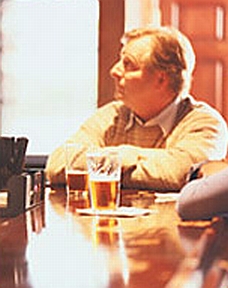
A fan at a local sports bar watches
Marvin J. Mavin
play in a match broadcast on the
Checker Television Network
You can email the Webmaster with your comments on this article.
Yomi Calculators
You can email the Webmaster with your comments on this article.
It's Your Turn "Pro Checkers" PDN Fixup
It's Your Turn doesn't produce correct PDN for 3-move restriction ("Pro Checkers") games; the balloted moves are omitted from the PDN output. You can fix that on this screen.
You may wish to print these instructions and bookmark this page.
- Go to the final end-of-game screen for the game of interest. In your browser, do "Select All" and then "Copy." (How you do this varies by browser but often Ctrl-A followed by Ctrl-C will work. If you are using a Mac you use the 'Apple' key instead of Ctrl.) Don't just copy the move list! Copy the whole page.
- Come back to this screen.
- Click in the box below and do a Paste in your browser (often Ctrl-V).
- Click on Submit for Conversion.
- You will get back a screen with a full PDN file.
- In your browser click File, Save As. Ignore any warning messages.
- Very important: be sure the "Save As Type" is set to "Text".
- Save the screen under whatever name you wish.
- The file you just saved is ready for use with any checker program that can correctly read PDN notation.
Please help out by reporting problems and errors to ChipsChap.
You can email the Webmaster with your comments on this article.
Alternative Scoring Systems for Avalon Hill's "Dispatcher"
Rediscovering a Classic
I played Dispatcher when I was a grade-schooler, when it was a relatively new game, back then in the early sixties, during my youth in New Jersey. It was a lot of fun to lay it out on a picnic table, outdoors on a fine summer day, and play it with neighborhood friends.
None of us ever really mastered the game, and neither did we question the rules. Game rules, to us in those times, were handed down from above, inviolable and sacrosanct, based on the certainty that the game author had superior knowledge and was likely a superior being. And besides, we were having a lot of fun and didn't care about much else.
Now, some four decades later, I've returned to Dispatcher. By luck I obtained a slightly scuffed used set for the sum of $17, which apparently is a real bargain from a collector's standpoint. (I did need to generate a few missing counters with a desktop drawing program. Times have changed; as kids we would replace a missing game piece with something scrawled on cardboard.) Imbued with the knowledge of age (or at least liking to think so), my view of the author's omniscience has changed. In short, Dis- patcher has failings and shortcomings.
Playing through the game, that sense of realism that I thought was there so long ago fell somewhat short now. To be sure, Dispatcher is a great game, and it is certainly still a great deal of fun. But I'd like to set out some thoughts about what bothers me about the original game, and what I think can be done to square things away.
Global Optimization vs. Competition
Dispatcher's existing scoring system, assigning demerits based on various factors, doesn't seem to work well. It was clearly designed with the needs of a competitive two-player game in mind, and that shows in the implementation.
That's fine as far as it goes, but it's a bit forced, because Dispatcher as a two-player game is a bit forced. Dispatcher is a consummate solitaire game, because the game is really at its best when the goal is not victory over an opponent, but global optimi- zation of the entire system.
To be sure, the two-player game tends toward a certain amount of a certain kind of optimization. But that optimization is done in separate divisions of the system, and "winning" the game often involves tactics which force non-optimal conditions on the oppo- nent. How often have you piled up freight trains at the east- west division at Glen Yard, knowing your opponent won't be able to handle the situation and will earn additional demerits under the existing game rules?
It is far better and a greater challenge to play the game in a solitaire or a cooperative mode and attempt to truly run the railroad. But the existing demerit system really doesn't promote that. Let's take a closer look.
Dispatcher by the Rulebook
First-class trains are considered the most important trains in the game, and running them on schedule is supposed to be the top priority. Those passengers can't be late, and the mail must go through. Next in importance, and sharing a similar demerit scoring system, are the merchandise express trains. (There are only a few of these, but the principles apply nonetheless.) First-class trains and MEs are assigned demerits according to these rules:
1. Each game-turn that one of these priority trains suffers a delay, by not being able to move its full movement allowance, demerits are awarded equal to the full movement allowance of the train. In other words, if the train can't move one space, repre- senting a 15 minute delay, it's treated the same as if it can't move several spaces, representing, in the case of a completely immobile first-class train, a delay of a full hour. For each game-turn that this "short" movement takes place, additional demerits are awarded. This bears some relationship to a train arriving late at its destination, but as we will see, not nearly enough.
2. If a train is mis-routed, no matter how badly, even if it is sent all over the system, it receives one full set of demerits, but no more. As long as it moves its full movement allowance every game-turn, a train can go anywhere it pleases with only one set of demerits.
3. Non-priority trains (the blue "freights") receive one demerit for each game-turn that they rest in their starting station without being moved out onto the railways. They also receive one demerit for each game-turn they rest in the east-west transition area at Glen Yard. According to the original rule- book, the former part of the rule is to penalize players who are very conservative and simply don't move their freights out. The second part of the rule, while having to some extent a similar purpose, seems to be targeted at the two-player "competitive" aspect of the game. One player can pile up freights in the transit yard at the expense of the other player, who will have to deal with the situation.
The sum total of these scoring rules simply doesn't lead to optimization of operations. I'll present a few key points that I believe represent "railroad-like" behaviors, which the rules should encourage. Then, let's see (a) how close the original rules come to this ideal state (or ideal as I see it) and then (b) how the rules might be changed to achieve a closer match-up. And remember, I'm looking at this more from the standpoint of "how to run a railroad" instead of what might make for two-player competition.
How to Run a Railroad
What would a "real" railroad system try to achieve? Let's look at this as it might have been in the early fifties, an era that the game could easily represent. (We certainly won't look at the railroads of today, where, in the United States at least, passen- ger travel other than on commuter lines barely exists.)
1. First-class trains, representing passengers and mail, clearly are of top priority. People must be transported to their destinations, not only on time, but in style. Mail can't be delivered late. And some critical or special-order merchandise must be delivered on-time, all the time. Delays simply aren't acceptable in this part of the business.
2. Freight needs to get to its destination in a timely manner. It is not on a fixed schedule per se, but certainly must be somewhat predictable. This means that there is a maximum acceptable delivery time. Freight needs to get where it's going within, say, 24 hours, and any arrival time within that time period is completely acceptable.
3. The railroad would run to maximize profit (rather obvious). While freight revenue was probably much of the profit even in the fifties (look at the large number of freights represented in the game), it seems that the freight revenue was in some sense "protected" by the reputation garnered by running crack first- class services.
All of this points to the need to place quite a priority on passenger operations without sacrificing efficient delivery of freight.
So How Close Did Charles Roberts Come?
The rules of the original game ensure that most demerits will occur from not moving freights out, although moving too many of them out will cause increasingly large demerit accumulations from delayed passenger trains. But there are some real anomalies.
1. Moving out a freight train and simply parking it somewhere avoids all demerits. (This is not as simple to do as I make it sound. But the principle applies.)
2. Keeping a passenger train moving, even if it's moving the wrong way, avoids all but a token single set of demerit points. Having a train arrive at its destination, much less arrive on time, is only an indirect goal (because demerits accumulate only when a train can't move its full allowance).
3. Piling up trains at the east-west junction at Glen Yard is virtually encouraged. This hardly leads to optimized global operations, although it leads to competitive advantage in a two- player game.
It appears, then, that the game strays rather far from an ideal global state. The player can, and will, do some rather odd things which are driven by the scoring system rather than by a desire to run a good railway operation.
Making Improvements
Let's look at some different ways to conduct business. We'll base them on a few principles derived from our analysis of the "ideal state" discussed above.
1. Passenger trains and specials need to arrive on-time. There is really no other measure of success. They need to take a prearranged path, as "waypoints" could well represent mail drops and the like. (The game doesn't seem to deal with traffic on anything but a point-to-point basis. While trains have certain timetable listings for various towers, they don't have intermediate station stops, although they sometimes have required routings. We won't try to deal with that here; we'll just take it as is.)
2. Freight trains should reach their destinations within the 24 hour period represented by a complete game. (We also won't deal with the so-called "shorter" games suggested in the rulebook, which simply don't work.)
Developing New Rules
Let's look at some ways to implement the principles described above. Let's state our first two principles:
1. First-class and second-class trains that arrive on-time at their destination (and required intermediate routing points) garner no demerits.
2. Freight trains which arrive at their destinations, via any required intermediate routing points (i.e. an AV-EL train) garner no demerits.
And now let's see how we earn demerits:
1. First-class and second class trains that arrive late to their destination or any required intermediate routing points earn demerits as follows:
D = L*T*>P
where
D = demerits
L = number of 15-minute increments late
T = train factor (Tf = 4 for first-class, and Ts = 3 for second- class)
P = parameter, different for first and second class, discussed later, and called Pfl for late first class trains and Psl for late second class trains
Intermediate routing point demerits and final destination demer- its are not cumulative; the larger of the two is used. (This actually makes sense in considering rule 2 below.)
2. For first and second class trains that don't arrive at all by the end of the game, the following slightly complex rules are used (these do not apply to a train that crashed; see below).
D = G*T*P + U
where
D = number of demerits
G = number of sections of track left to travel to a possible intermediate routing point and to final destination (not cumula- tive, but defines the path for counting the sections)
T = train factor, as in rule 1
P = parameter, different for first and second-class trains, call Pfg and Psg, and discussed later.
U = late calculation from rule 1 as follows: assume that the train had just arrived at the final destination at the very end of the game, and calculate the late penalty accordingly
3. For third class trains that don't arrive at all by the end of the game, apply rule 2 above with
T = train factor = Tt = 2
P = Ptg
which will be discussed shortly. Notice that this increases the need for planning. You can't simply shove any old third-class train onto a track, as you could in the original rules. Instead, those trains that need to travel farther have to leave earlier if they are to avoid non-finishing penalties.
Selection of the various parameters is all-important. Non- arrival of first and second-class trains is somewhat serious (especially given the timetables, which make this unlikely except in a case of really poor management). So non-arrival penalties factors should exceed late penalty factors and parameters must be chosen accordingly.
The distance factor, G, does not take into account the fact that a non-finishing train might not (and likely can't) proceed to the destination (after the end of the game) in a direct and undelayed manner. This calls for an increase in the various P-g parame- ters.
In the odd case where a train has reached a required intermediate point but then didn't finish, we apply the late train penalty for the intermediate point and the non-finishing penalty for the final destination.
The choice of the five parameters, Pfl, Psl, Pfg, Psg, and Ptg, also determine the economic balance between the various classes of trains (although T, the train factor, builds some of this in already; in fact T is not really necessary but it makes things more explicit and visible and can also be used to control the relative scoring structure).
Setting Parameters
The parameter choices need much research and game-play to fine tune, and I invite suggestion and comment. I'll simply suggest one set of parameters that seems logical and let you explore further on your own if you wish.
Pfl and Psl can be set to 1 for simplicity, and behavioral rules incorporated into the other parameters.
Pfg and Psg need to be set such that late arrivals cost less than non-arrivals. As an example, suppose a first-class train fails to finish at a distance of ten track sections from the final terminus, and it was due in two hours ago. According to the late formula, formula 1, the train earns 32 demerits, which becomes factor "U" in formula two. This represents how late the train already is. The ten track sections represent how much later it would be if it were to proceed direct to its destination (after the end of the game. How much higher should the penalty now be for not finishing, taking into account that further delays are possible, and that not finishing is a bad thing? If Pfg were equal to 1, we would have 40 demerits, surely too low. If Pfg were equal to 2, we would have 80 demerits, for a total of 112. This may seem high but it accounts for perhaps 50% additional delay and a 50% non-finishing penalty. For second-class trains a similar argument might apply and setting Psg to 2 may also be appropriate.
Setting Ptg, for third class trains, is critical in import. Let's say a freight finishes the game the same 10 sections from its destination as in the example above. Now, how far away it is doesn't matter except in how it influences how late we can expect that train to be. Freights are slower, so that means if there were no further delays, it would be five hours late. To reflect this in comparison with first-class trains, Ptg has to be at least 2 (twice as slow). Ptg of two would yield 40 demerits, or a little less than a third of the first-class train total above.
Now, there is no late arrival factor for third-class trains, which implies that Ptg ought to be a bit higher, but not too much since these are non-timetable trains. But, it should be higher still considering possible additional delays. Ptg of three yields 60 demerits, or about half of the first-class train example. This makes first-class trains about twice as important as freights. Is this appropriate?
In the original rules, there is no way any freight could get more than 24 demerits absent a collision. On the other hand, a first- class train could get up to 96 demerits in an absolute extreme case. Typical numbers are hard to justify, but you might say 8 demerits for a first-class train and 12 for a freight might actually occur on the average (I have nothing to back this up with). Now, in my proposed system, we're working with much higher numbers, but we're interested in the ratio as an expres- sion of relative importance.
So if we have first-class trains roughly twice as important as freights, what behaviors do we drive? Essentially, if we have trouble with three freights that would allow us to sacrifice a first class train to obtain a probable better score. To me that seems low. Five or six freights seems better.
So I'd leave Ptg at 3, move Pfg up to 4, and Pfl up to 2. This would, in our example, give us 264 demerits for the first-class train and 60 demerits for the third-class train. We're getting closer now. This is just over a four to one ratio and looks about right.
In summary:
Pfl = 2 Tf = 4
Psl = 2 Ts = 3
Pfg = 4 Tt = 2
Psg = 4
Ptg = 3
What About Collisions?
A collision is really serious, so serious that it should never happen. The original rules awarded 50 demerits for a collision (presumably per train, or 100 in all). With the higher numbers generated by my proposed scoring system, collisions need to be evaluated differently, and need to be related to the parameter factors shown above.
My formula for a collision, applied per-train, is:
D = C*P*100
where
D = demerits
C = 15 for a first-class train, 3 for a second-class, 2 for a third class train
P = Pfg, Psg, or Ptg depending on the train class
The collision factor "C" is much higher for a passenger train because of the injuries that would result. Thus a passenger train collision would incur 6000 demerits, a game-wrecking amount, and I think rightly so. If you disagree it is simple enough to adjust the "C" factor. A third-class train would incur 600 demerits, a more modest number but still quite significant.
Conclusion
No matter what the scoring system, Dispatcher is, absent the random event cards, a closed-form game which will have an optimal solution (even though it's hard to find). Computer analysis would be really interesting (any takers?) as a means of finding the best solution. "Best" of course will vary with the scoring system. Having such a computer program, and varying the rules and parameters would be a fascinating study, but one that is not likely to be done soon.
I would certainly love to hear from other Dispatcher enthusiasts. What rules do you play by? Do you stick to the originals or have you too developed your own system? What do you think of my system? Are the parameters right? There is a lot here to dis- cuss.
I can be reached for the indeterminate future at:
and I welcome your e-mail.
Bob Newell, Santa Fe, New Mexico, October 14, 2001; Minor revisions February 6, 2006
In true retro fashion, this document was composed in its entirety with WordStar 5.5 on an Epson Equity II (286) computer.
You can email the Webmaster with your comments on this article.
EMACS/ELISP Code and Programs
Here is a small collection of some Elisp that we've written for our editor and, in a sense, PIM of choice, EMACS. This code is known to (mostly) run on Emacs 20 and 21 for Linux, and probably Windoze. It may run on Emacs 19 as well, but testing all-around is minimal.
EDB, the Emacs database, is required for most of these. Get it here.
The first application is for "spaced interval recall" learning, based to some degree on the excellent Supermemo system. We call the EMACS version "ELIP" for "EMACS Learning Instruction Program." Try it . It's now at beta release 0.8xx and includes numerous databases, features and options;
- A 40 item "sample" Hawaiian vocabulary database.
- A 120 item Esperanto grammar database.
- "I Have a Dream" speech database.
- Import and export of question/answer items from/to text files.
- Ellipsis-style item generation from arbitrary text files. The Esperanto grammar database was generated in this manner from a public-domain web page in only 45 minutes.
- Interval-based repetition of items according to difficulty and a built-in optimization algorithm (which can easily be modified).
- Learn new items at the pace you wish.
- Complete global and individual question reports, stats, and tables, with flexible sorting options.
- A "Leitner" flashcard/pigeonhole learning option.
- A "text-mode" learning option for memorization of text passages. See if you can memorize the famous "I Have a Dream" speech.
- A "flashcard mode" for rapid review of old items, preview of new items, or extra practice on the hardest items.
- Full documentation.
Both ELIP and EDB are now maintained by Thien-Thi Nguyen and the links above reflect that change. Mahalo to TTN for taking on ELIP!
Unfortunate note: The Talmud files referenced below haven't been updated to the latest version of the EDB database.
Pretty much complete now is the Talmud Bavli Learning Log, inspired by a very nice Windoze program called Gemara Tracker. This is of interest mostly to Jewish scholars who study the Babylonian Talmud (the Bavli) and would like good records and notes of their learning. Again, try it and give us some feedback. And here is a companion version for those bold students of the Jerusalem Talmud (the Yerushalmi). Versions for Mishna Yomi, Halachah Yomi, Kitzur Shulchan Aruch Yomi, etc.? Perhaps some day.
There's also a recipe database manager that is perhaps nothing special except that it allows you to save your recipes and easily and quickly produce LaTeX output for printing. It seems very effective; my own database is over 100 megs and 117,000 recipes and it runs much faster than you would ever expect.
And, here is a speedreading system; teach yourself to read faster. With numerous options to control speed and amount of text, this has proven to be an effective tool, and in fact has been accepted into the mainstream EMACS release for a later date.
Please send comments, suggestions, and bug reports to oldelisp@bobnewell.net.
The legal stuff: this software may be used for free for any purpose you wish, but it is not public domain and we retain all rights. There are no warranties of any sort and no support is offered. We take no responsibility for damages of any nature, whether direct, indirect, consequential, or otherwise, even if you have notified us of the possibility of such damages. You are responsible for determining the suitablity of these codes in your own environment.
You can email the Webmaster with your comments on this article.
LaTeX Checkers, Chess, Go, and Skat Scoresheets
Here is a package of scoresheets for checkers, chess, Go, and Skat, developed with our typesetting system of choice, LaTeX. We think that these are among the best looking and most utilitarian scoresheets available on the web, and of course, they're completely free.

Download the complete package here.
The package includes the LaTeX source files, pre-made PDF files, and a short description.
These are very easy to use, and can be printed on any reasonably up-to-date printer.
If you are familiar with LaTeX and LaTeX options and packages, you can customize the forms all you wish.
Complete directions for printing and using the forms is provided within the scoresheet package.
Comments and suggestions are requested; write bobnewell@bobnewell.net.
You can email the Webmaster with your comments on this article.
The Checker Maven is produced at editorial offices in Honolulu, Hawai`i, as a completely non-commercial public service from which no income is obtained or sought. Original material is Copyright © 2004-2026 Avi Gobbler Publishing. Other material is public domain, AI generated, as attributed, or licensed under CC1, CC2, CC3 or CC4 and the various CC options. Information presented on this site is offered as-is, at no cost, and bears no express or implied warranty as to accuracy or usability. You agree that you use such information entirely at your own risk. No liabilities of any kind under any legal theory whatsoever are accepted. The Checker Maven is dedicated to the memory of Mr. Bob Newell, Sr.
MAVEN, n.:
An expert or connoisseur, often self-proclaimed.
Articles
Numbered Board and Notation
Book Reviews
Game Site Reviews
Program Reviews
A Mind Sport for the Common Man
Learning Checkers
The Unknown Derek Oldbury
Rediscovering Checkers
Regulation Checker Sets
Marvin's World
Downloads
Richard Pask Publications
Reisman: Checkers Made Easy
Clapham Common Draughts Book
Grover/Wiswell: Let's Play Checkers
Bob Murray's School Presentation
Jim Loy Publications
PDN collections
Oldbury: MoveOver
Reinfeld: How to Win
Ginsberg: Principles of Strategy
Draughts Books of the 20th Century
3-Move-Deck