The Checker Maven
The World's Most Widely Read Checkers and Draughts Publication
Bob Newell, Editor-in-Chief
Published every Saturday morning in Honolulu, Hawai`i
The Fugitive King
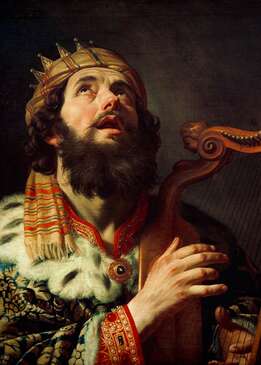
PICRYL CC0
Perhaps the most famous royal fugitive, King David, is to be found in the Scriptures. He spent 15 years in exile, fleeing from King Saul. Strictly speaking, David wasn't yet a king during his fugitive years, but he is nevertheless often referred to as "The Fugitive King."
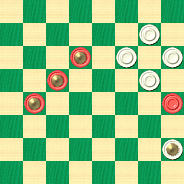
Today's entry in our Checker School series deals with a checker-related "Fugitive King" theme. This problem is reminiscent of the "Fortress" situations that we've covered in several earlier columns, although here if Black plays correctly the White king will find no refuge.
WHITE
BLACK
Black to Play and Win
B:W25,22,21,17,K5:BK23,K19,K16,13.
The problem requires very precise play and the solution is not short. We certainly have to rate this one as quite difficult. But don't go on the lam; try to solve it! When you're finished, run your mouse over to Read More to see the solution, a sample game, and detailed notes.
You can email the Webmaster with your comments on this article.
Thanksgiving 2012
Public Domain Pictures CC0
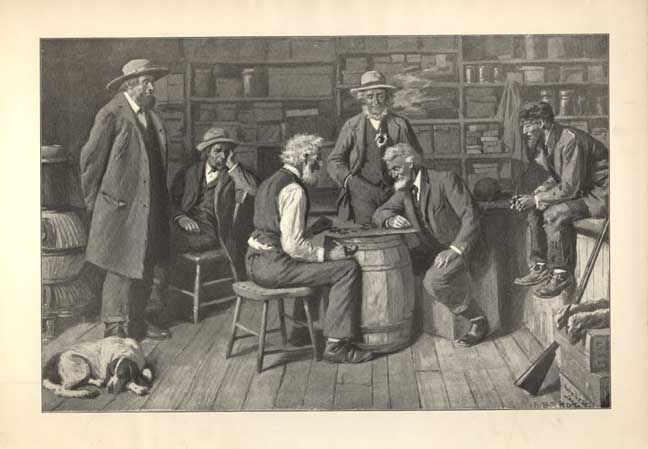
Thanksgiving, our favorite all-American holiday, is soon upon us, and we hope you enjoy the celebration as much as we do. Family dinners, such as the one shown above, are a holiday tradition. Can you recognize the family in the photo?
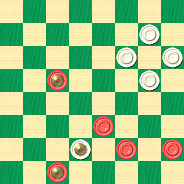
As usual at this time of year, we turn to our favorite all-American checker problemist, Tom Wiswell, for today's selection.
BLACK
Black to Play and Win
B:W25,22,21,17,K7:BK19,10,6,5,K3.
Add a few moments of checker enjoyment to your holiday. Solve the problem after your main course and before dessert. Then have a second helping of turkey and a slice of pumpkin pie. Mr. Wiswell describes this problem as "more amusing than difficult." While it requires precise play, it certainly isn't as difficult as some of his others.
When you've found your solution, click on Read More to verify your moves.
You can email the Webmaster with your comments on this article.
Lieber's Catapult
Picryl CC0
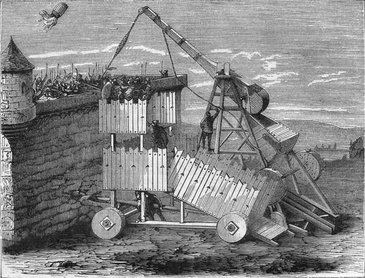
You're likely to see catapults similar to the one shown above in many an epic movie set in the Medieval period. They were fearsome siege devices; they would sling heavy rocks or Greek fire over a substantial distance in an effort to breach the defenses of the targeted castle.
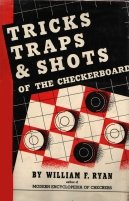
In today's entry from Tricks, Traps & Shots of the Checkerboard, Willie Ryan's classic, we present an aptly-named catapult in our game of checkers. Here's Willie's run-up and very brief description.
9-14, 22-18, 5-9, 24-19, 11-16, 26-22, 7-11---A, 22-17, 16-20---2, 30-26---B
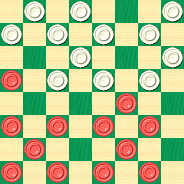
BLACK
Black to Play and Win
B:W32,31,29,28,27,26,25,23,21,19,18,17:B20,14,12,11,10,9,8,6,4,3,2,1.
A---"A somewhat inferior line of play---1, but the trap at B is well concealed.
B---Caught!"
1---We're not really sure why Willie calls this move inferior, as it seems to be the best move, with the computer evaluating 10-15 as slightly worse---Ed.
2---Definitely inferior to 11-15. Perhaps Willie misplaced Note A and meant to put it here---Ed.
Can you take the leap and solve this one? While you're finding the winning Black move, spring back and correct White's losing play at 30-26. This isn't a shot in the dark; it's scientific checkers at its best. When you're finished, fling your mouse to Read More to see the solutions and detailed notes.
You can email the Webmaster with your comments on this article.
Really Easy
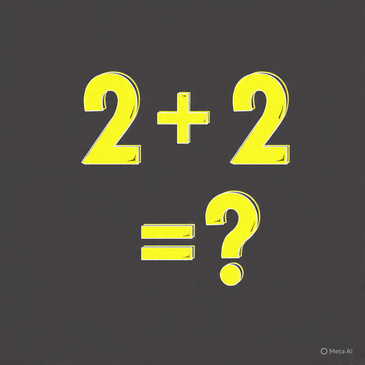
Some problems definitely fall in the "really easy" category; they're as simple as two plus two equals ... how much was that again? Oh, right, four--- in any integer arithmetic of base five or higher, to be a little more precise. (One could argue that two plus two equals four even in arithmetics of base four or base three, but the symbol "4" wouldn't exist. And in base two, the symbol "2" wouldn't even exist. We'll stop there!)
In checker terms, today's speed problem is also really easy even if it's a cut above the trivial. You won't need much time for this one; ten seconds is way too long but because of our innate generosity, we'll give you ten seconds anyhow.
When you're ready, click on the link below, solve the problem, then come back and click on Read More to check your solution.
November Speed Problem (very easy)
You can email the Webmaster with your comments on this article.
The Deckhand
NARA & DVIDS Public Domain
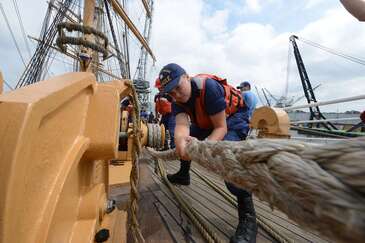
The deckhand in the photo above appears to be doing some sort of difficult shipboard task, and she doesn't appear to mind at all.
We're sure, too, that you won't mind tackling today's checker problem, which was composed by Chris Nelson, who used the nom-de-plume of "The Deckhand." We don't know why Mr. Nelson, who was a denizen of Brooklyn, chose this pseudonym. Perhaps he was a spare-time sailor. But we can say for sure that he was a fine checker problem composer, as the offering below will handily demonstrate.
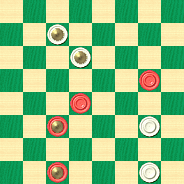
WHITE
White to Play and Win
W:WK6,K10,24,32:B16,18,K22,K30.
Get on board and solve this problem. It may not be as hard as shipboard labor, but it presents a nice little challenge. Then sail your mouse over to Read More to see the solution.
You can email the Webmaster with your comments on this article.
A Thinker's Game

Public Domain Pictures CC0
Those of us who play checkers in any sort of serious manner know very well that checkers is indeed a "thinker's" game, despite our oft-repeated laments that the general public doesn't usually share that opinion. Today's entry in our ongoing Checker School series demonstrates the fine line that can separate victory from just another drawn game; it takes a real thinker to see the difference between moves that look very similar but are far from it.
The situation is diagrammed below.
WHITE
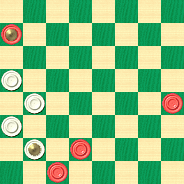
BLACK
Black to Play and Win
B:W20,16,12,K8:BK28,13,7,3.
You'll see in the solution notes and sample game the interesting manner in which this position came about, but for now, can you think your way to a Black victory, or will a thoughtless move give up your winning chances? Think it over, and then click on Read More to see the solution, thoughtful notes, and a sample game.
You can email the Webmaster with your comments on this article.
The Jaywalker Gambit

If you visit Honolulu, you'd best not jaywalk; the fine is a whopping one hundred and thirty dollars, and the police don't hesitate to hand out the tickets. Jaywalking is a gambit you won't want to risk; it could really cost you.
There's a Jaywalker Gambit in checkers, too, and it won't cost you a cent to hear how Willie Ryan describes it in his classic book, Tricks Traps & Shots of the Checkerboard.
"The late great A. J. Heffner, of Boston, former Champion of America and heralded as one of the greatest analysts of all time, was responsible for christening the following trap 'the Jaywalker,' pointing out that many experts had wandered into it, unaware of their predicament until it was too late to bail out. The Jaywalker, a formational 'natural,' was originally rated drawable on the basis of Tillum and Aitchison's play, as quoted in the trunk game. But the eminent British authority, J. A. Kear, of Bristol, England, published an analysis indicating that, by introducing the 16-19 move at Note E, the gambit ended in defeat. Kear's play remained unchallenged for many years, but the data assembled here indicate that Kear's 16-19 move is nothing more than a transposition that ultimately runs back into the Tillum and Aitchison draw. Play:
| 11-16 | 30-26 | 7-10 |
| 24-19 | 11-16 | 26-22---2 |
| 8-11 | 22-17---A | 10-14, |
| 22-18 | 4-8 | forming the |
| 10-14 | 17-10 | diagram. |
| 26-22 | 6-24 | |
| 16-20 | 28-19 | |
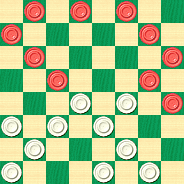
WHITE
White to Play and Draw
W:W32,31,29,27,25,23,22,21,19,18:B20,16,14,12,9,8,5,3,2,1.
A---A very weak move---1, forming the famous Jaywalker position. The correct play here for a draw is: 28-24, 4-8, 22-17, 7-10, 26-22, 3-7---B, 19-15, 10-26, 17-3, 26-30, 18-15, 6-10, 15-6, 1-10, 31-26, 30-23, 27-18, 20-27, 32-23, 9-13, 21-17, 5-9, 25-21, 2-7, 29-25, 7-11, 3-7, 10-14, 17-10, 16-20, 7-16, 12-26. Wm. F. Ryan.
B---White has a pretty trap here, for if the play goes 9-13, 18-9, 5-14, white wins by storm with: 19-15!, 10-26, 17-10, 6-15, 22-17, 13-22, 25-4, 26-30, 4-8. D. G. McKelvie."
1---The computer sees 22-17 as only very slightly worse than 28-24, so we're not sure why Willie thinks it's so weak. Perhaps the position is simply more difficult to play correctly---Ed.
2---Here's the real problem. The text move is substantially weaker than 25-22, though still not losing. Perhaps Willie should have flagged this move instead---Ed.
Don't be a jaywalker; walk the straight and narrow and solve the position. But we won't fine you if you don't get it; you can always safely click on Read More to see the solution and detailed notes.
You can email the Webmaster with your comments on this article.
One Stroke
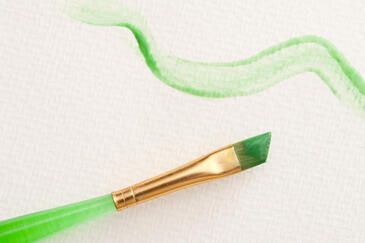
The item shown above is called a "one-stroke" brush, intended for use with the "FolkArt One Stroke" painting technique. Though we know very little about this brush technique, it certainly sounds fascinating.
We've never claimed to know a lot about our game of checkers, either, but today we present "one" stroke problem, and solving it it will call into play the technique of checker visualization, which we believe to be a fascinating art form in its own right.
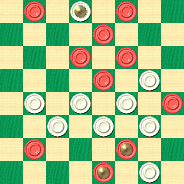
WHITE
White to Play and Win
W:W32,24,23,22,19,18,17,16,K2:BK31,K27,25,20,15,11,10,7,3,1.
Now that's "one" stroke problem! Try to solve it without moving the pieces; when you've had your brush with this one, sweep your mouse to Read More to see the solution.
You can email the Webmaster with your comments on this article.
Three by Three
PxHere CC0
Everyone's heard of a two by four (2x4), and there are other familiar sizes, such as 1x4 and the larger 4x4. But have you ever heard of a three by three (3x3)? There is such a thing, and in the strange world of "dimensional lumber" a 3x3 is in reality 2.5 inches by 2.5 inches.
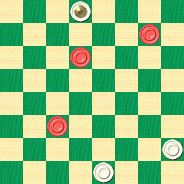
Fortunately, there's no such thing as "dimensional checkers." A 2x2 or a 4x4 ending is just what the label implies. (We're not really sure where half a checker piece would fit in the scheme of things!) Today, we'll look at the 3x3 ending that's diagrammed below. It's from a game played over the board many years ago at a club in the St. Paul, Minnesota area.
WHITE
White to Play and Win
W:W31,28,K2:B22,10,8.
Don't get cut down to size; sharpen your wits, not your saw, and see if you can solve the problem. When you have the answer, buzz your mouse on Read More to see the solution.
You can email the Webmaster with your comments on this article.
Accurate Judgment
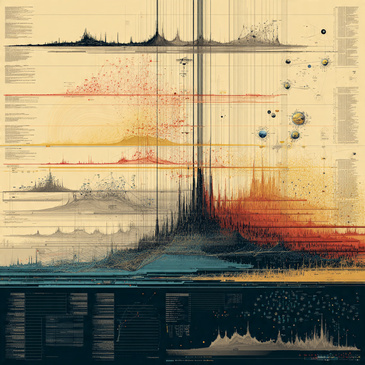
Accurate judgment is a necessary skill for success in technical fields. If you're able to assess complex information such as that shown in the chart above, and then make the appropriate decisions, you've very likely got what it takes.
In the world of checkers, accurate judgment in endgames is also a critical element in expert play. The position below, from a Samuel Gonotsky game shown years ago by Willie Ryan, requires the keenest of judgment to find the draw.
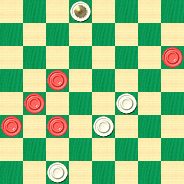
WHITE
White to Play and Draw
W:W30,23,19,K2:B22,21,17,14,12.
How good is your checker judgment? With White in a tough situation, this one is anything but easy and will definitely test your skill. When you've judged your line of play to be correct, click on Read More to see the solution.
You can email the Webmaster with your comments on this article.
The Checker Maven is produced at editorial offices in Honolulu, Hawai`i, as a completely non-commercial public service from which no income is obtained or sought. Original material is Copyright © 2004-2026 Avi Gobbler Publishing. Other material is public domain, AI generated, as attributed, or licensed under CC1, CC2, CC3 or CC4 and the various CC options. Information presented on this site is offered as-is, at no cost, and bears no express or implied warranty as to accuracy or usability. You agree that you use such information entirely at your own risk. No liabilities of any kind under any legal theory whatsoever are accepted. The Checker Maven is dedicated to the memory of Mr. Bob Newell, Sr.