The Checker Maven
The Last Problem
Pixabay CC0
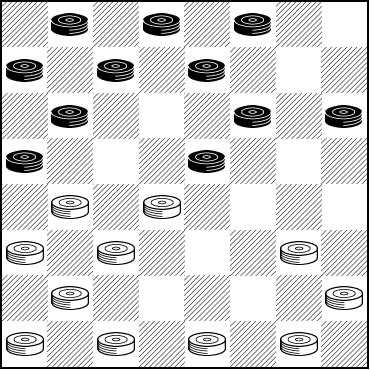
Many years ago, when checkers was played by man and by man alone, for there were no computers nor would there be for almost two centuries, a legendary person created a 9x9 checker problem that challenged the best players of the day; and yet they solved the problem despite its depth, trickery, and unusual nature. The creator of the problem was said to be named Hink, or perhaps it was The Hink, or perhaps it was someone else, for no one really knew, and yet the problem was known as Hink's Problem.
Down through the ensuing generations, Hink's Problem entertained and baffled, yet still, the best in each generation would solve it with enough thought and reflection.
And then came the time of the computers.
The earliest, created by a researcher at a large corporation, did not play checkers very well and of course could not solve Hink's Problem.
More computers arrived and more checker engines were created, and though they bore names like Fiend and Giant and Mountain Wind, and even Crowning Touch and Cookie--- the latter two being the greatest of their day--- still they could not solve Hink's Problem while the masters and grandmasters, all of them fully human, were able to succeed.

Needpix CC0
And so arose the Checker Question: Would, one day, computers solve Hink's problem?
More time passed and more generations came and went, and computers became universal, and beyond the comprehension of man, so incredible was their power. Men no longer designed new computers; the computers themselves did that until they became seemingly omnipotent. Yet still, they could not solve Hink's problem, while human masters--- the few that there still were--- would do so.
Millennia turned into millions of years and millions of years turned to billions, and the computers merged into one great Omnicomputer that integrated with the very fabric of the universe. But Hink's Problem remained beyond them. There were no humans left to solve it, for they had all moved into a higher plane of existence, but had there been any, they would surely have found the solution.

Public Domain Pictures CC0
Finally, the universe began to darken. The Omnicomputer had long known that the omega constant was less than one and the universe would eventually face heat death.
The last star winked out, and still Hink's Problem was beyond the Omnicomputer. It was the last unsolved problem that the great engine faced, and it could not shut down until the solution was found.
Finally, after so long that time no longer had any meaning, the Omnicomputer said, "It cannot be done" and this so upset the Omnicomputer that it erupted from its containment in the hyperdimensions, creating a New Big Bang that would give rise to a new universe, perhaps one in which the laws of logic would differ enough for Hink's Problem to be solvable, not just by humans, but by a mere Omnicomputer.

Public Domain Pictures CC0
With appreciation to Isaac Asimov, whose classic The Last Question inspired this story.
BLACK
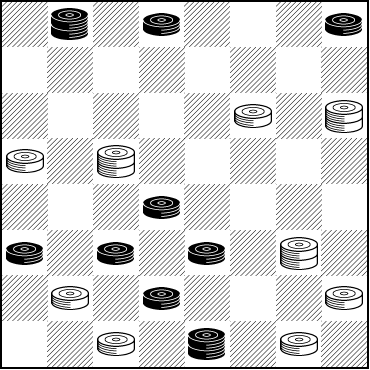
WHITE
White to Play and Win
W:W11,K12,13,K14,K24,25,28,30,32:BK1,2,4,18,21,22,23,26,K31
The Omnicomputer couldn't solve this one and had the cyber equivalent of a nervous breakdown. Can you solve it? It's probably at grandmaster level, but it's fascinating and worth your time. Just don't get so upset that you explode! After all you can always give your mouse a big bang on Read More to see the solution.
See You in September
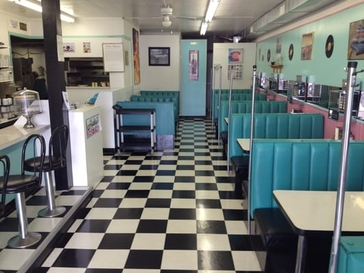
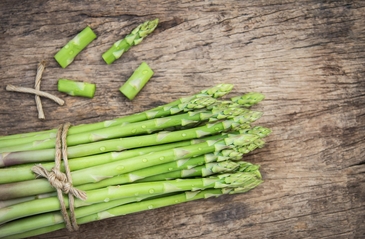
It was the last Saturday in May of 1955. In Bismarck, North Dakota, that meant the last frost of the winter was probably in the books, yards had been raked up and readied for the summer weeks ago, and outdoor life was stirring. Some flowers had started to bloom and in a couple of weeks Sal Westerman would have fresh asparagus from his garden, and fresh strawberries, too.
Pexels CC0
But it also meant that this would be the final meeting of Sal's beloved Coffee and Cake Checker Club before they took their summer break, which lasted from Memorial Day until Labor Day. Their meeting place, the Beacon Cafe, was closed on summer Saturdays, and during the whole month of August when the owner, Deana Nagel, went to Gackle to spend time on her family farm and help with the harvest.
The sun was out and the temperature was around 70 degrees when Sal walked the few blocks from his modest home to the Provident Life Building, where the Cafe was located. He expected a good turnout, as was usually the case for the last meeting of the season, and when he walked in the door he wasn't disappointed. Nearly everyone was there: Larry, Wayne, Delmer, Spooler, Louie the Flash, Ron, Tom, Dan, and even Ted, Howie, and Frank, the latter three being only infrequent participants. The group took up three booths in the back, and Deana was all smiles. Business was going to be good today.
"Rhubarb bars," she announced, "and I've got lots of them!"
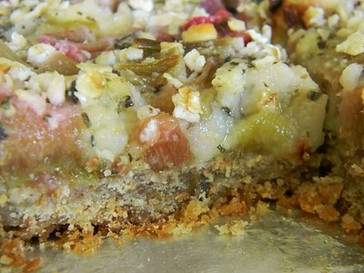
It was a long-standing tradition that Sal would bring along a checker problem, and if the "boys" (all of them at least 50 years old) could solve it, Sal would buy the treats, but if they couldn't, Sal got treated by them. Sal always made sure he brought along a tough problem to even the odds a little.
The boys talked for a little while, drinking coffee and playing a few informal games. Many of them had summer vacation plans, generally involving time on their farms (now usually run by their children), or visits to relatives around and about North Dakota, South Dakota, and Montana. Ron and his wife were actually going on a cruise; they'd take the train to New York and then sail for Paris. That was pretty unusual for most folk in Bismarck, who didn't feel comfortable when they were very far from home.
At around 2 o'clock the boys started clamoring for Sal to show his problem. "Gettin' kind of hungry in here," Wayne remarked. "Must be time for Sal to be buying us some of those rhubarb bars."
Sal smiled. "We'll see about that," he said, "I've got one from Ed and it's going to get published in All Checkers Digest."
The expression on Wayne's face changed. Ed, who was from Pennsylvania and one of Sal's checker pen-pals, always came up with tough, clever problems, and if All Checkers Digest was going to print it, then it must be really something.
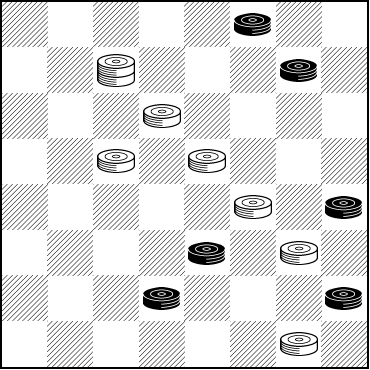
Sal laid out the following position on several of the checkerboards. "Okay boys," he said, "let's see what you can do with this one!"
WHITE
White to Play and Win
W:B3,8,20,23,26,28:W10,14,15,19,24,32,K6
"Oh ... " Louie the Flash said.
"Oh my ... " Howie said.
"Yikes!" Larry said.
Deana brought over more coffee as the boys set to work.
Fortunately, The Checker Maven doesn't take the summer off. But neither do we serve rhubarb bars, so you're on your own for afternoon treats. But do try to solve the problem and then click on Read More to see the solution and the conclusion of our little story.
Contest 62: Double Breeches
Today we won't go into the difference between breeches and britches, but we will mention that breeches are pants (or if you like, pantaloons) that cover the, um, posterior. Today that's true of most if not all pants.
What then, are double breeches? In terms of pants, we can't really say, but our Research Department did point out that the word breeches is what's known as a double plural. In old English, broc was a word which had a plural form of brec. In time the word evolved and added the usual -(e)s suffix and thus became the double plural, breeches.
If that's just a bit too complicated, fortunately in checkers double breeches has a very specific and easy to understand meaning, as you'll see in Bill Salot's 62nd World Championship Problem Composing Contest, which has double breeches as its theme. Access the contest problems here.
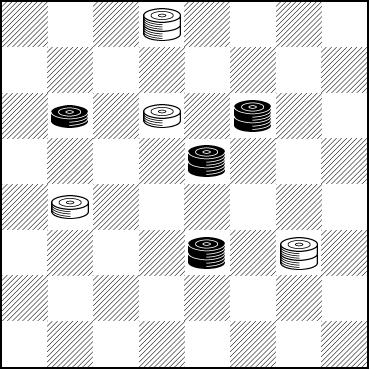
To get you started, here's a sample problem illustrating the contest theme. It's by grandmaster composer Ed Atkinson and was the winner of Contest 33 in June, 2017.
BLACK
WHITE
White to Play and Draw
W:WK2,10,17,K24:B9,K11,K15,K23
After you've enjoyed solving this problem, click on Read More to see the solution, and then go to the contest page to cast your vote for your favorite among four additional problems.
Warm Up

It's the beginning of May, and in the Northern Hemisphere, the weather should be warming up, likely something very welcome to those of you in colder climes.
Along those lines, today we have a speed problem that is itself in the nature of a "warm up" of the mental type. It's quite easy, and may be something of a good starter to get your brain into checker mode at the start of an evening's play or study.
NIH Image Gallery CC0
An experienced player will solve it in a couple of seconds; novices may have to think a bit, but in any case, it's good fun.
WHITE
White to Play and Win
W:W17,18,21,22,24,25,28,29,30,31,32:B1,2,3,5,6,7,9,11,12,13,15
Were you able to get it? We thought so, but still, warm up your mouse by clicking on Read More to check your play.
.jpg)
.jpg)