The Checker Maven
Richard Jordan: A Jim Loy Book
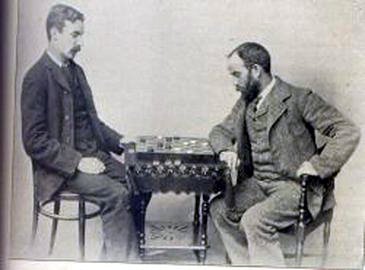
Jordan-Ferrie Match
Today we're pleased to present another of Jim Loy's books, this one in his developing series on the greatest checker players of past years. Jim's subject in this book is the great Edinburgh player Richard Jordan (not to be confused with another great, Alfred Jordan).
Richard Jordan only lived to age 39, his life cut short by a tragic accident. But in that time he played great checkers, including once having defeated the legendary James Wyllie.
The following position is from the cover of Mr. Loy's book. It's from the 1897 World Championship Match played by Mr. Jordan against R. Stewart, yet another luminary from the legendary age of checkers.
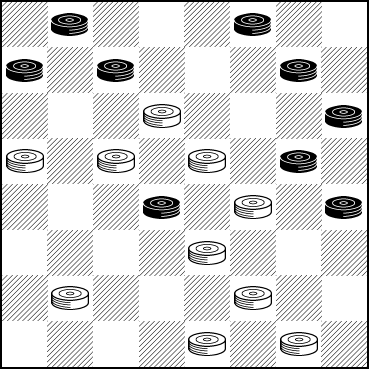
WHITE (R. Jordan)
White to Play and Win
W:W10,13,14,15,19,23,25,27,31,32:B1,3,5,6,8,12,16,18,20
Match wits with Richard Jordan and find the win. When you're satisfied with your solution, do one of two things. Either download the book here to see how the game actually went, or click on Read More to see a computer solution.
Freezing Rain: A Beacon Cafe Story
It was the Saturday after Valentine's Day, 1955, and the weather was wet in Bismarck, North Dakota. Snow mixed with rain was falling, and it was certain that after dark the roads and sidewalks would freeze over, making for dangerous driving and walking conditions.

But Saturday was the day the Coffee and Cake Checker Club met at the Beacon Cafe in the Provident Life Building, and Sal Westerman, the club's informal leader, wasn't about to miss his afternoon of checkers.

Sylvia Westerman
Oh, his wife, Sylvia, urged him to stay home so he wouldn't have to return on slippery sidewalks. Sal, after all, was over 70 now, and if he took a tumble it wouldn't be a good thing. But Sal was determined. He put on his winter jacket, rubber overshoes and some warm gloves and set out at about 12:45 PM. The club met at one o'clock and he didn't want to be late.
The skies were gray and Sal pulled up his hood to ward off the chilling rain. But he didn't live far from the Beacon and he was there in about fifteen minutes, his trip taking just a little longer than usual.
Some of the "boys" (all of whom were over fifty) were already there. Sam, Wayne, Dan, Delmer and Tom were seated in the big booth in the back. They waved to Sal as he came back to join them. Deana, the proprietress and an award winning baker, gave Sal a friendly greeting, too.
Then Louie (also known as "Louie the Flash") and Kevin (also known as "Spooler") came in. It was quite a gathering and it made Sal smile and forget the weather.
PickPik CC0
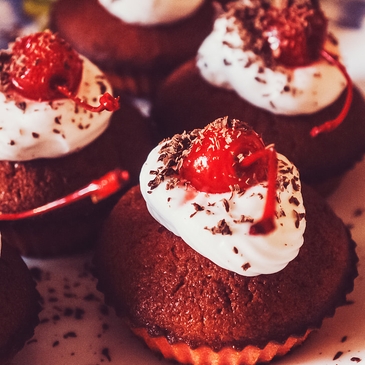
"Cherry muffins today," Deana said. "I got a shipment of really nice canned cherries and you're going to love these."
"We sure will," Sal said, "especially when the boys are buying."
That elicted groans and laughter from the boys. "Sure, Sal, whatever you say," Spooler said. The long-standing tradition was that Sal would set up a checker problem. If the boys could solve it, Sal bought, while if they couldn't, the boys bought.
"We'll see who laughs last," Sal replied. "I have a nice one from Ed."
Ed was Sal's checker pen pal in Pennsylvania, and his problems always were clever and always a challenge.
"Have a look at this," Sal said, and set up the following position on one of the checkerboards. "I'll give you an hour, and I think I'd better get you all some more coffee." Deana, never missing an opportunity, was already at the booth with a fresh pot ready to pour.
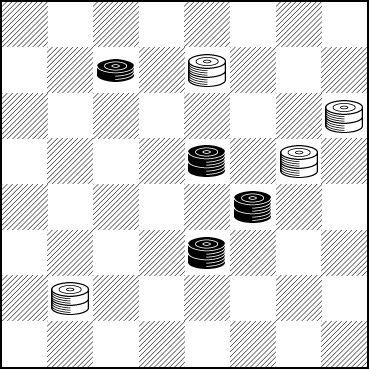
WHITE
White to Play and Win
W:WK7,K12,K16,K25:B6,K15,K19,K23
The boys focused on the problem. From time to time Sal took a look outside. By about two-thirty, when the hour Sal had alloted was up, the roads were indeed freezing over.
"Can't get it," Delmer said. "We tried, but ... "
Deana arrived at just that moment with a tray of cherry muffins. "Who's buying?" she asked with a smile. Delmer slowly raised his hand. "My turn," he said sheepishly. "Now, Sal, how about you show us how to do this one?"
Will you have better luck than "the boys"? Or will you be the one to buy the muffins? At least you won't have to go home on frozen roads (well, we hope not). Give this a try and then cherry-pick the solution by clicking on Read More.
Arizona Checkers: Ryan Pronk

Ryan Pronk
With permission
Today The Checker Maven has the pleasure of presenting an in-depth interview with a relatively young checker master, Ryan Pronk. Ryan is not only known for his playing prowess; he's created over 100 high-quality checker videos in his AZ Checkers series, which can be found on Ryan's YouTube channel. The videos present instructional material as well as analysis of games both historical and contemporary.
CM: At what age did you start playing checkers? What got you interested in the game?
RP: I started playing checkers seriously at the age of 14. Prior to that, I often played chess with my friends, who were involved in Scholastic tournaments. I was drawn to the competitive nature of it all, and that carried over easily to checkers. I found out about checkers thanks to a Hoyle Board Games CD-ROM gift a neighbor had given me.
I played all of the games on that disk, including Chess, Checkers, Othello, Backgammon, Mancala, etc. I found myself defeating the checkers computer opponent on expert level repeatedly, so I thought there might be something to this! In hindsight, I wasn't playing too terribly for an extreme novice, often developing 11-15, 7-11, 3-7 every game when handling the first side.
CM: Did you ever expect to become a top-tier player? How many hours of study do you suppose you've done?
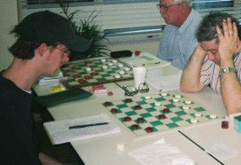
RP: I always wanted to compete against and be on par with today's masters. It wasn't until finishing runner-up in the 2007 Tennessee Masters (arguably my best result), did I really feel confident that I can compete and that I belong in the same field as some of the best players in the country.
With permission
Being invited to play on the International Team is easily the highest honor I have achieved, and it showed that my peers hold my ability in high regard--- and that is something I will never forget! I would study for two to three hours every night throughout high school, and a little bit less through college, and unfortunately even less now. I still do enjoy studying when I can, specifically endgame positions or lines of opening play.
CM: Any tips for the aspiring newcomer to the game?
RP: Always have fun when playing the game! Winning is great, and losing is not so great. It may feel like a rollercoaster at times. But keep at it, and continue to enjoy the game. Even the best players in the world today lose from time to time! Trust your intuition as you'll know if and when it's time to look up how to win a 2 kings vs. 1 king ending, or avoid being triple jumped. From there, your interest in other facets of the game might grow! In the interim, just have fun!
CM: Do you have a favorite checker book?
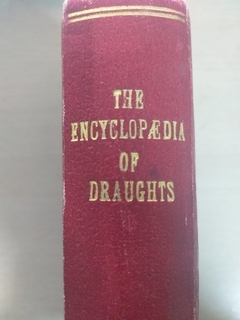
RP: I really enjoy anything by Richard Pask and Richard Fortman--- both have been tremendous inspirations to me. Solid Checkers and Basic Checkers are still my go-to books, along with Kear's Encyclopedia.
With permission
I also enjoy world title match compilation books, and Willie Ryan's writings (his Modern Encyclopedia, specifically).
CM: What's your background and your interests aside from checkers? Where are you originally from?
RP: I grew up in Minnesota and went to college and started my career in Arizona --- so one weather extreme to the other! I've lived in Virginia for more than a decade now; it's certainly a happy medium weather-wise! I've always had an interest in journalism, and spent more than six years in the industry as a reporter, copy editor, and page designer. The AZ Checkers YouTube channel allows me to combine my interests and hobbies all into one, as there's a good amount of writing, editing/video editing, and checkers involved!
CM: What led you to start your AZ Checkers video series?
RP: It originally started back when I was in college, and it was a way for me to highlight some instructional games that might benefit other players. My first videos were incredibly raw with no audio commentary, and very, very fast--- so in hindsight, I'm not sure many would find them helpful! I later focused on common endgame situations and basic strategies/openings. George Gerhauser ("Checkercycle") and I would talk occasionally and promote each other's videos.
George "Checkercycle" Gerhauser
With permission
When I saw his channel grow in popularity and publish videos regularly, I was really happy to see it and I stopped producing. Flash forward to September 2019--- I noticed George had stopped publishing videos and there was a void in English checkers/draughts on YouTube. My checkers opening moves and best counter moves had nearly 500K views at the time, so I started producing videos diving deeper into openings, and the rest is history!
CM: About how many videos have you made? Do you have any favorites or ones you think are the best?
RP: I've made more than 125 videos dedicated to checkers, broken down into various categories such as Beginners, Openings, Tactics, etc. My tactical videos are far and away the most popular. Although they are not as popular, my favorite videos to create are famous games. I like providing historical context, and do my best to set the stage, so the viewers can understand the pressure and stakes. I like how the 1982 Masters Hallett-Tinsley, and 1955 Tinsley-Hellman videos turned out. I'd also like to give thanks to Mike Mitchell for creating the fun animation introduction in my videos.
CM: Do you intend to continue the series? What are your hopes for it? Do you have any sort of new or special content planned?
RP: My plan is to continue publishing videos geared toward helping beginners and anyone looking to improve in basic strategy and tactics. Alex Holmes and I have been collaborating from time to time, and I expect there may be some additional collaborations to come in the future, along with live stream events, including the 11-man ballot world championship match.
Alex Holmes
With permission
There is always something new to learn in checkers, and I feel the same way about the channel, which is why I am always interested in hearing feedback and criticism. So far, I've been fortunate in that the vast majority of the feedback I receive is very positive.
CM: What can be done to revive interest in checkers, especially among younger players?
RP: Something I've learned while making these videos is that checkers is far from extinct, and players of all ages truly enjoy playing the game and learning some things along the way. However, high level tournament checkers is a different story. Attending a tournament can be a fun and fulfilling experience, and I try to relay that in videos. While we are seeing a decline in the United States, there appears to be a revival in places such as Kenya, South Africa and Tanzania, which is amazing to see! Is it possible these videos will generate interest in checkers in other parts of the world, including the United States? Perhaps! For me, I just like giving back to the game that has given a lot to me, and continues to enrich my life.
CM: Anything you'd like to add?
RP: One of my all time favorite problems is Henderson's Shot, which you covered in a 2008 article. However, my favorite tactical theme is The Brooklyn, which can arise from many openings, as you pointed out in 2017. The tactic can also be found in my favorite unrestricted opening, the Waterloo. The run-up can be found in Lees' Guide, page 158, variation 1, with play credited to H.F. Shearer.
11-15 23-18 8-11 18-14 9x18 24-19 15x24 22x8 4-11 27x20 5-9 21-17 9-14 25-21 11-15 28-24 7-11 29-25 15-18 32-27 11-15 26-23 3-7 30-26 6-9; forms diagram.
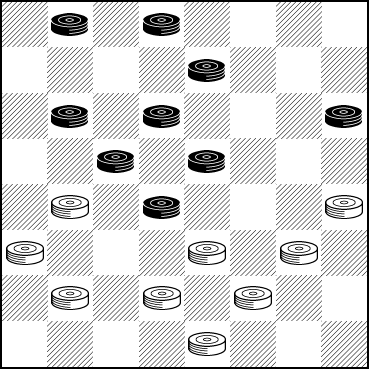
WHITE
White to Play and Draw
W:W17,20,21,23,24,25,26,27,31:B1,2,7,9,10,12,14,15,18
A fascinating interview and a classic problem. Expert players will likely be familiar with this one and know the solution offhand; the rest of us will have a bit of a challenge and some good instruction and entertainment. See how you do and then click on Read More to see the solution.
Cute and Acute
Can something be both cute and acute, as in "sharp" or an "acute angle"? We think so, and we're about to show you an example.
This month's speed problem is another easy one, but it's also definitely cute. And acute. You'll see what we mean when you solve it. Beginners might have to think a bit but experienced players should solve it quickly.
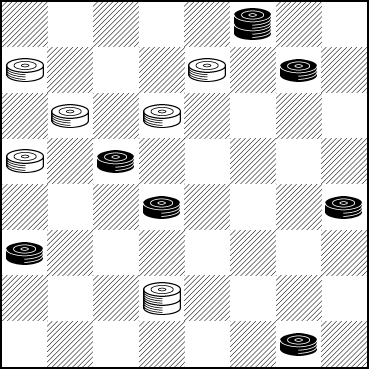
BLACK
Black to Play and Win
B:WK7,20,23,24,26,28:B1,12,13,15,19,25,K30
When you've come up with your solution, a cute (or should that be acute) quick of the mouse on Read More will allow you to check your solution.