The Checker Maven
Jump to navigationThe Feynman Technique
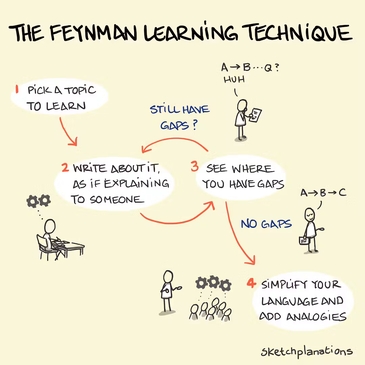
Richard Feynman was one of the great modern day physicists, and he had a special knack for being able to explain complex concepts in an understandable manner. He espoused a learning technique in which you study something and then try to teach it to someone else in language a child could understand. He said this will quickly expose gaps in your knowledge and allow you to fill them. The technique is repeated until mastery is achieved. It is remarkably effective.
In Andrew Banks' eclectic book, Checker Board Strategy, upon which we've based much of our ongoing Checker School series, he proposes something similar when introducing a series of "gem" problems by Paul McKay.
In each problem below, imagine that your rival is playing the other side; therefore, plan to meet anything that he can do. What if you should fail? Merely study the reason for failure and thus add to your knowledge; also note the reasons for the correct moves. To add to your experience, review the problems on a later date; show them to your friends."
In other words, learn the problem and then teach it to others.
Here's a sample from this set of problems.
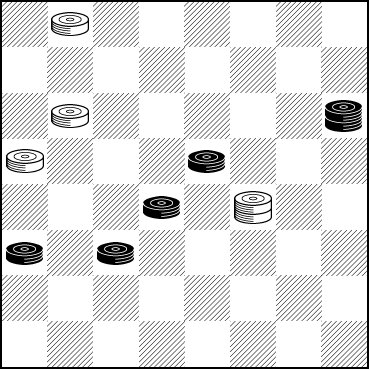
BLACK
Black to Play and Win
B:WK14,20,24,32:B11,12,15,18,K21
This is a rather nice problem. Try the Feynman technique by studying and trying to solve it, clicking on Read More to review the solution, and then teach it to a friend to test your understanding.
Solution
Lettered notes are by Mr. Banks; numbered notes by your editor.
18-23---A 14-10---1 23-27*---B 10x19---2 21-17* 32x23 17-14---C Black Wins.
A---When you must lose a piece, try to trade off the opponent's King in doing so. Here you cannot follow this general rule. (Seems like a strange place to give this bit of advice---Ed.)
B---As you are a man up, you can afford a double-sacrifice to create a "move-prison."
C---You have occupied a key position at a critical time. Avoid bunching pieces against the side of the board where they can be held or cramped by a lesser number.
1---Other defenses can be attempted but this seems like the most natural move.
2---Jumps can be in either order.
A gem indeed and worthy of study.

The Checker Maven is produced at editorial offices in Honolulu, Hawai`i, as a completely non-commercial public service from which no income is obtained or sought. Original material is Copyright © 2004-2026 Avi Gobbler Publishing. Other material is public domain, AI generated, as attributed, or licensed under CC1, CC2, CC3 or CC4 and the various CC options. Information presented on this site is offered as-is, at no cost, and bears no express or implied warranty as to accuracy or usability. You agree that you use such information entirely at your own risk. No liabilities of any kind under any legal theory whatsoever are accepted. The Checker Maven is dedicated to the memory of Mr. Bob Newell, Sr.