The Checker Maven
Jump to navigationLaws of Learning
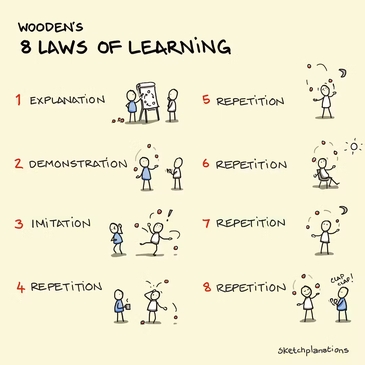
In this installment of our long-running Checker School series, we turn again to the eclectic volume entitled Checker Board Strategy, by Andrew J. Banks, published back in 1945. Part V of this book, "Fundamentals," starts out with a section called Laws of Learning. We offer the following brief quote.
In his college laboratory, Ned guided some white rats that were running in a maze box. Their problem was to find the path to some food. The scientific boy tutored some of the rats a few times by blocking the blind alleys, which directed them into the correct paths. Then he removed the block; this restored the original problem. Other rats were not guided at all. Which rats, do you think, learned the maze with fewer trials? In general those that Ned helped learned faster; however, those that he guided too much learned more slowly than those without any help--- perhaps a certain number of errors must be made in order to learn what to avoid.
The application to our game of checkers is obvious, but do you agree? We do. A certain amount of tutoring and explanation certainly is helpful but ultimately, over the board when your tutor is not present, you'll have to apply what you know, and you'll make some errors. You really cement your learning when you review your game later on and correct your errors. Note in the illustration above, "repetition" figures prominently.
Here are two classic problems which Mr. Andrews presented to illustrate his point. The first one is quite easy.
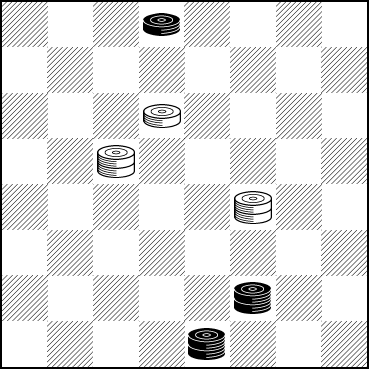
WHITE
White to Play and Win
W:B2,K27,K31:W10,K14,K19
The second one is also relatively easy with a little thought.
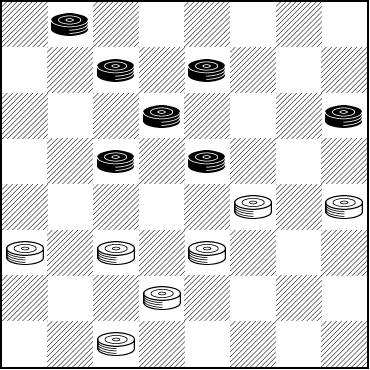
WHITE
White to Play and Win
W:B1,6,7,10,12,14,15:W19,20,21,22,23,26,30
These might be quite familiar to experienced players, who are challenged to solve them rapidly. For those of us not in the upper realms of checker knowledge, you might wish to solve the first one, check the solution, and then come back and try the second one. In any event, clicking on Read More will allow you to verify your work.
Solutions
Today's problems are indeed old; they date back to 1756 and William Payne, as many of you undoubtedly recognized.
Problem 1: 10-7 2-11 19-15 11-18 14-32 White Wins. Mr. Banks remarks, "---illustrates the long pitch. The Black Kings could be on 26 and 29, or or 25 and 26; the same idea would win. The threat of strokes pervades the entire game."
Problem 2: 20-16 (a hasty 19-16 only draws) 15-24 22-18 12-19 18-2 White Wins. Mr. Banks remarks, "---one checker 'frozen.' Note that Black had a scattered formation with holes behind vulnerable pieces."

The Checker Maven is produced at editorial offices in Honolulu, Hawai`i, as a completely non-commercial public service from which no income is obtained or sought. Original material is Copyright © 2004-2026 Avi Gobbler Publishing. Other material is public domain, AI generated, as attributed, or licensed under CC1, CC2, CC3 or CC4 and the various CC options. Information presented on this site is offered as-is, at no cost, and bears no express or implied warranty as to accuracy or usability. You agree that you use such information entirely at your own risk. No liabilities of any kind under any legal theory whatsoever are accepted. The Checker Maven is dedicated to the memory of Mr. Bob Newell, Sr.