The Checker Maven
Jump to navigationHighly Practical Practice

Editor's Note: Ed Gilbert pointed out a flaw in the original setting. Here's a corrected version.
There's theory and there's practice. The electrician shown working above is applying practical knowledge no doubt mostly obtained through study and experience. A similar concept applies to our game of checkers. We need to learn the theory but in the end, practical application is what wins or saves games for us, and the more experience we have, the better.
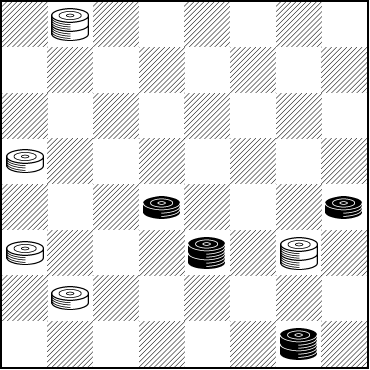
In the diagram below, credited to regular contributors Lloyd and "Gosh Josh" Gordon, White is a piece up but Black can achieve a draw--- with careful play.
Now, being something in the nature of a speed problem, the draw is neither difficult nor sophisticated.
WHITE
White to Play, Black to Draw
W:W25,21,13,K24,K1:B20,18,K32,K23
Experienced players will have little trouble; improving players may take a bit longer, but either way, it's a nice little workout. Give it a practical try and then take the practical step of clicking on Read More to see the solution.
Solution
The original "solution" was as follows, and it was flawed:
24-27 23-26 27-31 26-22---D 1-6 22x29---A 31-26 20-24---B 6-10---C 24-27 10-15 27-31 15x22 to a White Win.
A---Black evens the piece count but at the cost of trapping his king.
B---Not 29-25 26-22.
C---Now with the Black king stuck on 29, White goes after the unsupported Black man on 18.
D---Looks great, evening the piece count, but loses! Instead 26-23 draws as White can make no progress. Try it with your computer; the landscape is full of potential Black two for one shots. But 26-22 is how Black, with all good intent taking a move that many would make over the board, can go wrong.
Instead here's a straightforward drawing line for Black if White plays a different first move:
24-28 32-27 1-6 27-31 28-32 31-26 32-28 26-22 to a draw.
Again, thanks to Ed Gilbert for pointing out the flaw in the setting.
The Checker Maven is produced at editorial offices in Honolulu, Hawai`i, as a completely non-commercial public service from which no income is obtained or sought. Original material is Copyright © 2004-2026 Avi Gobbler Publishing. Other material is public domain, AI generated, as attributed, or licensed under CC1, CC2, CC3 or CC4 and the various CC options. Information presented on this site is offered as-is, at no cost, and bears no express or implied warranty as to accuracy or usability. You agree that you use such information entirely at your own risk. No liabilities of any kind under any legal theory whatsoever are accepted. The Checker Maven is dedicated to the memory of Mr. Bob Newell, Sr.