The Checker Maven
Jump to navigationChecker School: The Opposition
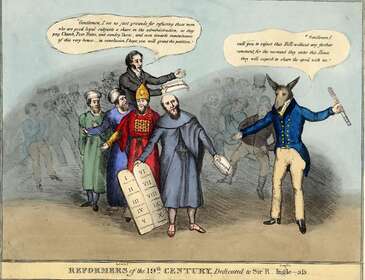
PICRYL CC0
Since time immemorial, in the world of politics, business, religion, what have you--- someone will come up with an idea or a concept and invariably there will be opposition from someone else, typically another political party. In genteel Parliamentary circles, these opposers are often called "The Loyal Opposition" but behind the polite facade often lies something entirely different. In less genteel circles, less genteel terms may be used but the concept is still the same.
In our game of checkers "the opposition" refers (happily) to quite another thing. In years past, and even now, this has been called "the move" and to paraphrase various famous checkerists, "Much nonsense has been written about it."
Do you win with the move? Sometimes. Does having the move make a difference? Sometimes. But recasting the notion as "having the opposition" (loyal or not) can clarify matters a bit, and this leads to today's position, accredited to J. Wyllie and published, among other places, in Andrew Banks' electic book Checker Board Strategy.
WHITE
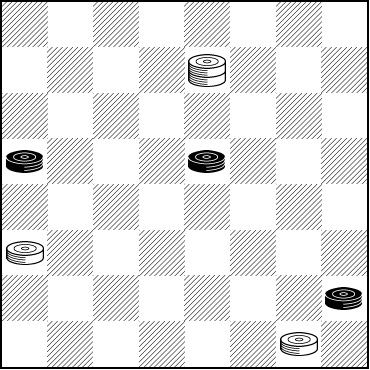
White to Play and Win
W:B13,15,28:W21,32,K7
This one is pretty easy; figure out "the move" that wins, and after that, we have no "opposition" to your clicking on Read More to check your solution.
Solution
7-10---1,2 15-18 *21-17---3 13-22 *10-15---A 18-23 15-18*---4 White Wins.
1---So who has "the move" in the diagrammed position? By traditional counting, Black does. However, does it mean anything?
2---7-11 wins in the same manner as the text move.
3---"The move" changes with an asymmetrical exchange. Does this now give White a win with correct play?
4---Interestingly, while this move clearly wins, any other move now loses for White!
Mr. Banks provides the following note:
A---Not 10-14 22-25, Drawn. A lesson on "the move," or "opposition," and its changes. The move becomes important when pieces are reduced to three or four of each color. This ending was won at Spennymoor, England, 1886.
We might suggest that, if you're a beginning player, Richard Pask's Checkers for the Novice and Complete Checkers: Insights both provide sensible advice on the opposition.
The Checker Maven is produced at editorial offices in Honolulu, Hawai`i, as a completely non-commercial public service from which no income is obtained or sought. Original material is Copyright © 2004-2026 Avi Gobbler Publishing. Other material is public domain, AI generated, as attributed, or licensed under CC1, CC2, CC3 or CC4 and the various CC options. Information presented on this site is offered as-is, at no cost, and bears no express or implied warranty as to accuracy or usability. You agree that you use such information entirely at your own risk. No liabilities of any kind under any legal theory whatsoever are accepted. The Checker Maven is dedicated to the memory of Mr. Bob Newell, Sr.