The Checker Maven
Jump to navigationAI Didn't Cut It

We thought for today's column we'd try something new; namely, publish a checker problem composed by one of the better artificial intelligence (AI) engines. So we got on to one of them--- although we won't mention the name, it's by far the most well known--- and gave it a try.
It was a real learning experience.
We started out by asking it to compose a problem for 8x8 Anglo-American checkers. It happily did so, putting pieces on both the light and dark squares, and then offering to compose more difficult problems. We went through two more iterations and got the same sort of thing.
We then explicity told it to only put pieces on the dark squares (something it had previously told us it was doing, but it wasn't). Same result. We admonished it again. It came back with a problem and a solution that made no sense. For one thing the pieces were either (a) moving in the wrong direction, or (b) it was just fine to have an uncrowned man on the last row.
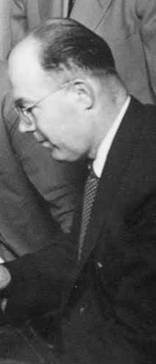
Tom Wiswell
Public Domain
After this we asked for sources of checker puzzles. It gave a few, with mixed accuracy; some of the websites cited didn't feature problems and the same was true of the referenced books. (It did give a pointer to our site, which was surprising but nice.) The engine also casually mentioned Tom Wiswell and offered to compose a Wiswell-style problem. Alas, that was a bust too, as again it confused movement directions and spewed out something that made no sense.
Rawpixel Public Domain
That was enough for us, and for today's column we turned back the clock to something well over a hundred years before AI and AI hype was ever even heard of, to select a nice problem by an honest to goodness human, who knew orders of magnitude more about composing checker problems than the best AI today seems to know.
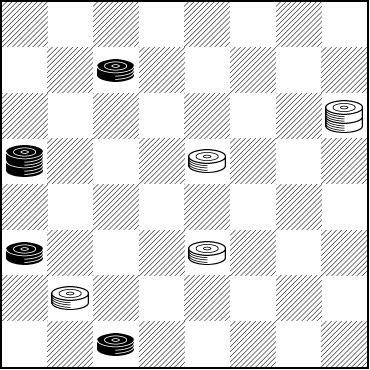
BLACK
Black to Play and Win
B:W8,10,18,K21:B3,12,K20,27
It's a nice problem, neither too hard nor too easy, which can be readily solved with your natural intelligence. Blow a raspberry at AI and solve this one, and then click on Read More to check your solution.
Solution
12-16* 8-4---A 3-8* 4x11 20-24* 11x20 27-32* 20x27 32x7 Black Wins with the opposition.
A---As published. 18-14 is the computer move, dropping a piece to prolong the ending. Such are the ways of computers.
Today's problem was composed by one E. Bacon (a real human) and appeared long ago as #802 in Gould's Problems, Critical Positions, and Games, 3rd Edition.

The Checker Maven is produced at editorial offices in Honolulu, Hawai`i, as a completely non-commercial public service from which no income is obtained or sought. Original material is Copyright © 2004-2026 Avi Gobbler Publishing. Other material is public domain, AI generated, as attributed, or licensed under CC1, CC2, CC3 or CC4 and the various CC options. Information presented on this site is offered as-is, at no cost, and bears no express or implied warranty as to accuracy or usability. You agree that you use such information entirely at your own risk. No liabilities of any kind under any legal theory whatsoever are accepted. The Checker Maven is dedicated to the memory of Mr. Bob Newell, Sr.