The Checker Maven
Jump to navigationA Single Corner Singe
PICRYL CC0
The Single Corner opening with 11-15, 22-18 is very popular and full of interesting play, but sometimes a seemingly reasonable and natural looking move will singe a player's fingers, so to speak. We'll look at one such situation in today's original study.
To set the scene, here's the run-up, without commentary.
| 1. | 11-15 | 22-18 |
| 2. | 15x22 | 25x18 |
| 3. | 9-14 | 18x9 |
| 4. | 5x14 | 29-25 |
| 5. | 8-11 | 25-22 |
| 6. | 10-15 | 22-17 |
| 7. | 4-8 | 17x10 |
| 8. | 7x14 | 23-18 |
| 9. | 15x22 | 26x10 |
| 10. | 6x15 | 24-19 |
| 11. | 15x24 | 28x19 |
| 12. | 2-6 | 32-28 |
| 13. | 11-15 | 19x10 |
| 14. | 6x15 | 21-17 |
| 15. | 12-16 | 28-24 |
Here's the position as it now stands.
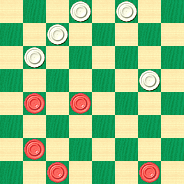
BLACK
Black to Play and Win
B:W31,30,27,24,17:B16,15,8,3,1.
White should have played 17-14 but didn't, and it's a win for Black, but how? Could you have drawn with White had you played 17-14? Black still would have an edge and the draw is not easy.
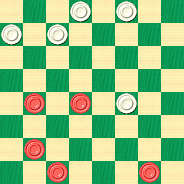
BLACK
Black to Play, White to Draw
B:W31,30,28,27,14:B16,15,8,3,1.
So we've burned the candle at both ends, and left you with two problems. Show the Black win after White's 28-24, and show how White could have made a draw with 17-14.
Too much? Burned out? Set your mouse aflame on Read More to see the solution and explanatory notes.
Solution
First we'll look into Black's winning line after 28-24.
BLACK
Black to Play and Win
B:W31,30,27,24,17:B16,15,8,3,1.
| 16. | 16-19 | 24-20 |
Forced.
| 17. | 19-24 | 27-23 |
Attempting to remove a target.
| 18. | 24-28 | 30-26 |
| 19. | 28-32 | 26-22 |
| 20. | 8-11 | 23-18 |
17-14 may be better here, but this move looks natural enough.
| 21. | 15-19 | 18-14 |
| 22. | 3-7 | 17-13 |
| 23. | 32-28 | |
The king swings into action.
| 23. | ... | 13-9 |
| 24. | 19-23 | 22-17 |
9-5 is the computer move but we show instead a less artificial conclusion.
| 25. | 23-27 | 31x24 |
| 26. | 28x19 | 9-5 |
| 27. | 11-15 | 14-9 |
| 28. | 15-18 | 17-14 |
| 29. | 19-15 | 20-16 |
| 30. | 18-22 | 16-12 |
| 31. | 15-11 | |
Black wins. White is out of safe moves.
And now, let's look at the situation had 17-14 been played instead of 28-24.
BLACK
Black to Play, White to Draw
B:W31,30,28,27,14:B16,15,8,3,1.
| 16. | 3-7 | 28-24 |
Now this move is okay. What a difference an interim move makes!
| 17. | 16-19 | 24-20 |
| 18. | 8-11 | |
Best at this point, to hold the white man on 16.
| 18. | ... | 30-26 |
| 19. | 19-24 | 26-23 |
| 20. | 24-28 | 14-9 |
| 21. | 28-32 | 27-24 |
| 22. | 7-10 | 9-5 |
| 23. | 10-14 | 23-19 |
| 24. | 32-28 | |
Best.
| 24. | ... | 19x10 |
| 25. | 28x19 | 10-7 |
| 26. | 14-17 | 7-3 |
| 27. | 11-15 | 3-7 |
| 28. | 15-18 | 7-10 |
| 29. | 18-22 | 10-14 |
| 30. | 17-21 | 14-17 |
Drawn. Black, with the narrowest of advantages, really can't win.
Computer analysis for this study was done with Ed Gilbert's KingsRow engine and the companion 10-piece end-game database.
The Checker Maven is produced at editorial offices in Honolulu, Hawai`i, as a completely non-commercial public service from which no income is obtained or sought. Original material is Copyright © 2004-2026 Avi Gobbler Publishing. Other material is public domain, AI generated, as attributed, or licensed under CC1, CC2, CC3 or CC4 and the various CC options. Information presented on this site is offered as-is, at no cost, and bears no express or implied warranty as to accuracy or usability. You agree that you use such information entirely at your own risk. No liabilities of any kind under any legal theory whatsoever are accepted. The Checker Maven is dedicated to the memory of Mr. Bob Newell, Sr.