The Checker Maven
Jump to navigationDiagramless
AI
Today's column brings our loyal readers something completely different. Not only do you have to solve a checker problem, you need to figure out what the problem is! It's somewhat analogous to a diagramless crossword, though we see it as considerably easier to solve.
The following verse was published under the title "Puzzle Problem" in The Checkerist in 1887 by our old friend O.H. Richmond, whose work we've featured before. Though we've never found out what the "O.H." in "O.H. Richmond" stands for, "R.A.G." in the poem obviously refers to Robert A. Gurley.
A game of checkers once was played in 1883
Between a man named Robinson and his friend R.A.G.
It was a very pretty game; with neither one ahead.
Until it came quite near the end, when R. A. Gurley said;
"I think I have the best of it, as one can see,
With my two Kings on four and five, and single man on three."
"You may be right," said Robinson, "but I have got the move.
And though my men are single ones, yet tartars they may prove.
But I must move to eleven now, for if to twelve I go,
You catch me in a problem, by Spayth, of Buffalo."
"Ah," said Gurley, "Rob, my boy, that move was very fine.
I fear t'will let that other man from thirteen down to nine.
For if I move my single man, it lets you get a King.
And yours on twenty we'll change off as sure as anything."
The end soon came, Rob drew the game,
But Gurley found next day,
oh, what a sin! he had a win
by a pretty piece of play.
Where's the diagram? Not so fast! There's enough information in the poem to figure out the position and the terms of the problem. You'll need to do that first; if you do, you'll have a nice checker problem to solve.
When you've got it all worked out, just click on Read More to see the problem diagram and the solution.
Solution
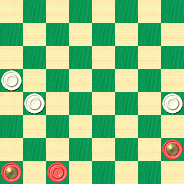
There is a single man on 3, so that has to be a Black man. This means the kings on 4 and 5 are also Black.
White has a man on 16, because that's the only square from which a man can move to either 11 or 12. White also is stated to have men on 13 and 20. It is White's turn to move, but Black has a win. White plays 16-11 to avoid the Black win shown in Note A, but it will prove to be of no avail.
BLACK
White to Play, Black to Win
W:W20,16,13:BK5,K4,3.
16-11---A 5-1---B 13-9 1-5 9-6 5-9 6-1 9-14 20-16---C 14-18 16-12---D 18-15 Black Wins.
A---16-12 3-7 20-16 5-1 13-9 4-8! 12-3 1-5 3-10 5-7 16-12 7-11 Black Wins.
B---3-8 11-7 to a draw.
C---1-6 3-8 11-7 14-10 6-15 8-11 15-8 4-2 20-16 2-7 16-12 7-11 Black Wins.
D---1-6 18-15 Black Wins.
This Black win, though hardly spectacular, shows how Black's one highly mobile King makes the winning difference. It's a very practical position and worth taking the time to master.
The Checker Maven is produced at editorial offices in Honolulu, Hawai`i, as a completely non-commercial public service from which no income is obtained or sought. Original material is Copyright © 2004-2026 Avi Gobbler Publishing. Other material is public domain, AI generated, as attributed, or licensed under CC1, CC2, CC3 or CC4 and the various CC options. Information presented on this site is offered as-is, at no cost, and bears no express or implied warranty as to accuracy or usability. You agree that you use such information entirely at your own risk. No liabilities of any kind under any legal theory whatsoever are accepted. The Checker Maven is dedicated to the memory of Mr. Bob Newell, Sr.