The Checker Maven
Jump to navigationCapers on the Kelso: Part 3
Nintendo (editorial fair use)
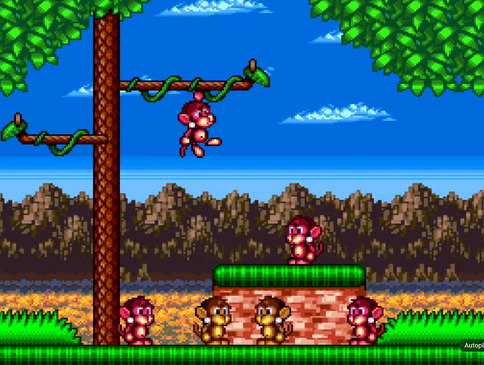
What does a screenshot from an arcade-style video game have to do with checkers?
We challenge you to identify the source of the screenshot, for therein lies the answer.
We continue with our multi-part excursion into the Kelso with the third installment, taken from Willie Ryan's Tricks Traps & Shots of the Checkerboard. Today we cover the beginning of Willie's Variation 1.
The run-up is short:
10-15, 22-18, 15-22, 25-18.
Now we continue with Willie's text:
Variation 1
| 6-10---A | 8-15 | 9-13 |
| 29-25---B,3 | 25-22 | 23-18 |
| 11-15 | 4-8 | 7-11*---D |
| 18-11 | 21-17---C | 30-25 |
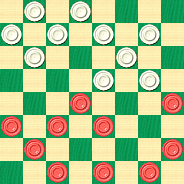
BLACK
Black to Play and Win
B:W32,31,28,27,26,25,24,22,18,17:B15,13,12,11,10,8,5,3,2,1.
A---"Black has three good moves to start with. Most of our leading masters have shown a preference for 9-13 here, but 6-10 (an earlier favorite) and 11-15 are just as good. The principal advantage of the text defense (6-10) is the fact that it may be applied also to another two-move opening: 9-13, 22-17, 13-22, 25-18, 6-9, which develops the same position.
B---Some players object to 6-10 at A because of the 18-14 'bust' at this juncture, and others dodge 6-10 because of the situation arising at C (21-17) in trunk. The analysis in this lesson is offered to prove that both objections are unfounded. See Variation 3 for play on 18-14.
C---This move has long been regarded as the major stumbling block of the 6-10 defense. My innovation at D deflates this highly rated attack.
D---This odd move improves on more published play than you can shake a stick at. The accepted move in the past has been 8-11, as used in the Stewart-Banks match, giving white a strong game. I had this 7-11 improvement cooked up for Walter Hellman at the 1939 Tacoma National Tourney, but he avoided the whole line by playing 18-14 at B."
3---Variation 3 will be the subject of a future column---Ed.
Click on Read More to see the solution and additional notes.
Solution
BLACK
Black to Play and Win
B:W32,31,28,27,26,25,24,22,18,17:B15,13,12,11,10,8,5,3,2,1.
The correct move is 26-23. Willie continues (his Note E in the book):
"An innocent might try 30-25, at which point black will beat him with: 10-14, 17-10, 13-17, 22-13---1. If 27-23 is used, then 5-9, 24-20* (not 23-19, 2-7, 26-23, 1-5, 24-20, 15-24, 28-19, 10-15, 19-10, 7-21, 32-27, 9-14, etc., or black will win---4), 1-5, 28-24, 9-14, 18-9, 5-21, 23-19, 2-6, 26-23, 3-7, will form the position on diagram at Note F---2."
1---Play continues 15x29 26-23 2-7 31-26 7x14 and Black wins---Ed.
2---To appear next in the series---Ed.
4---This is actually a draw: 27-24 17. 11-15 31-26 and now Black must give the man back. White threatens a 2 for 1 with 23-18 and Black's only option is 13-17 22-13 15-18 23-19 etc. to a draw. Willie should have taken it a couple of moves farther!---Ed.
The game screenshot? It's from the popular Nintendo game Congo's Caper.
The Checker Maven is produced at editorial offices in Honolulu, Hawai`i, as a completely non-commercial public service from which no income is obtained or sought. Original material is Copyright © 2004-2026 Avi Gobbler Publishing. Other material is public domain, AI generated, as attributed, or licensed under CC1, CC2, CC3 or CC4 and the various CC options. Information presented on this site is offered as-is, at no cost, and bears no express or implied warranty as to accuracy or usability. You agree that you use such information entirely at your own risk. No liabilities of any kind under any legal theory whatsoever are accepted. The Checker Maven is dedicated to the memory of Mr. Bob Newell, Sr.