The Checker Maven
Jump to navigationA Double Boomerang
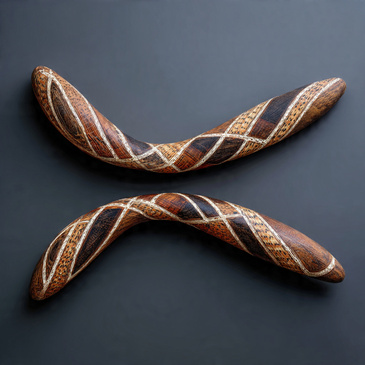
We usually think of Australia in conjunction with the boomerang, which in turn we usually think of as a device which, when thrown, will tend to return to the thrower after describing an extended aerial arc. Of course, that's the usual public over-simplification, but it is known that boomerangs were used in Australia at least ten thousand years ago. A boomerang is actually a rotating wing, and it's an example of a "heavier than air" aerial device; you might even think of it as a very distant forerunner of the airplane.
But if you want to know all about aerial boomerangs, we'll direct you elsewhere. Today's Checker Maven column, in our series taken from Willie Ryan's Tricks Traps & Shots of the Checkerboard, is about a boomerang of a different sort. Yes, indeed, checkers has its own variety of boomerang, though it doesn't have an Australian history. Willie will explain below.
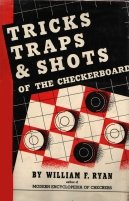
"As the name implies, a boomerang shot defines a situation wherein the first player, in executing a shot, uncovers a counterstroke for the second player. Such examples are fairly common, but double boomerangs, in which the mechanical process of a straight or single boomerang occurs twice in succession, are so rare they are considered oddities. The following game illustrates one of the very few practical double boomerangs, in which 16 pieces are removed from play in a hectic series of doubles and triples.
| 9-13 | 5-9---A | 6-10 |
| 23-19 | 29-25 | 28-24 |
| 11-15 | 10-14 | 1-5---B, 1 |
| 22-18 | 27-23 | 32-28 |
| 15-22 | 8-11 | 3-8 to the |
| 25-18 | 24-20 | diagram. |
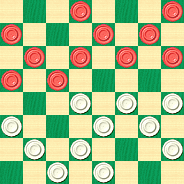
WHITE
White Plays; Black Draws
W:W31,30,28,26,25,24,23,21,20,19,18:B14,13,12,11,10,9,8,7,5,4,2.
A---Here is an old shot that Alfred Jordan used with stunning effect in his exhibition play, when handling the white pieces: 7-11, 19-15, 10-19, 24-15, 6-9, 26-23, 1-6, 29-25, 12-16, 31-26, 3-7, 28-24; at this position, 8-12 or 16-20 will produce the draw, but 16-19, 23-16, 11-20 will be smashed by 25-22, 9-14 (nothing better), 18-9, 5-14, 27-23*, 20-27, 15-10, 6-15, 23-18, 14-23, 26-3, a double exposure, and white wins.
B---This leads to a hazardous ending. Better play would be: 3-8, 25-22, 1-5, 32-28, 11-15, 18-11, 8-15, 19-16, 12-19, 23-16, 14-17, 21-14, 9-25, 30-21, 13-17, 21-14, 10-17, 26-23, etc., for a draw."
1---Here's the difference between human and computer analysis. The computer actually favors the text move, 1-5, by a slim margin; but the computer doesn't take into account how difficult it might be to thread your way through the ensuing ending, which Willie rightly characterizes as "hazardous." For a human player, trying to find the right moves over the board with the clock ticking, Willie's idea of playing 3-8 instead makes a lot of sense.
We're not sure if this is really a problem or an exercise; it's more in the nature of a study. In any case, decide how you would play this out, and then, click on Read More to circle around to Willie's high-flying line of play.
Solution
"Continue: 19-16---2, 12-19, 24-6, 11-16, 20-11, 8-29, 30-25, 29-22, 26-3, 13-17, 21-14, 9-27, 31-24, 2-9, 3-7, 9-14, 7-10, 14-18, 10-14, 18-23, 14-18, 23-27, 18-23, 27-32, 24-20, 4-8, 20-16, 8-12, 16-11, 5-9, 11-7, 9-14; a draw---3."
2---You, our reader, might have considered a line of play like 25-22 11-15 18-11 8-15 19-16 12-19 23-16 14-17 21-14 9-25 30-21 etc., which is a computer line and leads to a routine enough draw. Willie, naturally, goes for a far more spectacular, but equally valid continuation.
3---Even with the Black king temporarily trapped in the double corner, and the Black man on 12 temporarily unable to advance to the king's row, White has no advantage, for instance 7-3 12-16 3-7 16-20 7-10 14-17 10-14 17-22 14-18 22-25 18-22 25-30 and now White has to let one of the Black pieces out.
The Checker Maven is produced at editorial offices in Honolulu, Hawai`i, as a completely non-commercial public service from which no income is obtained or sought. Original material is Copyright © 2004-2026 Avi Gobbler Publishing. Other material is public domain, AI generated, as attributed, or licensed under CC1, CC2, CC3 or CC4 and the various CC options. Information presented on this site is offered as-is, at no cost, and bears no express or implied warranty as to accuracy or usability. You agree that you use such information entirely at your own risk. No liabilities of any kind under any legal theory whatsoever are accepted. The Checker Maven is dedicated to the memory of Mr. Bob Newell, Sr.