The Checker Maven
Jump to navigationThe Brooklyn Position

Brooklyn, New York, has got to be the center of the hipster movement. Now, a hipster is supposedly "a person who follows the latest trends and fashions, especially those regarded as being outside the cultural mainstream."
By that definition, checker players would not exactly be hipsters, yet many a top player has had humble origins in Brooklyn. Perhaps times have changed. But checkers does have the Brooklyn Position, and that's the topic of today's Checker School entry.
We've seen the Brooklyn Position at various times in previous columns, but today we present an in-depth study. The solution, accessible by clicking on Read More, gives half a dozen sample games that run into this position. It's well worth the time and effort to study it carefully.
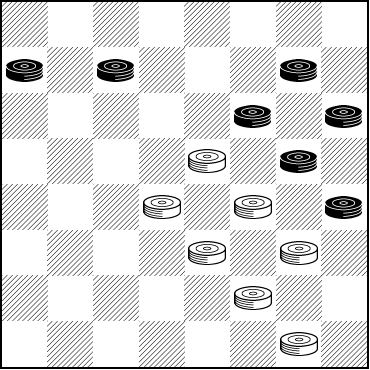
WHITE
White to Play and Win
W:W32,27,24,23,19,18,15:B20,16,12,11,8,6,5.
Are you hip, or just a drip? Show your stuff, and find the solution. It's actually not so difficult, and you might even think it's kind of trendy.
Solution
The solution, sample games, and general commentary are of course from Ben Boland's Famous Positions in the Game of Checkers. Numbered notes are by your editor, using the KingsRow computer engine with the companion 10-piece endgame database.
18-14, 11-18, 14-10, 6-15, 23-14, 16-23, 27-4, 20-27, 32-23---1. White Wins.
1---An easy 3x2 win.
Game: 11-15, 22-18, 15-22, 25-18, 9-13, 29-25, 12-16, 18-14, 10-17, 21-14, 16-20, 23-18, 6-10, 25-21, 10-17, 21-14, 1-6, 26-23, 13-17, 31-26, 8-11---2, 24-19, 4-8, 28-24, 8-12, 19-15, 3-8, 23-19, 11-16, 26-22, 17-26, 30-23, 7-10---3, 14-7, 2-11. Forms above position. K. Drummond, Scottish Draughts Player, 4th Ed. 1866, Vol. 2, Page 12.
2---End of KingsRow opening book.
3---Loses, while 7-11 draws. In checkers, subtle differences are everything!
Game: 11-15, 22-18, 15-22, 25-18, 8-11, 29-25, 4-8, 26-22, 11-16, 24-19, 16-20, 31-26, 9-13, 18-14, 10-17, 21-14, 6-10, 25-21, 10-17, 21-14, 1-6---4, 22-18, 13-17, 28-24---5, 8-11---6, 19-15, 3-8, 23-19, 11-16, 26-22, 17-26, 30-23, 7-10---7, 14-7, 2-11. Forms position. H. Spayth, New York Clipper, Vol. 21, 1874.
4---End of KingsRow opening book.
5---Gives Black a small advantage. 18-15 is better.
6---7-11 would have held the edge.
7---As in the previous game, this loses, and 7-11 would draw.
The rest of the sample games are given without annotation---Ed.
Game: 11-15, 21-17, 9-13, 25-21, 8-11, 17-14, 10-17, 21-14, 4-8, 24-19, 15-24, 28-19, 6-10, 29-25, 10-17, 25-21, 1-6, 21-14, 11-16, 22-18, 13-17, 27-24, 16-20, 31-27, 8-11, 19-15, 3-8, 23-19, 11-16, 26-22, 17-26, 30-23, 7-10, 14-7, 2-11. Forms position. Professor Fitzpatrick, Boston Weekly Globe, contributed by R. E. Bowen. (Around 1880).
Game: 10-14, 22-17, 14-18, 23-14, 9-18, 25-22, 18-25, 29-22, 6-10, 17-14, 10-17, 21-14, 11-15, 24-19, 15-24, 28-19, 8-11, 27-24, 11-16, 26-23, 16-20, 31-27, 7-10, 14-7, 2-11, 22-18, 3-7, 30-26, 4-8, 26-22, 11-16, 18-15, 7-11, 22-18, 1-6. Forms position. Played between two Durham Amateurs, Notable Problem No. 4 in Leeds Mercury.
Game: 9-13, 22-18, 10-15, 24-19, 15-22, 25-18, 11-16, 29-25, 7-10, 28-24, 16-20, 18-14, 10-17, 21-14, 3-7, 23-18, 6-10, 25-21, 10-17, 21-14, 1-6, 26-23, 13-17, 31-26, 8-11, 19-15, 4-8, 23-19, 11-16, 26-22, 17-26, 30-23, 7-10, 14-7, 2-11. Forms Position. Given by H. Spayth, in Stearns' Book of Portraits, Part 2.
Game: 9-13, 24-19, 11-15, 22-18, 15-22, 25-18, 8-11, 26-22, 11-16, 29-25, 16-20, 31-26, 4-8, 18-14, 10-17, 21-14, 6—10, 25-21, 10-17, 21-14, 1-6, 22-18, 13-17, 28-24, 8-11, 19-15, 3-8, 23-19, 11-16, 26-22, 17-26, 30-23, 7-10, 14-7, 2-11. Forms Position. Given by H. Spayth, in Stearns' Book of Portraits, Part 2.
From Gould’s Match Book we learn: That identical combinations may be evolved from independent openings by different players, at different times, are facts well known to experienced Draughts votaries; and as a very interesting illustration of those principles in connection with the foregoing composition, we propose to narrate its history, for which, in essential particulars we are indebted to the late Mr. M. Wilder, who published the result of his researches on the subject in an early issue of the Draughts department of the Boston Weekly Globe.
Wilder traced the game and position to the following sources: Liverpool Albion, Problem No. 58, Frank Dunne; Liverpool Albion Game 206, “White King," Gentleman's Journal, Problem No. 44, H. Stansfield, Mutual Friend, Hoges and McIndoe; and Chicago Tribune, Problem No. 27, E. S. H.
Also see “Familiar Themes," Page 11.
Editor's Note: This is sometimes called the "Brooklyn Stroke," for obvious reasons. What we couldn't turn up is just what the connection between the position and "Brooklyn" might be. Perhaps it's because Ben Boland was from Brooklyn, though we can't say for sure. However, we are certain that Mr. Boland was not a hipster.
Editor's Addendum: Readers George Hay and Edgar Atkinson who both wrote and pointed out that the Brooklyn Position is attributed (by Denvir, and cited by Call) to Robert Yates, who hailed from Brooklyn. We thank these gentlemen for this information.
The Checker Maven is produced at editorial offices in Honolulu, Hawai`i, as a completely non-commercial public service from which no income is obtained or sought. Original material is Copyright © 2004-2026 Avi Gobbler Publishing. Other material is public domain, AI generated, as attributed, or licensed under CC1, CC2, CC3 or CC4 and the various CC options. Information presented on this site is offered as-is, at no cost, and bears no express or implied warranty as to accuracy or usability. You agree that you use such information entirely at your own risk. No liabilities of any kind under any legal theory whatsoever are accepted. The Checker Maven is dedicated to the memory of Mr. Bob Newell, Sr.