The Checker Maven
Theory of Fun
"Fair Use" for review purposes
There's an interesting book titled A Theory of Fun for Game Design by Raph Koster, published in 2004. The book touches on some valid points about how games are designed and ultimately played. However, when it comes to our game of checkers, Mr. Koster says the following ("fair use" quotation for review purposes).
"Until now, I've been discussing formal game design--- abstract simulations. But we realy see truly abstract simulations in games. People tend to dress up game systems with some fiction. Designers put artwork on them that is suggestive of some real-world context. Take checkers for example--- abstractly it's a board game about entrapment and forced action, played on a diamond-shaped grid. When we say "king me" in checkers, we're adding a subtle bit of fiction to the game; suddenly it has acquired feudal overtones and a medieval context. Usually, the pieces have a crown embossed on them."
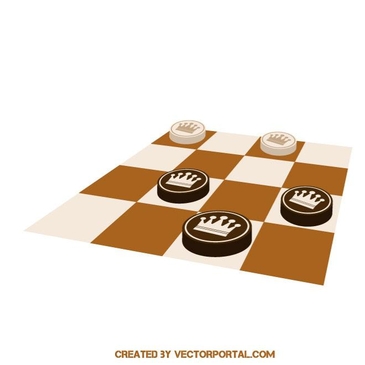
We don't have enough space in this column to discuss all of Mr. Koster's misconceptions; suffice it to say that he seems to be unfamiliar with played as a serious game. However, we did find genuine interest in the idea of "feudal overtones" related to the process of crowning a piece. We wonder if, as a potential player, he would also subscribe to the common erroneous advice to "always keep your king-row intact."
So, for today's checker problem, let's use our collective imagination. Think of the kings as bearing jeweled crowns and dressed in the finest of purple robes. Think of the men as clad in leather armor and metal helmets, bearing swords, axes, and pikes. Think of the checkerboard as the field of battle, perhaps in ancient Carthage (ancient rather than medieval, but still quite colorful). Listen to the call of trumpets, the beat of drums, the battle cries of the massed warriors.

PICRYL CC0
Or maybe not. Perhaps you'd just like to solve a good checker problem without a lot of distracting imagery. It's up to you. Was Mr. Koster correct or incorrect with his medieval contexts and feudal overtones? Does it really matter?
WHITE
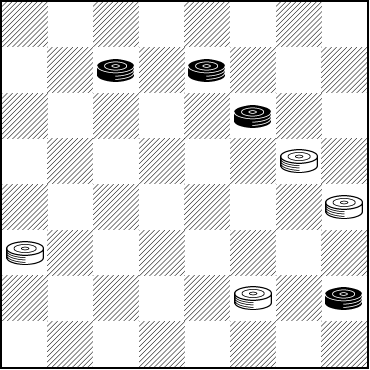
White to Play and Draw
W:W16,20,21,27:B6,7,11,28
See how you do with this one and then click on (or march over to, if you will) Read More to view the solution.
Marvin in Maine

Marvin J. Mavin
In May, Marvin J. Mavin had once again led the Detroit Doublejumpers to another World Series of Checkers Championship, defeating the Los Angeles Leapers over the course of seven hard-fought matches.
June and July were off months; training camp didn't take place until August. Marvin and his financee, Priscilla, usually took separate vacations in June and a vacation together in July.
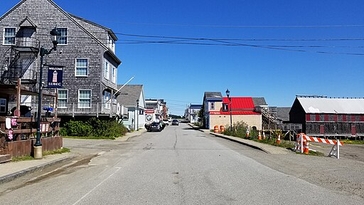
This year Marvin decided to go to Maine. It would be just about the start of the height of the lobster season, and there would also be fresh fish caught in cold Atlantic waters, of course with a nice crisp beer (or two) as an accompaniment.
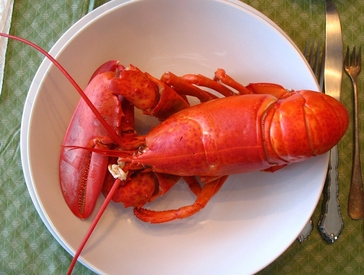
PICRYL CC0
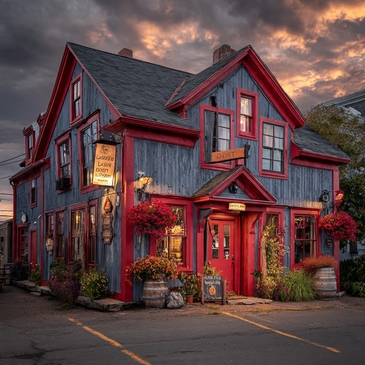
It was quite a drive from Detroit to Loobish, Maine, especially in Marvin's very old Volkswagen Beetle. He took his time and after two overnight stays, checked into The Lobster Loft, a well-known pub and restaurant with several rustic rooms to rent.
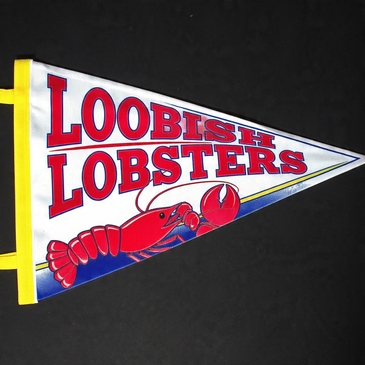
Marvin spent a day or two exploring the town, trying to remain incognito, as even remote Loobish had its checker fans, and the town had an amateur team appropriately named the Loobish Lobsters, who competed in a league in eastern Maine.
Of course, a star such as Marvin couldn't help but eventually be noticed. However, though Maine folk are very friendly, they do respect a person's privacy, so Marvin didn't have to do a lot more than sign a few autographs, shake a few hands, and pose for some selfies.
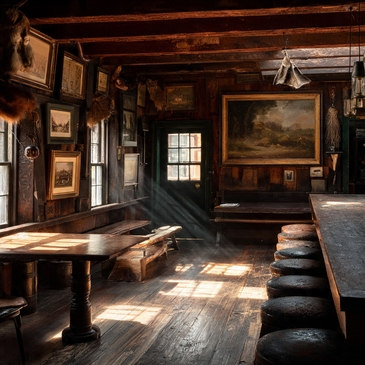
About a week into his visit, Marvin was enjoying some local brews in the Loobish Tavern. He had gotten to talking with a few of the lobster fisherman and raised a couple of glasses with them. Well, maybe more than just a couple. But fishermen rise early and by about 11 o'clock the tavern was empty except for Marvin and the bartender. Closing time wasn't until one AM but the bartender looked tired so Marvin called for one last beer before going back to his lodgings.
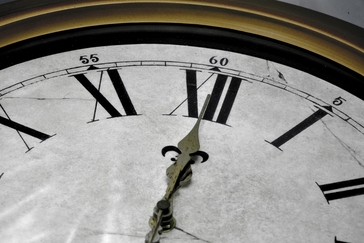
He must have taken his time with his beer, for as he drained the last of it he looked up at the tavern's old wall clock and saw that it was exactly midnight. He was going to get up to leave but all of a sudden he noticed a large, middle-aged, ruddy-looking man sitting opposite him at his table.

The Great Murray
"Where did you come from?" Marvin said, startled by the man's sudden appearance.
"Where did I come from?" the man replied in a voice that was shaky and distant. "What do you mean, where did I come from! Don't you know me? Everybody around here knows The Great Murray! John Murray, that's me, and they call me The Great Murray because of how well I play checkers. The best in Eastern Maine. Maybe the best in all of Maine. Might even be the best in the world only haven't quite got the title yet."
"But," he continued, "I'm going to get there, and I'll start by beating you. Yes, you're some kind of hot-shot professional but I'm not scared, no sir I am not, because you're nothing compared to The Great Murray."
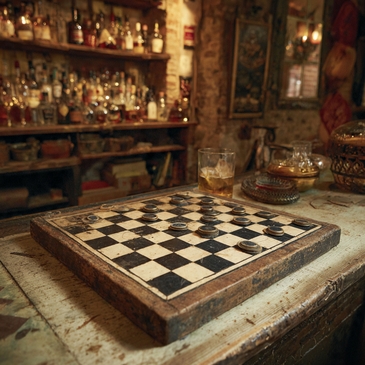
Suddenly there was a rustic old checkerboard on the table. Murray set it up and quickly made a move with the Black pieces. "Now there, your turn, so play."
Marvin, still startled, replied, "Hey, look, whoever you are, it's kinda late and I've had a couple of ... well a few ... quite a few ... anyhow I want to get to bed, so look, why don'tcha come back another night."
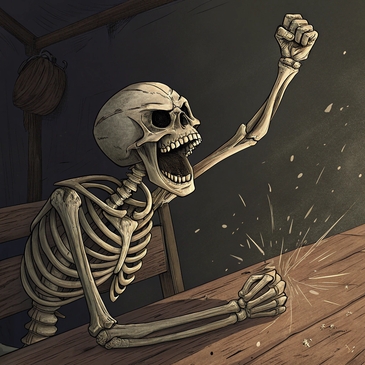
"Play, I said!" Murray banged a fist on the table. "Play if you'd like to get to bed in one piece tonight!"
"Aw, c'mon now ... "
Now the fist was inches from Marvin's face. Marvin looked over at the bar, but the bartender was nowhere to be seen.
A sudden shiver went through Marvin's body. Without even meaning to, he reached out his hand and made a move.
The game went on, Murray glowering all the time. Once or twice Marvin made as if to get up and leave, and on each occasion Murray said, "You may not leave unless you resign the game!"
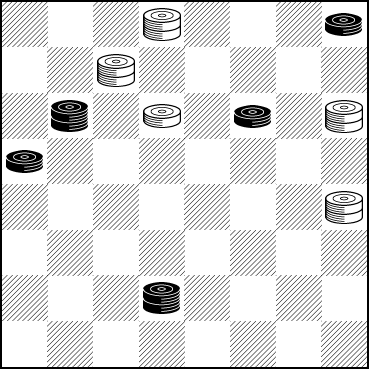
Eventually the play led to the following position.
WHITE
White to Play, What Result?
W:WK2,K6,10,K12,K20:B4,K9,11,13,K26
"Ha ha ha," Murray laughed, "you shall lose now. And you know what shall happen then? I will spread the word far and wide that The Great Murray beat this so-called professional champion, and you shall see if any pro team wants you after that. You shall die poor lying in the gutter because tonight is when your career ends."
Marvin heard these words, stunned. But something must have gotten through to him, because all at once, he sat up straight and said, "Now wait a minute there pal, just who do you think you are? Great Murray? You ain't great anything, 'cept maybe a Great Windbag! Now take this, you old blowhard!"
Marvin looked down at the checkerboard and made his move.
Is The Great Murray all that great? Is he the equal of Marvin J. Mavin? Are you up to Murray's challenge? See how you do with the position above and then click on Read More to see the solution and the conclusion to our story.
Bad Teacher

Bad Teacher was a terrible movie from the year 2011 (the image above is illustrative and not from the film). We certainly don't recommend it, but the idea does lead us nicely into today's Checker Maven column.
LARNER TRIES TO TEACH
"This is the way," said Larner impatiently as he persisted in rapidly solving a problem without giving the boastful Skittle a trial.
Galileo once said, "You cannot teach a man anything; you can only help him to find it within himself." How could Skittle learn without being permitted to make mistakes and then correct them?
Since 1775, due largely to the experiments of Johann Pestalozzi, the science of education has been based on problem solving or reasoning, rather than on memorizing. This Swiss educationalist combined manual with mental exercises. Teachers merely develop your latent power. You learn mainly by practice!
The preceding short selection is from Andrew J. Banks' eclectic book, Checker Board Strategy. It seems that Mr. Larner, whoever he was, is an example of a bad teacher. Is it true, for our game of checkers, that we learn mainly by practice, and that teachers merely develop our latent power?
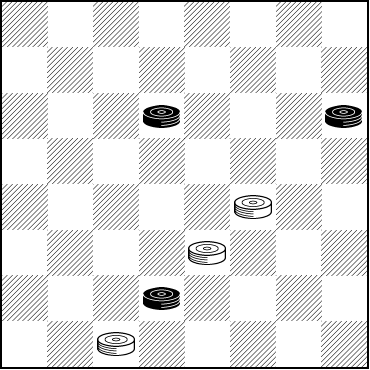
That could be the subject of an extended and interesting debate. But for the moment, let's get some practice, with today's rather easy problem. It's really at the beginner level but more experienced players should see if they can solve it with just a quick glance.
WHITE
White to Play and Win
W:W19,23,30:B10,12,26
Did you solve it rapidly? Did it provide any sort of useful practice? We surely don't have to teach you that you can click on Read More to verify your solution.
The June Bug
PICRYL CC0
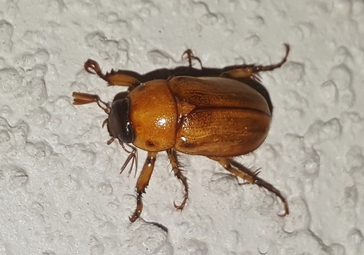
It's the month of June and in some parts of North America it's the "June Bug" season. The June Bug is related to the scarab, and there are some 100 varieties of this insect. It makes a brief appearance usually in May and June each year, hence the name "June Bug" (or sometimes "May Bug"). They are widely considered to be a pest harmful to trees and lawn.
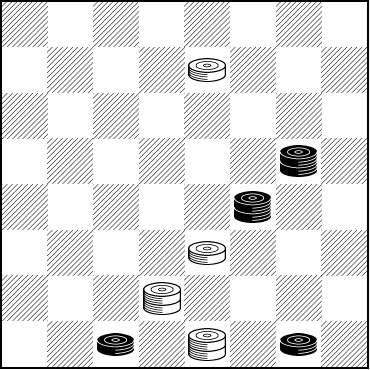
What's that got to do with checkers, and our (more or less) monthly speed problem? Take a look at the diagram below.
BLACK
Black to Play and Win
B:WK2,K7,10,26:B1,3,K14,K17
So, you say, it's pretty straightforward, right? What's the point of a problem with such an "obvious" solution? Well, then--- this one could indeed "bug" you if you get it wrong. Experienced players won't have any difficulty. But the rest of us might, shall we say, get, um, bitten[1].
Solve it quickly and then let your mouse crawl over to Read More to see the solution.
[1] June bugs don't actually bite humans, but allow us this small artistic liberty.