The Checker Maven
Getting Even
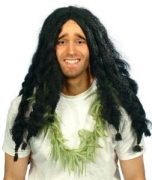
Marvin J. Mavin
Marvin J. Mavin, professional checkers superstar and Captain of the World Champion Detroit Doublejumpers, had gotten himself into serious trouble with his long-time girlfriend, corporate executive Priscilla Snelson.
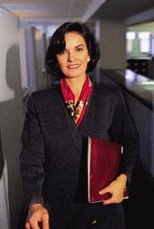
Priscilla Snelson
At her swank New Year's Eve party, Marvin had responded in what Priscilla felt to be an inappropriate manner to the advances of the Hollywood starlet known as Suzette Slinky. Priscilla threw both Suzette and Marvin out of her condo, and it was more than two weeks before Priscilla would even answer Marvin's phone calls.
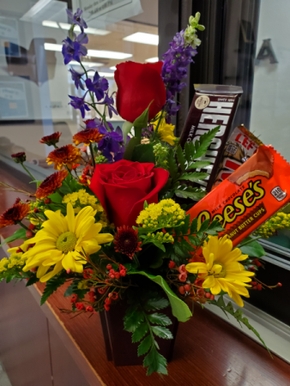
Marvin, of course, apologized profusely. He sent candy and flowers and his own homespun version of love notes. He even considered taking out newspaper ads asking for forgiveness. But in the end, Priscilla came up with an alternative.
"If you want to get back in my good graces," she told Marvin during a tense phone call, "you'll do what I ask."
Priscilla told Marvin was to appear at the Annual Meeting of the Women's Entrepreneur Network Communal Help (WENCH), a non-profit of which Priscilla was President. The theme of this year's meeting was "How Women Can Be Equal Partners in Professional Sports."
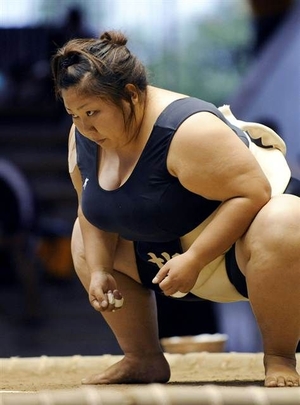
Yuko Hashimoto
But it was hardly as simple as just making an appearance. Priscilla, who had connections in very high places, arranged for Marvin to play a match with a rising Japanese checker star, Yuko Hashimoto. However, there was more to this than met the eye, though Priscilla wasn't letting on as to the full content of her plan.
Now, recall that Marvin had recently gone on trial for Misogynistic Microaggression Offending and Improper Gender Address in the court of the National Checker Federation. While Marvin won the case, most people thought it had been on a mere technicality and that Marvin had actually been in the wrong.
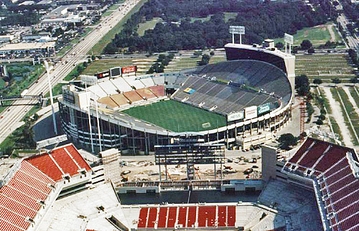
Tampa Checkerdrome
When Marvin appeared on the field in the Tampa Checkerdrome in front of 25,000 members of WENCH, he was greeted by a chorus of boos, jeers, and catcalls. Priscilla had told him what to expect, but Marvin was still taken aback.
"Aw, gee, folks," he said, being careful not to use the word 'ladies', "I ain't that bad."
This only made things worse. But when Yuko Hashimoto took the field, the booing subsided and was replaced by loud cheers and thunderous applause.
Marvin took a look at Yuko as she shook hands with him and then sat at the checkerboard. He was about to say something, but uncharacteristically thought better of it, and then the huge crowded hushed as the match began.
It was a tensely fought contest, and Marvin soon realized he was up against a top contender in Yuko. Finally, Marvin got what he felt to be a bit of and advantage, and thought he had a chance to win.
Marvin looked over at Yuko. He started to say, "Betcha can't ..." but the words caught in his throat as he pictured Priscilla glaring at him from her 50 yard line seat.
The position was as follows. Yuko was playing the White pieces.
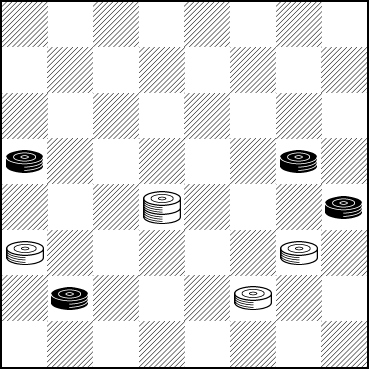
WHITE
White to Play and Draw
W:W21,24,27,K18:B13,16,20,25
Several minutes passed, with Yuko's gaze focused intently on the board. Then she looked up at Marvin. Her expression gave Marvin the shivers. Yuko didn't say a word and simply made her move.
Could you pull off a draw in this situation? Do you have Yuko's calm disposition and steady nerves?
This problem was sent to us specifically for this story by master problem composer Brian Hinkle. As our regular readers know, this means it will be a fine problem but not an easy one. The problem is Brian's modification of a correction to Ben Boland, as found by Jim Loy using the KingsRow engine.
When you're ready, click on Read More for the solution and the conclusion of our story.
Beacon Cafe: Challenge Returned
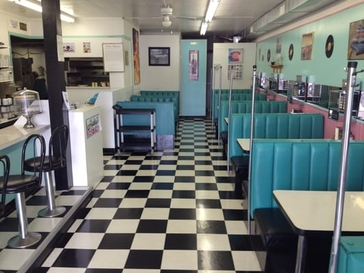
"They solved it," Sal Westerman said, with obvious distaste. "They solved Ed's 'Kaleidoscope' problem. Now they say we owe them, and not only that, they sent us one in return."
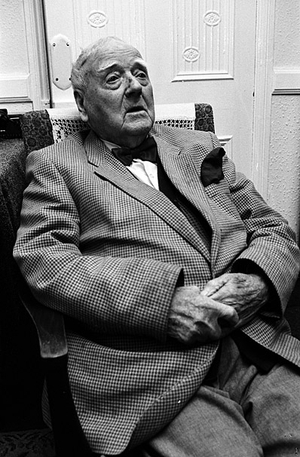
Sal Westerman
It was a Saturday afternoon in February, 1955, and the "boys" (who were all over 50 years old) were gathering as they always did in the Beacon Cafe in Bismarck, North Dakota. It was a blustery day, snow mixed with rain and an iron-gray sky, and Sal thought the weather suited his mood.
Sal was the unofficial leader of the Coffee and Cake Checker Club, which had been meeting at the Beacon for years. Recently, what Sal referred to as an "upstart" club had sprung up in Fargo (see previous Checker Maven story). They called themselves "Let's Have Another Cup of Coffee, Let's Have Another Piece of Pie" and they had challenged Sal's club to a checker problem solving contest. Sal sent them his Pennsylvania pen-pal's "Kaleidoscope" composition, and Don Steam, the Fargo club leader and a professor at North Dakota State University, soon afterwards sent Sal a letter in reply.
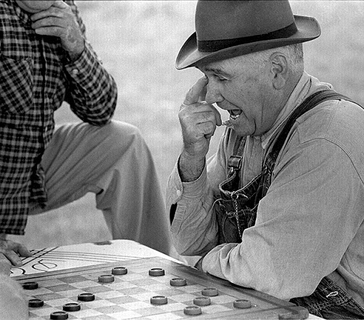
Don Steam
"Listen to what this character told me," Sal said. He was waving Professor Steam's letter around. "'Send us something challenging next time. Something worthy of our skills. The solution to your trivial problem is below, along with one for your club to solve. Which you won't, because you haven't got the chops."
There were mutterings around the table in the big booth at the back of the Cafe. Larry, Dan, Wayne, Delmer, and Louie were on hand today. "Pretty rude and arrogant," Delmer said.
"And not only that," Sal exclaimed, "they sent us a problem composed by Brian in St. Louis! I thought Brian was my pen-pal, but he's been two-timing us!"
"Easy now, Sal," Larry said. "Brian is a nationally famous grandmaster problemist. He probably corresponds with lots of people."
Sal shuffled a little in his seat. "I suppose," he said, "but does it have to be that bunch of scoundrels?"
"Let's see it," Wayne said. "We better get it. We all ready owe them for one round of coffee and pie."
"Yes, and this Steam character told me to send him five bucks," Sal said. "Imagine!"
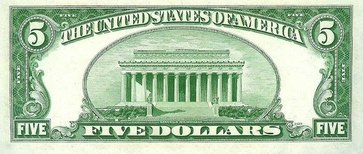
There was a low whistle from behind Deana's counter. Deana was the proprietor and a championship baker. She sold coffee for ten cents and her bars were two for a quarter. "Five bucks! Are there forty of them or something?" she asked. "But hey, I've got cherry granola bars today!"
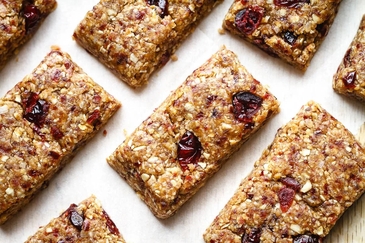
"Sure thing," Sal said. "I'll buy a dozen. The boys need to be fueled up so they can crack this one."
"Thanks, Sal!" Wayne said, and the others added their agreement. "Now let's get at it!"
Sal laid out the following position on one of the checkerboards.
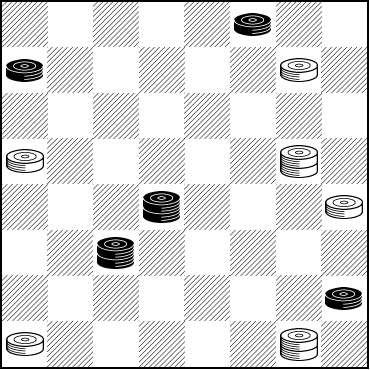
WHITE
White to Play and Win
W:W8,13,K16,20,29,K32:B3,5,K18,K22,28
"No time limit today, boys," he said. "We just have to solve it."
A large platter of bars and a fresh pot of coffee arrived at the table. The boys dug in while talking over the problem.
Would you be able to handle Professor Steam's--- or should we really say Brian's--- challenging problem? Another fiver is on the line, and in 1955 that represented a significant amount (almost $50 in today's terms). You too can take as long as you want and indulge in your favorite snack. When you're ready, click on Read More to see the solution and the rest of the story.
[Read More]Rebooting Checkers

Checkers is in need of a reboot. That's the opinion of Australian Richard Torning, and he has some original ideas about how to go about it.
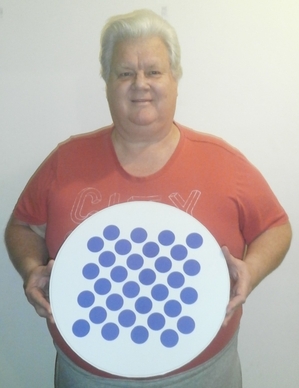
Richard Torning and "Roundsquare" Board
We can't argue with Mr. Torning's major premise. The fortunes of our game of checkers have been declining since the 1950s, when television became a big thing. You've heard it all before, about how the public considers checkers a game for kids and old men; that someone is playing "checkers" instead of "chess" when they need to up their game and move to a higher level; and the list goes on.
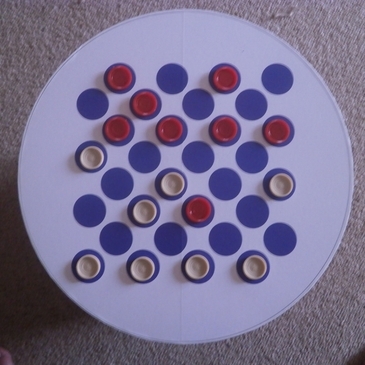
Mr. Torning wants to make the game more appealing, and to do so he's revived and modernized an idea that actually goes back more than 100 years but never really caught on: the "roundsquare" board. But instead of trying to fit a square peg into a round hole (or vice-versa), he's instead "circling the square" and the new board is just one part of a multi-pronged approach.
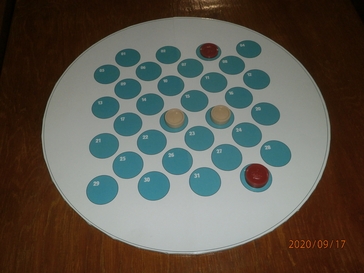
Numbered "Roundsquare" Board
We did an an-depth interview with Mr. Torning. You can read it all by clicking on Read More, just below the problem solution (please solve the problem first!), and we think you should. Mr. Torning has an insightful and appealing message for us. Not for him is yet another "modern" variant of the game that inevitably detracts rather than adds. His ideas are practical and cogent.
For one thing, he'd like to see a fresh start with the game renamed, and the name depending upon the language and usage of a particular area. He suggests Checkers-32 in the United States, Draughts-32 elsewhere in the English-speaking world, and so on, even going so far as to suggest a series of meaningful names to use among Aboriginal groups in Australia.
Of the "roundsquare" board, he says this: "The aim is to keep a minimalist approach to the game by further eliminating the 32 superfluous squares on the board but retaining the rules and shape of the two pieces. Instead of limiting the game to red/white or black/red pieces there is a need to make the game colorful, attractive, eye-catching, and simple to understand."
Mr. Torning's prototype boards are indeed very colorful and attractive and instantly attract attention. He also points out that using this board would uniquely differentiate our version of checkers from all others, and especially distance the game from chess.
Again, we urge you to read Mr. Torning's full remarks. He has also provided an interesting booklet, Early Australian Draughts Games, which you can download here.
The Draughts-32 idea is currently being prototyped at Minimbah Aboriginal School in Australia. Mr. Torning hopes to spread it far and wide and asks for your support by trying out the new board and the new ideas in your own checker playing community, and then becoming an ambassador.
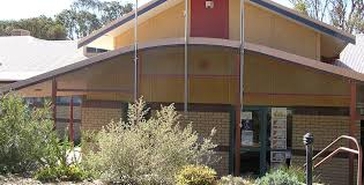
Building at Minimbah School
We can only wish Mr. Torning much success. Surely we would all like to see checkers have a vibrant and exciting future. Mr. Torning is working to make that happen.
And now, to "round" out today's column and "square" all accounts, here's a checker problem presented on a roundsquare board.
BLACK
WHITE
White to Play and Win
W:W13,18,20,22,29,30,31,32:B1,3,6,9,10,11,12,23
See if you can get "round" to solving it, after which you can "square"-ly click your mouse on Read More to see the solution.
Cute and Tricky

We think the title photo speaks for itself. This cute little one certainly seems to be up to something.
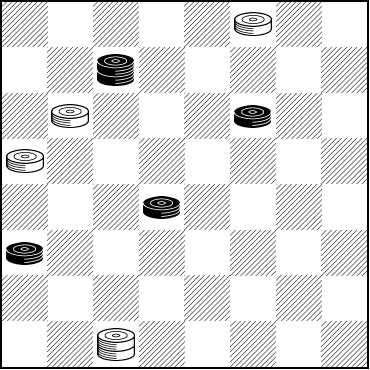
Today we have not one but two speed problems. The first one is very easy but quite cute.
WHITE
BLACK
Black to Play and Win
B:WK3,20,24,30:B12,15,22,K27
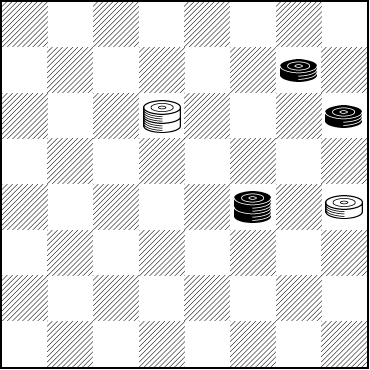
The second problem is a bit harder, but not much.
BLACK
WHITE
White to Play and Draw
W:WK10,20:B8,12,K19
This problem could just as well have had the terms White to Play, Black to Draw. It's not at all difficult but it has a nice tricky little twist. You'll see what we mean when you solve it.
Are you tricky enough to solve a cute problem? (We won't ask you the implied inverted question.) When you've found the solutions, click on Read More to verify your solutions.